
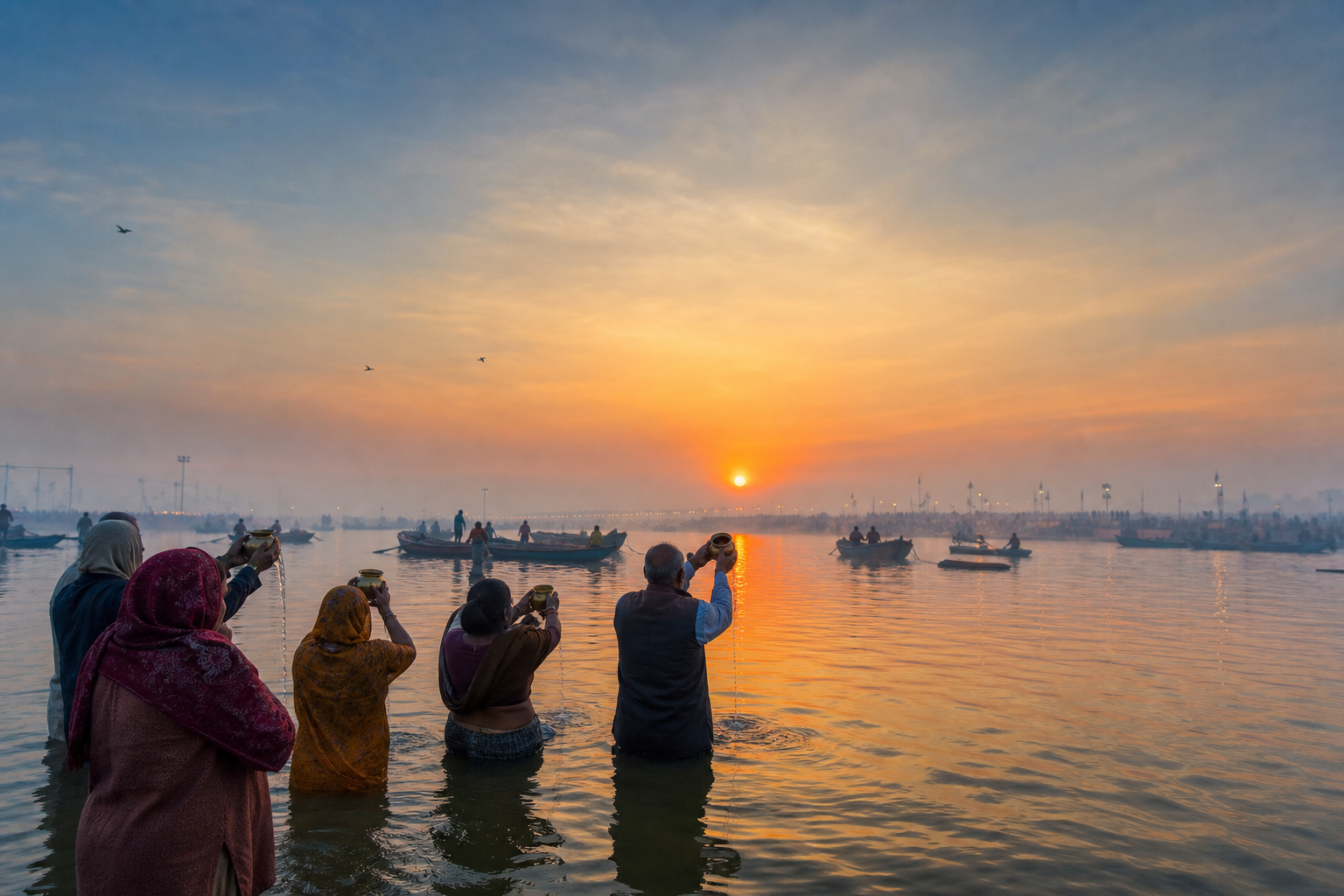
You want to observe Magha properly, but the calendar seems to offer several starting points. The Mela opens on one date, the Sun enters Makara on another, and Mauni Amavasya follows a few days later. These dates are not competing answers. They belong to different layers of the Dharmic calendar.
Your first decision is therefore practical: will your observance center on Surya worship, sacred bathing, silence, an extended vrata, or a pilgrimage to Prayagraj? Once you choose the discipline, the calendar becomes much easier to read.
Magha follows solar and lunar time at once
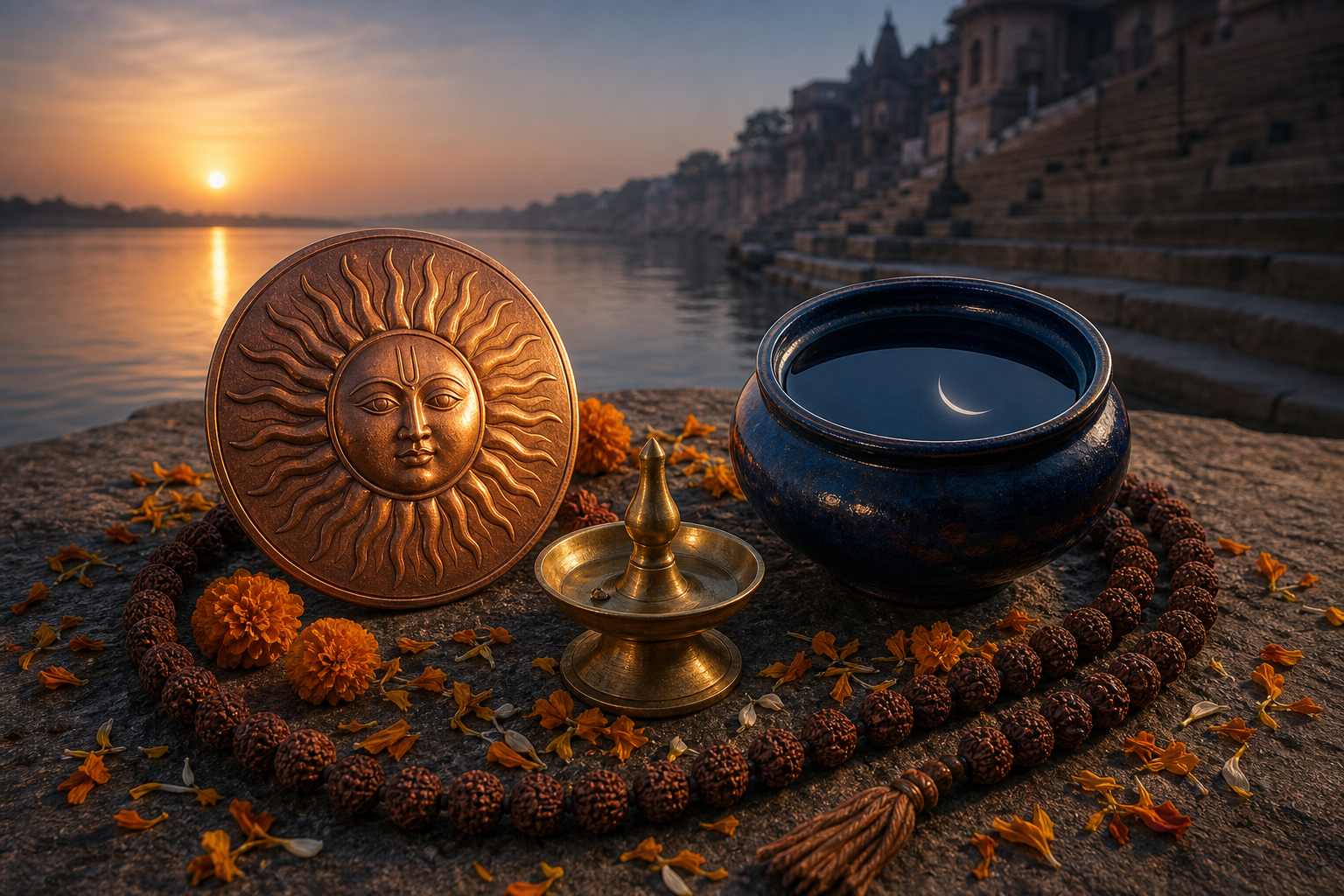
Makara Sankranti is a solar transition. It marks Surya’s entry into Makara rashi and the ritual commencement of Uttarayana. Mauni Amavasya, by contrast, is a lunar observance: the Amavasya, or no-moon tithi, of Magha. Magh Mela provides the longer pilgrimage setting within which several such observances occur.
A third strand begins before Magha. Odisha’s Samba Dashami falls in Pausha and honors Surya through sunrise prayer, arghya, vrata, food offerings, and remembrance of Samba’s devotion. It belongs to the same winter current of solar reverence, but it should not be relabeled as a Magha bathing day.
| 2025-2026 observance | Calendar basis | Primary devotional focus |
|---|---|---|
| Samba Dashami, December 29, 2025 | Pausha Shukla Dashami | Sunrise arghya, Surya puja, family well-being, and the Samba vrata tradition of Odisha |
| Magh Mela, January 3 to February 1, 2026 | An extended observance containing multiple tithis | Repeated snana, vrata, japa, dana, and seva at Prayagraj or through a disciplined home observance |
| Makara Sankranti, January 14, 2026 | Surya’s transition into Makara rashi | Surya worship, Uttarayana, gratitude, food offerings, charity, and regional harvest celebrations |
| Mauni Amavasya, January 18, 2026 | Magha Amavasya | Sacred bathing, mauna, japa, vrata, dana, and inward attention |
This distinction prevents two common mistakes. Do not treat Makara Sankranti and Mauni Amavasya as alternate names for the same festival. Do not assume that the four-day interval between them in 2026 will repeat every year. Solar transitions and lunar tithis are calculated differently, so future observances require a reliable local panchang.
Key takeaways
- Makara Sankranti is the solar anchor; Mauni Amavasya is the lunar anchor.
- Magh Mela is an extended field of practice, not merely another name for one major bathing date.
- Samba Dashami strengthens the winter theme of Surya devotion, but it occurs in Pausha rather than Magha.
- Traditional Magha practice joins snana to restraint, prayer, charity, and service. Immersion by itself is not the whole discipline.
- You can observe meaningfully at home when travel, health, weather, or crowd conditions make pilgrimage unwise.
A sacred bath begins before you enter the water
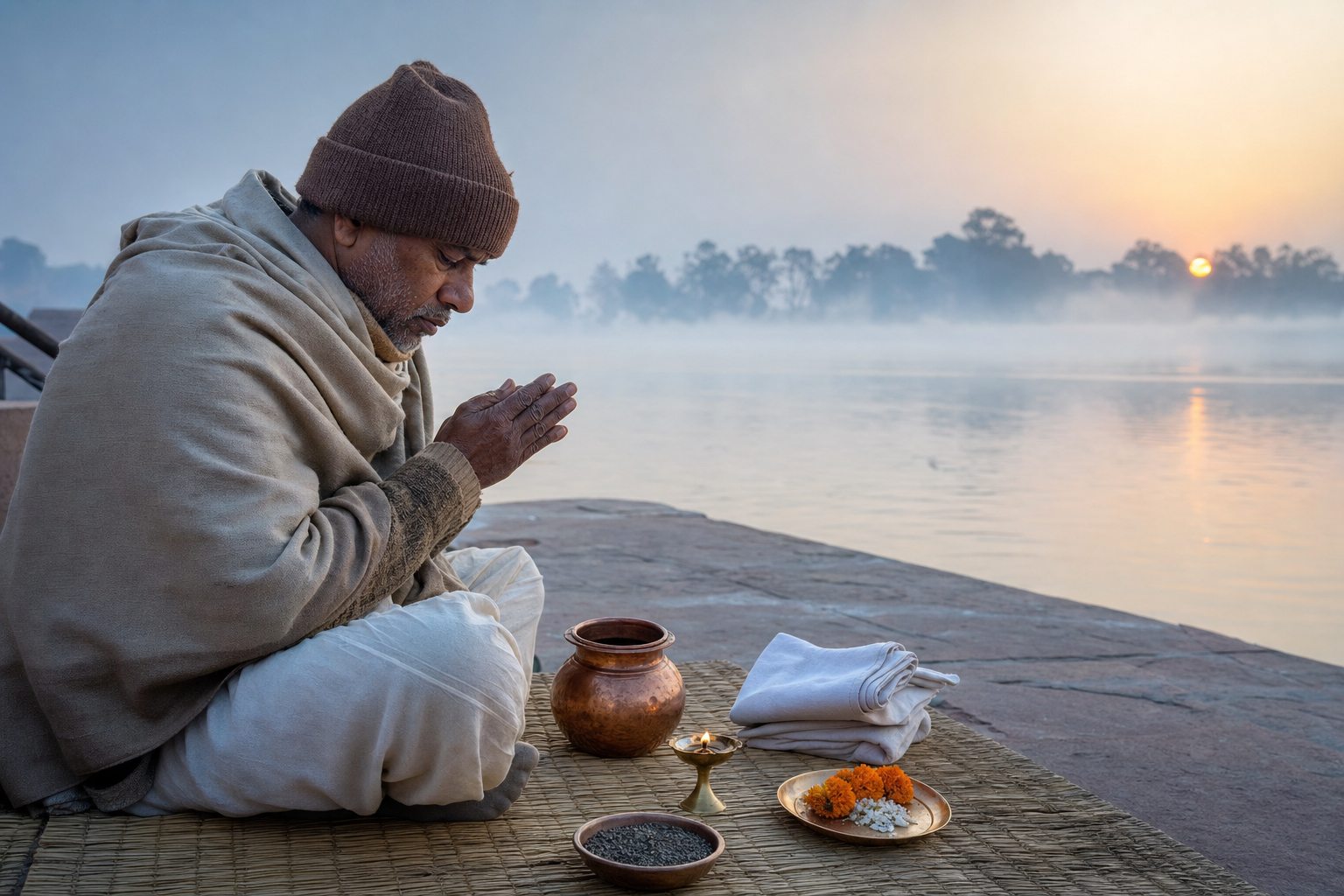
A physical bath and a sacred snana use the same element, but they do not have the same purpose. One cleans the body. The other places the body inside a chosen relationship among sacred time, sacred water, sankalpa, prayer, and ethical restraint.
Tradition reveres the purificatory power of bathing at the Triveni Sangam, where the Ganga and Yamuna meet the mystical Saraswati. Yet the wider Magha discipline never stops at the river’s edge. Daily bathing is accompanied by vrata, japa, dana, and seva. On Mauni Amavasya, silence turns the same discipline inward by reducing speech and making attention harder to evade.
Use the following sequence whether you are approaching the Sangam or bathing at home:
- Choose a sankalpa before the day begins. Name one discipline you will actually keep: mauna, japa, dietary restraint consistent with your tradition, scripture reading, dana, or a specific act of service. A vague wish for purification gives you nothing to carry into the following day.
- Verify the date and local timing. Festival dates identify the civil day, but tithi and muhurta boundaries can depend on place. Consult a dependable local panchang instead of copying a time meant for another city.
- Approach the water without haste. If you are at a tirtha, follow the designated bathing route and current safety directions. If you are at home, bathe cleanly and deliberately after stating your sankalpa.
- Give the mind a practice immediately afterward. Continue with japa, prayer, meditation, scripture, or mauna. Otherwise the force of the moment is quickly absorbed by conversation, photography, and logistics.
- Convert devotion into dana or seva. Food distribution, support for pilgrims, local community service, and other practical forms of care prevent purification from becoming a private feeling with no ethical consequence.
- Keep one restraint after the observance. Decide what will remain when the festival ends. Even a modest promise kept steadily is more useful than an elaborate vow abandoned at sunset.
Magha Snan, Surya arghya, and the associated tithis are specifically Hindu observances. Silence, meditation, non-harm, self-restraint, remembrance, and service also have recognizable expressions within Buddhist, Jain, and Sikh paths. That kinship reveals a Dharmic ethical vocabulary; it does not make the rituals or theologies interchangeable. Follow your own lineage honestly while recognizing the values that neighboring traditions hold in common.
Choose one coherent 2026 observance
You do not need to perform every regional festival, every bathing day, and every vrata to honor Magha. Choose the form that corresponds to your real intention and family tradition.
For a Surya-centered household observance
Use January 14 as your principal day. Offer arghya and prayer to Surya in the morning, prepare fresh food, make a charitable offering, and bring the household together around gratitude for nature, labor, nourishment, and learning. Makara Sankranti shares its civilizational season with Pongal, Magh Bihu, Lohri, and, in 2026, the Makaravilakku observance at Sabarimala. These traditions express related themes through distinct regional forms; you do not need to combine all their rites into one improvised ceremony.
If your family follows Odisha’s Samba Dashami tradition, begin the solar sequence on December 29, 2025. The vrata remembers Samba, the son of Sri Krishna, whose recovery from severe affliction is associated in sacred memory with penance and devotion to Surya. Sunrise arghya, sattvic food offerings, and the retelling of the vrata katha give this observance its own integrity. Treat it as a Pausha prelude to the winter solar season, not as a substitute name for Makara Sankranti.
For a focused day of snana and silence
Use January 18, Mauni Amavasya, as your center. Bathe around sunrise where local practice and safety permit, then observe either complete silence or a clearly defined period of silence. Tell the people who depend on you beforehand, settle necessary arrangements, and keep a simple means of communicating if safety requires it. Mauna is disciplined speech, not neglect of responsibility.
Follow the bath with japa, meditation, scripture reading, dana, or annadana. The practical test is whether silence sharpens your attention. Replacing speech with continuous messages, videos, or festival commentary preserves the noise while removing only the voice.
For an extended Magha vrata
Use the January 3 to February 1 Magh Mela period as the frame for a repeatable daily discipline. Choose a small pattern you can sustain: bathing, a fixed japa practice, a vrata suited to your circumstances, and regular seva or dana. Mark January 14 and January 18 as intensified days within that longer rhythm.
The advantage of this form is cumulative. A festival day can awaken resolve, but repeated practice reveals whether that resolve governs ordinary mornings. Keep the daily commitment realistic enough to survive work, caregiving, and travel. The point of an extended vrata is continuity, not an impressive first day followed by collapse.
At the Sangam, logistics are part of the sadhana
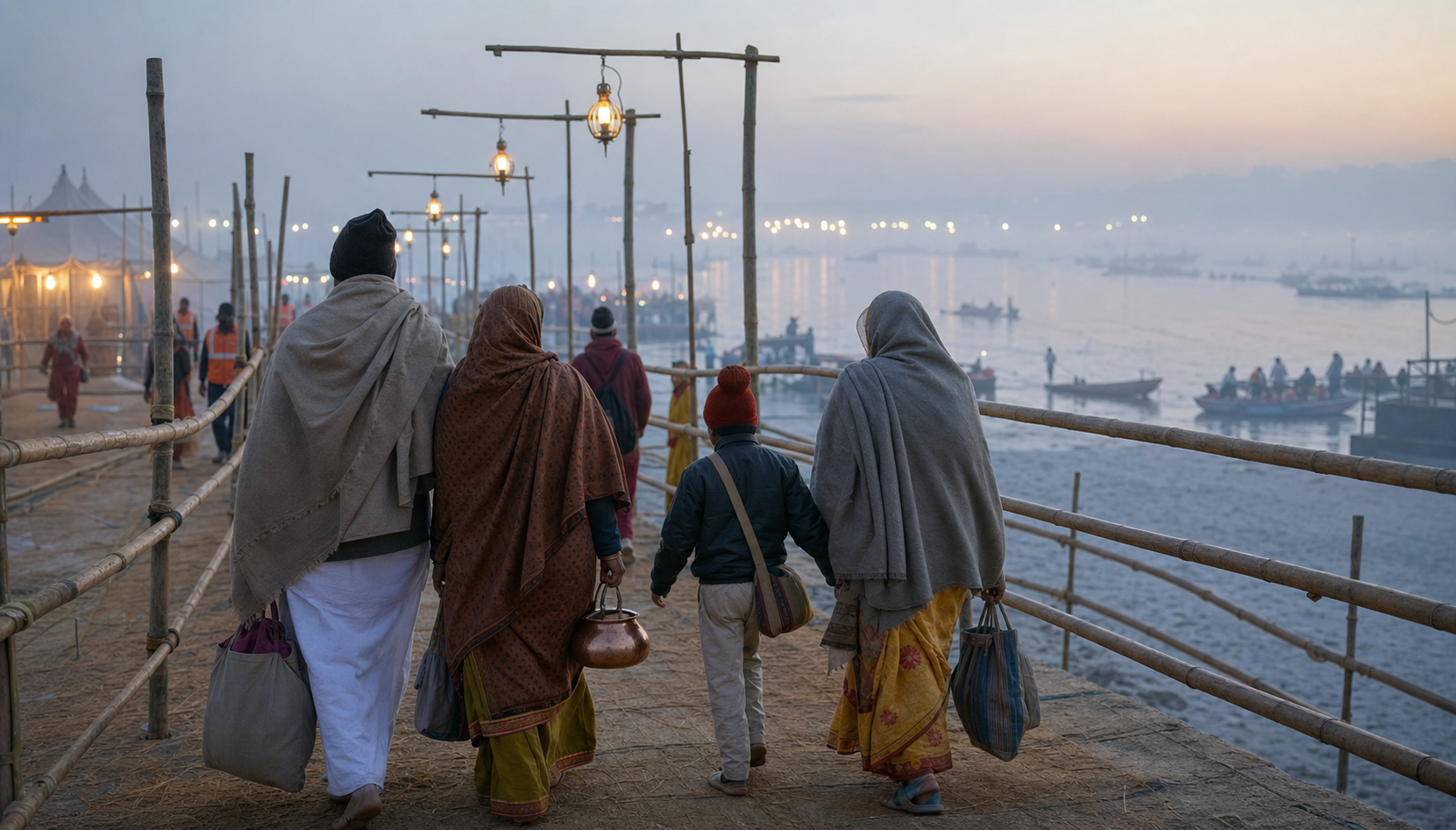
Prayagraj is not merely a backdrop. The Triveni Sangam is the tirtha around which Magh Mela’s bathing, prayer, temporary community, charity, and service are organized. A pilgrimage there requires reverence for both the waters and the human beings sharing limited access to them.
- Confirm the bathing day and timing locally. Use a reliable panchang, then check current route and safety information rather than assuming last year’s arrangements still apply.
- Arrive early on a major snan day. Mauni Amavasya carries exceptional significance, so build your plan around orderly access rather than trying to force a preferred moment through a crowd.
- Use only designated approaches and bathing areas. Barriers, closures, and route instructions protect the shared flow. If officials close access or conditions become unsafe, do not force a dip.
- Keep your group accountable. Agree on a meeting point, watch children and anyone who needs assistance, and do not let ritual urgency separate vulnerable members from their support.
- Reduce what you leave at the riverbank. Minimize plastic, use designated disposal points, and join a cleanliness effort where one is properly organized. Reverence for a river is contradicted by waste left in its name.
- Offer dana without obstructing movement. Annadana and support for pilgrims belong to the social fabric of the Mela, but service should work with local arrangements and preserve safe passage.
A sacred date does not make cold exposure or crowded water safe for every person. If you have reason to doubt whether immersion is safe for you, choose a home snana or seek guidance from a qualified clinician. If the route itself is unsafe, stepping back is not a spiritual failure. The tradition already makes room for sincere observance away from Prayagraj.
A complete home practice
Begin with a sankalpa, bathe at home, and continue immediately with the discipline appropriate to the date. On Makara Sankranti, orient the practice toward Surya, gratitude, food offerings, and charity. On Mauni Amavasya, place the emphasis on silence, japa, meditation, and dana. During an extended Magha vrata, repeat a manageable version each day.
Choose the contemplative language of your own path: japa or dhyana within Hindu practice, mindfulness within a Buddhist discipline, introspection joined to vrata within Jain practice, or simran within Sikh practice. What unites these possibilities is not a blended ritual. It is the decision to make inward attention answerable to non-harm, restraint, and service.
Before your chosen observance arrives, write down three things: the date you will follow, the discipline you will keep, and the act of service that will complete it. That small plan turns Magha from a calendar entry into a vrata you can carry beyond the water.
References
- Hindu Pad – 14 Jan 2026: Makara Sankranti, Pongal, Magh Bihu & Makaravilakku Dates, Meaning, Unity
- Hindu Pad – Magh Mela 2026: Jan 3-Feb 1 at Prayagraj (Allahabad) Triveni Sangam with Sacred Snan
- Hindu Pad – Auspicious Mauni Amavasya 2026: Date, Sacred Silence, Magh Mela and Triveni Sangam Rituals
- Hindu Pad – Samba Dashami 2025: Radiant Surya Puja in Odisha, Date, Legend, and Rituals Explained
