
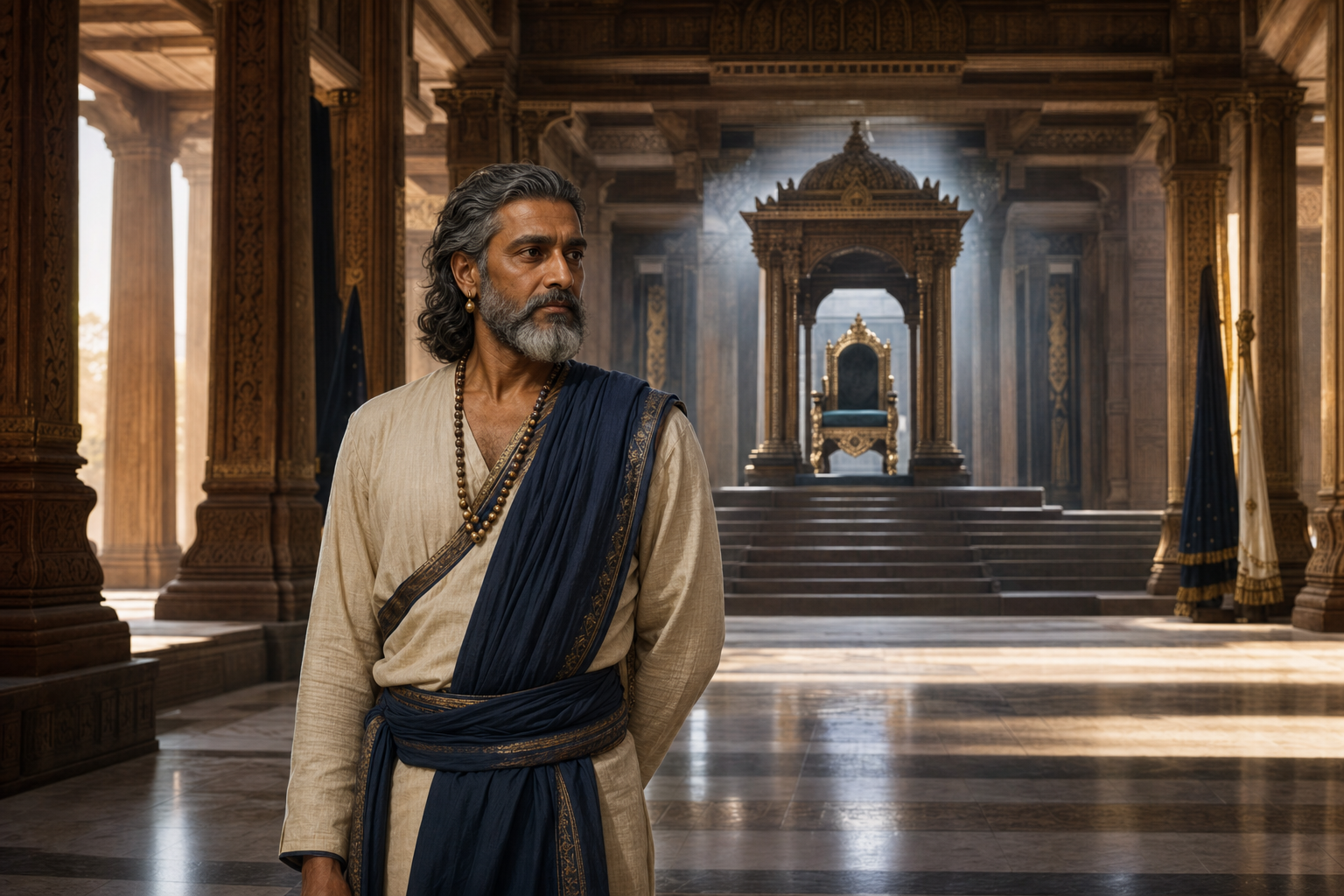
You are probably trying to settle one deceptively simple question: was Vidura kept from the Kuru throne because of his birth even though he was the wisest man available? The careful answer is yes, but with an important qualification. His birth status removed him from the normal field of royal eligibility; he did not merely lose a fair contest between equally recognised claimants.
That distinction matters. It lets you acknowledge the injustice without turning the Mahabharata into a modern election story or making claims the narrative cannot sustain. Vidura’s case is ultimately about three things that institutions often separate: the ability to see what is right, permission to advise those in power, and eligibility to exercise power yourself.
What “denied the throne” actually means
Vidura was born within the Kuru household through Vyasa, as were Dhritarashtra and Pandu, but his mother was a palace attendant rather than a queen. The palace did not treat this maternal distinction as a private detail. It determined his standing within the dynasty.
The queen-born sons remained possible bearers of sovereignty. Vidura did not receive the same recognition, even though he belonged to the same generation and possessed exceptional judgment. When Dhritarashtra’s blindness made his initial accession unacceptable to the Kuru establishment, Pandu was crowned. Vidura’s wisdom did not bring him into equal consideration.
It is therefore misleading to picture a single assembly in which Vidura presented his claim, was judged the best candidate, and then had a promised crown taken away. The exclusion was more fundamental. Birth status defined the eligible field before merit could be compared. In that precise sense, he was denied kingship structurally rather than defeated competitively.
This is a useful distinction whenever you examine inherited inequality. An institution does not need to announce, “You are unworthy,” to exclude someone. It can praise that person’s intelligence, depend on their labour, and still write its eligibility rules so that the person can never hold final authority.
We should also resist an unsupported counterfactual. Vidura may appear morally better equipped to rule, but no one can prove what an actual Vidura reign would have produced. The injustice does not depend on imagining a flawless reign. It lies in the mismatch between demonstrated fitness and a system that refused to convert that fitness into eligibility.
Why the wisest man remained only an adviser
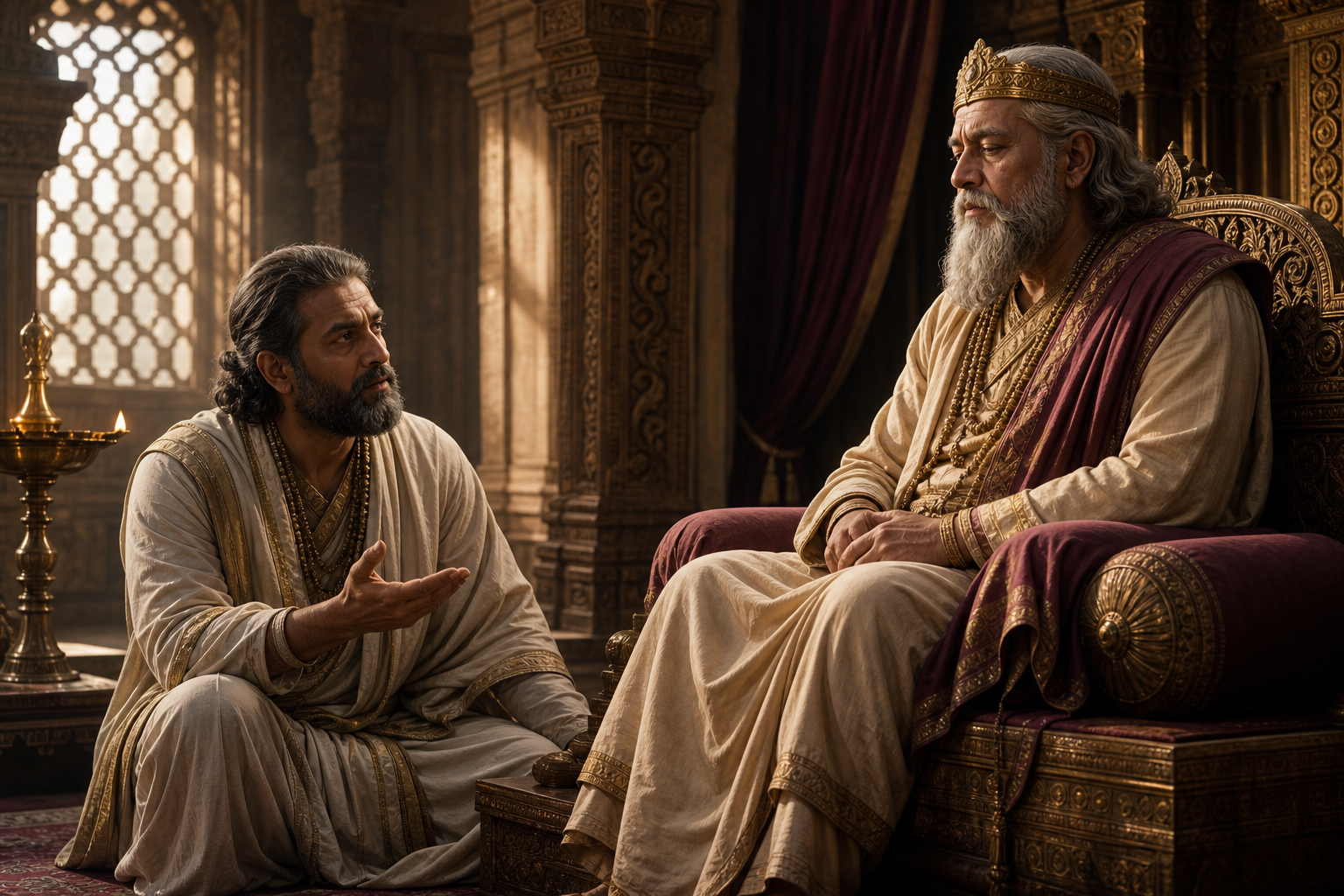
Vidura’s position becomes clearer when you separate three forms of authority that are often confused:
- Moral authority: the capacity to recognise dharma, expose self-deception, and foresee the consequences of a wrongful choice.
- Institutional access: permission to enter the court, speak to rulers, and participate in deliberation.
- Sovereign authority: the recognised power to decide, command, and accept responsibility for the kingdom’s course.
Vidura possessed the first and much of the second. He was close enough to power to warn kings when they departed from dharma and to speak unwelcome truth. He did not possess the third. His advice remained advice, dependent on a ruler’s willingness to accept it.
This explains the apparent contradiction at the heart of his life. The Kuru court could esteem Vidura without accepting him as an equal claimant. It could use his wisdom while withholding the office that would allow him to act on it. Being heard was not the same as being obeyed, and proximity to the throne was not a path to the throne.
When you read a scene in which Vidura gives counsel, track the flow of authority carefully. Ask who identifies the danger, who has the power to prevent it, and who will suffer if the warning is ignored. That small exercise changes the story. The recurring problem is not a shortage of moral knowledge. It is that moral knowledge has no binding force when the recognised ruler prefers attachment, fear, or expediency.
A throne is not simply a prize for being the cleverest person in the room. Kingship also involves action, command, public legitimacy, and accountability. Yet that observation does not excuse Vidura’s exclusion. It sharpens the question: why did inherited maternal standing count as a qualification for sovereignty while proven judgment did not even secure equal eligibility?
The dharmic question is deeper than ancient custom

A custom does not become identical with dharma merely because it is old. Customs organise society, but the Mahabharata allows you to judge human arrangements by their conduct and consequences. Vidura’s presence creates exactly that test. The Kuru order relies upon the man whom it excludes, yet repeatedly leaves his clearest warnings without the force of decision.
Two interpretive errors can hide this tension:
- The apologetic error: because dynastic convention explains Vidura’s status, the convention must therefore have been just. Explanation identifies the mechanism; it does not deliver a moral verdict.
- The anachronistic error: because the outcome resembles modern discrimination, every feature of contemporary caste, citizenship, or electoral politics can be projected back into the episode. A hereditary monarchy is not a modern public institution, and maternal rank in royal succession should not be treated as a complete account of every question involving varna or jati.
The more defensible reading stays close to the actual conflict. Vidura’s birth through a woman of lower palace status limited his dynastic eligibility. His character, counsel, and commitment to dharma nevertheless surpassed those of people whose recognised birth gave them greater authority. The narrative therefore exposes a gap between socially granted rank and morally demonstrated fitness.
You do not have to establish that Vidura possessed an undisputed formal right to the crown in order to recognise the injustice. “Formally entitled under Kuru convention” and “morally fit to rule” are different claims. The evidence for the second is much stronger than the evidence for the first. Keeping them separate makes the ethical criticism more credible, not less.
A pro-dharmic reading does not require us to sanitise every social practice found in an ancient setting. Dharma can also supply the standard by which a practice is questioned. Vidura matters because he shows that social recognition, inherited legitimacy, and righteous conduct can diverge. Once they diverge, invoking convention alone cannot resolve the moral problem.
How to use Vidura’s case without reducing it to a slogan

Vidura is often invoked whenever status appears to defeat merit. The comparison can be illuminating, but only if you make it precisely. Use this five-step test when applying his case to a community body, temple committee, family enterprise, political organisation, or other institution:
- Define the office before discussing the candidate. Write down what the person holding authority must actually do: judge, administer, protect resources, resolve conflicts, preserve a tradition, or accept public accountability. Otherwise, “merit” remains an empty compliment.
- Name the gatekeeping rule exactly. Is eligibility determined by knowledge, initiation, family descent, seniority, wealth, gender, social identity, election, or appointment? Do not hide an inherited restriction beneath vague language such as “tradition” or “suitability.”
- Test whether the rule serves the duties of the office. Some qualifications have a direct relationship to the work. Others survive mainly because the people already inside the system benefit from them. Ask what failure the restriction prevents and what evidence connects it to that failure.
- Compare recognition with authority. Does the institution praise certain people, invite their advice, and depend on their work while keeping them away from binding decisions? If so, access may be functioning as a substitute for equality rather than a path to it.
- Follow the cost of ignored judgment. Identify who bears the consequence when a qualified warning remains optional. In the Kuru court, the danger was not merely that Vidura felt slighted. The kingdom was deprived of a reliable way to turn sound counsel into action.
This method prevents two opposite abuses of the story. Vidura does not prove that every wise adviser should automatically become a ruler; discernment and executive responsibility are not identical. Nor does hereditary context make his exclusion morally irrelevant. The central question is whether an institution can justify preventing demonstrated fitness from entering the field of responsible authority.
It also helps to use accurate language. If your edition or commentary supplies a precise traditional term for Vidura’s social status, explain that term and its context. If it does not, “birth-status exclusion within dynastic succession” is safer than making a sweeping claim about the whole structure of Indian society. Precision protects a serious moral argument from an easy factual objection.
The modern setting is different in one decisive respect. A hereditary throne defines legitimacy through lineage, while modern public institutions usually claim legitimacy through citizenship, law, election, professional competence, or accountable appointment. You should not pretend those systems are identical. You can still recognise the recurring mechanism: an inherited identity may be treated as a proxy for ability even when a person’s actual conduct contradicts that assumption.
Key takeaways
- Vidura did not simply lose a merit-based contest. Maternal birth status kept him outside equal royal eligibility from the beginning.
- His place in the court gave him access to rulers but not the sovereign power to make his warnings binding.
- Dynastic convention explains how the exclusion operated; it does not by itself prove that the exclusion was dharmic or just.
- The strongest moral claim is not that Vidura held an uncontested legal title, but that demonstrated wisdom was prevented from becoming responsible authority.
- Modern comparisons should identify the exact gatekeeping rule and its consequences rather than reducing the episode to a broad slogan about caste or merit.
The next time you encounter Vidura, do not stop at saying that he was wise. Mark the point where his authority ends and another person’s power begins. Then take one institution you can influence and write three lists: who may advise, who may decide, and who is considered eligible. If inherited status separates those lists without a clear connection to duty, competence, or accountability, you have found the part of Vidura’s problem that still demands action.
References
