
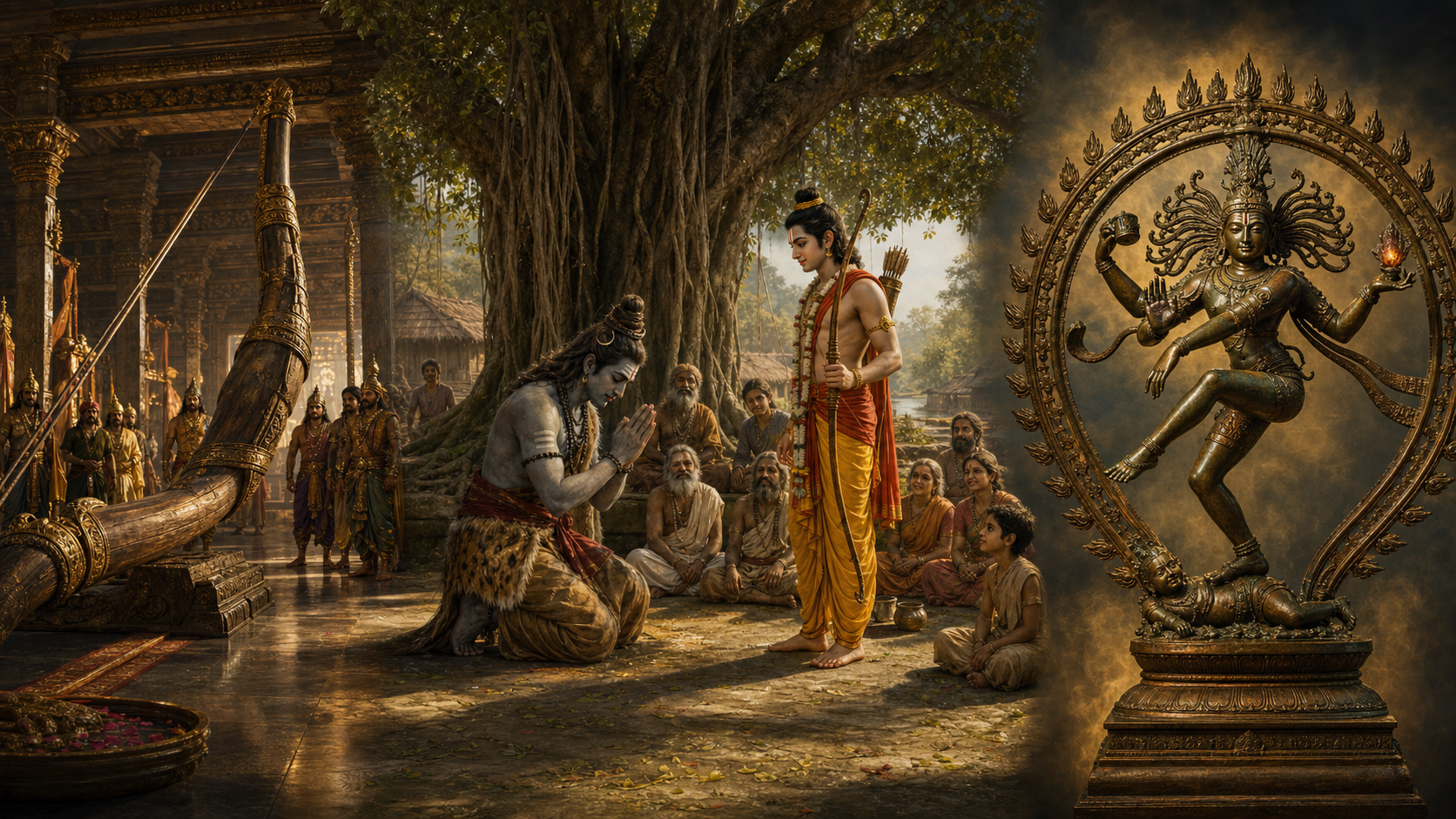
You hear that Shiva’s bow represents disciplined power. Then you encounter a folk story in which Shiva reveres the child Rama. Later, a Chola Nataraja confronts you with a body in motion, a foot over ignorance, a hand offering assurance, and a face at rest. If you force all three images into one slogan, you miss what each one is asking you to notice.
A better approach is to read Shiva through action and relationship. Ask what kind of power appears, what restrains or redirects it, what it confronts, and what response it asks from you. That method works whether you are reading the Ramayana, listening to a village katha, teaching a child, or looking closely at temple sculpture.
First separate epic, folklore, and sacred image
Epic, folklore, and iconography do different work. An epic places a symbol inside a consequential action. Folklore rearranges familiar sacred figures so that a community can experience a theological or ethical truth. Temple art compresses doctrine into posture, gesture, material, light, and ritual space. One form should not be treated as a defective version of another.
- Name the medium. Determine whether you are dealing with an episode from a primary text, a regional devotional retelling, or an icon shaped by temple conventions.
- Find the governing action. A bow is drawn, a deity recognizes another deity, or a dancer subdues ignorance. The action usually carries more meaning than an isolated object does.
- Read the relationships. Ask what stands opposite the symbol: restraint against force, humility against status, assurance against fear, or knowledge against ignorance.
- Translate the image into a discipline. Decide what it asks you to practise: measured action, reverence, service, clarity, courage, or self-restraint.
This order matters. A symbol dictionary might tell you that an object means power, but it cannot tell you how that power is being used in a particular scene. Shiva’s symbols are rarely about possession alone. They reveal what becomes of power when it is subjected to dharma.
In the epic setting, Shiva’s bow tests disciplined strength
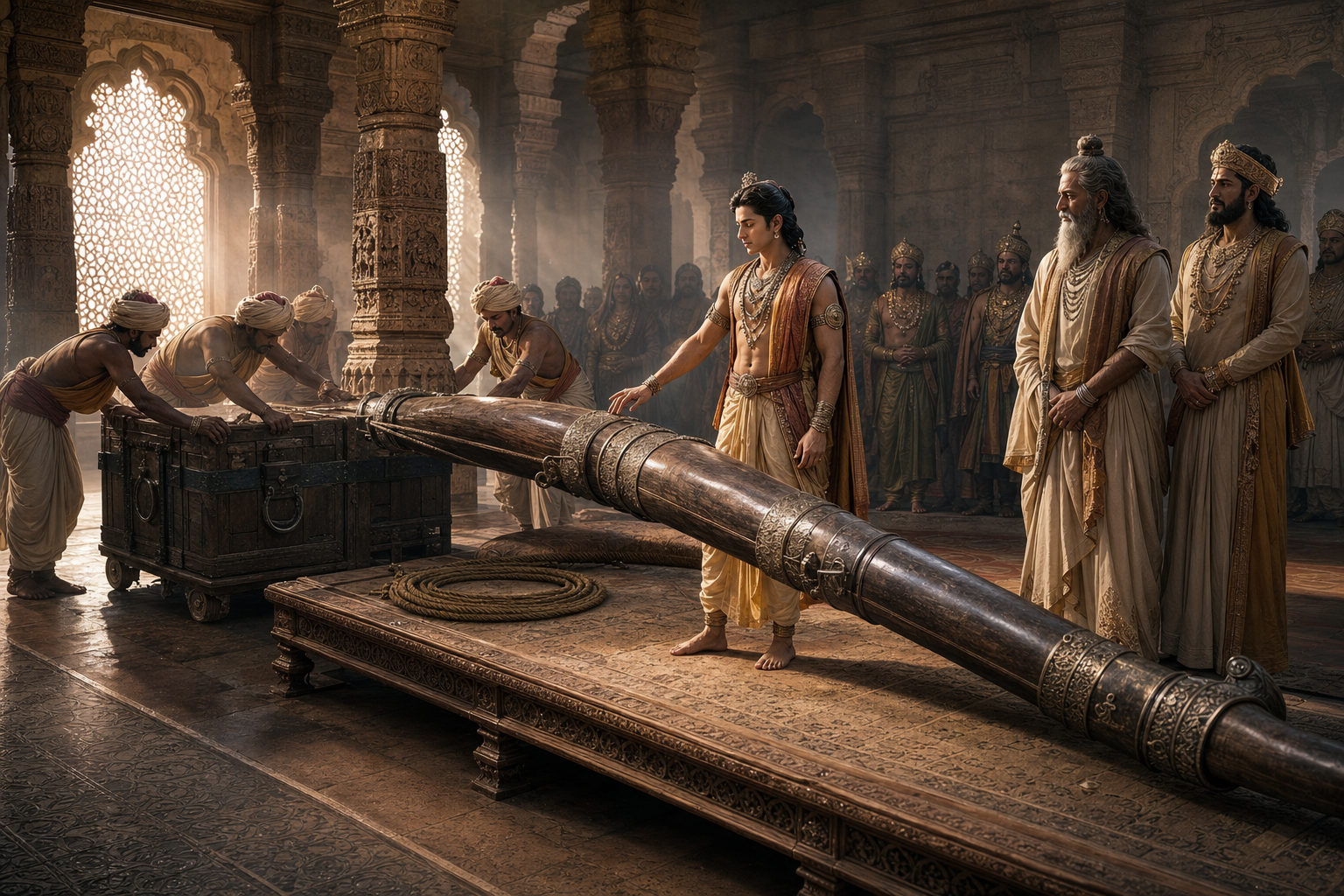
At King Janaka’s court in the Ramayana, the bow associated with Shiva is not merely a heavy object waiting for the strongest contestant. Its presence makes strength answerable to fitness, steadiness, and purpose. The scene becomes easier to read when you remember how a bow works: energy is gathered through tension, held through balance, directed through alignment, and released at a chosen moment.
That physical sequence supplies the ethical symbolism. Capacity is not enough. The wielder must hold power without being mastered by its tension, see the aim clearly, and release force without waste. This is why Pinaka can signify restraint, protection, and morally directed force, rather than aggression for its own sake.
The epithet Pinakapani, meaning the wielder of Pinaka, helps you recognize this dimension of Shiva in hymns, liturgy, and iconography. Traditions may refer to Pinaka or to the Shiva Dhanush when recalling the sacred bow. You need not settle every naming question before grasping the central point: the bow represents power brought into line before it is released.
The bow should also be distinguished from the Trishul. The trident’s three points can represent will, knowledge, and action; the three gunas; or past, present, and future. It pierces bondage and clears what obstructs transformation. The bow presents another problem: once the obstruction has been recognized, how should power be aimed? The Trishul and Pinaka therefore offer complementary disciplines, not successive ranks in a hierarchy of weapons.
- Before praising force, ask what restrains it. In the bow’s symbolism, tension is mastered before action begins.
- Before judging the wielder, ask what qualifies the person. Strength without steadiness or moral purpose does not satisfy the symbol.
- Before calling an action dharmic, examine its aim and excess. Protection is different from domination, even when both employ power.
This gives you a practical test for modern uses of martial imagery. If someone invokes Shiva’s weapon while glorifying anger, pride, or indiscriminate force, the symbol has been severed from its discipline. Pinaka does not sanctify every release of power. It asks whether intention, means, and consequence have been brought into alignment.
In folklore, Shiva’s humility becomes the central symbol
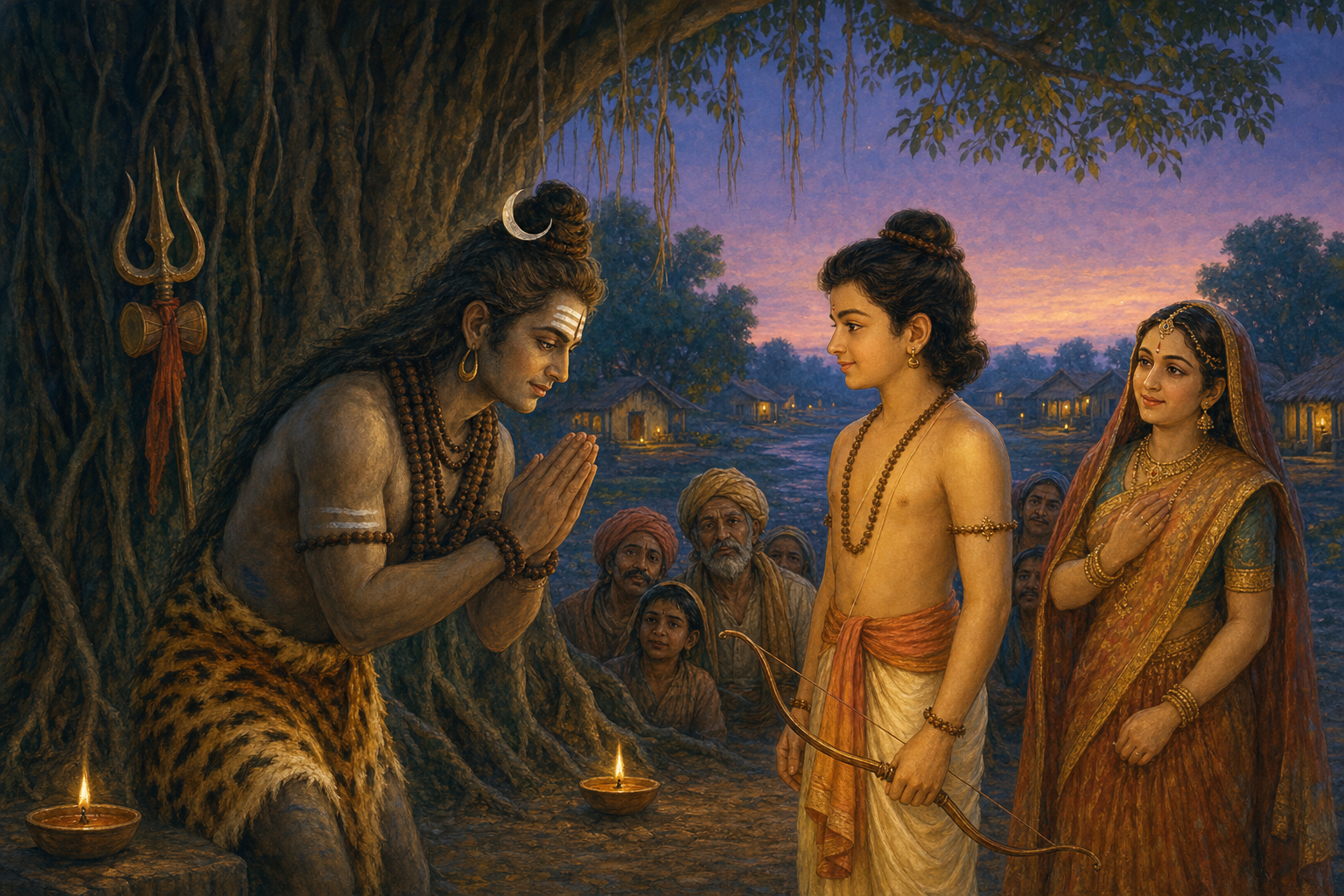
A widely loved folk motif brings Shiva and Hanuman to Ayodhya for darshana of the young Rama. Its emotional force lies in recognition: great spiritual power does not need to deny greatness in another form. Shiva approaches in reverence, Hanuman embodies devoted service, and the child Rama represents dharma expressed through maryada, or principled conduct.
Accuracy requires one important distinction. The particular visit of Shiva and Hanuman to the young Rama does not occur in the Valmiki Ramayana. It belongs to the living world of folk Ramayana narration and devotional elaboration. When you repeat it, introduce it as a folk or regional Ramayana tradition rather than placing invented verses in Valmiki’s text.
That distinction protects both forms. The Valmiki Ramayana retains its textual identity, while folklore is allowed to perform its own work through katha, Ramlila, bhajan gatherings, Yakshagana, and family storytelling. A story does not have to masquerade as a passage from the root epic in order to transmit dharmic wisdom.
- Shiva represents jnana and vairagya: insight joined to freedom from possessiveness.
- Hanuman represents bhakti and seva: devotion proven through selfless action.
- Rama represents dharma and maryada: righteousness made visible in conduct and responsibility.
The scene is not a contest over which deity stands higher. Its governing action is mutual recognition. Shiva’s reverence does not diminish Shiva; it demonstrates the confidence of wisdom. Hanuman’s service does not make him weak; it gives his strength a purpose. Rama’s childhood does not make dharma immature; it makes the sacred approachable without stripping it of authority.
This is also where a sectarian reading fails. If the story is used to defeat Shaivism with Vaishnavism, or the reverse, its most visible lesson has been ignored. The folk encounter joins knowledge, devotion, and conduct. You can use it in a family or study group by asking three precise questions: Who recognizes holiness first? Which virtue does each figure contribute? What would recognition look like as action rather than sentiment?
The answers lead directly into practice. Pause before judging, serve without demanding recognition, and let devotion improve conduct. Folklore becomes useful when its tenderness is allowed to change how you meet another person, not merely how warmly you remember the scene.
In Chola Nataraja, movement must be read with stillness
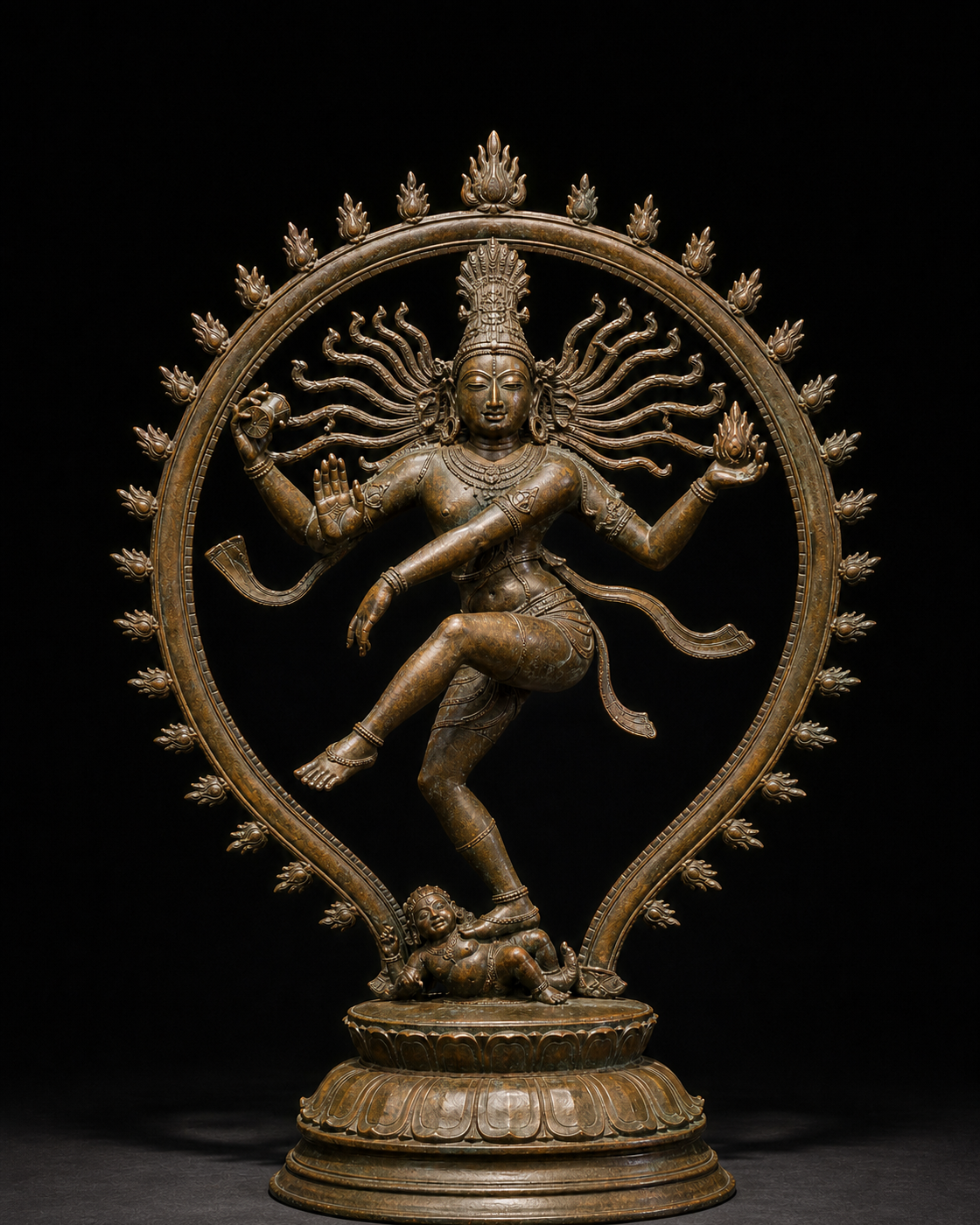
At Gangaikonda Cholapuram, Shiva’s symbolism moves from narrated action into carved presence. The Gangaikondacholeesvarar Temple was commissioned by Rajendra Chola I and belongs to the ensemble known as the Great Living Chola Temples. Within this sacred setting, an 11th-century granite Nataraja unites dynamic dance with a restrained, serene smile.
Do not begin by assigning a meaning to every feature separately. First observe the tensions within the whole composition: circular movement and facial calm, cosmic force and personal assurance, the animation of the dance and the ignorance held beneath the planted foot. The icon’s theology appears in these relationships.
- Start with the circle. The prabhamandala frames the dance as cosmic rather than merely athletic. Follow its rhythm before concentrating on the face.
- Notice the upraised hand. Its abhaya gesture offers assurance. Power is present, but the beholder is not simply threatened by it.
- Look at the planted foot. Apasmara represents ignorance under restraint. The dance does not celebrate motion for its own sake; it establishes a moral and spiritual order.
- Return to the face. The mouth’s slight upward turn prevents the surrounding energy from becoming agitation. The dancer remains inwardly composed.
- Let the architecture participate. Change your viewing angle and attend to the available light. Minute planes around the lips can make the expression appear quieter or more animated as light and shadow shift.
This sequence corrects a common viewing mistake. If you isolate the smile, it may seem like a charming display of technical skill. If you isolate the foot, the image may seem concerned only with conquest. Read together, the features say something more demanding: ignorance is subdued without disturbing the center of consciousness, and immense activity coexists with assurance.
The workmanship serves that experience. Chola sculptors worked within traditions informed by shilpa shastras and regional workshops, using carefully graduated tools to articulate hard granite. Temple space then extended the sculpture’s meaning through controlled light and shadow. The result is not an ornament that happens to sit inside a building. Image, architecture, ritual, and attention form one sacred environment.
When you visit a Chola temple, resist the impulse to take one frontal look and move on. Read the image in passes: overall rhythm, gesture, foot, face, and light. This does not require specialized art-historical vocabulary. It requires patient attention to what the sculpture is visibly doing. Nataraja teaches through the discipline of seeing before interpretation begins.
Key takeaways: a field guide for reading Shiva
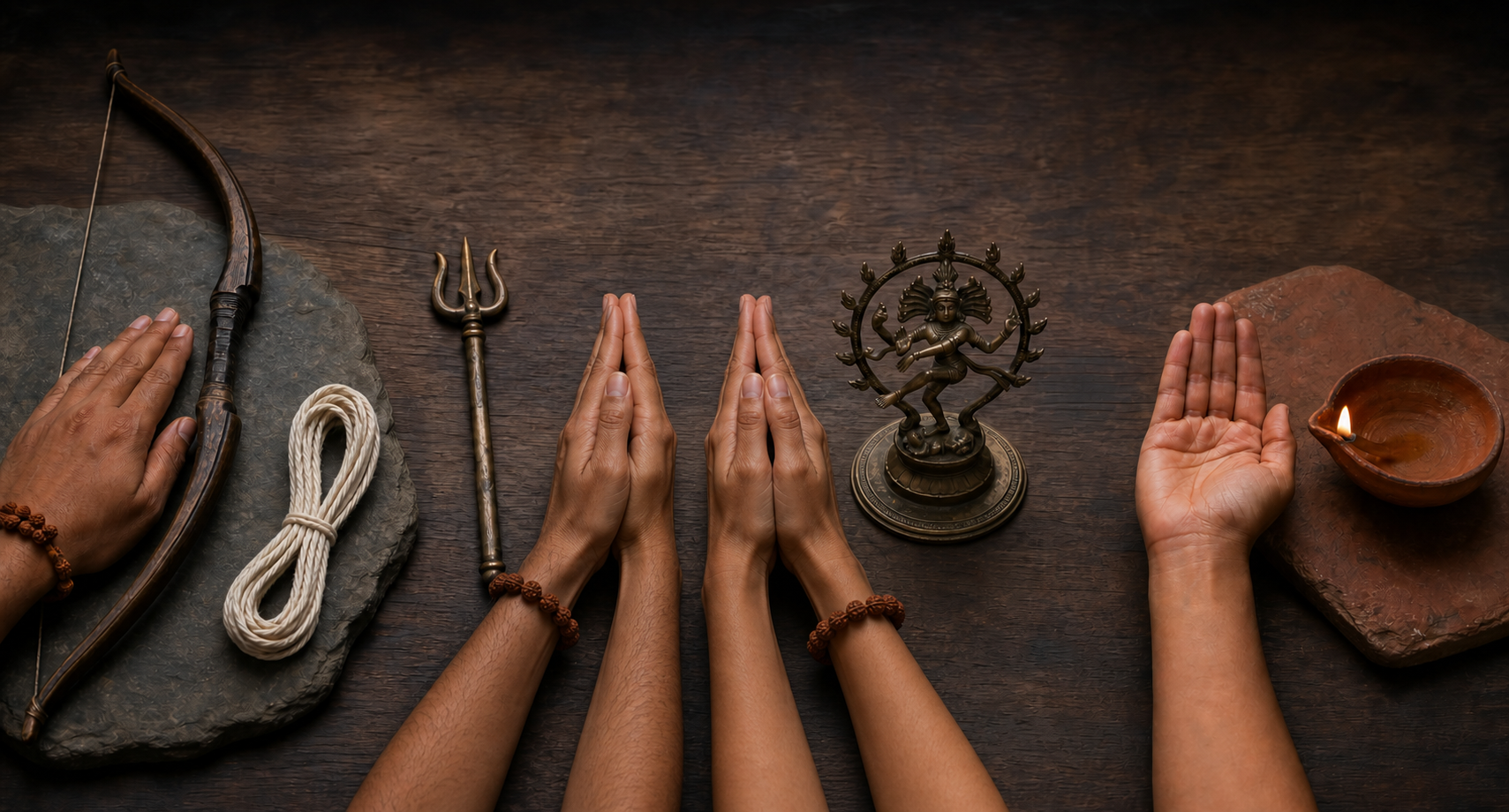
- Name the layer before making a claim. Distinguish a primary epic episode from devotional folklore and both from temple iconography.
- Let the action decode the object. The bow stores and directs force; the folk encounter turns greatness toward reverence; the dance transforms cosmic energy while ignorance remains subdued.
- Read symbols in pairs. Tension needs alignment, power needs restraint, movement needs stillness, and sectarian identity needs recognition of holiness beyond itself.
- Do not flatten plurality into contradiction. Archer, renunciant, devotee, and dancer are not competing biographies of Shiva. Each form addresses a different spiritual problem.
- End with a discipline you can practise. Use Pinaka to examine intention before action, the folk encounter to practise humility and seva, and Nataraja to remain inwardly steady while acting in the world.
At your next encounter with a Shiva image or story, write down four things: its medium, its governing action, the condition it overcomes, and the discipline it asks of you. That small habit will keep Shiva from becoming a decorative emblem or a sectarian badge. More importantly, it will turn symbolism back into sadhana.
References
- DharmaRenaissance Blog – When Shiva and Hanuman Visit Young Rama: Folk Ramayana Symbolism, Significance, and Unity
- DharmaRenaissance Blog – When Stone Smiled: Nataraja’s Timeless Grace at Gangaikonda Cholapuram Reveals Chola Genius
- DharmaRenaissance Blog – From Trishul to Pinaka: Unveiling Shiva’s Supreme Weapon and Its Sacred Evolution
