

Your life can seem to become a different life in a single conversation. A role ends, an emotion takes over, or an opinion you once defended no longer fits. You may understand that change is inevitable and still feel caught by one question: if the body, mood, thought, and identity all change, what does the word I actually refer to?
Vedantic inquiry turns that question into something you can examine directly. You don’t have to manufacture a mystical experience or persuade yourself that the world is unreal. You begin with what is present, separate the changing experience from the fact that it is known, and then carry that discrimination into waking, dream, deep sleep, emotion, and action.
Start with what you can verify: the known keeps changing
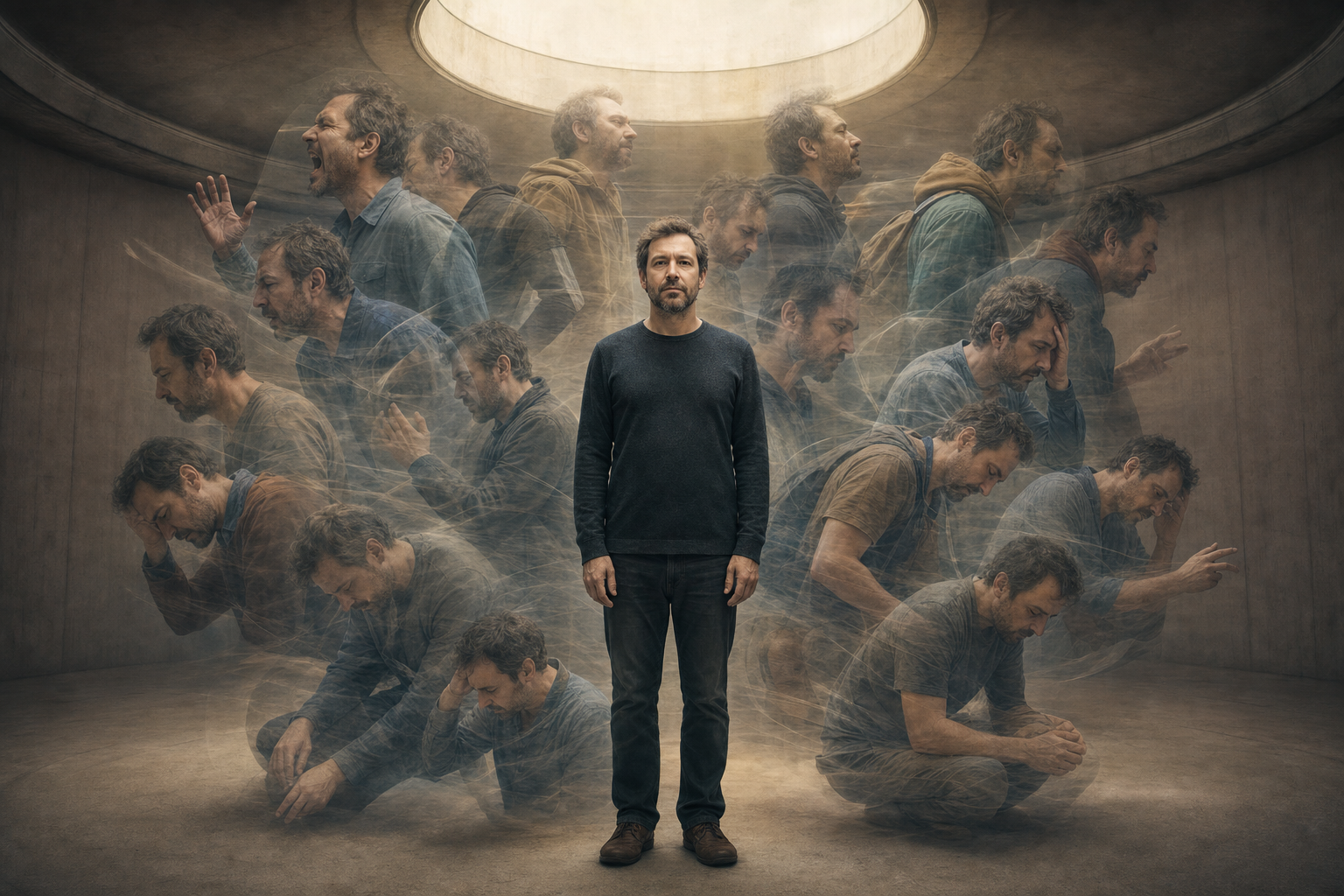
Don’t begin by repeating a conclusion such as “I am Brahman.” Begin with a fact you can test: whatever you can notice is known to you, and much of what you know as yourself is continually changing.
- The body is known. Sensations, energy, comfort, pain, appearance, and physical capacity do not remain fixed.
- Emotion is known. Irritation intensifies, grief changes texture, fear recedes, and pleasure passes.
- Thought is known. A sentence appears in the mind, holds your attention, and gives way to another sentence.
- Identity is known. You move among family, professional, social, civic, and spiritual roles without becoming reducible to any one of them.
- The inner observer is also known. If you imagine a calm figure standing apart from experience, that figure is another mental appearance.
“Known” does not mean external or unimportant. A private memory is known inwardly. A painful feeling is known intimately. A duty may demand your full commitment. The point is narrower and more precise: an object of knowledge, whether physical or mental, cannot by itself be the changeless knower.
The distinction between kshara and akshara gives this inquiry its larger frame. The Bhagavad Gita’s fifteenth chapter places embodied, conditioned existence on the side of the perishable, while directing attention toward what is imperishable. In Advaita Vedanta, the body, mind, emotions, and circumstances belong to the changing field; Atman is not limited by that field.
Try the distinction without adding a metaphysical answer:
- Choose an experience that is unmistakably present: pressure in the chest, a sound, anticipation, a memory, or a restless thought.
- State the bare fact: “This sensation is known” or “This thought is known.”
- Notice its movement. Does it strengthen, weaken, shift location, acquire a story, or disappear?
- Ask, “What knows this change?” Do not rush to answer with a word, image, or definition.
- If an answer appears in thought, notice that the answer is known as well. Return from the answer to the immediate fact of knowing.
This is the first important correction: Sakshi, the witness, is not a special object hidden behind ordinary objects. Attention moves from a sound to a thought and from a thought to the breath. The witness is not another moving beam of attention. Even the movement, distraction, and recovery of attention are known.
This line of inquiry is specifically Advaita Vedantic. Its culmination is the recognition that Atman is not confined to body or mind and, in Advaita, is not other than Brahman. That qualifier matters. A useful contemplative method should not be turned into the claim that every Vedantic school formulates ultimate reality in exactly the same way.
Test the witness across waking, dream, and deep sleep

A mood may last longer than a thought, and a body lasts longer than a mood. Vedanta therefore applies a more demanding test: does the identity you call “me” remain absolute when an entire state of experience ends?
Waking, or Jagrat, presents a body, a sensory world, other people, duties, and events that can be publicly checked. It has practical validity. Yet every part of the waking presentation changes. Perception moves, thoughts replace one another, and the person you take yourself to be differs with age, context, and condition.
Dream, or Svapna, presents another body and another environment. While the dream lasts, fear can feel urgent and loss can feel final. Upon waking, the dream world dissolves without requiring you to solve every problem inside it. Dream therefore exposes a useful error: conviction and vividness do not establish permanence.
Deep sleep, or Sushupti, is different again. Differentiated objects and ordinary mental activity do not appear. On waking, you may report that you slept well or knew nothing. Vedantic reasoning treats this retrospective recognition as indirect evidence of continuity: the absence of ordinary content did not become the annihilation of the one who later distinguishes sleep from waking.
Be exact here. You do not need to claim a memory of watching deep sleep. If you cannot confirm such a memory, don’t manufacture one. Work with the honest data available upon waking: the states differ radically; the presence and absence of their contents can be distinguished; and no single state remains.
Avasthatraya Viveka examines these three states to distinguish their changing contents from the awareness in which their appearance and disappearance are recognized. The Mandukya tradition calls the underlying reality Turiya. The name can mislead if it makes you imagine a fourth episode arriving after deep sleep. Turiya is not another temporary state in the sequence. It is the ever-present reality that is not confined to waking, dream, or deep sleep.
Use the transition into waking as an inquiry. Before reaching for a device or reconstructing your plans, notice what has reappeared: bodily orientation, place, memory, name, and responsibility. Then ask:
- What was absent in deep sleep but is present now?
- If a dream is remembered, what made its world convincing while it lasted?
- Which parts of the waking person had to reassemble before the day’s story could continue?
- What knows the difference among presence, absence, dream, and waking?
The purpose is not to become suspicious of waking life. It is to stop treating the waking personality as the full measure of the Self merely because it is currently present.
Bring the inquiry into the moment an emotion becomes an identity

The distinction matters most when a changing condition hardens into a statement about what you are. Disappointment becomes “I am a failure.” Anger becomes “I am an angry person.” Praise becomes “I am finally important.” The experience may be real at the practical level, but the identity claim goes further than the evidence supports.
When a strong reaction appears, use this sequence:
- Recognize the identity sentence. Listen for the moment “this is happening” becomes “this is what I am.”
- Return to observable content. Identify the bodily sensation, mental image, recurring sentence, and impulse to act. Don’t argue with them and don’t embellish them.
- Add the fact of knowing. Say inwardly, “This is present, and it is known.” The phrase is useful only if it points you back to experience.
- Watch for change. Notice whether the sensation moves, whether the thought repeats, and whether the urge gains or loses force. Change is easier to see when you stop feeding the story around it.
- Ask about the witness. What knows the reaction at its height and also knows its decline? Any picture you form of the witness is itself another known appearance.
- Choose the dharmic response. Decide what truthfulness, care, restraint, courage, or responsibility requires now. Witnessing creates room for wiser action; it does not choose on your behalf.
This is not a verbal trick for making pain disappear. Replacing “I am angry” with “anger is known” does not make the anger false. It prevents a temporary condition from claiming the whole of your identity. That separation can give you enough room to examine whether the reaction contains valid information and whether acting on its first impulse would serve dharma.
Suppose you receive criticism. The witnessing stance does not require you to smile, become passive, or dismiss the criticism as maya. Notice the tightening body, the defensive argument, and the urge to retaliate. Then examine the practical issue: Is the criticism accurate? Is a correction, clarification, apology, or boundary required? You remain responsible for the answer.
This is where non-attachment becomes ethically serious. You release the demand that a feeling, reputation, relationship, or outcome stay fixed. You do not release truthfulness, compassion, or responsibility. Recognizing the impermanence of a role should make you perform it more intelligently, not abandon it.
Avoid the mistakes that turn Sakshi into another form of ego
Self-inquiry can be conceptually subtle while the mind’s evasions are remarkably ordinary. Watch for these errors:
- Turning the witness into an aloof person inside the mind. If you imagine a detached observer looking down on experience, notice that the observer has a position, mood, and image. All of those are known. Sakshi is not a second personality competing with the first.
- Chasing blankness. A quiet mind is useful, but quiet is a condition that begins and ends. Deep sleep contains no ordinary differentiated experience, yet Vedanta does not equate being unconscious of objects with stable Self-knowledge. Turiya underlies both mental activity and its absence.
- Using witnessing to suppress feeling. Genuine inquiry includes the sensation, thought, and urge in clear observation. Numbness says, “Nothing affects me.” Discernment says, “This affects the body and mind, it is known, and it does not exhaust what I am.”
- Declaring practical life unreal. Advaita distinguishes ultimate inquiry from vyavaharika, the domain of ordinary transactions. A promise still binds you, harm still calls for a response, and another person’s suffering does not become irrelevant because experiences are changing.
- Replacing investigation with a slogan. “I am awareness” may be a correct teaching statement, but a memorized sentence is itself a thought. Use it as a pointer. Then inspect the fear, pride, attachment, or defensiveness that appears when life contradicts your preferred self-image.
- Waiting for a permanent spiritual experience. Every experience has content and duration. If it comes, stays for a while, and goes, it belongs to the changing field. The inquiry concerns that by which the arrival, presence, and departure are known.
Shared Dharmic concerns should also be handled without collapsing distinct teachings into one formula. Buddhist analysis emphasizes anicca and non-self. Jain reflection brings anityatva and the humility of anekantavada. Sikh teaching places changing life within hukam and speaks of natural equipoise, or sehaj. These paths can converge in non-clinging, compassion, and disciplined engagement while retaining different metaphysical conclusions. When learning across traditions, receive the practical insight without relabeling every doctrine as the Vedantic Sakshi.
Build a practice that survives ordinary life

Self-inquiry becomes reliable through repetition in ordinary transitions. Meditation can steady attention, breath awareness can reduce distraction, and devotion or karma yoga can loosen self-centered motives. None of these requires you to withdraw from family, profession, or community. They prepare the mind to recognize what is changing without being ruled by every change.
- On waking: notice the return of body, place, memory, and role before becoming absorbed in the day’s narrative. Ask what knows their return.
- During meditation: use the breath to settle attention, then notice that breath, attention, distraction, and calm are all known. Do not mistake the object used for concentration for the witness.
- During a role change: as you move from colleague to parent, friend, citizen, or devotee, notice how conduct and self-description change. Ask whether awareness acquires and discards each role in the same way the mind does.
- During emotional pressure: separate sensation, thought, and impulse. This prevents a single reaction from arriving as an unquestioned command.
- Before sleep: review what changed during the day and what you tried to hold still. Let the review expose attachment rather than become another exercise in self-judgment.
- After a dream: record what felt unquestionably real inside it. Use the contrast with waking to examine how quickly the mind grants permanence to a convincing appearance.
A short journal can keep the inquiry honest. For any event, write down the content that appeared, how it changed, the identity claim you added to it, and the dharmic action still required. Avoid writing a grand description of the Self. The journal is more useful when it exposes mistaken identification than when it records spiritual vocabulary.
You can also test whether the practice is maturing by looking at conduct. Are you quicker to notice an identity claim before acting from it? Can you receive praise without needing it to continue? Can you face loss without denying its practical and emotional consequences? Can you correct a mistake without treating the mistake as your essence? These are more revealing questions than whether meditation produced an unusual state.
Key takeaways
- Anything you can observe in body or mind belongs to the known field; even a mental image of the witness is known.
- Kshara names the perishable dimension of embodied life, while akshara directs inquiry toward what is not altered by changing conditions.
- Waking, dream, and deep sleep test identity more rigorously than observing a single passing thought.
- Turiya is not a fourth temporary experience to be produced after the other states.
- Witnessing does not cancel emotion, relationships, promises, or dharmic responsibility.
- The practical move is to notice the changing content, return to the fact that it is known, and then act with clarity.
At the next moment when experience hardens into “this is what I am,” don’t force a grand answer. Identify what is changing, notice that the change is known, and ask what the knower depends on. Then do what dharma requires. Let repeated inquiry, not a borrowed conclusion, reveal how much of the self you defend is only passing through awareness.
References
- DharmaRenaissance Blog — Kshara and Akshara in Hindu Philosophy: Embrace Impermanence, Realize the Eternal
- DharmaRenaissance Blog — Avasthatraya Viveka Demystified: A Profound Guide to Vedanta’s Three States of Consciousness
