

You may be deciding whether a lucrative job, investment, purchase, inheritance, or donation is morally sound. Asking whether you can afford it is only the beginning. You also need to ask how the wealth was produced, which duties it creates, whose lives it affects, and what kind of person its possession encourages you to become.
Kubera and Plutus offer two different lenses for that decision. Kubera represents ordered stewardship: prosperity must be held and directed under dharma. Plutus exposes the blindness of fortune: wealth does not reliably arrive according to merit. One lens examines how you hold resources; the other challenges the story you tell about why they are yours.
The ethical question begins before the money is spent
Prosperity is neither automatically virtuous nor automatically corrupting. In the Hindu framework of the puruṣārthas, artha, the pursuit of material well-being, stands alongside dharma, kāma, and mokṣa. Material security has a legitimate place in life, but it does not operate outside duty, rightly ordered desire, or the search for liberation.
This ordering matters because people often postpone ethics until the spending stage. They ask whether they will donate some profit, support relatives, or fund a good cause after the money arrives. But generosity downstream cannot cleanse dishonesty upstream. If an income depends on deception, broken promises, deliberate humiliation, or avoidable injury to others, a later donation does not repair its origin.
Before accepting a profitable opportunity, ask a prior question: can this form of artha remain within dharma? That means examining the method, not merely the amount. Honest earnings, prudent saving, responsible investment, care for family, and generosity belong to one moral chain. Breaking the chain at the beginning and decorating it at the end is not ethical wealth.
This also corrects the opposite mistake: treating every desire for financial stability as spiritual failure. Providing for dependants, preparing for foreseeable needs, maintaining a livelihood, and preserving resources for a future generation can express responsibility rather than greed. The decisive issue is whether money serves a duty or quietly becomes the authority that defines every duty.
Kubera turns possession into custodianship
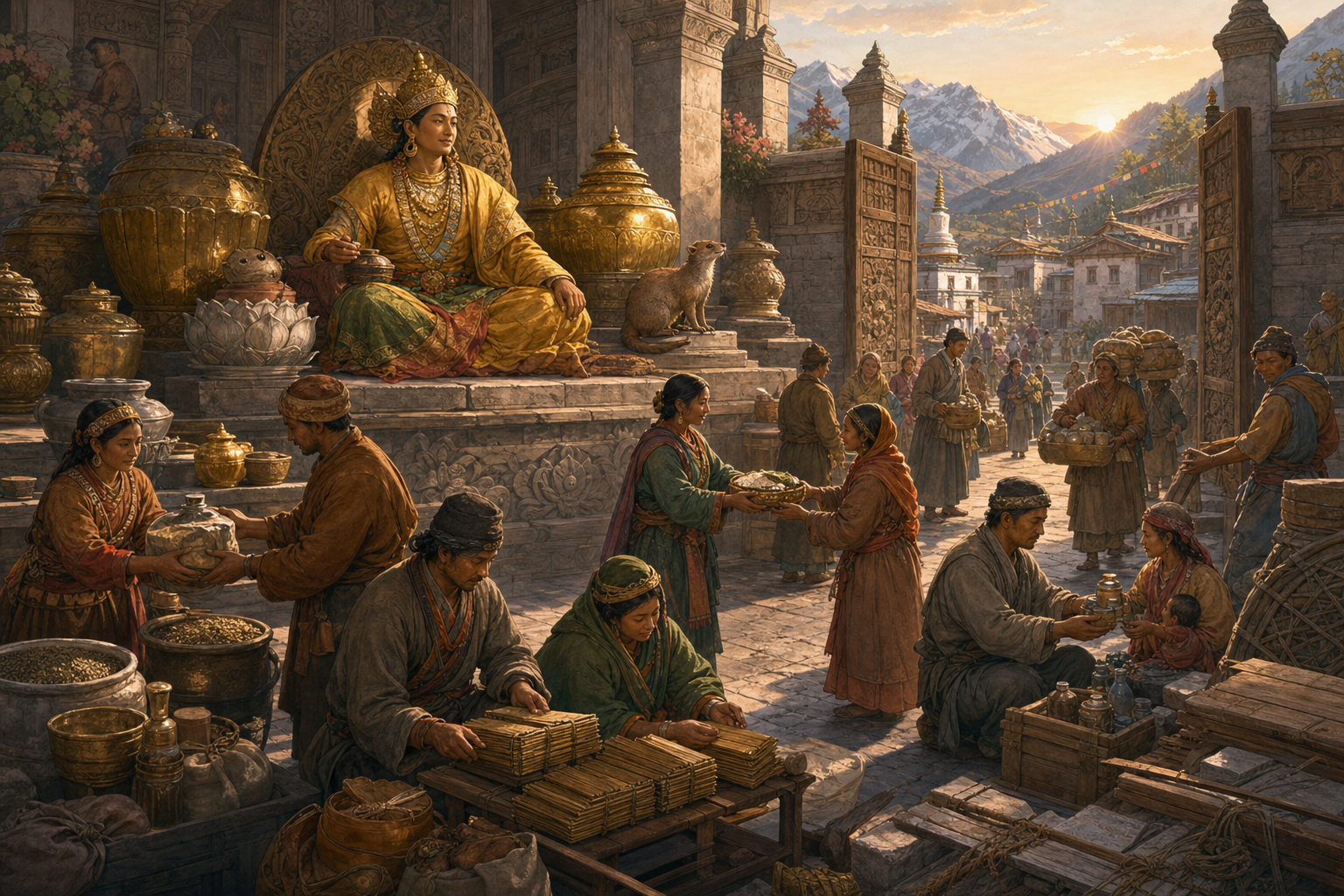
Kubera is king of the Yakṣas, guardian of the North, and treasurer of the gods. His jeweled, pot-bellied form and the money pot or bag in his hand signify abundance. Yet his identity as treasurer is more ethically revealing than the treasure itself. A treasurer possesses access and authority, but those powers come with an obligation to preserve, account for, and direct what has been entrusted.
That is a more demanding image than the modern fantasy of wealth as unrestricted personal choice. Under the Kubera lens, ownership does not erase obligation. The larger your capacity becomes, the more carefully you must decide what should be protected, what should be put to productive use, and what should circulate through dāna and service.
Kubera’s place in Alakapuri and his association with the meeting of dharma and artha make prosperity intelligible as an ordered social power. The point is not that every prosperous person has received divine approval. It is that wealth becomes worthy of reverence only when its acquisition and use remain accountable to something higher than appetite.
This custodial image extends beyond one Hindu setting. As Vaiśravaṇa, he guards the North among Buddhism’s Four Heavenly Kings. Related Yakṣa figures in Jain narratives and visual culture carry protective and distributive associations. Sikh principles of honest livelihood and sharing speak to the same practical concern from a distinct theological tradition. These are family resemblances, not interchangeable doctrines: each tradition keeps its own practices and meanings while refusing to separate prosperity completely from responsibility.
You can convert the custodial idea into a simple habit. Whenever a major sum enters your control – a bonus, business profit, inheritance, or sale proceeds – assign its duties before assigning its pleasures. Write down what must preserve household stability, what can support productive work, what should remain for future resilience, and what can move outward in generosity. Do not invent a supposedly sacred percentage. Choose an amount that is deliberate, compatible with genuine obligations, and concrete enough to be acted upon.
Prosperity rituals make a similar principle visible. Lamps, coins, and newly opened ledgers are not merely decorations around acquisition; they can remind a household or enterprise to begin a financial cycle with intention. When you next open an annual ledger or mark a festival associated with prosperity, review not only the balance but also the conduct behind it. A clean ledger should record more than arithmetic.
Plutus exposes the role of luck and unequal distribution
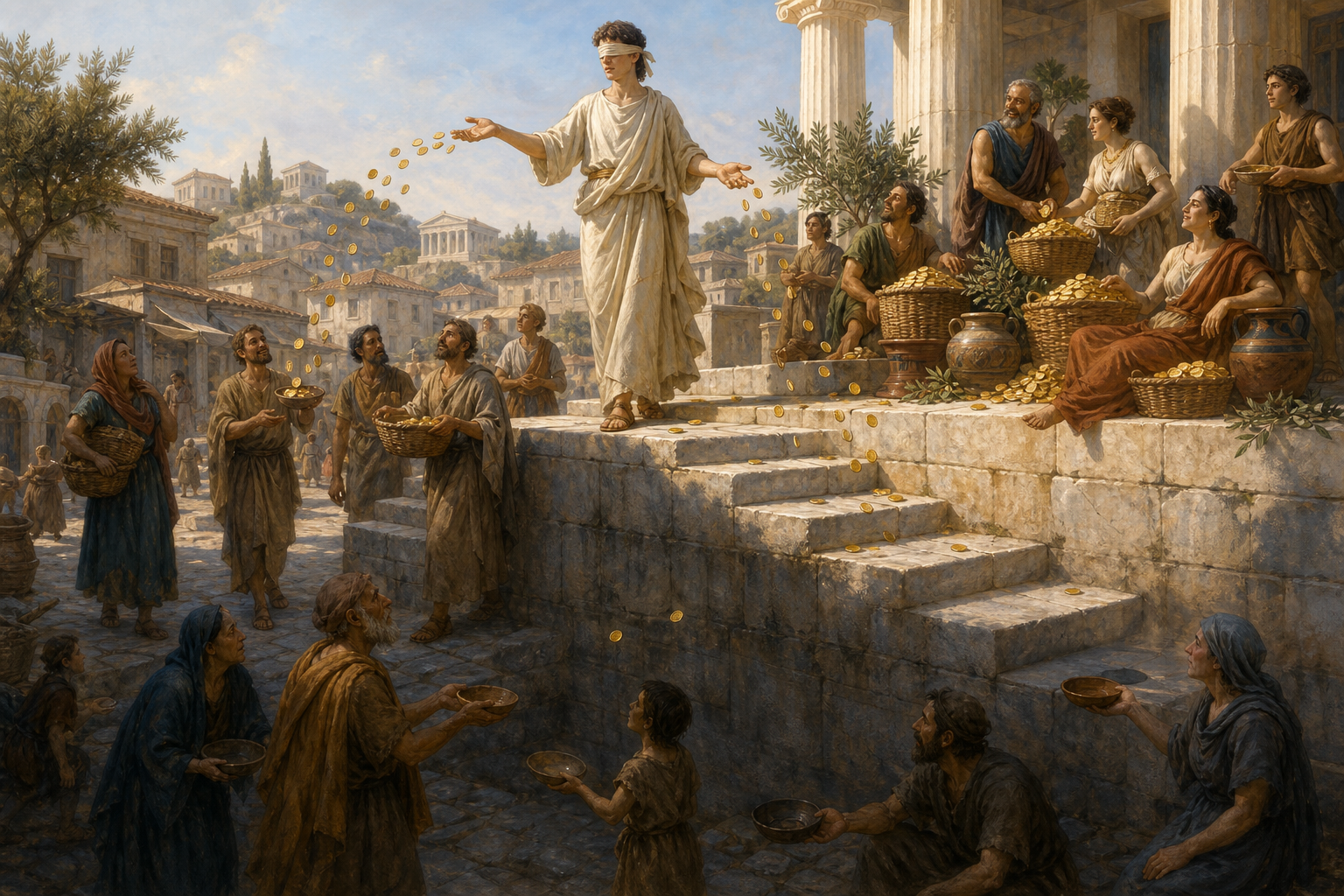
Plutus, or Ploutos, does not function as a Greek counterpart to Kubera in every respect. Kubera has an enduring ritual and temple presence. Plutus chiefly personifies wealth and becomes a vehicle for ethical and civic criticism. Treating them as two versions of the same deity would hide the most useful difference between them.
In Hesiod’s Theogony, Ploutos is associated with Demeter and the fertility of the earth. Wealth here begins with conditions that no individual creates alone: soil, season, fertility, and the cycles on which a community depends. In Aristophanes’ comedy Plutus, wealth is portrayed as blind, dramatizing its indiscriminate and capricious distribution. Riches do not consistently find the wisest, hardest-working, or most virtuous person.
That blindness corrects a flattering story prosperous people can tell themselves: every gain proves exceptional merit, while every hardship proves insufficient effort. Discipline and skill matter, but so do inheritance, timing, social position, access, and chance. Acknowledging those factors does not require shame about success. It requires accuracy about success, and accuracy changes the duties that follow from it.
Run a luck audit when a substantial gain arrives. On one side of a page, list what you controlled: work, restraint, judgment, preparation, or a risk knowingly carried. On the other, list what you did not control: favourable timing, inherited resources, introductions, public infrastructure, or circumstances that could easily have been different. The second column does not cancel your labour. It prevents your labour from becoming a complete moral explanation for the outcome.
The Greek lens also pushes the question beyond private benevolence. Athenian civic life debated wealth through law and public obligation, including liturgies through which elites funded collective goods. The underlying concern is still recognisable: a society cannot rely entirely on the moods of wealthy donors. Institutions, public responsibilities, and rules of distribution matter because private generosity is selective and fortune is blind.
When applying this lens, ask two different questions. First, what good will you personally do with the resources under your control? Second, what arrangements helped place those resources under your control, and are those arrangements fair enough to defend when you are not their beneficiary? Dāna answers part of the first question. Civic responsibility is needed for the second.
Use this five-question test before a material decision

The following test is meant for ethical examination. It cannot determine whether a particular investment is safe, suitable, lawful, or tax-efficient. Those questions require proper due diligence and, where the consequences are substantial, qualified financial, legal, or tax advice. Do not risk essential household security because an opportunity has been presented in moral or spiritual language.
- Earning: How was this money produced? Name the labour, exchange, or asset behind it, then identify who bore the cost. If you would conceal the method from the people affected by it, the problem begins before profit.
- Duty: What legitimate obligations attach to this wealth? Include dependants, people to whom you made promises, those whose work helped create the gain, and commitments already accepted. Giving publicly while neglecting a direct obligation is not dāna.
- Fortune: Which part resulted from disciplined action, and which part depended on conditions you did not create? Keep credit for genuine work, but do not turn favourable circumstance into evidence of superior worth.
- Direction: What conduct will this money strengthen? A purchase, investment, or business reserve is not inert. It supports particular people, institutions, incentives, and habits. Examine those consequences rather than relying on a respectable label.
- Circulation: What will move beyond your private use, through which channel, and when? A vague intention to give later is easy to preserve forever. Name the recipient or purpose and the event that will trigger action.
Write the answers before making the decision, not after. A difficult answer does not always require rejection; sometimes it identifies a condition that can be renegotiated, a harm that can be removed, or an obligation that must be secured first. But some defects are decisive. Deception in earning cannot be balanced by generosity in spending, and reckless giving cannot be excused as detachment when other people depend on you.
The test changes slightly with the situation. For a lucrative job, concentrate on earning and direction: what must you do, and what system does the work sustain? For an inheritance or windfall, concentrate on fortune and circulation: what did you not create, and what responsibility accompanies that fact? For an investment, examine direction as seriously as expected return. For a donation, examine duty as well as generosity so that public virtue does not conceal private neglect.
For a business owner, all five questions operate at once. Honest revenue does not excuse unfair treatment inside the enterprise. Good employment does not excuse misleading customers. A charitable gift does not erase either failure. Ethical wealth requires continuity between the way value is created, the way gains are allocated, and the purposes those gains eventually serve.
Key takeaways
- Artha is a legitimate human aim, but it must remain answerable to dharma rather than becoming an independent moral authority.
- Kubera’s treasury represents stewardship: wealth should be accounted for, preserved prudently, and directed toward duties larger than private appetite.
- Plutus’s blindness warns you not to confuse possession with merit or favourable circumstance with moral superiority.
- Ethical examination begins with the origin of income and continues through saving, investing, spending, giving, and public responsibility.
- A donation cannot purify corrupt earnings, while generosity that abandons genuine dependants is not responsible detachment.
- Hindu and Greek thought converge on wealth’s double character: it can sustain flourishing when governed by virtue and destabilise society when detached from obligation.
Before your next substantial money decision, put the amount at the top of a page and answer the five questions in plain language. If an answer depends on euphemism, pause. If the answers withstand scrutiny, choose the next verb: decline, renegotiate, reserve, invest responsibly, discharge a duty, or give. Wealth becomes ethical through that movement from possession to accountable action.
References
