

You can chant in a crowded kirtan, read about Krishna, volunteer at a temple and still wonder how these activities fit together. Is Gaudiya Vaishnava bhakti mainly a philosophy, a devotional feeling, a discipline or a way of organizing community life?
The practical answer is that it is all four, but in a definite order. Doctrine establishes your relationship with Krishna. Sadhana trains you to live within that relationship. Duty tests whether devotion has entered your conduct. Community gives that conduct a shared form. When one part is detached from the others, bhakti can become abstract, sentimental, mechanical or socially exhausting.
Start with the relationship at the heart of the doctrine

Gaudiya Vaishnava doctrine does not begin by asking you to escape personality, relationship or the world. It asks you to understand them in relation to Krishna. The individual self is neither an independent center of existence nor simply identical with Krishna. The world, the self and their capacities depend upon the Divine while retaining real distinction.
This is the practical force of acintya-bheda-abheda, the teaching of inconceivable simultaneous difference and non-difference. Difference makes devotion possible: service requires a real servant and a real object of love. Non-difference explains intimacy and dependence: nothing exists outside Krishna’s sustaining reality. The word acintya, or inconceivable, warns you not to reduce that relation to a formula that the ordinary mind can completely contain.
That doctrine changes how you handle ordinary life. If the world is Krishna’s energy, it cannot honestly be treated as your private possession. If another person is not merely an object in your story, service must respect that person’s dignity. If you remain distinct from Krishna, a powerful devotional experience does not make you the Divine or exempt you from moral responsibility. Humility is therefore not decorative piety. It follows from the nature of the relationship.
The theology of the holy name brings the relationship into immediate practice. In the Gaudiya understanding, Krishna’s name is not merely a verbal sign pointing toward an absent deity. The name is regarded as non-different from Krishna. Chanting is therefore an encounter practiced through sound, attention and receptivity.
The sixteen-word maha-mantra is Hare Krishna Hare Krishna Krishna Krishna Hare Hare, Hare Rama Hare Rama Rama Rama Hare Hare. Your tongue participates, but control is not the point. Gaudiya teachers describe the name as acting by grace rather than becoming a spiritual object that the practitioner masters. You make yourself available by chanting and hearing; you do not manufacture Krishna’s presence through vocal technique.
This corrects two common mistakes. Mechanical repetition without listening treats the name as an inert tool. Chasing tears, exhilaration or unusual sensations turns attention back toward your own experience. Tears or quiet joy may arise in kirtan, but emotion is not a daily admission test. When your mind wanders, return to the sound you are actually uttering. That simple return is more faithful to the doctrine than trying to imitate someone else’s visible devotion.
Build a daily loop of hearing, understanding and service

A sustainable practice needs a repeatable shape. Inspiration can begin a morning of chanting, but only a rhythm carries bhakti through work pressure, family obligations and periods when you feel little. Vaidhi-bhakti addresses this problem through regulated devotion: you accept practices because they orient attention toward Krishna, not because every session produces an intense mood.
- Anchor chanting to a dependable point in your day. Choose a cue you can keep, such as after waking or before the household becomes busy. If you have accepted a formal commitment from a teacher, follow that commitment. If you are still exploring, begin with a promise you can actually honor rather than borrowing an advanced practitioner’s public standard.
- Hear at least as deliberately as you speak. Clear pronunciation matters, but attention is the immediate discipline. When you notice planning, resentment or fantasy taking over, return to the next audible name. Do not spend the rest of the session judging the distraction.
- Connect sound with understanding. Read a manageable portion of shastra or a trusted Gaudiya teaching. Ask one concrete question: what view of Krishna, the self or service is this passage asking me to correct?
- Translate remembrance into one duty. Select a real responsibility already in front of you. Complete it honestly, without using spiritual activity as an excuse to leave the burden for someone else. This is where doctrine begins to acquire social credibility.
- Return regularly to satsanga and congregational kirtan. Solitary practice reveals your habits of attention; shared practice reveals your habits of cooperation. You need both forms of learning.
Congregational kirtan has a function that private repetition cannot duplicate. Shared rhythm gathers attention, and the intention of the assembly can help a distracted person re-enter remembrance. At the same time, the group cannot hear on your behalf. A loud room does not remove the need to listen. The useful question after kirtan is not only, “Did I feel uplifted?” It is also, “Was I more available to the name and to the people with whom I chanted?”
Review the loop at the end of each week. Look for movement in conduct rather than demanding a dramatic inner event. Are you keeping promises more reliably? Is your study correcting your assumptions, or merely supplying quotations that support them? Does seva make you more attentive to other people, or more eager to be seen as indispensable? These questions do not replace devotion with self-improvement. They help you notice whether devotional practice is passing through the ego’s usual defenses.
Let duty support bhakti without mistaking duty for its goal
The relation between varṇāśrama-dharma and bhakti becomes urgent when spiritual aspiration appears to conflict with work, family or social obligation. In Śrī Caitanya-śikṣāmṛta, Bhaktivinoda Thakura directly raises the question of whether a person should abandon social duties in pursuit of devotion. The practical Gaudiya answer preserves a hierarchy without creating a false opposition: bhakti is the ultimate aim, while disciplined and ethical responsibility can protect the conditions in which bhakti becomes steady.
Vaidhi-bhakti does not become a reward for being professionally efficient or socially respectable. Grace cannot be purchased by a tidy calendar. Yet disorder has consequences. Dishonest work, neglected dependents and promises casually broken generate conflict and mental agitation. You then carry that agitation into japa, study and kirtan. By contrast, honest livelihood, fulfilled family duties and consistent seva reduce avoidable friction around spiritual practice.
For a contemporary practitioner, the most constructive application is functional rather than exclusionary. Read varṇāśrama here as a discipline of role, character, responsibility and contribution to the common good. It should not become a pretext for ranking the spiritual worth of people by birth or barring them from devotion. That application does not pretend that every historical dispute about social order has disappeared. It identifies the part you can responsibly practice now: discover what has legitimately been entrusted to you and offer it without possessiveness.
Before you leave an ordinary obligation in the name of bhakti, ask:
- Is the duty itself unethical, or is it merely inconvenient?
- Am I moving toward deeper service, or escaping accountability?
- Who will carry the practical cost if I withdraw?
- Can the task be simplified, shared or performed in a devotional consciousness instead of abandoned?
- Have I sought mature guidance from someone who understands both sadhana and household or professional responsibility?
This test prevents two opposite distortions. One is spiritualized irresponsibility: ordinary commitments are dismissed as beneath a devotee. The other is respectable stagnation: work and family become permanent reasons never to deepen practice. Duty supports bhakti when it steadies life and becomes service. It obstructs bhakti when status, control or accumulation becomes the real object of loyalty.
Ethical disciplines such as satya, ahimsa and dana belong in this supporting structure. Truthfulness keeps speech from dividing your devotional and public selves. Ahimsa asks you to examine what your habits cost other beings. Dana loosens the conviction that resources exist only for your own security. None of these disciplines replaces remembrance of Krishna. Each removes a familiar way in which self-centeredness can contradict it.
Judge a community by the life its devotion produces
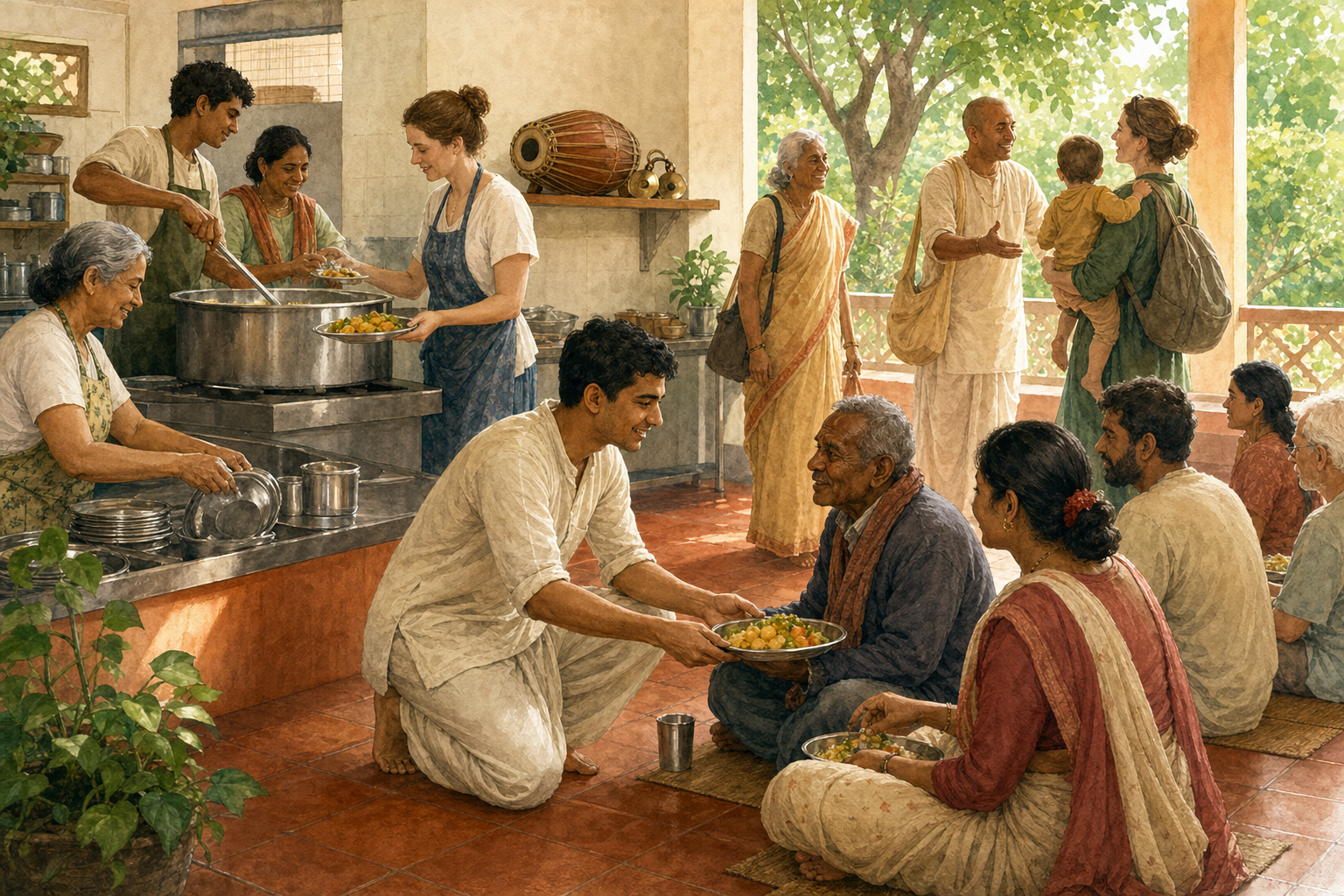
A Gaudiya community is not simply a collection of people who accept the same propositions. It is a setting where chanting, teaching, work, hospitality and resources are organized around service. This makes community life more than an optional social benefit. It is one of the places where a practitioner’s understanding becomes visible and correctable.
Look beyond the intensity of the public program
A moving kirtan can introduce you to a community, but it cannot by itself tell you how that community lives. Watch the repeated, less dramatic patterns. They disclose whether devotion has entered the culture.
- Is the holy name central or ornamental? Kirtan should invite participation and hearing, not reduce the congregation to an audience for spiritual performers.
- Does seva include ordinary work? Cleaning, cultivation, cooking, maintenance, teaching and receiving guests should be understood as part of communal devotion, not as distractions from its visible moments.
- Are responsibilities treated seriously? A community that praises devotion while normalizing broken commitments teaches an internal contradiction.
- Does simplicity affect consumption? Restraint should appear in actual decisions about food, land, possessions and shared resources, not remain a slogan directed only at newcomers.
- Can hospitality cross cultures without emptying the teaching? A tradition can speak intelligibly in a new country while preserving its theological center. Accessibility and dilution are not the same thing.
New Mayapur in France offers a concrete model of how these elements can be brought together. Srila Prabhupada spent time there and articulated a rural vision commonly summarized as “simple living and high thinking.” The community’s kirtan, seva, seasonal work and aspiration toward self-sufficiency place devotion within the rhythm of land and shared responsibility.
Self-sufficiency should be understood as an aspiration and discipline, not a purity claim. A farm still has material limits, interpersonal pressures and practical dependencies. Its spiritual value does not lie in pretending those difficulties have vanished. The land makes consumption, labor and stewardship harder to keep abstract. People must decide what to grow, what to use, what to repair and how to share necessary work.
You do not need to move to a rural community to apply that insight. An urban household or congregation can reduce waste, consume more deliberately, share work, support compassionate food practices and treat facilities as entrusted resources. The form changes; the underlying test remains. Does your material life reinforce remembrance and service, or continuously demand that devotion accommodate unchecked consumption?
Recognize shared Dharmic ground without erasing distinctions
Gaudiya community life also sits within a wider Dharmic world. Hindu, Buddhist, Jain and Sikh communities all preserve forms of ethical discipline, sacred remembrance and service. Sikh Naam Simran and remembrance of Waheguru, the Jain Namokar Mantra, and Buddhist refuge formulas such as Buddham saranam gacchami illustrate the wider Dharmic confidence in disciplined sacred recitation.
The useful conclusion is not that these practices are interchangeable. They arise within different accounts of the Divine, liberation, the self and authority. Calling them all the same would make dialogue easier only by making it shallower. The sounder basis for cooperation is a shared commitment to remembrance, ahimsa, disciplined simplicity and seva while allowing each tradition to explain its own practice in its own terms.
For a Gaudiya Vaishnava, this balance follows from the tradition’s own center. You can recognize another community’s integrity without treating Krishna as a vague symbol. You can preserve a distinct doctrine without turning difference into contempt. In practical encounters, ask what a practice means to the people who actually follow it, identify the ethical ground on which cooperation is possible and resist the urge to manufacture agreement where real differences remain.
Key takeaways for your own practice
- Acintya-bheda-abheda makes bhakti relational: intimacy with Krishna does not erase the distinction that makes loving service possible.
- The holy name is approached as Krishna’s presence, not as a technique you control. Chant, hear and return to the sound without making emotion the measure of success.
- Vaidhi-bhakti supplies a repeatable discipline for days when inspiration is weak. Its purpose is attentive devotion, not mechanical compliance.
- Work and family duties can steady bhakti when they are honest and service-oriented. They become obstacles when status, possession or avoidance takes the central place.
- A community’s devotional health appears in its ordinary patterns: shared work, reliability, hospitality, restraint and care for resources.
- Dharmic traditions can cooperate around sacred remembrance, ahimsa and seva without pretending that their doctrines or mantras are identical.
For the next seven days, keep one daily chanting anchor, listen closely to the names, and choose one neglected responsibility to perform as seva. Join congregational kirtan if it is available to you. At the end of the week, do not ask only whether you felt spiritual. Ask whether remembrance became steadier, whether one relationship became more responsible and whether your use of time or resources became less possessive. That is a small enough beginning to keep and a serious enough test to reveal whether doctrine is becoming life.
References
- Dandavats – New Mayapur’s Living Legacy: Srila Prabhupada’s Vision of Bhakti, Community, and Self-Sufficiency
- Dandavats – Varṇāśrama and Bhakti in Gauḍīya Siddhānta: A Powerful Guide to Harmonizing Duty and Devotion
- Dandavats – Mystic Power of the Divine Name: How Chanting Awakens the Heart across Dharmic Traditions
