
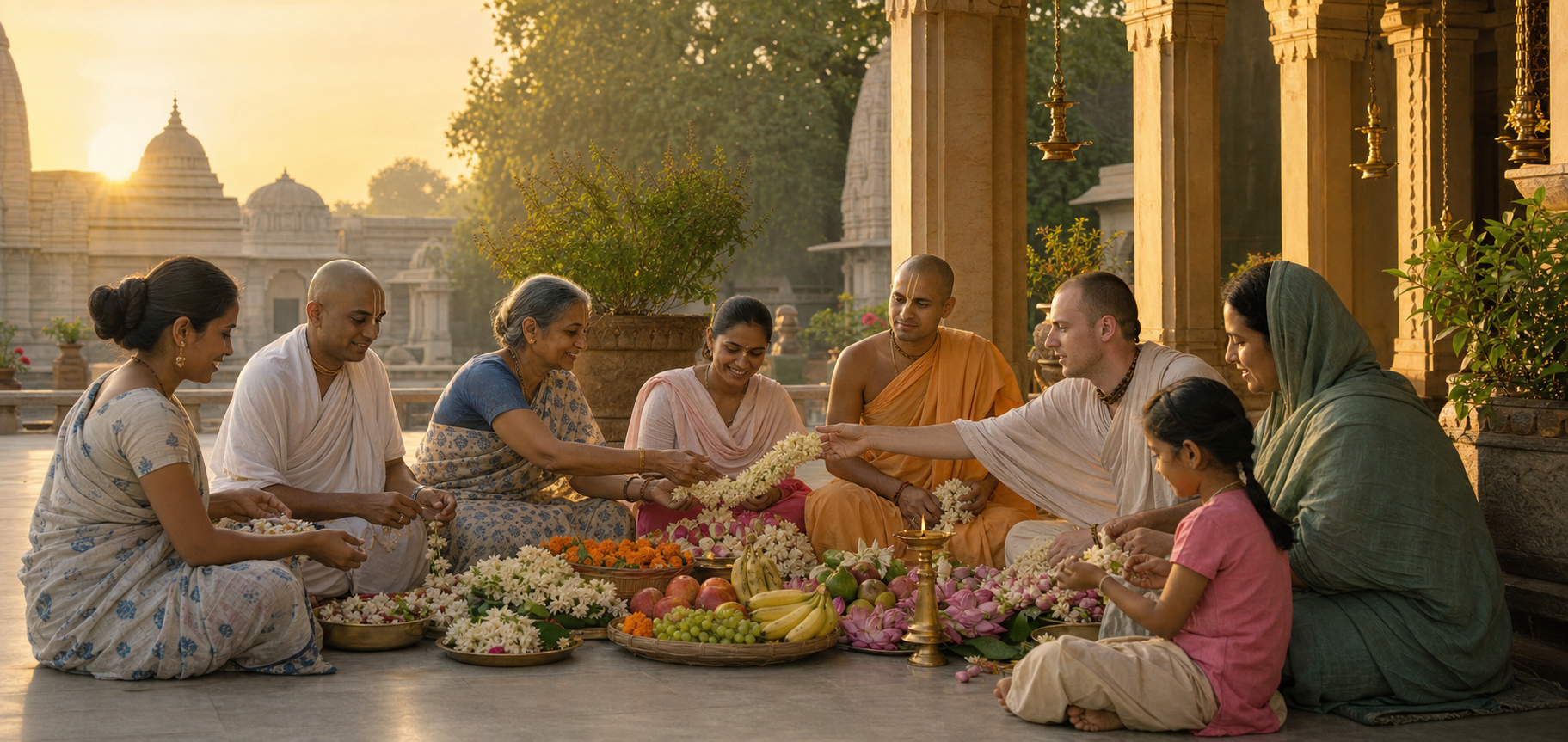
You may be preparing a temple conversation, a shared seva project, or a class attended by people from another sampradaya. The difficult question is not whether to be courteous. It is how to be generous without blurring siddhanta, and how to be clear without turning fidelity into rivalry.
Vaishnava teaching offers a workable discipline: begin from service to Bhagavan, teach according to the hearer’s actual need, and let mercy seek transformation rather than victory. That combination helps you decide what can be shared, what must remain distinct, and how fellowship should respond when someone causes harm.
Fellowship does not require the same conclusion
A sincere meeting can contain both agreement and unresolved difference. If participants have to conceal their lineage’s conclusions before they are welcomed, the gathering has achieved conformity, not fellowship.
The distinction became visible during the week-long sadhu-sanga held at Udupi Sri Krishna Matha from 7-12 December 2025. ISKCON and Madhwa sannyasis met around guru, shastra, seva, and devotion to Sri Krishna. The setting honored parampara while leaving room for the identities of the two Vaishnava lineages to remain intact. Senior disciples of A.C. Bhaktivedanta Swami Prabhupada participated alongside Madhwa renunciants in an atmosphere shaped by worship, study, and courteous conversation.
The order matters. Shared devotion establishes that the people in the room are fellow servants rather than rival abstractions. Doctrinal discussion can then proceed as an effort to understand truth, not as a contest over whose community deserves dignity.
Before entering an inter-tradition setting, separate the relationship into three layers:
- Devotional center: Name the sacred orientation you genuinely share, such as remembrance of Sri Krishna, reverence for guru, scriptural study, or seva. Do not claim more agreement than exists.
- Ethical method: Agree on the conduct that will govern the encounter: truthful speech, patient listening, freedom from ridicule, and willingness to correct misrepresentation.
- Doctrinal boundary: State where your sampradaya has a definite teaching. A common act of worship or service does not silently merge distinct accounts of authority, grace, the self, liberation, or the nature of the Divine.
This gives you a practical test for success. After the meeting, can each participant describe the other tradition in terms its own adherents would recognize? Can everyone name a real point of agreement and a real point of difference? Can they still undertake an honest act of service together? If so, the fellowship has substance. A photograph of religious leaders sharing a platform proves much less.
Teach the person in front of you, not merely the position

Good teaching does not throw the same formulation at every spiritual difficulty. It preserves truth while choosing an entrance suited to the hearer’s condition.
Sri Krishna’s conversations with Arjuna and Uddhava show this pedagogical range. At Kurukshetra, Arjuna receives guidance centered on duty, discernment, and steadfast action amid crisis. In Dvaraka, Uddhava receives intimate counsel on mature bhakti, humility, remembrance, contemplative wisdom, and detachment as a great transition approaches. The Uddhava-gita forms the longest philosophical section of Srimad Bhagavatam. The truth has not become inconsistent; the immediate spiritual need has changed.
Before you teach, answer four questions:
- What is the actual burden? Is the person confused about duty, clinging to a threatened identity, struggling to act, or trying to understand a doctrine outside their lineage?
- What can the person presently receive? A newcomer may need a clear practice and vocabulary. A mature practitioner may need a finer distinction between attachment to service and attachment to control.
- What response should the teaching produce? Decide whether the immediate need is action, restraint, remembrance, study, repentance, or patient endurance.
- What level of authority are you invoking? Distinguish revealed scripture, lineage commentary, local custom, and your own practical judgment. Personal preference should not be presented as universal siddhanta.
The final question is especially important across traditions. Many avoidable conflicts begin when a local habit is defended as if every Vaishnava must accept it, or when a profound doctrinal difference is dismissed as a matter of regional style.
Use language that keeps the boundary visible. Say that your lineage teaches a particular conclusion. Say which meaning of a Sanskrit term you are using. Before objecting, restate the other person’s position and ask whether you have represented it fairly. Avoid saying that all Dharmic paths really mean the same thing. That phrase may sound hospitable, but it often replaces living traditions with a theory none of them actually holds.
This approach also changes how you answer a hostile question. First identify whether the person is seeking understanding, defending communal dignity, or merely inviting a public quarrel. The first two situations may call for patient explanation. The last may require a concise correction and a refusal to perform sectarian conflict for an audience. Discernment is not evasion; it is part of responsible teaching.
Mercy changes the aim without erasing accountability

Mercy becomes meaningful when kindness is no longer easy. Nityananda Prabhu’s encounter with Jagai and Madhai, narrated in Chaitanya Bhagavata, places it at precisely that point. Even after a violent assault, Nityananda refuses to let retaliation become the final answer and keeps divine love open to the offenders. Their degradation becomes an occasion to display the transforming reach of Lord Chaitanya’s grace.
Jagai and Madhai move from social stigma toward spiritual transformation. Their past is not denied, but it is no longer treated as their permanent identity. That is the demanding center of Vaishnava mercy: oppose the offense without declaring the offender metaphysically disposable.
Mercy therefore changes the desired outcome. The aim is no longer humiliation, revenge, or the pleasure of proving superiority. It becomes protection, truth, repentance, and whatever restoration is genuinely possible. Several distinctions keep this from collapsing into permissiveness:
- Forbearance governs your retaliation. It prevents anger from choosing an excessive response.
- Accountability addresses the act. Harm should be named accurately, stopped, and answered with appropriate consequences.
- Repentance belongs to the offender. It cannot be manufactured by the injured person. It becomes credible through acknowledgment, correction, and changed conduct.
- Reconciliation requires mutual truthfulness. You can relinquish vengeance without pretending that a relationship has already been repaired.
- Trust returns through conduct. Goodwill does not require the immediate restoration of access, office, influence, or responsibility.
If danger or abuse is ongoing, distance and community safeguards may be necessary. Mercy does not require you to remain available for further harm. Protecting the vulnerable and leaving a path to repentance can be part of the same response.
Apply this directly when someone insults another sampradaya. Neither public humiliation nor embarrassed silence is adequate. Identify the exact statement. Explain why it is false, degrading, or careless. Invite the speaker to restate the point without caricature. If the behavior continues, set a boundary on participation. The purpose is to stop the offense and create a disciplined route toward correction, not to make an example of someone for the crowd’s enjoyment.
A useful mercy test asks four things: Does this response protect the person who was harmed? Does it give the offender a clear way to change? Does it reduce the chance of repetition? Does it avoid treating punishment as entertainment? A response that fails all four is unlikely to become merciful merely because it uses devotional language.
Build fellowship around truthful practice and shared seva
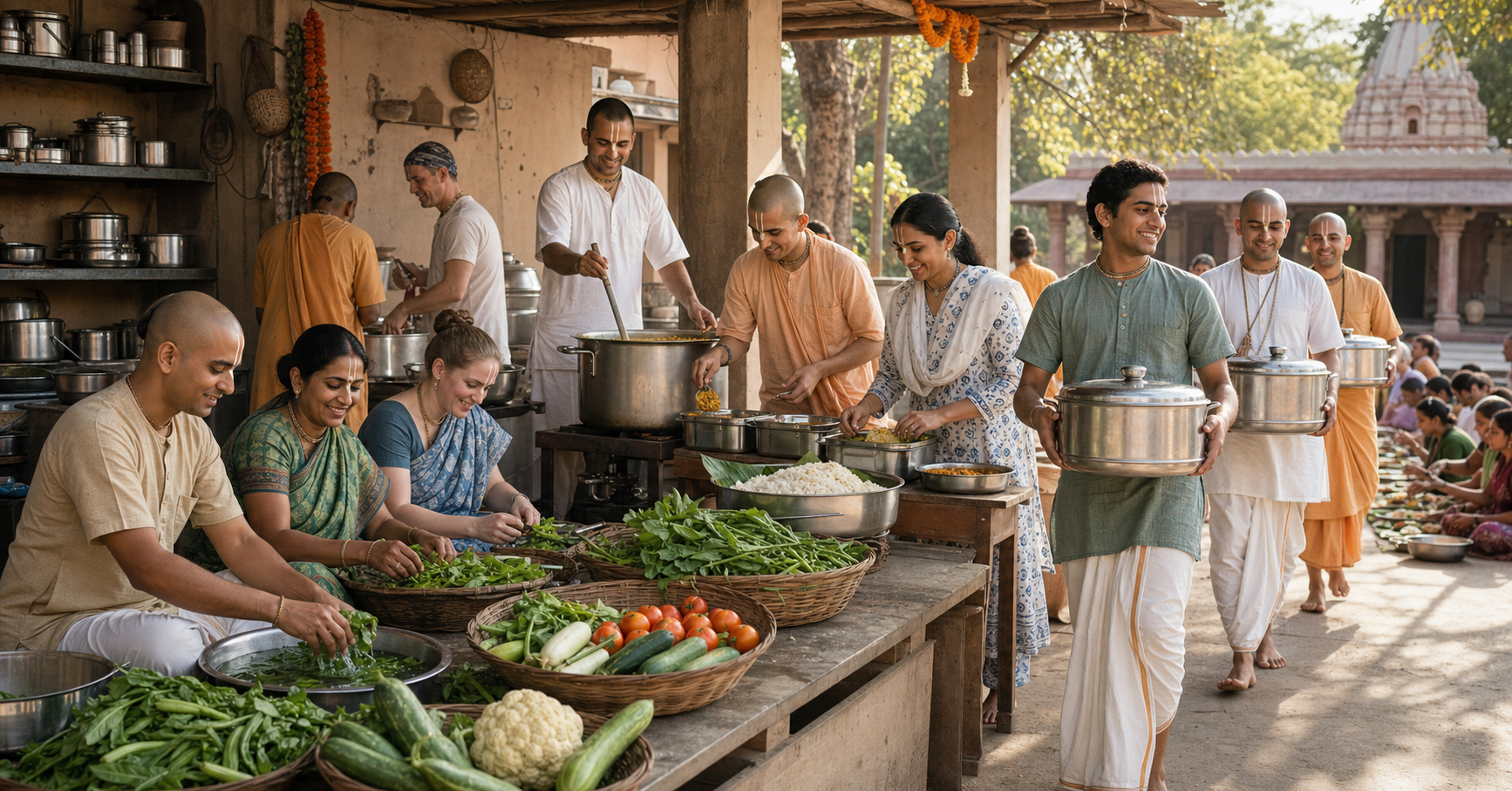
Vaishnava mercy can enter a wider Dharmic conversation without claiming that every tradition means the same thing. Its redemptive orientation can converse with karuna in Buddhism, ahimsa in Jainism, and seva in Sikhism. These resonances create openings for cooperation. They do not prove doctrinal equivalence, because each virtue belongs to a distinctive account of reality, discipline, and liberation.
If you are convening a temple exchange, student forum, community event, or shared service initiative, use this sequence:
- Write an honest purpose. State that the gathering seeks mutual understanding and useful cooperation without requiring doctrinal synthesis. Send that purpose before invitations are accepted.
- Prepare both common ground and boundaries. Ask each participating tradition to name a practice or value it can share and a conclusion it cannot merge. This prevents surprise accusations of either sectarianism or dilution.
- Let every tradition describe itself. A participant may ask critical questions, but no one should define another community’s beliefs over the objection of its own informed representative. Translate technical terms instead of assuming identical vocabulary.
- Use reflective exchange before rebuttal. Let a speaker present a position. Ask the listener to restate it. Allow the speaker to correct the restatement. Only then begin questions or disagreement. This exposes misunderstanding before it hardens into argument.
- Connect dialogue to seva. Choose work that everyone can support honestly, such as care for a sacred site, food service, preservation of cultural learning, or a study initiative. Shared labor reveals character in a way that ceremonial declarations cannot.
- Record what changed and what did not. End by naming a misunderstanding that was corrected, a disagreement that remains, and a commitment that will continue. Unresolved difference is not failure when it is represented accurately and carried without hostility.
Watch for warning signs. Unity should not be used to pressure a participant into hiding doctrine. Dialogue should not become concealed recruitment. Mercy should not be invoked only when an injured person asks for accountability. A shared platform should not be advertised later as endorsement of every claim made there. Agreeing on these boundaries beforehand protects both hospitality and integrity.
The most revealing question for a cross-Dharmic conversation is not whether everyone values compassion. Ask how each tradition trains compassion when the other person is offensive, what limits prevent compassion from becoming indulgence, and what practice turns the virtue into conduct. Those questions invite genuine learning because they move from agreeable vocabulary to spiritual discipline.
Key takeaways
- Vaishnava fellowship joins fidelity with hospitality; it does not require lineages to erase their conclusions.
- Effective teaching begins with the hearer’s need, capacity, and required response while clearly identifying the authority behind the counsel.
- Mercy restrains retaliation and seeks transformation, but it still names harm, protects the vulnerable, and requires changed conduct before trust is restored.
- Shared virtues such as mercy, karuna, ahimsa, and seva can support Dharmic cooperation without making their theological settings interchangeable.
- A worthwhile gathering produces accurate understanding, honest disagreement, shared service, and a practical method for repairing offenses.
Before your next fellowship event, prepare three things: the commitments everyone can share, the distinctions nobody should be asked to conceal, and the steps that will follow if someone misrepresents or harms another participant. Ask an informed representative of each tradition to correct your description before it is circulated. That small act of humility is already part of the fellowship you hope to build.
References
- DharmaRenaissance Blog – Sadhu-sanga 2025 in Udupi: ISKCON and Madhwa Sannyasis Forge a Heartfelt Spiritual Bond
- DharmaRenaissance Blog – Uddhava-gita Unveiled: Krishna’s Profound Counsel in Srimad Bhagavatam Beyond Kuruksetra
- DharmaRenaissance Blog – Lord Nityananda’s Boundless Mercy: Transforming Jagai-Madhai and Inspiring Dharmic Unity
