
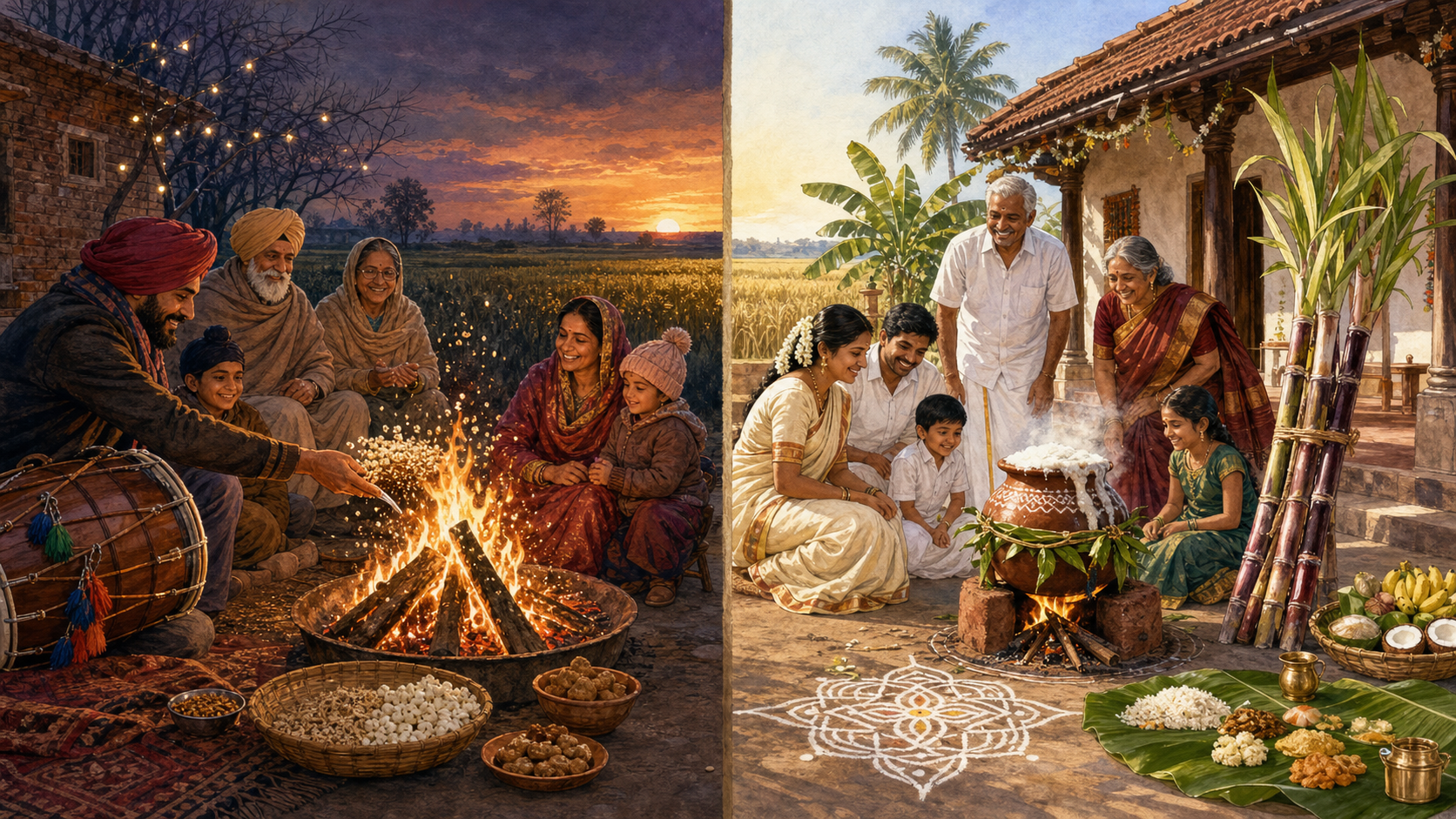
If you are explaining Lohri and Pongal to your children, joining another family’s celebration, or planning a community event, the difficult question is not which foods to serve. It is how to recognize a shared Dharmic foundation without turning two complete regional traditions into one generic “Indian harvest festival.”
The sound approach is simple: begin with the common seasonal purpose, then let each festival speak in its own ritual language. You will understand more, offend less, and give younger participants something deeper than a list of colorful customs.
Begin with kinship, not sameness
Lohri and Pongal are observed in mid-January around Makara Sankranti and the onset of Uttarayana. Both turn a seasonal threshold into an act of gratitude. The Sun, the harvest, nourishing food, fire and fellowship all matter. Yet the forms grew within different languages, landscapes and agrarian cultures.
| What to notice | Lohri | Pongal |
|---|---|---|
| Regional setting | Punjab and parts of northern India, including Haryana, Himachal Pradesh and Delhi | Tamil Nadu and Tamil communities, with related southern harvest observances |
| Central ritual image | A community gathered around a bonfire | Newly harvested rice and milk rising and overflowing from a pot |
| Characteristic offerings and produce | Sesame, jaggery, rewri, groundnuts and popcorn | Rice, milk, sugarcane and turmeric plants |
| Social expression | Ballads, Bhangra, Giddha and special recognition of newly married couples and newborns | Kolam, an offering to Surya, honor for cattle and a four-day sequence of observances |
Use this comparison to orient yourself, not to manufacture a hybrid ritual. Fire does not make Bhogi and Lohri interchangeable. Gratitude to the Sun does not erase the difference between a Punjabi bonfire gathering and Thai Pongal in a Tamil household. Unity becomes meaningful when it can hold particularity.
At Lohri, read the bonfire as a social center
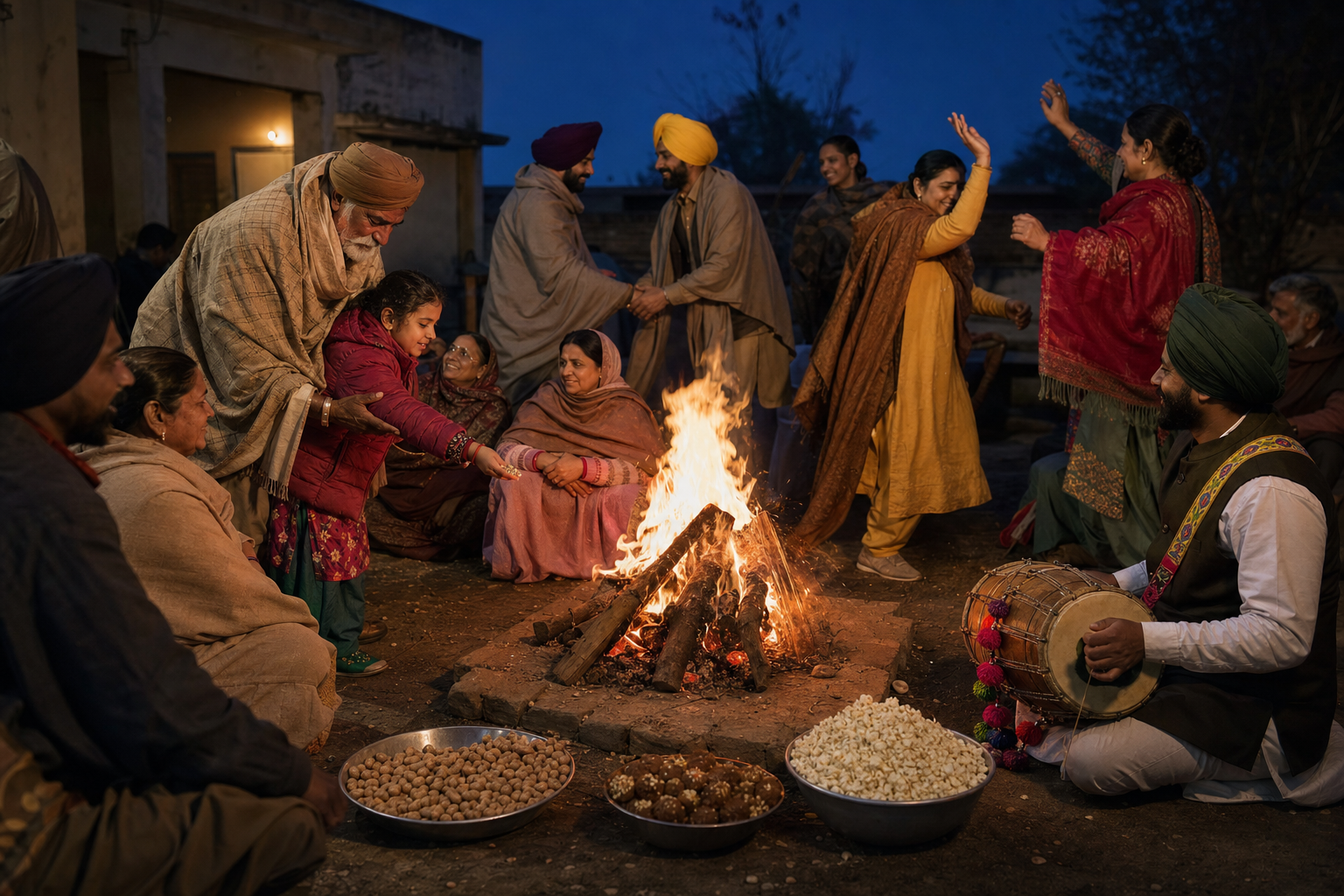
The Lohri fire is not merely an attractive winter backdrop. It gathers the neighborhood into one circle and gives visible form to warmth, protection and renewal at winter’s end. Sesame seeds, jaggery, rewri, groundnuts and popcorn connect the gathering to food, season and generosity.
If you are a guest, follow the household or community leading the observance. Offer what is provided, move around the fire as your hosts direct, and listen before treating the songs as entertainment. Traditional ballads associated with Dulla Bhatti carry cultural memory; Bhangra and Giddha extend the celebration through collective movement.
- Bring something appropriate to share. Sesame sweets, jaggery, rewri, groundnuts or popcorn fit the festival’s established food vocabulary better than an unrelated party snack.
- Let the fire remain communal. Do not crowd it for photographs or turn the offering into a performance for the camera.
- Notice whom the gathering honors. When a family gives special attention to a newly married couple or a household with a newborn, it is expressing continuity, prosperity and the community’s investment in new beginnings.
- Join without claiming expertise. A guest can sing, dance, offer food and serve others while still allowing elders and rooted participants to set the form.
Lohri also shows why regional culture cannot always be sorted into narrow religious compartments. Hindu and Sikh communities share much of its Punjabi social space. That does not make every theological identity identical; it shows how gratitude, generosity and seva can be carried through a common regional inheritance.
At Pongal, follow the full four-day movement
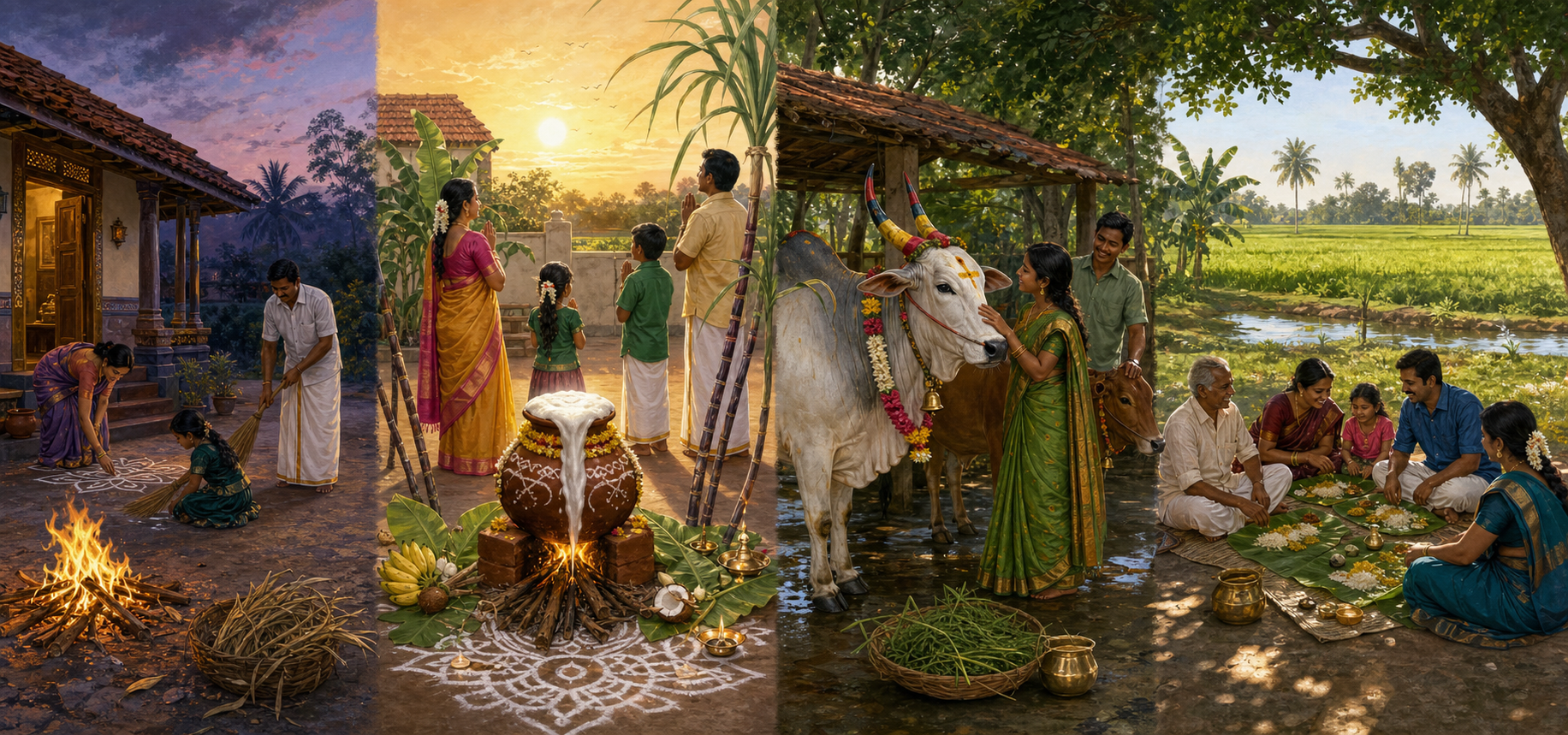
Pongal makes more sense when you resist reducing it to one pot of sweet rice. Its four days – Bhogi, Thai Pongal, Mattu Pongal and Kaanum Pongal – move through renewal, thanksgiving, recognition of agricultural dependence and continued social connection.
- Bhogi clears space for renewal. The day is associated with relinquishing what is old. Related regional customs include Bhogi Mantalu in Andhra and Telangana, where a bonfire marks that transition. Treat this as its own southern observance rather than relabeling it as Lohri.
- Thai Pongal centers gratitude to Surya. Freshly harvested rice is cooked with milk until it rises and spills over. The overflow is welcomed as auspicious abundance with the words “Pongalo Pongal,” and the preparation is offered to the Sun.
- Mattu Pongal makes agricultural dependence visible. Cattle are honored for their essential contribution to farming. In an urban celebration, explain that relationship clearly instead of using animals as decorative props.
- Kaanum Pongal completes the sequence. Household and regional practices should guide how the day is observed. If you are unfamiliar with them, ask your hosts what they follow rather than filling the gap with a generic activity.
At home, prepare the space before the cooking begins. A kolam at the entrance, sugarcane and turmeric plants can place abundance within a recognizably Tamil visual language. If you do not know how to make a kolam, learn from someone who does or invite a knowledgeable participant to guide the activity. Copying a pattern only as exotic decoration misses its role in welcoming auspiciousness into the household.
The overflowing pot also requires the right attention. Do not apologize for it as though the cooking went wrong. The abundance is intentional and auspicious. Make enough space for people to witness the moment, allow the household leading the rite to make the offering, and share the prepared food afterward.
Plan a joint celebration without flattening either tradition
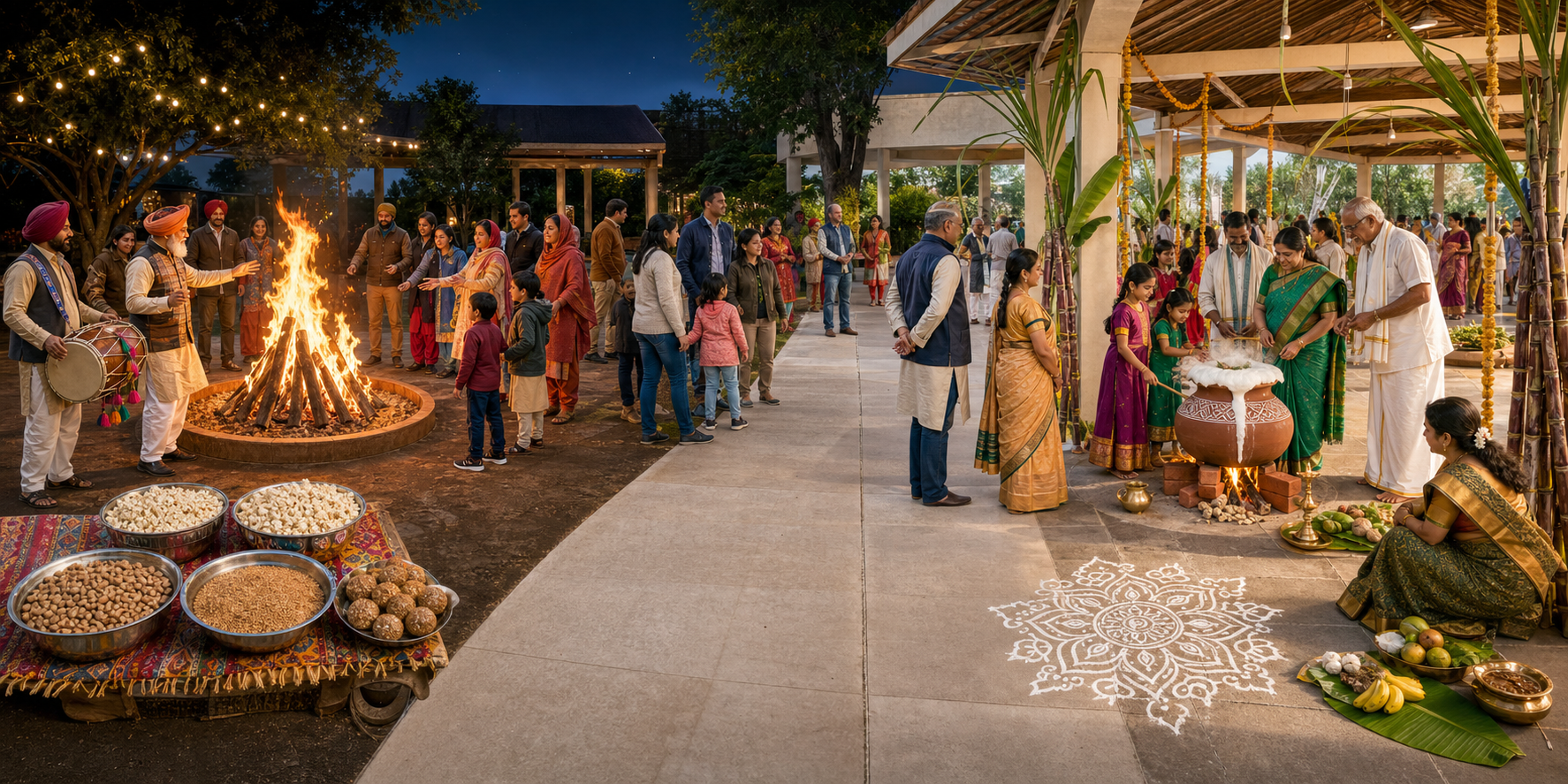
A school, workplace, apartment community or diaspora association can honor both festivals well. The key is sequencing. Give Lohri and Pongal distinct names, voices and ritual explanations, then identify their common ethic after participants have encountered the differences.
- Open with the shared seasonal frame. Explain that both celebrations express gratitude around harvest time, solar transition and community renewal.
- Present Lohri in a Punjabi voice. Introduce the bonfire, seasonal foods, Dulla Bhatti ballads, dance and recognition of new family beginnings. Let someone rooted in the tradition lead where possible.
- Present Pongal in a Tamil voice. Explain the four-day structure, the offering to Surya, the meaning of the overflowing pot, kolam and the honoring of cattle.
- Share food with context. Name the ingredients and what they represent. Sesame and jaggery answer a northern winter setting; rice and milk express the abundance of the southern harvest. The menu should teach the connection between land and table.
- Close with reciprocity. Invite participants to share food, assist with cleanup and identify one way the gathering can care for its own commons.
Adapt the means when your venue requires it, but state the adaptation honestly. An approved portable stove can support the Pongal cooking moment. A properly permitted and safely managed bonfire can serve a Lohri gathering. If open flame is not permitted, omit it rather than creating a hazardous imitation. Explain what the fire means and let food, song and fellowship carry the gathering.
Keep environmental choices close to the festivals’ agrarian logic. Use local produce where practical, choose natural decorations and minimize single-use plastic. These are not cosmetic upgrades. A harvest thanksgiving that creates needless waste contradicts its own recognition of dependence on land, animals and shared resources.
Avoid describing Lohri and Pongal as rites jointly observed by every Dharmic religion. Gratitude, non-harm, restraint and care for the commons resonate across Hindu, Sikh, Buddhist and Jain thought, but resonance is not the same as identical ritual observance. Say precisely what is shared: a civilizational habit of treating nature’s gifts as relationships carrying duties, not as raw material available without limit.
Key takeaways for your next celebration
- Lohri and Pongal share a January harvest setting, gratitude to the Sun and an emphasis on food, fire and community.
- Lohri should remain recognizably Punjabi, centered on the communal bonfire, seasonal offerings, song, dance and social continuity.
- Pongal should remain recognizably Tamil, understood through Bhogi, Thai Pongal, Mattu Pongal and Kaanum Pongal rather than through the cooking pot alone.
- A joint event works best when each tradition receives its own explanation and leadership before their common Dharmic values are discussed.
- Urban and diaspora adaptations should preserve meaning, follow venue safety rules, reduce waste and avoid turning rituals into photo props.
- The most faithful response to harvest abundance is reciprocity: thank, share, serve and care for what sustains the community.
When you next attend or organize either festival, choose one responsibility along with the celebration. Bring a traditional food to share, help a younger person understand the ritual, support the cleanup, or reduce disposable waste. That small act keeps gratitude from ending when the music stops or the pot is emptied.
References
