
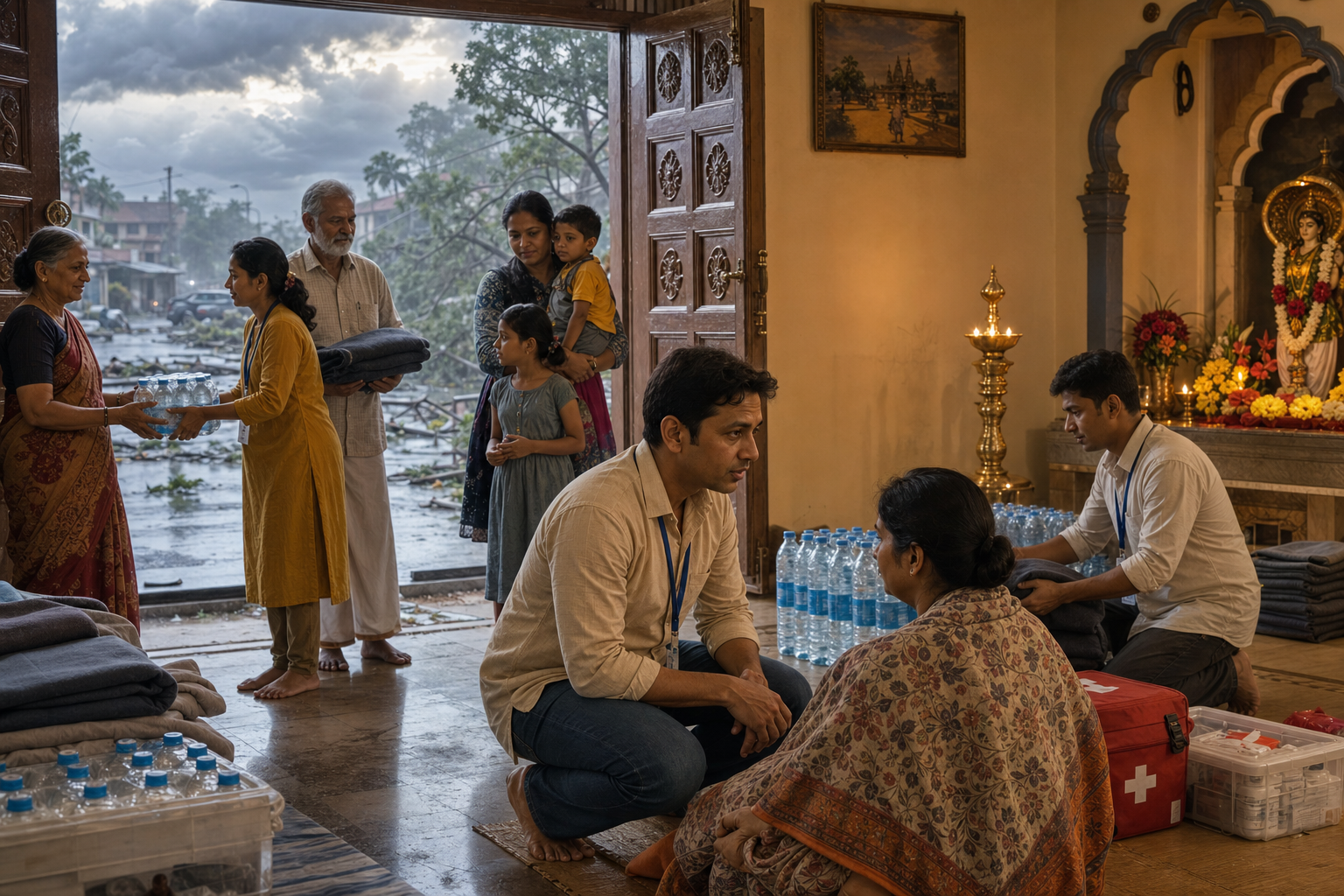
A flood warning has arrived, a storm has cut off a neighborhood, or someone close to you is facing illness or loss. You may want to pray, yet worry that prayer is too passive when food, shelter, information, and difficult decisions are urgently needed.
You don’t have to choose between worship and work. Worship serves its dharmic purpose when it steadies you, reveals the next duty, and sends you toward competent service. It becomes an evasion when it delays safety, substitutes for trained help, or asks suffering people to perform devotion before receiving care.
Treat worship as a compass, not a guarantee

The weakest test of worship is transactional: Did this prayer prevent every loss or produce the result you requested? No Dharmic discipline makes a person immune to illness, disaster, grief, or uncertainty. Its more credible protection lies in preserving attention, courage, compassion, and ethical restraint when circumstances cannot be controlled.
Here, worship is shorthand for disciplined spiritual practice: devotion, prayer, remembrance, meditation, ethical self-examination, and service. It is not a claim that Hinduism, Buddhism, Jainism, and Sikhism have identical theology. Practices such as japa, kirtan, simran, ardas, mettā meditation, and Pratikraman can strengthen attention, inner steadiness, and ethical intention. Those capacities matter because fear can narrow your view precisely when other people need you to notice clearly.
Calm is not passivity. It is the condition from which you can distinguish an urgent need from a rumor, a useful task from a dramatic gesture, and courageous service from reckless exposure. If life is in immediate danger, contact local emergency services and follow evacuation or safety instructions. A mantra can accompany the movement to safety; it cannot replace that movement.
Key takeaways
- Put immediate safety first. Spiritual practice should support evacuation, first aid, and trained assistance, never delay them.
- Use a familiar practice that steadies attention without removing you from necessary action.
- End worship by naming the next concrete duty: whom to contact, what to carry, where to serve, or what information to verify.
- Organize seva through clear roles, handoffs, and transparent communication.
- Offer practical help without discrimination and without making participation in prayer a condition of receiving it.
Turn inner steadiness into the next right action
You do not have to achieve perfect calm before helping. You need enough steadiness to make the next sound decision. A simple cycle can keep worship connected to action.
- Pause without withdrawing. Use a familiar recitation, prayer, breath practice, or period of silent remembrance. Keep it brief enough that it does not postpone an urgent response. The aim is to interrupt panic and recover attention, not to escape the situation.
- Name the immediate dharma. Ask what is unsafe now, who cannot act without help, which information has been confirmed, what task fits your competence, and who is coordinating the response. These questions turn a general desire to help into a responsible decision.
- Serve and report back. Complete one defined task, then tell the coordinator what was done, what remains missing, and who needs the next handoff. Compassion becomes reliable when another person can see the status of the work.
This cycle prevents two common failures. The first is frantic action without judgment: several people rush toward the most visible need while a quieter need is missed. The second is devotion without follow-through: a gathering generates emotion, but nobody accepts responsibility for food, shelter, transport, communication, or continued care.
Let competence set the boundary of your seva. If a task requires rescue training, medical skill, structural assessment, or another specialized ability, support the qualified person instead of improvising. You can carry supplies, relay confirmed information, contact families, prepare an accessible space, or take another safe supporting role.
Honor different paths without losing the shared ethic
Dharmic unity does not require interchangeable practices. Each tradition can approach the same human need through its own vocabulary and discipline:
- In Hindu practice, bhakti, japa, bhajans, and satsang can gather the mind and direct devotion into seva.
- In Sikh practice, ardas, simran, and kirtan can sustain courage, while langar gives devotion a practical form through nourishment and welcome.
- In Buddhist practice, mettā meditation trains benevolent attention so that suffering is met without indifference or hatred.
- In Jain practice, Pratikraman examines conduct, while ahimsa-oriented service keeps the protection of life at the center of action.
Do not flatten these disciplines into a single theology. Their shared ethical floor is more concrete: protect life, uphold dignity, and extend care without discrimination. In a mixed community, agree on the duty while allowing each person to keep the integrity of their path.
Prepare your spiritual practice and emergency plan together

The middle of a crisis is a poor time to decide who has the contact list, where essential supplies are kept, or who will check on a neighbor. The same is true of spiritual practice. Under severe stress, a familiar prayer or meditation is easier to use than a complicated discipline learned for the occasion.
Preparedness becomes more coherent when you pair go-bags, emergency contacts, first-aid training, and evacuation drills with daily practice and community fellowship. Store the practical plan and the spiritual plan together so that neither is treated as someone else’s responsibility.
- Maintain practical readiness. Keep a go-bag and personal essentials usable, make emergency contacts easy to find, learn the relevant evacuation arrangements, and obtain first-aid training rather than assuming goodwill is enough.
- Choose a familiar spiritual anchor. Write down the short prayer, mantra, recitation, or meditation your household already knows. It should be usable without delaying safety instructions or depending on an elaborate ritual setup.
- Name people and roles. Decide who carries supplies, who contacts relatives, who checks on people requiring assistance, and who communicates with the wider community. Name a backup for responsibilities that cannot be left unattended.
- Identify the community link. Know which temple, gurdwara, sangha, Jain community, neighborhood group, or other trusted body can coordinate food, shelter, and information. Record the person or channel through which instructions will be confirmed.
- Rehearse the handoff. During an evacuation drill or preparedness discussion, practice reporting what has been completed, what is still needed, and who owns the next task.
A household can keep a small card with four lines beside its emergency supplies: immediate safety action, primary contact, familiar spiritual practice, and first seva responsibility. The card is not a complete emergency plan. Its purpose is to reconnect attention with the plan you have already made.
Keep worship inclusive rather than coercive. A family or neighborhood member who follows another path, or no religious path, should still have an equal place in the safety plan and the service effort. Shared silence can sometimes serve a mixed group better than asking everyone to repeat unfamiliar words.
Make seva dependable through roles and accountability

Good intentions can still produce confusion. Supplies may accumulate where they are not needed, an urgent request may be passed from person to person without an owner, or outdated information may continue circulating after conditions change. Clear organization is not separate from compassion. It is how compassion reaches the intended person.
A temple, gurdwara, sangha, Jain community, or neighborhood team can use a simple seva board. Every request should have an owner, confirmed details, and a visible handoff.
| Need | What must be confirmed | Named owner | Handoff |
|---|---|---|---|
| Food distribution | Who needs food and where distribution is operating | Person coordinating preparation and delivery | What was delivered and what remains |
| Temporary shelter | Available space, access, and current capacity | Person managing placement | Who has been accommodated and who still needs help |
| Information and contacts | Origin of the information, when it was received, and who confirmed it | Person maintaining the current update | Where corrections and new needs should be sent |
| Prayer or grief space | Consent, accessibility, and separation from practical aid | Person facilitating the gathering | What pastoral or practical follow-up has been requested |
Use a few firm operating rules:
- Safety before visibility. Do not attempt hazardous work for the sake of appearing useful. Take a supporting role when trained help is required.
- Consent before display. Do not publish a recipient’s name, image, grief, or religious participation without permission. A person receiving aid is not material for someone else’s spiritual reputation.
- Assistance without religious conditions. Prayer circles should be voluntary. Food, shelter, information, and other practical help must not depend on joining worship or affirming a belief.
- Transparent communication. State what has been collected, what has been distributed, what remains available, and where the gaps are. Correct outdated information visibly instead of allowing two versions to circulate.
- Cooperation without erasure. Different communities can coordinate kitchens, shelter, transport, and communication while retaining their own prayers and observances.
- A completed handoff. A task is not finished merely because you have stepped away from it. Confirm that the next responsible person has the information and accepts the role.
This is where seva becomes more than spontaneous generosity. A clear role protects effort from duplication. A record protects resources from confusion. A handoff protects vulnerable people from being forgotten when the first surge of attention passes.
Let recovery deepen your duty to Mother Earth

Once immediate danger passes, the need changes rather than disappears. Familiar rituals, bhajans, kirtan, silent meditation, and ethical reflection can give people space for grief and gratitude. They can also lead to a harder question: what should reverence change in the way a household or community lives?
Honoring rivers, forests, and soil becomes materially meaningful through water conservation, tree planting, waste reduction, and climate-aware livelihoods. Choose actions suited to local conditions, then give each one an owner and a way to check whether it continues after the ceremonial moment.
- Connect reverence for water with a specific conservation practice your household or institution can maintain.
- Treat tree planting as a continuing responsibility by assigning care after the planting ceremony.
- Reduce avoidable waste in community kitchens, festivals, relief distribution, and regular worship.
- Include affected households in conversations about livelihoods and recovery rather than deciding everything on their behalf.
- Continue checking on people whose needs remain after public attention has moved elsewhere.
These actions are not offerings exchanged for immunity from nature. They express a relationship of restraint, gratitude, and responsibility. Devotion becomes credible when the river honored in ritual is also treated with care, and when compassion shown during disaster becomes an ordinary habit.
At your next household or community gathering, put one practical question on the agenda: if disruption began tonight, who would do what? Write the contacts, choose the familiar spiritual anchor, and assign the first seva roles. Then rehearse the sequence aloud: safety, steadiness, service, handoff. You will be preparing not only to endure difficulty, but to meet it without abandoning dharma.
References
- DharmaRenaissance Blog — When Nature Turns Fierce, Worship Unites: A Steady, Compassionate Path to Resilience
- DharmaRenaissance Blog — Why Worship Is Never a Waste: Enduring Protection, Inner Strength, and Dharmic Unity
