
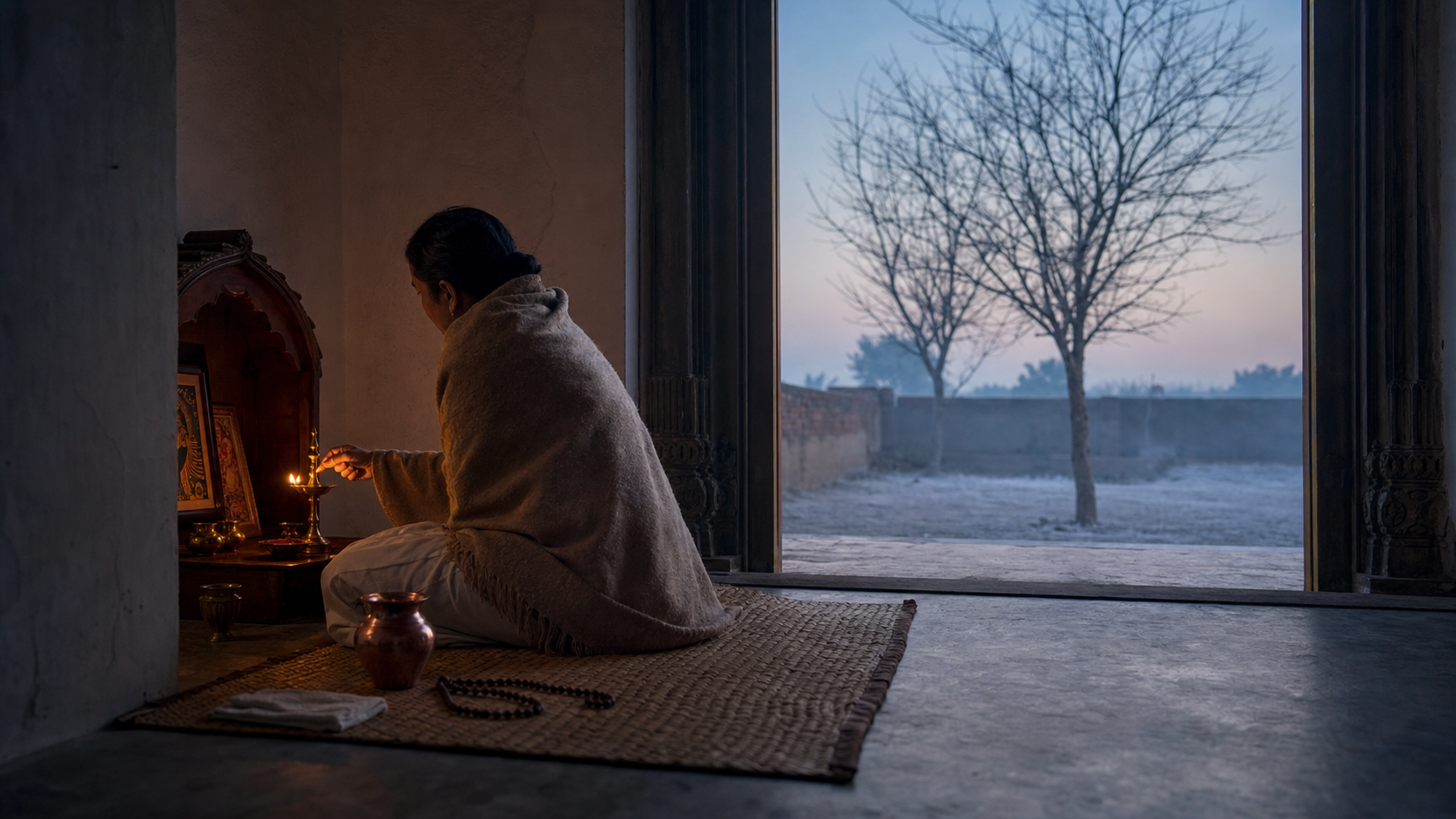
By midwinter, you may know that your spiritual life needs attention while also knowing that another ambitious resolution won’t help. The problem is rarely a lack of ideals. It is the noise, haste, and unfinished duty that keep those ideals from governing an ordinary evening.
This season offers a more honest form of renewal. You can withdraw from distraction, remember what deserves loyalty, and return to daily life with one clear obligation. The aim is not a dramatic spiritual experience. It is a steadier mind, cleaner conduct, and a practice you can still keep when the season ends.
See midwinter as a threshold, not a mood
Midwinter is not one weather report for every part of Bharat or for every member of the diaspora. It names a seasonal threshold shaped by shorter days, longer evenings, and the turning of light around the Winter Solstice. Poh broadly overlaps Poush, from mid-December into mid-January, giving this interval a recognisable place in the Dharmic year.
Darkness is not automatically sacred. It becomes useful when it makes limits visible: the limits of your attention, energy, speech, and time. Instead of treating the long evening as empty space to fill, you can treat it as a boundary around what matters.
Poh also prevents seasonal spirituality from becoming merely cosy. In Sikh memory, it bears the Shaheedi of the Sahibzadas and Mata Gujri. Courage, truthfulness, and compassion therefore enter the season as costly obligations, not decorative sentiments. Remembrance asks what you will protect, what you will refuse to betray, and how you will act when convenience pulls in the other direction.
Begin by naming the part of life most in need of repair. It may be attention, speech, duty, or a relationship. Choose the one whose neglect is affecting the others. If your speech has become sharp, for example, consuming more spiritual material may not be the next step; pausing before the next careless reply may be.
The agrarian rhythm associated with this interval offers a sound image: tools were restored and the next sowing was planned. Your habits are also tools. Midwinter is the time to examine which ones are blunt, broken, or being used against the purpose for which you adopted them.
Use the season in the right order: pause, remember, renew
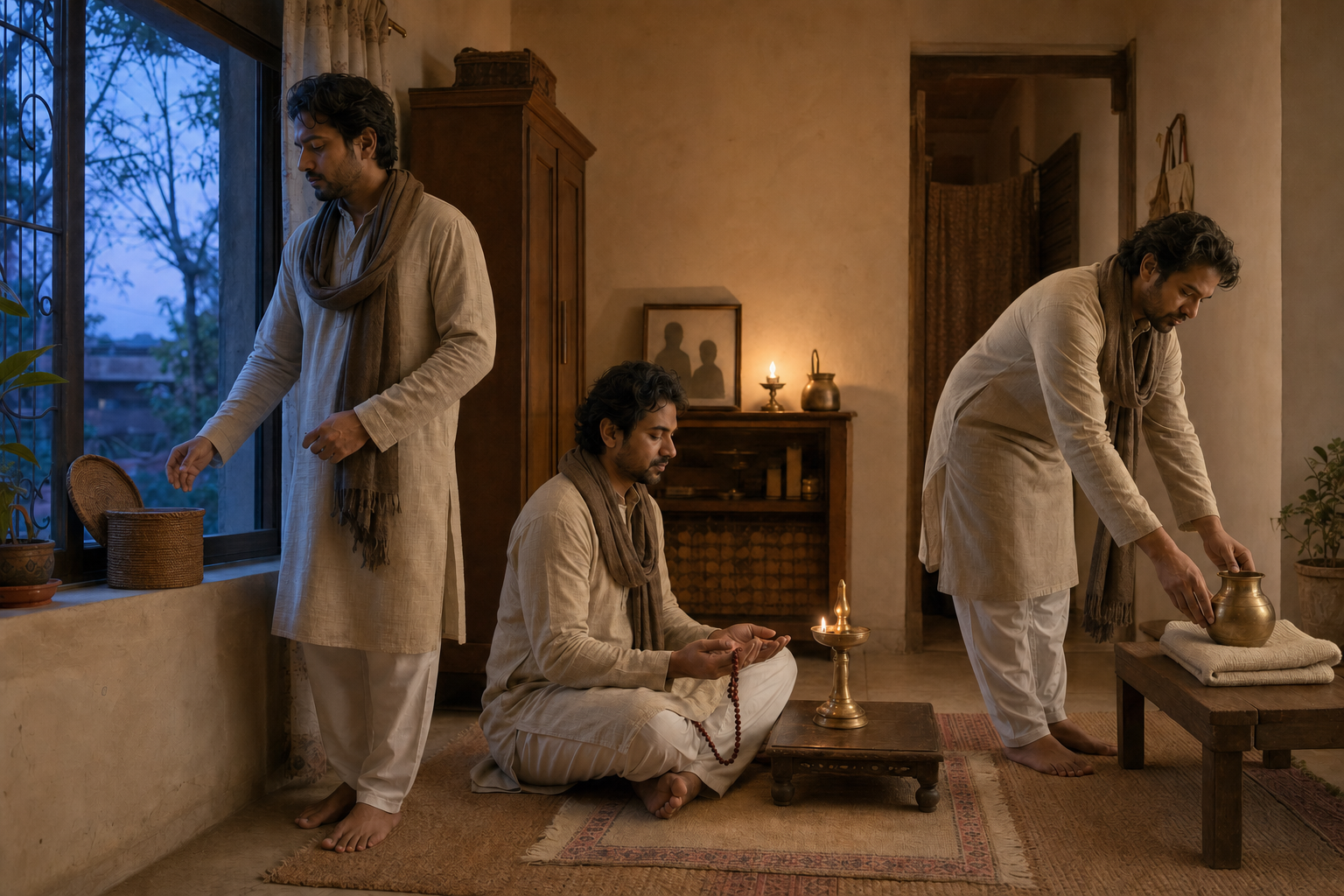
Renewal often fails because we begin with a vow before discovering what is driving the old behaviour. A better sequence is separation, remembrance, and return. Each movement corrects a different kind of disorder.
- Pause before you add. At dusk, end one stream of input before beginning your practice. Put the phone out of reach, close the news or entertainment feed, and let the room become quiet. Ask: What becomes obvious when I stop distracting myself?
- Remember for the sake of conduct. Bring to mind a teaching, sacred life, sacrifice, vow, or act of mercy from your own lineage. Then identify the virtue it demands from you now. Memory without a present obligation easily becomes nostalgia.
- Renew through a bounded action. Attach the virtue to something you can actually do. Truthfulness may require an honest reply you have delayed. Compassion may require food, attention, or practical help for someone. Restraint may require ending an argument instead of winning it. Complete the action before choosing a larger vow.
This sequence keeps introspection from becoming self-absorption. The pause reveals the disorder. Remembrance supplies a moral measure. The action carries spiritual insight back into the world.
Repeat the same sequence rather than searching for novelty each evening. Small and sincere observances gain strength through repetition. If the practice keeps changing, you may spend the season arranging spiritual tools without ever using one long enough to expose resistance.
Use a stable cue. Dusk, the lighting of a household lamp, the end of the evening meal, or the moment before sleep can become the threshold. A cue already present in your day is more dependable than waiting until you feel serene.
Stay rooted in your path without losing the shared horizon
Dharmic traditions share an ethical horizon, but they do not become interchangeable because they value discipline and compassion. A useful midwinter observance honours the form, vocabulary, and authority of your own path. Unity does not require a generic ritual stripped of lineage.
- In Hindu practice, japa can collect scattered attention, while dhyana allows the mind to become less reactive. Use a mantra and method grounded in your sampradaya, family tradition, or trusted instruction rather than assembling an improvised mixture.
- In Sikh practice, simran and reflective kirtan can join remembrance of the Divine with the ethical demands carried by Shaheedi. Let the memory of courage change conduct; do not reduce it to an inspirational background for private self-improvement.
- In Jain practice, samayik and pratikraman offer a disciplined frame for equanimity, review, acknowledgment, and correction. The practical question is not whether you can describe ahimsa beautifully, but where thought, word, or action departed from it and what repair is now possible.
- In Buddhist practice, attentive mindfulness and recollection of teaching or conduct can reveal craving, aversion, and habitual reaction without feeding them. Carry that awareness into the next encounter rather than treating meditation as an escape from encounter.
These practices differ in form while cultivating steadiness, clarity, compassion, and ethical resolve. That is the right level at which to speak of Dharmic kinship: shared moral work, accompanied by respect for genuine distinctions.
If your household includes more than one Dharmic tradition, share the container without forcing identical content. You may gather at the same time, keep silence together, hear a family story, and agree on an act of seva. Each person can then recite, meditate, or reflect according to their own lineage. Children learn unity more honestly when they see reverence across difference rather than difference being erased.
Build a household rhythm that survives ordinary life
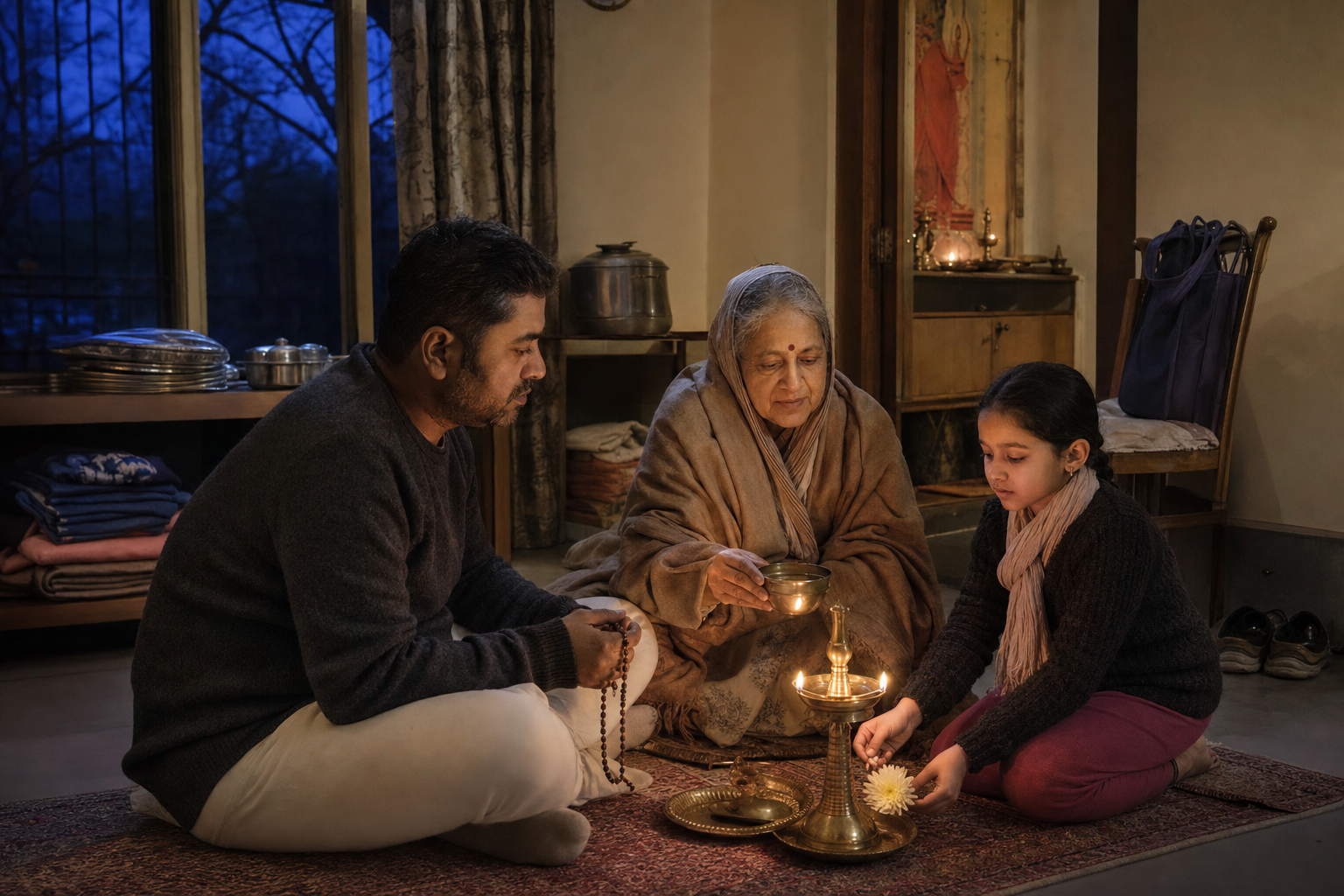
A practice that depends on an ideal evening will disappear on a working evening. Prepare the physical space before fatigue makes every decision feel negotiable. Put the prayer text, mala, or meditation seat where it will be used. If your household lights a lamp, place it safely and never leave the flame unattended. Move the phone away before the observance begins, not after it has already interrupted you.
A workable household rhythm can follow this order:
- Cross the threshold. Wash your hands and face, lower the room’s noise, and sit down without opening another stream of information.
- Enter your lineage practice. Recite, sing, meditate, read, or undertake ethical review in the form proper to your tradition.
- Ask one exact question. Where did fear, anger, pride, carelessness, or avoidance govern me today?
- Name the repair. Decide which apology, duty, act of restraint, or service follows from what you noticed.
- Close deliberately. End before tiredness turns the observance into irritation, and leave the space ready for its next use.
With children, use a sacred or family story and ask what courage, compassion, or truthfulness would look like at school or at home. With elders, invite a remembered observance or account of resilience, then listen without rushing to correct the telling. If you practise alone, write the required repair in one plain sentence and place it where tomorrow’s routine will bring it back to view.
Let seva keep the household practice from turning inward. Food support, practical help for a neighbour, or participation in a community clean-up can convert gratitude into shared welfare. Choose a task that is actually needed, and do not make its visibility the measure of its value.
On days of collective remembrance, allow the relevant gurdwara, temple, sangha, or Jain community to set the form of communal observance. Your private routine should prepare you to participate with attention and humility, not compete with the community’s memory.
Let the Panchang guide timing without postponing practice
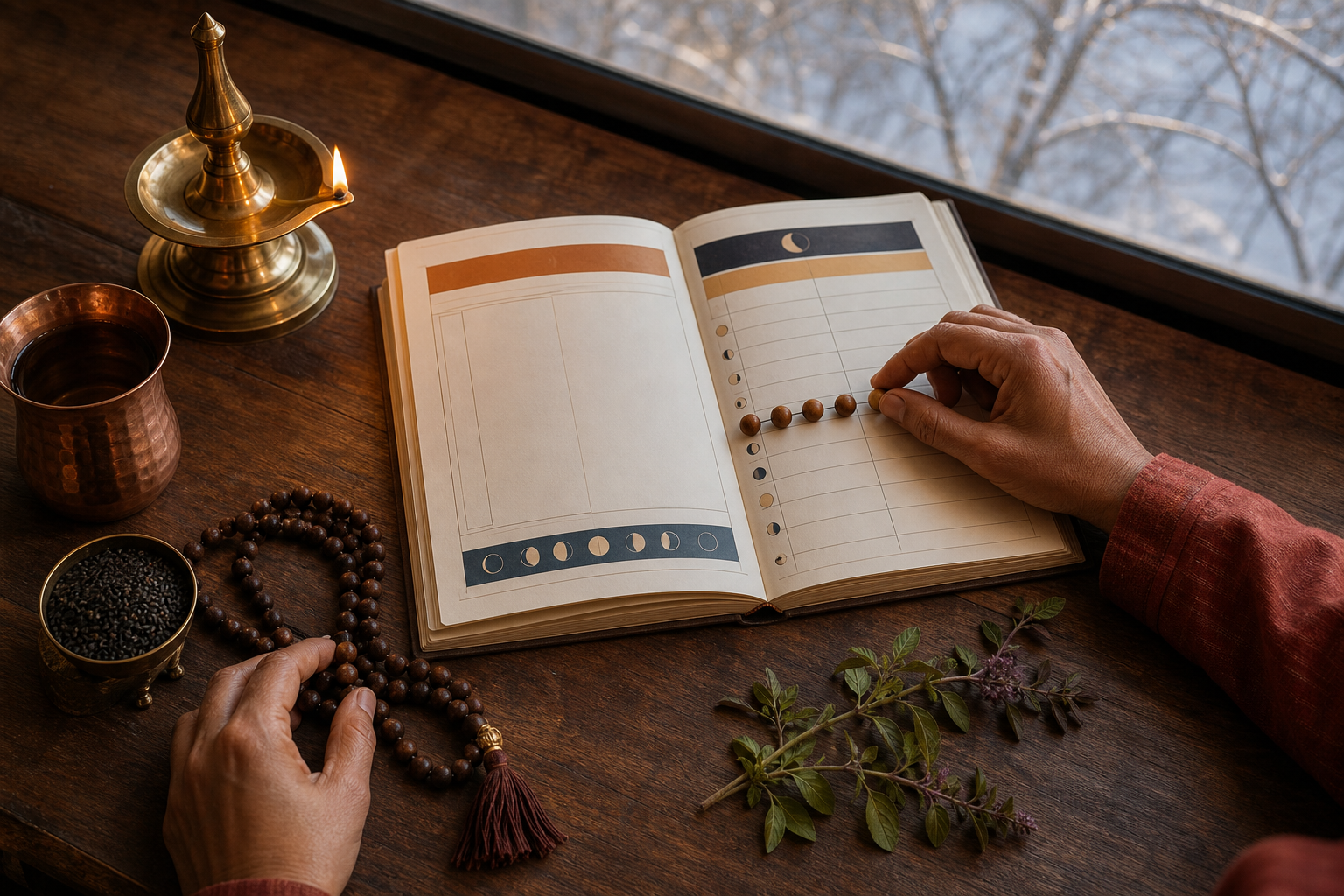
Midwinter sacred time contains several layers: the solar turn, lunar tithis, regional month names, lineage observances, and community commemorations. They should not be flattened into one universal date.
For a tithi-specific puja, Poush Purnima observance, sacred bathing practice, or temple programme, consult a local Panchang and the appropriate religious authority. Sunrise, location, Nakshatra, Rashi, and regional calculation affect precise timings. A timetable copied from another city may not apply where you live.
The waxing fortnight can provide a meaningful marker for renewal. Early Shukla Paksha is associated with gradual illumination, while Dwitiya can mark the movement from beginning an intention to stabilising it. If that rhythm belongs to your practice, use the relevant local calculation and treat the tithi as a point of rededication.
Do not turn auspicious timing into a reason for indefinite delay. Use the Panchang for observances whose form depends on the calendar. Use the community calendar for collective remembrance. Use a stable household cue for your continuing japa, simran, meditation, self-review, or ethical repair. Sacred timing should deepen practice, not replace it.
Key takeaways
- Begin midwinter renewal by removing an input, not by adding a catalogue of goals.
- Let remembrance produce a present duty; otherwise it remains nostalgia.
- Practise within your lineage while recognising the shared Dharmic work of clarity, restraint, compassion, courage, and service.
- Anchor the household observance to an existing evening cue so it can survive ordinary days.
- Consult a local Panchang for calendar-dependent rites, but do not wait for a muhurta to make an apology, fulfil a duty, or help someone.
Before the next dusk, decide what input you will stop, what memory you will honour, and what repair must follow. Prepare the place and the text in advance. As the daylight begins to lengthen after the solstice, judge the season by what has become steadier in you: attention that stays, speech that harms less, and service that no longer waits for the perfect moment.
References
- DharmaRenaissance Blog – Poh’s Quiet Fire: Separation, Remembrance, and Inner Awakening across Dharmic Paths
- DharmaRenaissance Blog – January 20, 2026 Panchang: Shukla Paksha Dwitiya Tithi, Timings and Auspicious Notes
