
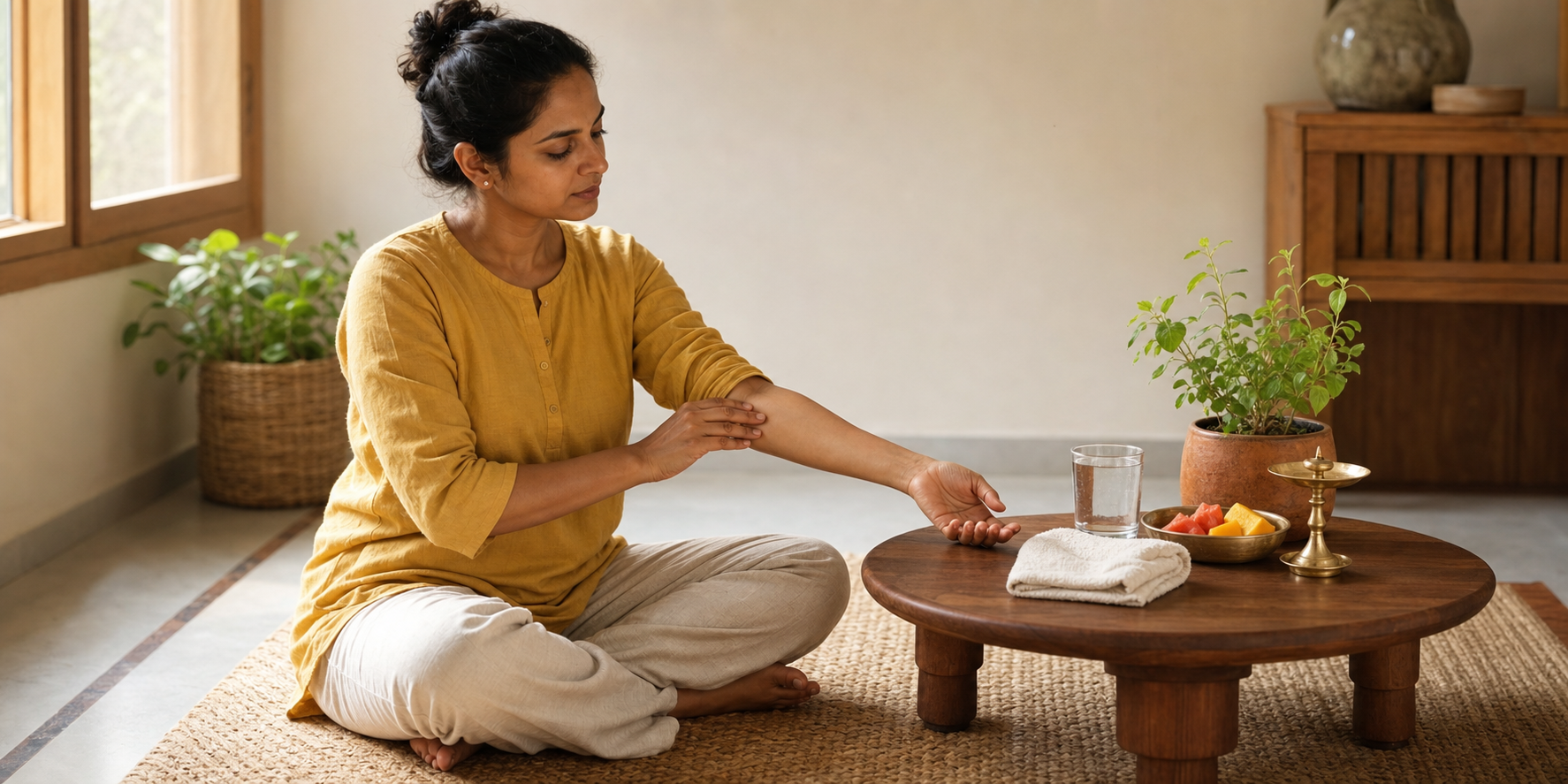
You may want relief from a stiff neck after screen time, a heavy head after a stressful day, or a familiar ache that appears when sleep and routine slip. The first decision is not which remedy to try. It is whether the discomfort is suitable for self-care at all.
For mild, familiar discomfort, gentle finger pressure, regulated breathing, movement, rest and a steadier daily rhythm can form a sensible traditional routine. The aim is modest: settle the body, notice its response and avoid turning a symbolic practice into a diagnosis.
Decide whether self-care is the right tool

Traditional care begins with attention, not bravado. Sudden numbness, dizziness, severe pain, a significant injury, or pain that is persistent or repeatedly returning warrants assessment by a qualified health professional. Finger pressure, mudra, mantra or breath practice must not delay that assessment.
Mild discomfort is a more appropriate setting for a cautious trial. Think of the stiffness that follows prolonged sitting, the tension that builds during concentrated work, or the restlessness that accompanies an unsettled evening. Even then, stop if the practice increases pain, produces unusual sensations or makes you feel unwell. Do not use temporary relief as permission to keep repeating the activity that provoked the problem.
Make one distinction before you begin:
- Relief means the discomfort eases while you rest, breathe or apply gentle pressure.
- Recovery means the underlying pattern also changes through sleep, movement, timely meals, workload adjustment or professional treatment.
A calming practice may help with the first without resolving the second. That is useful, provided you do not confuse the two.
Use finger pressure as a gentle body-awareness practice
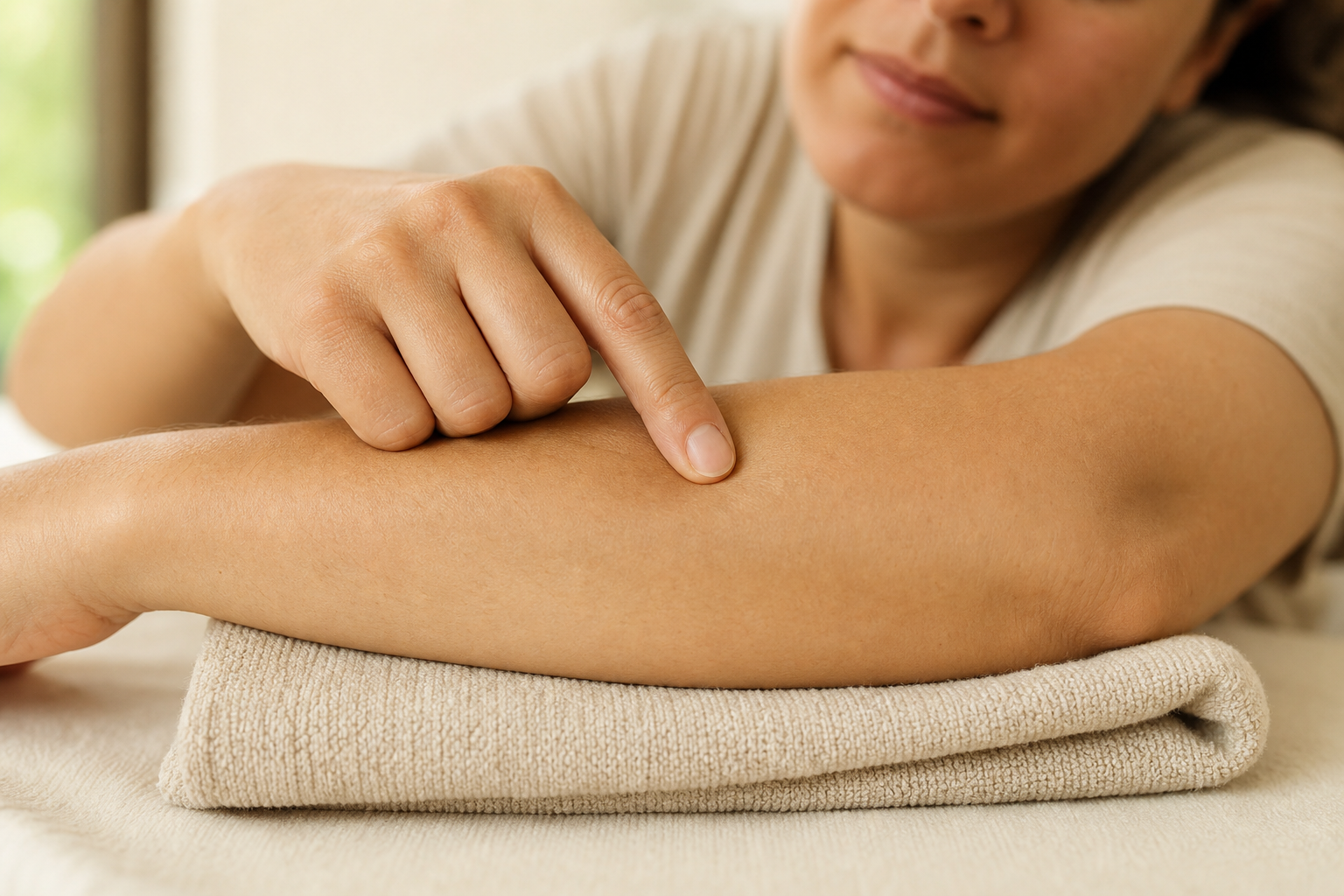
Finger-reflex traditions associate each finger with a different aspect of physical or emotional balance. These associations are symbolic prompts for self-observation, not anatomical pathways and not evidence that a particular organ is diseased. The practical value lies in combining gentle touch, unhurried breathing and focused attention.
| Finger | Traditional association | A reasonable occasion to try it |
|---|---|---|
| Thumb | Mental clarity and energy | Mental overload or a heavy, scattered feeling |
| Index finger | Breathing and the neck-shoulder region | Familiar stiffness after prolonged screen time |
| Middle finger | Tension and circulation | A general sense of bodily tension |
| Ring finger | Digestion and steadiness | Mild, familiar uneasiness around meals |
| Little finger | Emotional balance and the water element | Restlessness that feels emotionally charged |
Follow the same method whichever finger you choose:
- Sit in a supported position and let your shoulders soften. Notice where the discomfort is and whether it feels mild enough for self-care.
- Breathe through the nose. Let the inhalation take four to six counts and the exhalation six to eight counts. Keep the breath comfortable; the longer exhalation should not feel forced.
- Use the opposite hand to hold the selected finger. Apply light, steady pressure at its base and then at its pad.
- Stay at each area for 60 to 90 seconds. Repeat on the other hand so the practice remains balanced.
- Complete two to three cycles if the pressure remains comfortable. More force is not an improvement.
- Release your hands and reassess. Notice whether the discomfort, breath or mental agitation changed. If nothing changes, do not keep escalating the pressure.
For screen-related head heaviness or familiar shoulder tension, the thumb and index finger offer a simple starting point. For mild digestive uneasiness, the ring finger can become a cue to slow the breath and stop rushing the body. Neither choice identifies a cause. Persistent digestive symptoms, breathing difficulty or recurring pain belongs with an appropriate clinician, not a finger chart.
Keep Jyotisha in its proper place
Jyotisha can add a reflective layer to health practice, but it should come after the basic safety question, not before it. Graha associations describe tendencies and themes rather than certainties. A kundali cannot establish the medical cause of pain, fatigue, inflammation, disturbed sleep or metabolic change.
Used carefully, the framework turns a complaint into a question about conduct:
- Chandra and Budha themes: Restlessness, anxiety or disturbed sleep can prompt you to examine evening stimulation, irregular timing, mental overload and the absence of quiet pauses.
- Mangal themes: Heat, recurring inflammation or minor injuries can prompt you to notice haste and impulsive exertion. Recurring inflammation or injury still requires competent medical evaluation.
- Shani themes: Chronic strain and low vitality can prompt a review of overwork, inadequate recovery and unsustainable discipline. Persistent fatigue should not be reduced to a planetary explanation.
- Guru and Shukra themes: Nourishment, diet and endocrine irregularity can prompt greater attention to meals and daily rhythm. Suspected endocrine problems require clinical assessment.
This is the ethical boundary: use Jyotisha to ask better questions about routine, restraint and attention, while letting qualified healthcare determine what needs diagnosis or treatment. The most constructive traditional approach treats graha patterns as prompts for balance rather than verdicts about illness.
Be cautious with anyone who blames your suffering on moral failure, promises certainty from a chart, or asks you to replace necessary care with ritual. A Dharmic health practice should reduce fear and support responsible action. Fatalism does neither.
Build a daily rhythm that supports the relief practice
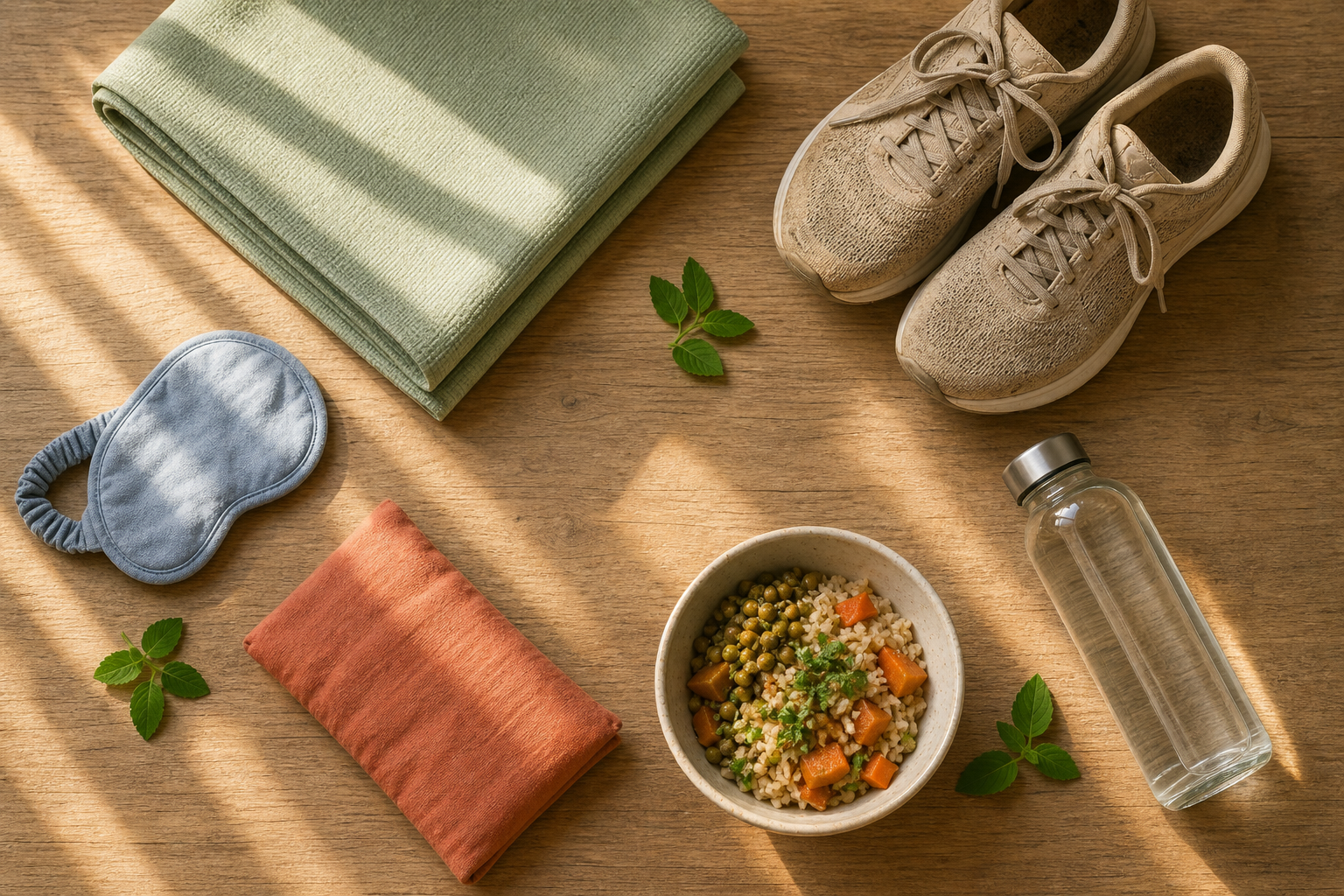
A pressure technique is easiest to overvalue when the rest of the day remains unchanged. If screen time repeatedly tightens your shoulders, a few minutes with the index finger may settle you, but the recurring pattern still asks for movement and breaks. If late stimulation disrupts sleep, evening japa cannot do all the work while the screen stays on until bedtime.
Use a simple day-long structure:
- Morning: Take in early light, sit briefly in quiet contemplation, and choose light stretching or a short walk. Begin gently instead of treating intensity as proof of discipline.
- Meals: Eat balanced, sattvic food at reasonably consistent times. If a food or eating pattern repeatedly causes discomfort, record the pattern and discuss persistent symptoms with a qualified professional rather than assigning them to a dosha or graha on your own.
- During work: Let bodily tension become a cue to pause. Soften your hands, lengthen the exhalation and move after prolonged sitting. A brief reset is more useful before stiffness becomes severe.
- Evening: Reduce screen stimulation, choose gentle chanting, reading or gratitude, and protect adequate sleep. The purpose is to make rest possible, not to perform a complicated ritual while exhausted.
Several Dharmic virtues make this routine more intelligent. Ahimsa means you do not force a joint, breath or pressure point. Abhyasa means you favour a sustainable practice over occasional intensity. Buddhist maitri and karuna bring a less combative attitude to discomfort. Jain anuvrata and aparigraha favour restraint and simplicity. Sikh seva and simran keep well-being connected to remembrance and service rather than self-absorption.
Mantra, japa, dhyana, pranayama, daan, seva and satsanga therefore have a meaningful role, but not as competing cures. They support steadiness, ethical conduct and the habits within which recovery becomes easier to pursue. Choose a small practice you can repeat without strain. Consistency is the relevant discipline.
Key takeaways
- Use traditional self-care for mild, familiar discomfort; seek medical help for severe or persistent pain, sudden numbness, dizziness, significant injury or other serious symptoms.
- Combine gentle finger pressure with comfortable nasal breathing. Use 60 to 90 seconds at each selected area, practise on both hands and stop if symptoms increase.
- Treat finger and graha associations as reflective maps, not medical diagnoses or proof of causation.
- Judge a practice by what it helps you notice and change: sleep, movement, meal timing, screen habits, workload and emotional steadiness.
- Keep ahimsa at the centre. More force, more repetitions and more complicated remedies are not automatically better.
Start with the next mild, familiar episode: pause, screen for warning signs, breathe comfortably and try one gentle practice. Then change the daily condition that keeps bringing the discomfort back. If the pattern persists, carry your observations to a qualified health professional; they are more useful there than a confident self-diagnosis.
References
- DharmaRenaissance Blog – Jyotish, rog aur upay: Grahon ke prabhav se samanya bimariyon ki vyavaharik samajh aur samadhan
- DharmaRenaissance Blog – Haath ki paanch ungliya: Powerful finger-reflex methods for natural pain relief and balance
