

If your child is questioned for wearing a tilak, or you are trying to bring Hindu texts into a university course, it is easy for the discussion to become a vague argument about whether religion belongs in education. That argument rarely resolves the actual problem.
You will make more progress when you identify the decision in front of the institution: accommodating a lived religious practice, correcting unequal treatment, or approving the academic study of a tradition. Each requires different evidence, language and remedies.
Identify the decision before making your case
Hindu identity enters educational life in more than one way. A tilak-chandlo worn after daily puja is a personal religious practice. A student losing responsibilities after wearing it is a question of treatment and welfare. A proposal to study the Bhagavad Gita is a curricular question. Combining these issues under a broad demand to “respect Hinduism” leaves an administrator unsure what action you want.
| Situation | Question the institution must answer | What you should provide | Useful outcome |
|---|---|---|---|
| A student wears a tilak, chandlo or another religious marker | Can the practice be accommodated under the applicable dress, uniform, safety and equality rules? | A concise explanation of the practice, how it is observed and the exact accommodation requested | Written permission, or a written explanation of the specific rule and any workable alternative |
| Questioning, monitoring, exclusion or loss of responsibilities follows | Was the student treated adversely or differently because of the Hindu practice? | A factual chronology, copies of communications, policy language and the change you want corrected | A welfare response, an explanation of decisions, restoration where appropriate and protection against recurrence |
| Students seek serious study of Hindu or dharmic traditions | Does the proposal meet academic, curricular and governance standards? | Learning outcomes, primary texts, teaching methods, translations, assessment design and safeguards for academic freedom | A peer-reviewed elective, reading seminar, pilot module or interdisciplinary course |
This distinction also protects the integrity of the Hindu position. A family requesting space for a devotional mark should not have to defend an entire political philosophy. A lecturer proposing a course should not present personal reverence as sufficient academic justification. Religious freedom and rigorous scholarship support each other, but they are not interchangeable.
Put a religious accommodation request in precise language

A school may know that a turban or cross can have religious significance while having little understanding of a tilak-chandlo. Do not assume that staff will recognize the practice, but do not turn a simple request into a theological examination either. Explain what the institution needs to know in order to make a fair decision.
Your written note should cover:
- The name of the practice and the student’s preferred terminology.
- Its religious significance to this student or family. Say whether it is part of daily worship, observance on particular days, a sampradaya tradition or another regular commitment.
- What the practice looks like in ordinary school life, including how often the mark is worn and whether it affects clothing, equipment or an activity.
- The exact accommodation requested. For example, ask for confirmation that the student may attend in uniform while wearing the tilak-chandlo.
- A request for the specific written rule if the institution believes there is a conflict, together with the identified safety, hygiene or operational concern.
- The name or role of the person who will make the decision and how the outcome will be communicated.
A usable message can be this direct: “Our child wears a tilak-chandlo as a regular Hindu devotional practice following worship. We request written confirmation that the practice is permitted during the school day. If the school believes that it conflicts with a policy, please identify the relevant clause, the concern it is intended to address, the decision-maker and any alternative the school proposes.” Add only the details that apply to your family.
The point is not to ask the institution to certify whether the student is Hindu enough. Hindu traditions are internally diverse, and the same marker may not be observed by every family. The relevant question is whether this is a sincere religious practice and whether the institution has a valid, consistently applied reason to restrict it.
The tilak-chandlo is a visible expression of Hindu devotion that may be worn in daily worship and community life. Describe it that way if that reflects the student’s practice. Avoid reducing it to costume, decoration or a festival accessory merely because those categories seem easier for a school to understand.
If you are in the United Kingdom, the Equality Act 2010 protects religion or belief, while Department for Education guidance expects schools to balance uniform requirements with inclusion and religious accommodation. That framework is relevant when a restriction is proposed, but it does not decide every individual case automatically. School type, policy wording and the facts of the treatment can matter. If a dispute may become a formal legal claim, obtain advice from a qualified legal professional or an appropriate religious-freedom organization rather than relying on a general guide.
When treatment changes, record conduct rather than guessing motive

A confused question from a teacher and a sustained pattern of adverse treatment are not the same thing. You do not need to label every misunderstanding as Hinduphobia. You also should not dismiss repeated questioning, unusual supervision, lost opportunities or pressure to remove a Hindu marker as harmless curiosity. Focus first on what happened and what changed.
In a London dispute involving an eight-year-old Hindu child, Insight UK alleged that staff repeatedly questioned the child, monitored the child during breaks and removed previously assigned responsibilities after the child regularly wore a tilak-chandlo. The parents reportedly tried to explain its religious significance, and the child ultimately transferred. The organization also alleged that similar problems had led at least four Hindu children to change schools. These remain allegations, but the pattern shows why families should document changes early instead of waiting until trust has collapsed.
Build a chronology that someone outside the dispute can understand:
- Record the date, setting, people present and words used as accurately as possible.
- Separate what you observed, what the student reported and what you infer. Do not merge them into a single claim.
- Save emails, messages, meeting notes and the version of the uniform, equality, conduct or safeguarding policy in force at the time.
- Note any change in supervision, classroom participation, responsibilities, clubs, awards or disciplinary treatment. Record the institution’s stated reason, if one was given.
- Write down the effect on the student, such as reluctance to attend, fear of being questioned or withdrawal from participation. Do not prompt the student to use legal or political language.
- Ask for a written outcome that addresses the practice, the disputed treatment and the steps intended to prevent repetition.
A meeting is more useful when it is organized around answerable questions. Ask which written rule applies, what concrete concern has been identified, whether comparable religious markers are handled through the same process, who authorized any increased monitoring, and what criteria governed the removal of a role or responsibility. If the school says the changes were unrelated to religion, ask for the neutral criteria and their consistent application.
Do not make the child repeatedly defend Hinduism before different members of staff. Ask the institution to designate a single contact, keep conversations age-appropriate and avoid public questioning in front of peers. The adult disagreement belongs with adults. The student’s task is to learn, not to act as counsel for an entire religious community.
Your requested remedy should be as concrete as your chronology. It may include written confirmation that the religious marker is allowed, an end to unnecessary questioning, an explanation or reversal of an adverse role change, a private welfare check, a consistent staff instruction and a clear route for reporting recurrence. If the first meeting does not resolve the matter, use the institution’s published complaint or review process and preserve each response. External mediation can sometimes restore communication before positions harden.
Where a child faces threats, physical interference with a religious marker, severe distress or another immediate welfare concern, use the institution’s safeguarding channel promptly. A policy dispute should never be allowed to obscure a child’s immediate safety.
Build Hindu studies around texts, methods and intellectual choice
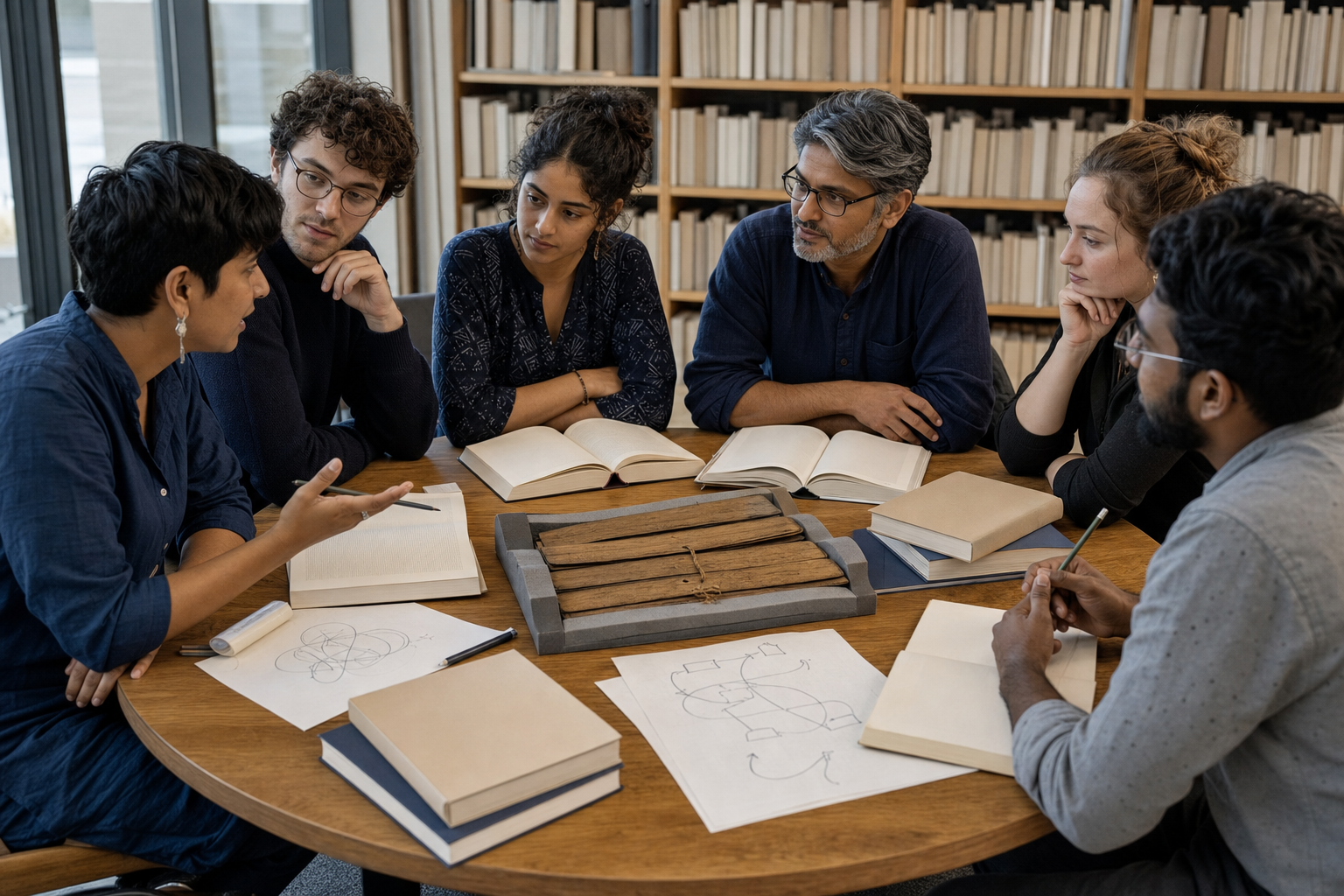
Visible identity is only one part of inclusion. Students can be permitted to wear a tilak while still encountering Hindu civilization only through festivals, stereotypes or fragments selected by others. Serious inclusion gives students access to the intellectual traditions themselves.
On 20 January 2026, a national conference at Lucknow University considered structured academic study of Hindu texts through electives, reading seminars and interdisciplinary courses. The proposals included the Upanishads, the Bhagavad Gita, classical Smriti literature and regional bhakti compositions, studied alongside Buddhist, Jain and Sikh writings. That model is useful because it joins civilizational confidence to recognizable academic standards.
If you are proposing a school or university course, submit a curricular design rather than a general request for more Hindu content:
- State the academic purpose. Suitable aims include textual interpretation, history of ideas, ethics, philosophy, aesthetics, legal thought, literature and the study of social institutions.
- Name the corpus. Identify primary texts, commentarial traditions and regional-language works instead of using “Hindu wisdom” as an undefined category.
- Explain the method. Include close reading, historical context, comparison of interpretations, attention to genre and careful distinction between a text’s claim and a student’s evaluation of it.
- Provide multilingual access. Use reliable translations while showing where an important Sanskrit or regional-language term cannot be reduced to a single English equivalent.
- Design assessments that test analysis rather than assent. A student should be able to earn full credit through accurate, well-supported criticism; no one should be graded on devotional belief.
- Use peer review and transparent learning outcomes. Bring together relevant expertise from philosophy, history, Sanskrit, regional languages, comparative literature, religious studies, law or the arts.
- Begin with an elective or pilot where institutional readiness is limited. Faculty workshops, digital reading lists and student research colloquia can build capacity around it.
Comparative study should clarify traditions, not dissolve them into a generic spirituality. Hindu, Buddhist, Jain and Sikh writings can be placed in dialogue around dharma, liberation, ethics, knowledge and disciplined practice while preserving their different authorities, vocabularies and conclusions. Shared civilizational origins do not require pretending that every tradition teaches the same doctrine.
The same discipline applies to the term Hindutva. If it appears in a course title or proposal, define how it is being used. A civilizational or cultural frame should be stated as a frame to be examined, not treated as an answer students must accept. Clear definitions, competing interpretations and evidence-based assessment prevent an academically serious proposal from becoming a loyalty test or a slogan.
Voluntary participation matters. A Hindu student should not have to abandon religious identity to be considered objective, and a non-Hindu student should not have to affirm Hindu belief to study a Hindu text. The classroom protects both students when it distinguishes learning about a tradition from being required to practise it.
Key takeaways
- Define the institutional decision: religious accommodation, unequal treatment and curricular approval require different cases.
- Describe a tilak-chandlo or other practice in the terms the student actually lives, then request a specific written accommodation.
- If treatment changes, document dates, words, decisions and effects before arguing about motive.
- Keep adult disputes away from the child as far as possible. Ask for one contact and age-appropriate, private communication.
- Request a concrete remedy: policy confirmation, an explanation of adverse decisions, restoration where appropriate and safeguards against recurrence.
- For curriculum reform, bring named primary texts, critical methods, reliable translations, transparent learning outcomes and non-confessional assessment.
- Use comparative dharmic study to illuminate both relationships and differences among Hindu, Buddhist, Jain and Sikh traditions.
- Seek qualified advice when a dispute creates legal exposure, and use safeguarding procedures immediately when a student’s welfare or safety is at risk.
Your next step should fit the problem you actually have. Send the precise accommodation request, turn the incident notes into a clean chronology, or reduce the curricular ambition to a credible elective proposal. Hindu identity becomes harder to marginalize when families and educators can express it with both civilizational confidence and institutional clarity.
References
- Hindu Human Rights – UK School Row Over Hindu Tilak-Chandlo: Disturbing Claims Force 8-Year-Old to Transfer
- Struggle for Hindu Existence – Lucknow University Conference on Hindutva Calls for Teaching Hindu Texts to Enrich Curriculum
