
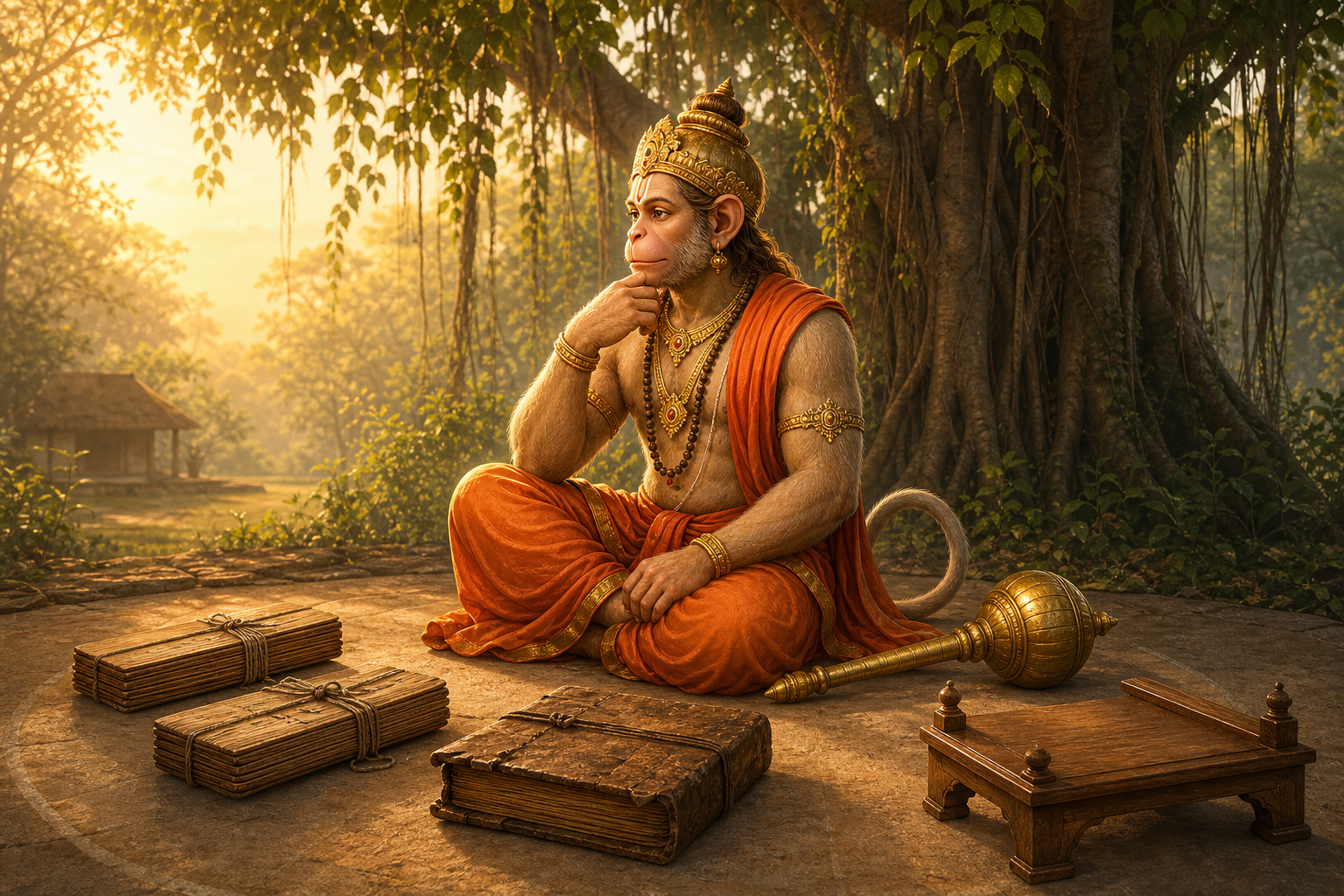
You have seen a confident list of Hanuman’s five brothers, perhaps accompanied by the assurance that their names come from scripture. You want to know whether you can repeat that claim in a class, a family discussion, or a devotional gathering without passing folklore off as textual fact.
The careful answer preserves both shraddha and accuracy. It asks not only whether a story exists, but where it exists, what kind of tradition carries it, and whether the relationship described is actually one of full biological brotherhood.
Key takeaways
- Neither the Valmiki Ramayana nor Ramcharitmanas identifies five biological brothers of Hanuman.
- Later narratives, regional kathas, local sacred traditions, and devotional interpretations may preserve additional family details, but they do not produce one universally accepted list.
- Hanuman’s identification as Vayu-putra does not by itself make every other figure associated with Vayu his full brother.
- Panchamukhi Hanuman is a five-faced devotional form, not evidence for five siblings.
- Unless a claim comes with a verifiable work, passage, and context, describe it as an unverified or tradition-specific account rather than an established scriptural genealogy.
The strongest answer is narrower than a simple yes or no
Hanuman is traditionally known as the son of Anjana and Kesari and as Vayu-putra. Yet the two Rama narratives most often invoked in this discussion contain no account of five brothers born to the same parents. They supply neither an agreed name-list nor a sibling episode that establishes the popular claim.
That absence matters, but it must be stated precisely. It permits you to say, ‘The five-brother claim is not attested in the Valmiki Ramayana or Ramcharitmanas.’ It does not permit the much larger claim that no Hindu community, later work, or regional Ramakatha has ever told such a story.
This distinction is basic textual discipline. Silence in a particular work is evidence about that work. It is not a universal denial of every narrative that developed around the character. In the other direction, the existence of a local katha does not insert its details retrospectively into the Valmiki Ramayana.
The word ‘brother’ also needs examination. A narrative can express biological kinship, affinity through a divine power, spiritual fraternity, companionship, or an honorific bond. Those are not interchangeable. If a claim specifically says ‘five full brothers,’ the passage must establish common parentage; a loose association with Vayu is insufficient.
Different layers of tradition answer different questions
Hindu tradition does not live in one undifferentiated shelf called ‘scripture.’ It includes Itihasa, devotional Ramakatha compositions, Puranic narration, sthala-purana, oral performance, commentary, and family memory. Each can carry religious meaning. Each also has a different evidentiary role when you are checking a historical or genealogical assertion.
| Traditional layer | What it can establish | How you should describe it |
|---|---|---|
| Valmiki Ramayana | Whether a detail occurs in the Valmiki narrative | ‘The Valmiki Ramayana states…’ followed by an exact passage |
| Ramcharitmanas | Whether the detail belongs to Tulsidas’s Rama narrative | ‘Ramcharitmanas presents…’ with the relevant kanda and passage |
| Later Puranic or devotional narrative | A teaching or genealogy preserved in that particular work | Name the work instead of saying only ‘the scriptures’ |
| Sthala-purana | A sacred account connected with a particular temple or place | Name the place and its local tradition |
| Regional or oral katha | A living community’s devotional memory and interpretation | Name the region, community, or storytelling lineage when known |
The table is not a ranking of spiritual worth. A temple tradition can shape generations of devotion even when its account is absent from an earlier epic. The point is accurate labeling. ‘This is told in a local tradition’ is a meaningful statement. ‘All the scriptures confirm this’ is not an acceptable substitute for a citation.
The lack of a stable list is therefore revealing. Popular and regional tellings circulate the five-brother idea without a universally agreed set of names. If different lists appear under the same sweeping claim, you should first suspect that several streams of narration have been merged. Do not manufacture harmony by choosing the list repeated most often online.
How to verify a list before teaching or sharing it
You do not need specialist training to test most viral claims. You need a repeatable sequence that forces the claim to become specific.
- Write down the exact assertion. ‘Hanuman had brothers,’ ‘Hanuman had five brothers,’ and ‘Anjana and Kesari had six sons’ are three different claims requiring different evidence.
- Ask for the grantha by name. ‘It is in the Puranas’ is not a usable reference because it does not identify a work.
- Ask for the internal location: kanda or section, chapter, and verse or comparable passage marker. If an edition is named, record that too.
- Read the passage around the alleged proof. A caption, forwarded image, modern retelling, or commentary may state more than the quoted lines establish.
- Check the relationship itself. Does the passage identify shared parents, use ‘brother’ in another sense, or merely associate several figures with the same divine principle?
- Classify the result honestly. Use ‘attested in this named work,’ ‘preserved in this regional tradition,’ or ‘repeated without a verifiable citation.’ These labels tell your listener exactly how much weight the evidence can carry.
If someone supplies only a list of names, you still do not have textual evidence. A claim becomes checkable when the cited passage can be located and read in context. Until then, ‘I have not verified this list’ is more accurate than either endorsing it or declaring every possible version false.
Be especially cautious when an argument jumps from Panchamukhi Hanuman to five brothers. Five faces describe a sacred form; five siblings describe a genealogy. A shared number does not establish a textual connection. The same rule applies to Vayu-putra: a theological relationship to Vayu cannot silently be converted into common human-style parentage.
Textual precision protects devotion rather than diminishing it
Some devotees hesitate to question an attractive katha because scrutiny can sound like disrespect. But you do not honor a local tradition by stripping away its name and falsely presenting it as the uniform testimony of every major text. Naming its actual home preserves the community, place, and devotional imagination that carried it.
Nor does Hanuman’s spiritual stature depend on discovering additional relatives. His enduring force lies in steadfast bhakti, selfless service, courage, and compassion. These qualities remain central whether a devotee encounters him through the Ramayana, the Hanuman Chalisa, Panchamukhi worship, a temple katha, or a regional performance.
In a satsang, you can say, ‘This account belongs to a particular local or later tradition,’ if that provenance is known. In a scripture class, use the narrower formulation: ‘The Valmiki Ramayana and Ramcharitmanas do not give Hanuman five biological brothers.’ If provenance is unknown, invite the exact citation before repeating the claim.
The next time a five-name graphic reaches you, ask one question before forwarding it: which grantha, which passage, and what words establish the kinship? If no answer follows, keep the story in the category it has actually earned. That small act of viveka allows affection for Hanuman and fidelity to the textual tradition to stand together.
References
