

You may have turned to Gautama Dharmasutra with a practical question: can an ancient account of dharma still help when conscience, family custom, social duty, and public rules point in different directions? It can, but only if you avoid two easy mistakes. One is treating every ancient rule as a timeless command. The other is dismissing the whole work because its social setting is not ours.
A better reading separates enduring virtues from historically situated institutions, then asks how personal discipline, legitimate custom, responsible authority, and fair procedure work together. That approach gives you something more useful than either literalism or rejection: a disciplined way to make decisions without reducing dharma to private preference.
First separate the kinds of instruction
Gautama Dharmasutra is generally dated between 600 and 400 BCE and is often regarded as the oldest surviving Dharmasutra. It belongs to an early layer of the Dharmashastra tradition and predates later compendia such as the Manusmriti. Its compact sutra form made rules and principles easier to remember, but that brevity also means modern readers must pay close attention to the kind of question each rule addresses.
The work brings together matters that modern life often places in separate compartments: ethical virtues, ritual observance, household responsibilities, marriage, inheritance, penance, adjudication, evidence, punishment, and the obligations attached to social position and stage of life. That breadth is important. Dharma here is not merely an inward spiritual feeling, and it is not equivalent to a modern statute book. It is an effort to connect character, conduct, institutions, and communal continuity.
Before applying a passage, identify which of four kinds of guidance you are reading:
- Ethical discipline: a virtue such as truthfulness, non-violence, generosity, or self-restraint that can guide conduct across many settings.
- Role-based duty: an obligation connected to a householder, ascetic, ruler, assembly, family member, or another social position.
- Ritual practice: a rule governing observance, purity, penance, or the maintenance of a particular religious discipline.
- Legal or social procedure: a method for evaluating testimony, settling disputes, assigning responsibility, or correcting misconduct.
This classification prevents a common misreading. A ritual distinction is not automatically a universal judgement about a person’s moral worth. A rule designed for an ancient institution is not automatically a present-day legal instruction. A virtue, meanwhile, should not be weakened merely because the social arrangement surrounding it has changed.
When you encounter a difficult rule, do not begin with, “How do we reproduce this?” Begin with, “What kind of rule is this, what responsibility was it organizing, and what ethical principle should govern that responsibility now?”
Let the ethical core govern the reading
The most portable teachings are also among the most demanding: ahiṁsā, satya, dāna, dama, and fidelity to vows and obligations. These are not decorative ideals placed above ordinary life. Each one changes how you should handle an actual choice.
- Ahiṁsā, non-violence: identify the harm created by every available option. Ask which harm is avoidable, who will bear it, and whether convenience is being mistaken for necessity.
- Satya, truthfulness: establish the material facts before defending a person, custom, or institution. Strategic omission can corrupt a decision even when every spoken sentence is technically true.
- Dāna, generosity: consider what you can give rather than merely what you may claim. Depending on the situation, that may mean resources, time, knowledge, patience, or access.
- Dama, self-restraint: do not let anger, appetite, status, or the desire to win choose your response. Restraint creates the interval in which judgement becomes possible.
- Fidelity to obligations: keep a promise when it remains righteous and possible. When you cannot, acknowledge the breach directly, limit the resulting harm, and make repair rather than inventing an excuse.
These virtues also help explain the family resemblance among Dharmic traditions without pretending that their philosophies are identical. Buddhist compassion and mindful discipline, Jain ahiṁsā and aparigraha, and Sikh truthful living and seva meet Hindu ethical thought at important points of conduct. Shared virtues can support cooperation even where doctrines, practices, and religious identities remain distinct.
If you are organizing a Hindu, Buddhist, Jain, and Sikh initiative, start with a concrete ethical commitment rather than a claim that all traditions are the same. Agree on truthful communication, restraint in disagreement, avoidance of needless harm, transparent use of resources, and service to the community. Unity built around conduct can respect real differences; unity built on flattening those differences usually cannot.
Social order begins with responsibility, not privilege
Rules connected with varṇa and āśrama are among the hardest parts of Gautama Dharmasutra for a modern reader. They belong to an ancient social world in which responsibilities were organized through inherited classifications and stages of life. It is neither honest to conceal that setting nor sound to declare every feature of it eternally binding.
The durable insight is that a functioning society cannot be built from personal preference alone. Householders, ascetics, rulers, assemblies, and communities have different responsibilities because their choices affect different people. The mistake is to turn differentiated responsibility into permanent moral superiority. The constructive question is not, “Where do I rank?” It is, “What do I owe because of the role, trust, and power I presently hold?”
You can make that question concrete with a simple duty ledger. For any disputed decision, write down:
- Your role: parent, teacher, employer, office-holder, caregiver, volunteer, trustee, or community member.
- Your actual power: what you can decide, withhold, disclose, fund, delay, or influence.
- Your corresponding duty: the protection, fairness, truthfulness, competence, or care that this power requires.
- The person carrying the cost: who suffers if you act carelessly, remain silent, or protect your own standing.
This reverses the usual temptation of status. Greater authority should create a greater burden of explanation and care, not a larger exemption from ethical scrutiny. That is especially relevant to religious and community leadership. Invoking dharma cannot excuse secrecy, arbitrary treatment, or the transfer of every sacrifice to people with less power.
The same discipline applies to āśrama, the ordering of life through stages and corresponding duties. The practical lesson is not that every person’s life must follow one inflexible social script. It is that duties change with commitments and circumstances. A person responsible for dependants cannot evaluate withdrawal in exactly the same way as someone without those obligations. Spiritual aspiration becomes dharmic when it faces existing responsibilities rather than using transcendence to evade them.
Custom has authority, but it must remain answerable to dharma
Gautama’s framework recognizes more than one source of dharma. Śruti, remembered tradition or smṛti, and established practice or ācāra all contribute to the formation of norms. This plurality matters because life cannot be governed by abstract rules alone. Communities inherit working knowledge through observances, relationships, and institutions.
Yet respect for ācāra is not permission to defend any practice merely because it is old. Custom carries a presumption of accumulated meaning, not immunity from ethical examination. A custom that disciplines appetite, preserves memory, distributes responsibility, or sustains worship may deserve careful protection. A custom used to conceal harm, compel dishonesty, or shield the powerful conflicts with the very virtues that make social order worth preserving.
When a family or community practice is contested, test it in this order:
- Name its purpose. Ask what good the practice was meant to protect. “We have always done it” describes continuity but does not identify purpose.
- Examine its present effects. Identify who participates freely, who bears the cost, and whether the practice still produces its intended good.
- Test it against the ethical core. Look directly at truthfulness, avoidable harm, restraint, generosity, and fulfilled obligations.
- Distinguish preservation from adaptation. Some purposes require the existing form; others can survive through a form better suited to present circumstances.
- Keep the decision accountable. A community should be able to explain why a practice is retained, reformed, or discontinued without relying on intimidation.
This method avoids two extremes. It does not make novelty the measure of moral progress, and it does not make age the measure of righteousness. It treats tradition as living responsibility: something received with gratitude, understood with care, and transmitted without refusing moral judgement.
Fair procedure turns moral conviction into justice
Good intentions do not by themselves produce a just outcome. Gautama Dharmasutra’s treatment of testimony, oaths, burdens of proof, assemblies, intent, harm, and proportionate correction recognizes that social trust depends on procedure as well as virtue.
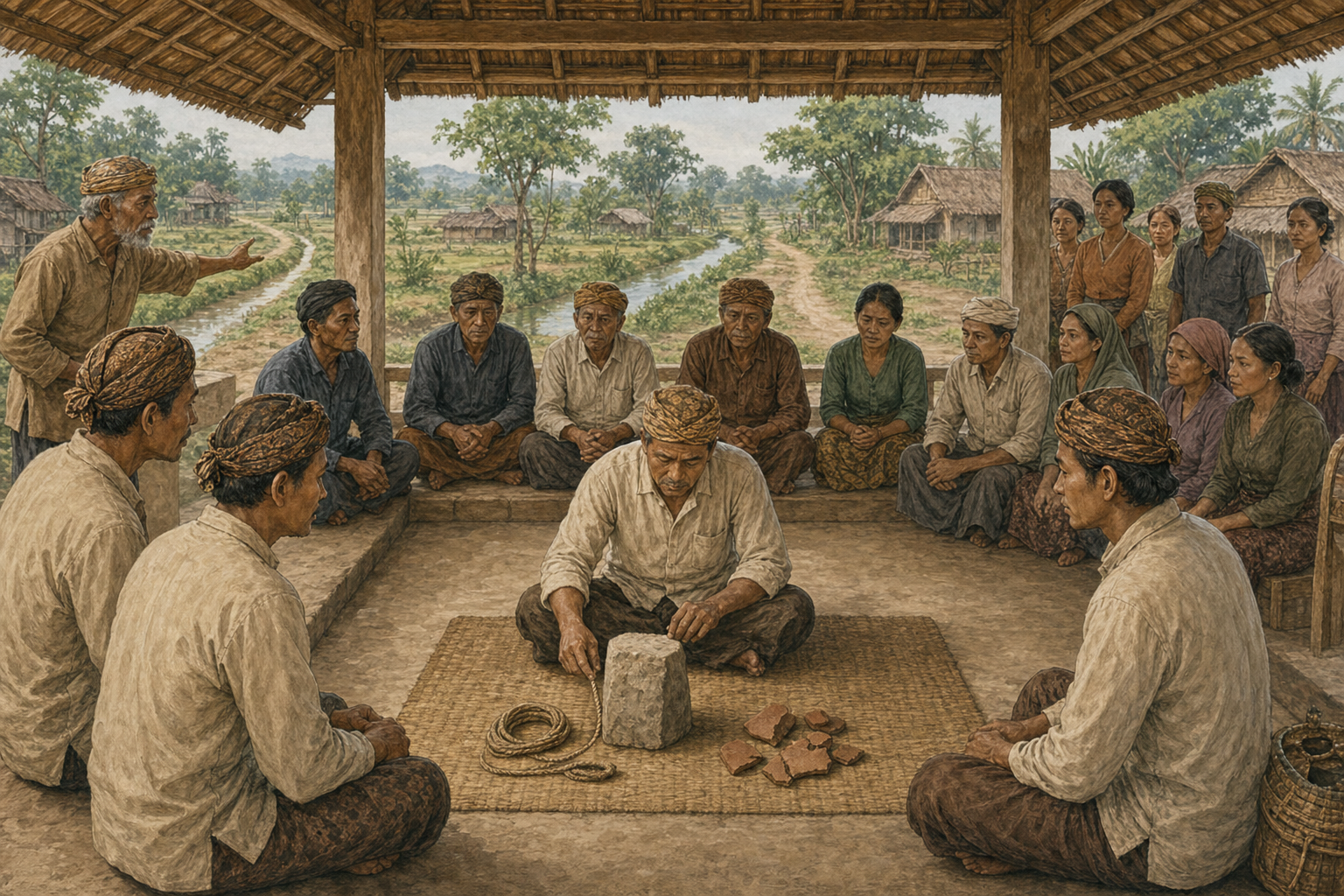
This is where the work becomes particularly useful for families, temples, associations, and cultural organizations. When an accusation or breach arises, moral urgency can tempt a group either to punish on rumor or to suppress the matter for the sake of appearances. Both responses damage trust. Use a procedure that makes truth and accountability possible:
- State the allegation precisely. Replace vague claims about character with the specific act, omission, promise, or rule in question.
- Separate knowledge from repetition. Record what each person directly knows, what evidence exists, and what has merely been heard from someone else.
- Allow a meaningful response. The person accused must know the substance of the claim and have an opportunity to answer it.
- Assess intent and harm separately. Deliberate wrongdoing, careless conduct, and an unavoidable mistake may cause similar effects but do not call for identical judgements.
- Choose a proportionate remedy. Consider protection, restitution, correction, changed responsibilities, and prevention of recurrence. Public humiliation is not a substitute for repair.
- Review the institution’s part. Ask whether unclear duties, concentrated power, or the absence of oversight allowed the problem to grow.
This procedure is an ethical discipline in its own right. Satya requires evidence. Ahiṁsā restrains reckless accusation and needless punishment. Dama prevents anger from becoming the judge. Accountability protects the community without treating correction as vengeance.
Ancient jurisprudence should not replace the law that governs a present dispute. Allegations involving violence, abuse, employment rights, property, inheritance, or criminal conduct may require current legal authorities and qualified professional advice. A private religious process must never be used to obstruct lawful reporting, deny someone’s rights, or place a person in further danger.
Use a five-question dharma test before you act
You do not need to resolve every historical controversy before Gautama’s ethical method becomes useful. Take one decision currently in front of you and answer five questions in writing:
- What is true? List established facts, unresolved claims, and assumptions separately.
- What harm is avoidable? Include harm caused by delay, silence, exclusion, or failure to keep a commitment.
- What does my role require? Identify the duty created by your power and relationship, not merely the outcome you prefer.
- Which custom is relevant? Determine what inherited practice protects, then test its present operation against the ethical core and applicable law.
- What response restores order? Choose a proportionate action that protects people, corrects the wrong, and reduces the chance of recurrence.
Suppose a family custom conflicts with a member’s conscientious objection. The dharmic response is not automatic submission or automatic abandonment. Establish what the custom means, hear the objection truthfully, identify actual rather than imagined harms, examine the duties held by each person, and ask whether adaptation can preserve the practice’s legitimate purpose. Coercion may secure outward conformity while destroying the trust the custom was meant to sustain.
Suppose a community leader is accused of misconduct. Loyalty to the institution does not require suppressing facts, while ahiṁsā does not permit judgement by rumor. The right response is a fair inquiry, protection against further harm, an opportunity to answer, and a remedy proportionate to what can be established. In this setting, procedure is not a distraction from dharma. It is one of the ways dharma becomes visible.
Key takeaways
- Classify a teaching as ethical, role-based, ritual, or procedural before applying it.
- Use ahiṁsā, satya, dāna, dama, and fidelity to obligations as the controlling ethical questions.
- Translate social position into responsibility rather than inherited moral superiority.
- Respect ācāra by understanding its purpose, then test its present effects against dharma.
- Require evidence, a fair hearing, attention to intent and harm, and a proportionate remedy when resolving disputes.
Choose one live obligation this week and write down your answers to the five-question test before speaking or acting. That small pause turns dharma from a slogan into a practice: truth before self-protection, duty before status, and restoration before retaliation.


References
