
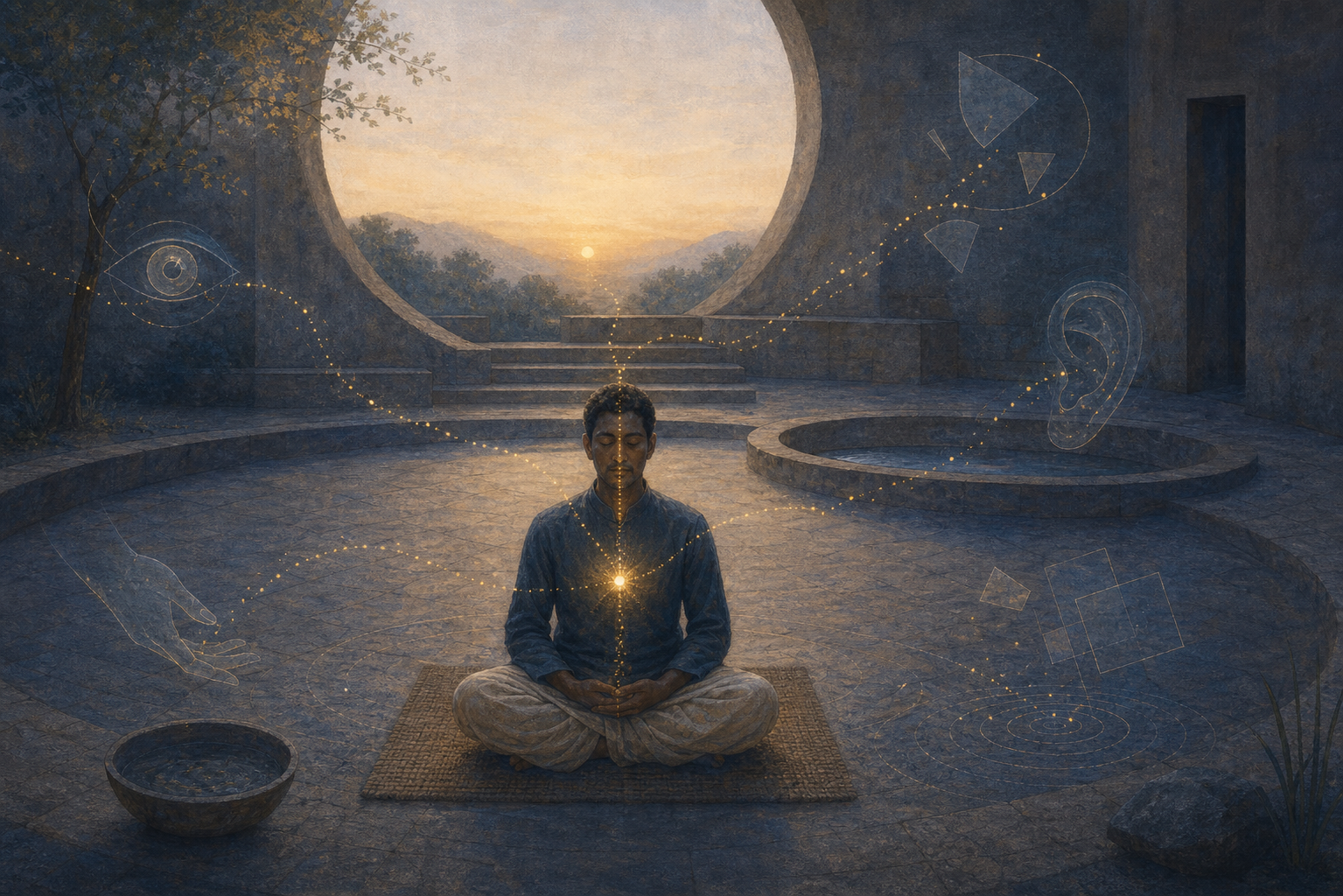
If your meditation moves between witnessing the mind and remembering the Divine within, you may wonder whether Tantra and Bhagavata theology are describing the same consciousness. They are not interchangeable. Treating them as synonyms hides the practical strength of each.
The Bhagavata map helps you distinguish conscious presence from the senses, mind, intelligence and ego. The Tantric map considered here shows how scattered attention and vital power can be gathered into an integrated current. Used carefully, these teachings help you notice who is directing your faculties, what is fragmenting them and whether your inner practice is changing your conduct.
The first distinction: an instrument is not conscious presence
Much confusion begins because the word consciousness is made to carry several meanings at once. It can refer to wakefulness, attention, mental activity, self-awareness or the divine ground of embodied life. Tantric and Bhagavata language becomes clearer when you stop moving casually among those meanings.
When you encounter a claim about consciousness, ask what the word denotes in that sentence:
- A faculty: seeing, hearing, remembering, imagining or deciding.
- A state of attention: distracted, concentrated, contemplative or absorbed.
- A sense of ownership: the movement that says, this is happening to me or I am doing this.
- An enlivening presence: that by which the faculties can function as parts of a living whole.
- Supreme consciousness: the ultimate spiritual reality rather than a passing condition of the mind.
These meanings are related, but they are not identical. Eyes participate in seeing, yet an eye is not the whole of awareness. Manas coordinates impressions, but coordination is not the final ground of experience. Ahankara appropriates an experience as mine, but ownership is not proof that the ego produced consciousness.
This distinction gives you a useful rule for practice: do not call every mental event consciousness. Name the faculty that is active. Once sensation, attention, interpretation and appropriation are distinguished, you can investigate what integrates them instead of letting ahankara claim the entire process.
The Bhagavata map: a complete apparatus can still be inert
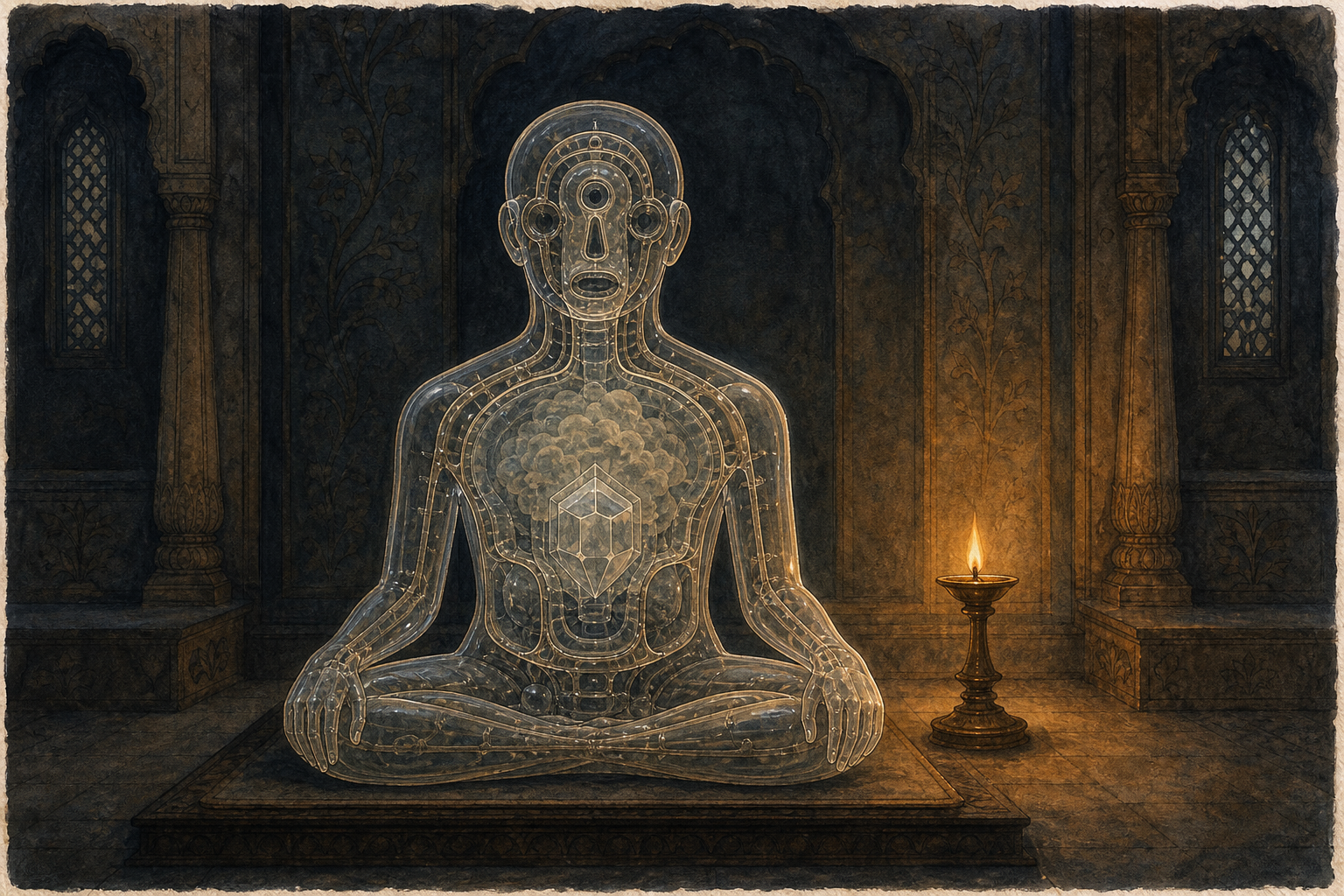
The cosmic body of the Virat Purusha provides a precise way to separate function from the source of life. In Srimad Bhagavatam 3.26.62-71, the presiding powers of the faculties enter the cosmic form in sequence. Speech, smell, sight, hearing and touch take their places. So do procreation, excretion, movement, circulation and hunger. Manas, buddhi and ahankara are present as well. The form nevertheless remains dormant until Paramatma enters.
The point is not that the faculties are useless. Every one has a proper role. The point is hierarchical: a collection of functions does not explain the conscious unity in which those functions cooperate. In Bhagavata thought, Paramatma is the inner controller and enlivening ground, not another faculty added to the list.
You can apply that hierarchy whenever a strong perception or emotion takes command. Instead of saying, I am angry or I am overwhelmed, examine the sequence more carefully:
- What did the senses actually receive?
- What did manas select, repeat or combine?
- What conclusion did buddhi draw?
- What identity or possession did ahankara attach to it?
- What is aware of this entire movement?
The questions create room between awareness and its instruments. They also expose a common mistake: a loud thought is not necessarily an intelligent one, and an urgent impulse is not automatically a command from the deepest self.
There is an equally important theological limit. Paramatma should not be reduced to your ability to pay attention. Attention fluctuates; the Supersoul is presented as the inward ground upon which the embodied system depends. Concentration may make the instruments orderly and receptive, but it does not manufacture the Divine presence.
For a Bhagavata practitioner, this changes the mood of self-mastery. You still discipline speech, thought and action, but you do not enthrone the disciplined mind as sovereign. The faculties become cooperative instruments, and remembrance of Paramatma restores their proper orientation.
The Tantric map: gather power without worshipping intensity
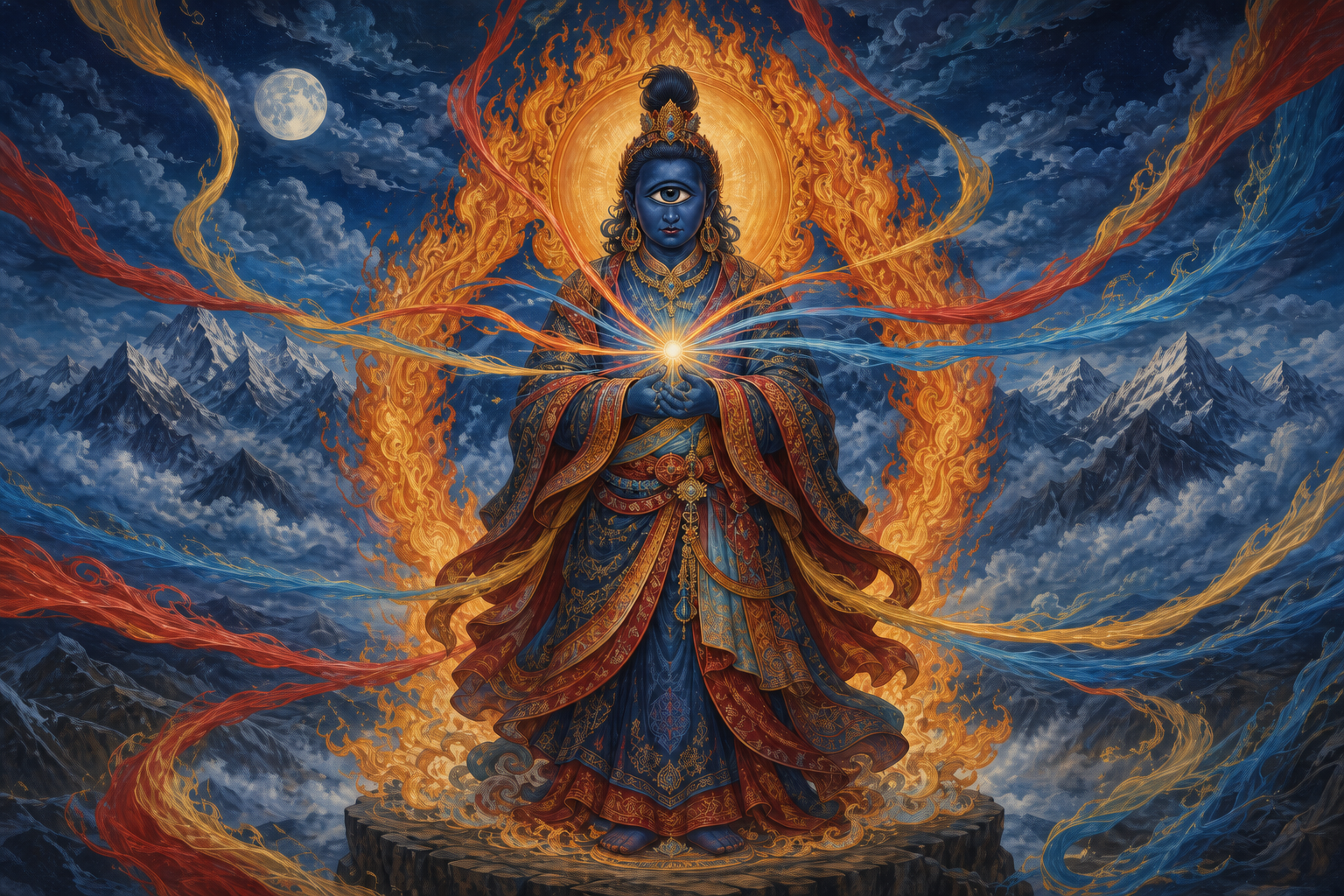
Tantric practice approaches fragmentation through the disciplined collection of Shakti. Ekajata makes that principle visible. Her name means single-plaited, and her defining single braid condenses vitality, tapas and Shakti into an image of ekagrata, or one-pointedness. Many strands remain real as strands, but they cease pulling in unrelated directions.
This is more exact than the usual advice to focus. Scatteredness is not always an absence of energy. It is often energy divided among sensory attraction, remembered conversations, imagined futures, competing duties and self-protective reactions. The Tantric response is to gather those movements around a worthy center rather than merely suppress them.
The traditional subtle-body image deepens the lesson. Ida and pingala are harmonized into the central movement of sushumna, supporting steady awareness and the ascent of Kundalini. This language is best approached as a Tantric map of practice, not casually converted into a claim about gross physical anatomy. Its practical question is direct: are breath, mantra and attention moving together, or is each being pulled by a different intention?
Ekajata’s protective character adds a part of concentration that is easily neglected. A sacred practice needs boundaries. If every notification, appetite, argument and passing curiosity receives equal access to your attention, one-pointedness never acquires continuity. Protection here is not withdrawal from duty. It is the refusal to let what is trivial repeatedly displace what you have recognized as sacred.
That protection must remain joined to compassion. Forceful concentration can become another form of fragmentation when one part of the personality attacks the rest. The single braid points toward disciplined integration, not hostility toward the senses or the body. A gathered mind is firm enough to return and gentle enough not to turn every distraction into a moral failure.
Intensity alone is therefore a poor measure of Tantric maturity. Unusual sensations, forceful emotion or a dramatic inner image may command attention without integrating the person. A more reliable test is whether thought, speech and action begin to move in the same ethical direction. If meditation feels powerful while conduct remains deceptive, cruel or chronically scattered, the strands have not yet been braided where it matters.
Where the two maps meet, and where they remain distinct
Both maps deny sovereignty to the ordinary stream of impulses. Both also demand integration. Yet they correct different errors, and you lose clarity if you flatten their terms into a single doctrine.
| Question | Ekajata-centered Tantric lens | Bhagavata lens | What to notice in practice |
|---|---|---|---|
| What appears fragmented? | Vitality, breath and attention move in competing directions. | Senses, mind, intelligence and ego operate as distinguishable faculties. | Name the active movement instead of calling all of it consciousness. |
| What establishes order? | Ekagrata gathers the strands into a directed current. | Paramatma enlivens and grounds the functioning whole. | Focus can organize your faculties without becoming their ultimate source. |
| What is the spiritual mood? | Concentrated Shakti, protected practice and movement toward non-dual awareness. | Dependence on and inward orientation toward the Supersoul. | Integration and surrender address different forms of egoic disorder. |
| What is the common failure? | Mistaking intensity, secrecy or sensation for realization. | Mistaking the senses, mind or ahankara for the conscious ground. | Watch how quickly ego converts either insight into a claim of superiority. |
The Tantric side of this comparison is deliberately specific. Tantra contains diverse schools and vocabularies; the emphasis here comes from Ekajata’s concentrated iconography and its subtle-body interpretation. The Bhagavata side is equally specific in locating the awakening principle in Paramatma. Respecting those contours is more fruitful than declaring that Shakti, attention, the individual self and the Supersoul are merely different words for one undefined thing.
The maps can nevertheless be held in a disciplined relationship. Tantra asks how your divided powers can become a coherent vehicle of awakening. Bhagavata thought asks why even a fully furnished vehicle cannot be its own enlivening ground. One corrects dispersion; the other corrects self-sufficiency.
Key takeaways
- Consciousness should not be used as a vague synonym for sensation, thought, attention or ego.
- The Bhagavata hierarchy treats the faculties as necessary instruments while locating their enlivening ground in Paramatma.
- Ekajata’s single braid presents concentration as the integration of Shakti, not the destruction of vitality.
- Ekagrata can prepare and steady the mind, but concentration by itself is not proof of realization.
- The practical test of integration is increasing coherence among attention, speech, choice and conduct.
A practice for turning the distinction into conduct
You do not need to merge two theological systems to learn from both. Use the following sequence within the commitments of your own sampradaya. If a mantra or visualization in your lineage requires formal instruction, work only with a practice you have actually received.
- Begin with the instrument. Notice the most prominent sensory or mental event. Identify it plainly as hearing, seeing, remembering, anticipating, judging or desiring. This interrupts the habit of turning every event into a total statement about who you are.
- Observe appropriation. Watch for the moment ahankara adds mine, for me, against me or because of me. Do not fight that movement. See it as another function appearing within awareness rather than the unquestioned owner of awareness.
- Gather the current. Bring breath, attention and your established sacred focus into one movement. If mantra belongs to your practice, listen inwardly to the mantra instead of repeating it mechanically while the mind pursues another story. When attention wanders, return without aggression.
- Restore right relation. A Tantric practitioner may recollect the gathered power as Shakti moving toward integration. A Bhagavata practitioner may remember that the faculties depend upon Paramatma, the inner controller. If you draw from both streams, preserve the distinction instead of forcing a verbal equation.
- Give the insight an ethical outlet. Before leaving the practice, identify the next piece of speech or action that needs alignment. It may require restraint, a truthful answer, completion of a neglected duty or a compassionate boundary. Let concentrated attention govern that concrete choice.
Look for maturation in ordinary situations. A sense impression may still arise strongly, but it no longer has to become an immediate command. Buddhi gets room to discern. Ahankara is easier to recognize before it claims possession. Speech becomes less divided from inward conviction. These changes matter more than whether a sitting felt dramatic.
Also watch for spiritual ego. If concentration makes you contemptuous of distracted people, compassion has been severed from discipline. If remembrance of Paramatma becomes an excuse for passivity, the faculties are not being used as responsible instruments. If subtle-body language becomes a claim of physical certainty or personal rank, a contemplative map has been turned into self-advertisement.
At your next interruption, pause before following it. Name the faculty that has been captured, notice the claim of ahankara, gather attention around your sacred center and choose the next action deliberately. That small return is where a philosophy of consciousness begins to become sadhana.

References
- DharmaRenaissance Blog – Ekajata’s Single Braid: Powerful Symbolism of Focus, Protection, and Supreme Consciousness
- DharmaRenaissance Blog – Virat Purusha Awakens: Srimad Bhagavatam 3.26 Reveals the Power of the Supersoul
