
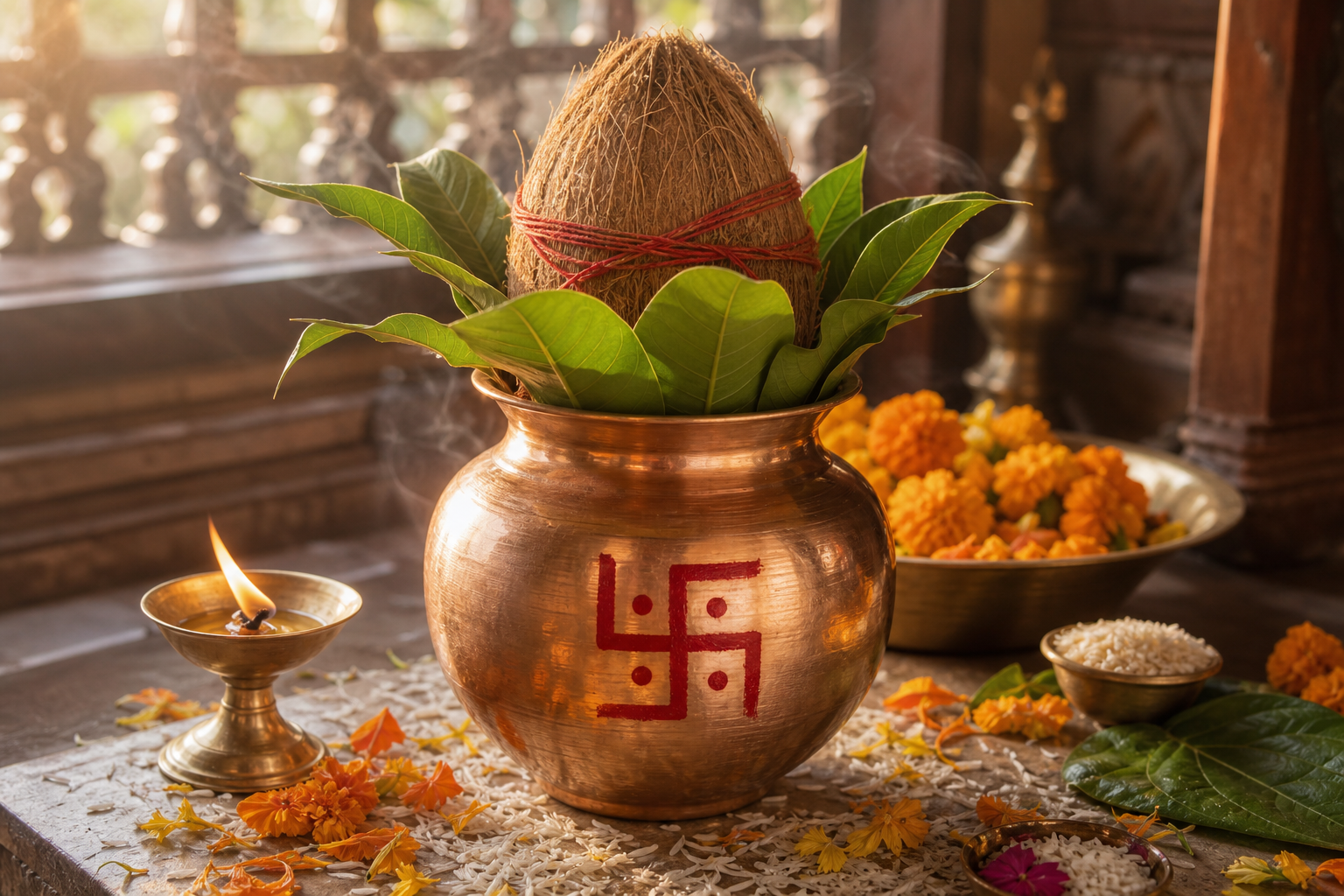
You are preparing a Kalash for Griha Pravesha, Navaratri, a wedding, or a family puja. Then someone asks the question that turns a familiar ritual object into a difficult conversation: why is there a Swastika on the vessel?
The clearest answer begins with the two symbols together. The Swastika establishes auspicious order around the Kalash; the Kalash gathers and sustains life within that order. Once you understand that relationship, you can prepare the arrangement more thoughtfully, explain it without defensiveness, and carry its meaning beyond the ceremony.
Read the Swastika and Kalash as one sacred composition
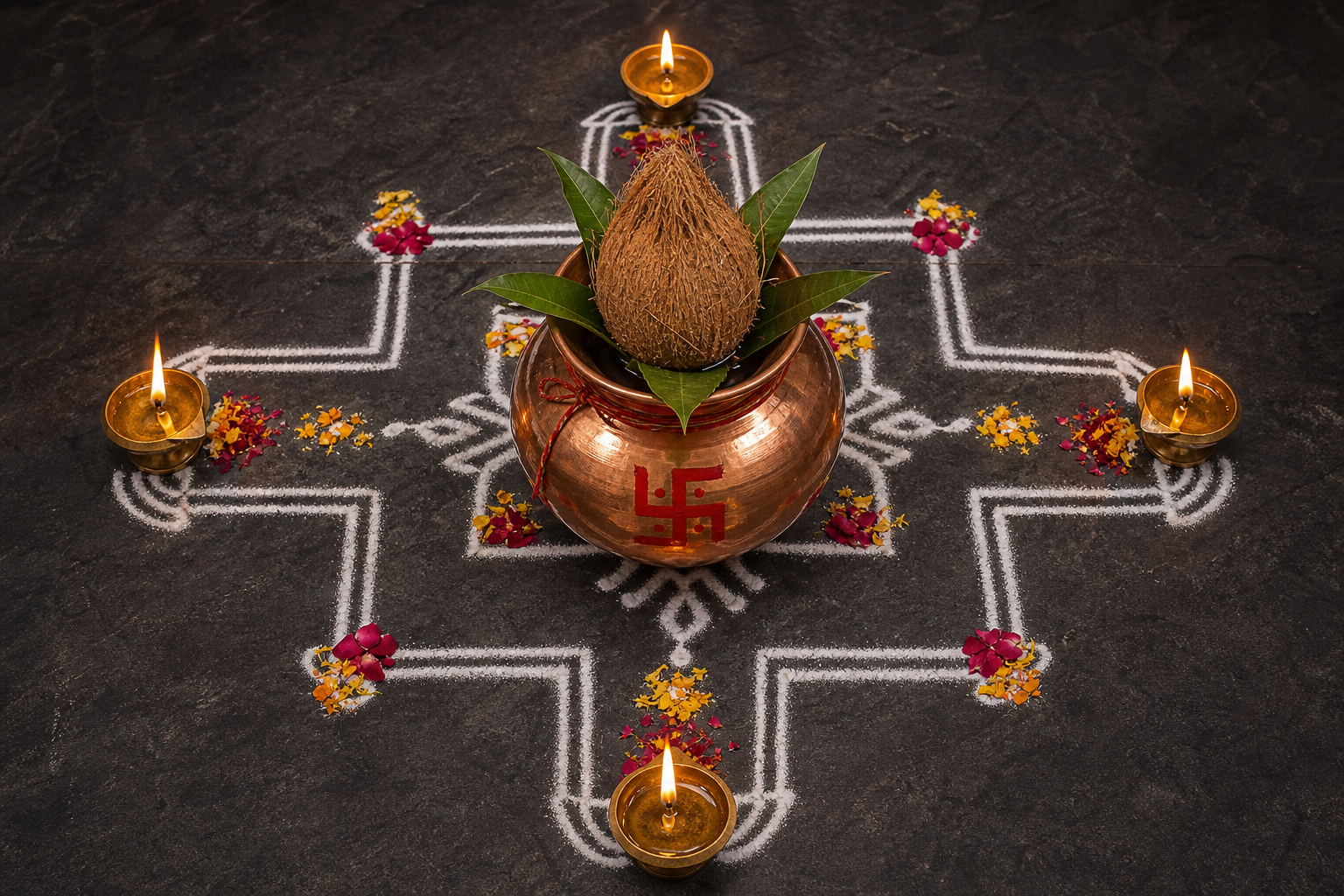
The Sanskrit sense behind Swastika is su-asti: well-being, auspiciousness, or the condition in which life is rightly ordered. Its four arms evoke balance among the cardinal directions, cyclical time, and the sun’s apparent movement. It does not promise that nothing difficult will happen. It expresses the hope that change will unfold within dharma and rita, the principle of right cosmic order.
The Kalash supplies a complementary image. A vessel receives, contains, and nourishes. Filled with water and crowned with leaves and a coconut, it can be understood as a life-bearing womb and a small representation of the cosmos. In one traditional mapping, the pot corresponds to earth, its water to amrita, the leaves to the panchabhutas, and the coconut to the living axis rising through the arrangement.
These associations should help you contemplate the form, not reduce it to a code that must be decoded identically in every household. The central relationship is simpler: the Kalash holds the potential for life, while the Swastika situates that life within balanced space and recurring time.
The geometry reinforces the meaning. The Swastika extends in four directions around a stable centre. The Kalash rises vertically from a grounded base to the coconut above. One marks ordered movement across space; the other joins earth, life-giving water, vegetation, and the upward axis. Together they become a compact map of a flourishing world.
This is why the pairing belongs naturally in rites concerned with beginnings and continuity. At a house entrance, it asks that domestic life be stable and hospitable. At a wedding, it places fertility and shared prosperity within dharma. During Navaratri, it gives material form to divine abundance and generative power. The arrangement may invoke Lakshmi’s abundance and Ganesha’s protective grace, but its purpose is larger than acquiring wealth or avoiding inconvenience: it orients the whole household toward auspicious living.
Key takeaways
- The Swastika signifies well-being, directional balance, cyclical continuity, and right order.
- The Kalash represents purity, abundance, hospitality, and the generative capacity of life.
- The horizontal movement of the Swastika and the vertical form of the Kalash create a visual map of an ordered cosmos.
- In ritual, the pairing is an enacted intention for stability and flourishing, not an ornamental logo.
- Its meaning becomes complete only when the ceremony shapes how you treat people, water, food, work, and the home.
Prepare the Kalash so that each action carries intention
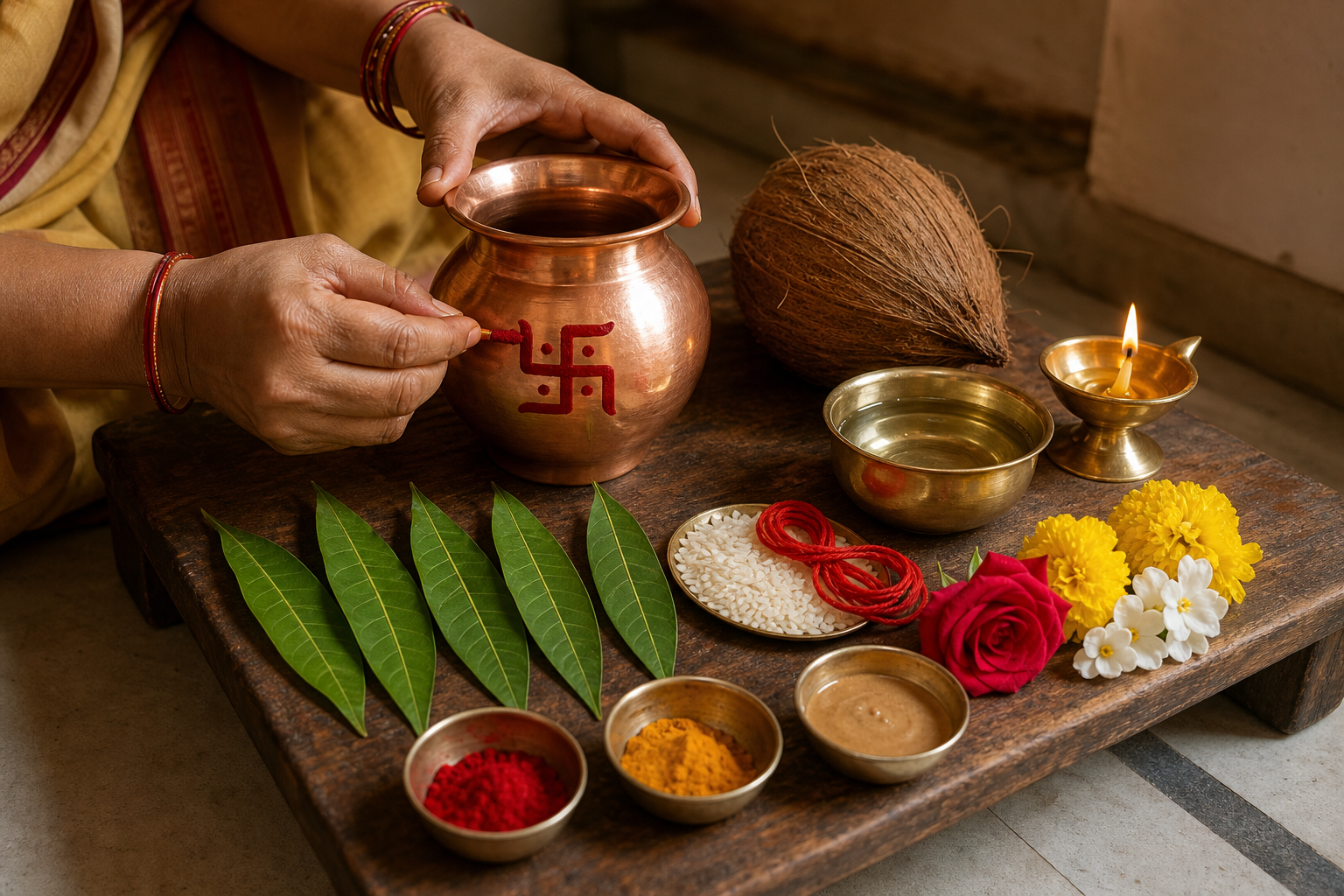
A Kalash can be visually elaborate or very simple. Cost is not the measure of sanctity. Copper, silver, and clay vessels are all used, and each places the same basic form at the centre: a clean container, clean water, leaves, a coconut, and a sacred mark.
If you are participating in a formal ceremony, follow the sequence taught by your family, priest, temple, or lineage. Mantras, placement, and local customs differ. You do not need to mix several regional procedures to make the rite more authentic. Consistency, cleanliness, and attention are more meaningful than accumulating extra elements whose purpose you do not understand.
- Begin with a clean vessel. Choose copper, silver, or clay according to the rite and your household practice. Treat the empty vessel as something about to receive life, not as an ordinary container hurriedly taken from storage.
- Fill it with clean water. The water is central, not incidental. It represents purity, vitality, and the sustaining depth held within the visible form.
- Arrange the mango leaves. Their outward spread connects contained water with vegetation and the elemental world. Arrange them with care rather than using them as filler around the rim.
- Place the coconut above. It completes the upward movement of the Kalash and marks the living axis of the composition.
- Apply the Swastika with kumkum or haldi. Draw deliberately and legibly. This is the point at which the vessel of life is visibly placed within an auspicious order.
- Consecrate the arrangement according to your tradition. Mantra and focused intention turn assembly into worship. If you do not know the prescribed mantra, seek guidance rather than inventing a formula and presenting it as inherited practice.
- Name the intention in conduct as well as thought. Prosperity, clarity, protection, hospitality, and harmony should become duties for the household, not merely benefits requested from the divine.
Do not become so anxious about visual perfection that the preparation loses its devotional quality. A neat Swastika matters because attention matters, but ritual is not a drawing examination. The mark, water, leaves, coconut, mantra, and intention work as a whole.
Nor should the Kalash be handled as disposable event decoration. Before the ceremony, decide who will prepare it, where it will be placed, and how its contents will be treated afterward under your customary practice. That small amount of planning prevents the sacred vessel from receiving great attention at the beginning and careless treatment once guests leave.
The union of consecrated water, mantra, material form, and mindful intention is what gives the arrangement ritual coherence. The physical elements focus the mind; the mind, in turn, changes how the physical elements are approached.
Carry the symbol from the ritual space into household conduct
The most useful test of symbolism comes after the puja. If the Kalash represents abundance, does your household understand abundance only as possession, or also as the capacity to feed, welcome, teach, and serve? If the Swastika represents right order, are time, duties, and relationships being arranged with the same care given to the ritual space?
This question protects the pairing from becoming a demand for private good fortune. Shri is not mere accumulation. Prosperity that weakens self-restraint, hospitality, or responsibility has become detached from dharma. When you invoke abundance through the Kalash, connect the request to a use: food that can be shared, knowledge that can be taught, resources that support duty, or stability that makes seva possible.
Water makes that responsibility especially concrete. The ritual vessel asks you to see water as a bearer of life before you see it as a household utility. You need not invent a new ceremony to honour that insight. Begin with ordinary discipline: avoid careless waste, keep local water sources in mind, and support the cleanliness of the places on which your community depends. Reverence for water inside the puja room should sharpen your treatment of water outside it.
The same principle applies to the Swastika’s directional balance. A stable centre does not mean inactivity. Its arms suggest movement that remains related to an ordering centre. In household terms, cooking, study, work, worship, caring for elders, raising children, and seva need not be treated as unrelated compartments. They can become different directions of one dharmic life.
You can use the prepared Kalash as a quiet household examination. Ask what your home is receiving, what it is preserving, and what it is giving. A vessel that only receives eventually overflows or stagnates; a household that receives blessings without extending hospitality and service has missed part of the symbol’s instruction.
This is also the point at which serenity becomes intelligible. A carefully prepared Kalash at a threshold can calm the mind because it gathers scattered hopes into a visible order. The effect need not be treated as magic. Clean water, balanced form, familiar materials, mantra, and deliberate attention place the household’s intentions before everyone who enters.
Recognise shared Dharmic themes without erasing differences
The Swastika and vessel motif travel across Dharmic traditions, but they do not carry one mechanically identical doctrine everywhere. You can recognise a civilizational family resemblance without claiming that Hinduism, Jainism, Buddhism, and Sikhism use the same ritual vocabulary.
In Hindu practice, the combined form gathers ideas of cosmic order, divine abundance, purity, fertility, protection, and sacred hospitality. The Kalash is used in domestic and public rites, while the Swastika marks an auspicious orientation around it.
In Jainism, the Swastika provides moral orientation and is associated with the four gatis, or conditions of embodied existence. Kalasha forms also appear in temple settings. The responsible comparison is therefore not that every Jain interpretation duplicates the Hindu one, but that both traditions use disciplined sacred forms to direct attention toward ethical and spiritual order.
In Buddhism, the treasure vase is counted among the ashtamangala and signifies inexhaustible blessing. Swastika forms are also retained as auspicious signs in regional Buddhist art. Here again, a related visual language serves a distinct religious framework.
Sikh tradition centres recognisably different symbols, especially Ik Onkar and the Khanda. It should not be folded into a claim that the Swastika-Kalash pairing is universal across every Dharmic path. The more defensible kinship lies in values such as purity, seva, communal well-being, and reverence associated with water, visibly present around sarovars.
This distinction improves inter-tradition conversation. Say, “These traditions share concerns with auspiciousness, ethical order, service, and the sanctity of life,” rather than, “All our symbols mean the same thing.” The first statement creates a bridge while respecting each tradition’s integrity. The second gains superficial unity by discarding the very diversity it claims to honour.
Explain the Swastika clearly in a diverse public setting
Outside a Dharmic setting, many people encounter the Swastika first through the violent history of the twentieth-century Hakenkreuz. Their reaction may arise from genuine historical memory rather than hostility toward Hindu practice. You do not have to surrender the Dharmic symbol to that history, but you should recognise the history your listener is bringing to the conversation.
Begin with identity and meaning, not accusation. State that the mark is an ancient Dharmic Swastika and that its name is connected with well-being and auspiciousness. Then point to the Kalash. Explain that the vessel represents life, purity, abundance, and hospitality, while the four-armed sign places those aspirations within balanced space and cyclical order.
Next, make the distinction directly: the Dharmic Swastika is not an endorsement of the Nazi Hakenkreuz or its destructive ideology. Do not minimise the crimes associated with that emblem, and do not accept the false conclusion that an ancient life-affirming symbol must therefore be understood only through its modern distortion. Both truths can be stated without confusion.
A three-sentence explanation you can use
“This is the Dharmic Swastika, a sign of well-being, auspiciousness, and balanced order. It is drawn on the Kalash, a sacred vessel representing life, purity, and abundance. Its meaning and religious setting are distinct from the twentieth-century Hakenkreuz and the ideology attached to that emblem.”
That explanation is usually more effective than beginning with “You misunderstand our symbol.” It gives the listener a correct name, a positive meaning, a visible context, and the necessary historical distinction. If the setting is a school, workplace, community hall, or public festival, place a short explanation beside the display rather than waiting for confusion to occur.
Context should be visible in the presentation itself. A Swastika drawn in kumkum or haldi on a water-filled Kalash with mango leaves and a coconut is embedded in a recognisable ritual composition. A mark reproduced alone, without explanation, asks an unfamiliar viewer to supply the context. In the diaspora, a small placard identifying the symbols and the ceremony can turn a moment of alarm into an opportunity for accurate cultural understanding.
Avoid overclaiming when you explain the pairing. You do not need to say that every Dharmic community uses it in the same way, that every arm has one universally fixed definition, or that discomfort can only come from prejudice. Precise explanation is stronger: identify your practice, explain its affirmative meaning, distinguish it from the Hakenkreuz, and allow sincere questions.
Your next use of the Swastika and Kalash can begin with one deliberate choice. Learn what each element means before assembling it, assign the preparation enough time to be attentive, or write the three-sentence explanation for guests who may not know the symbolism. The pairing remains alive when its geometry orders conduct, its water deepens responsibility, and its promise of well-being extends beyond the people performing the rite.
References
