
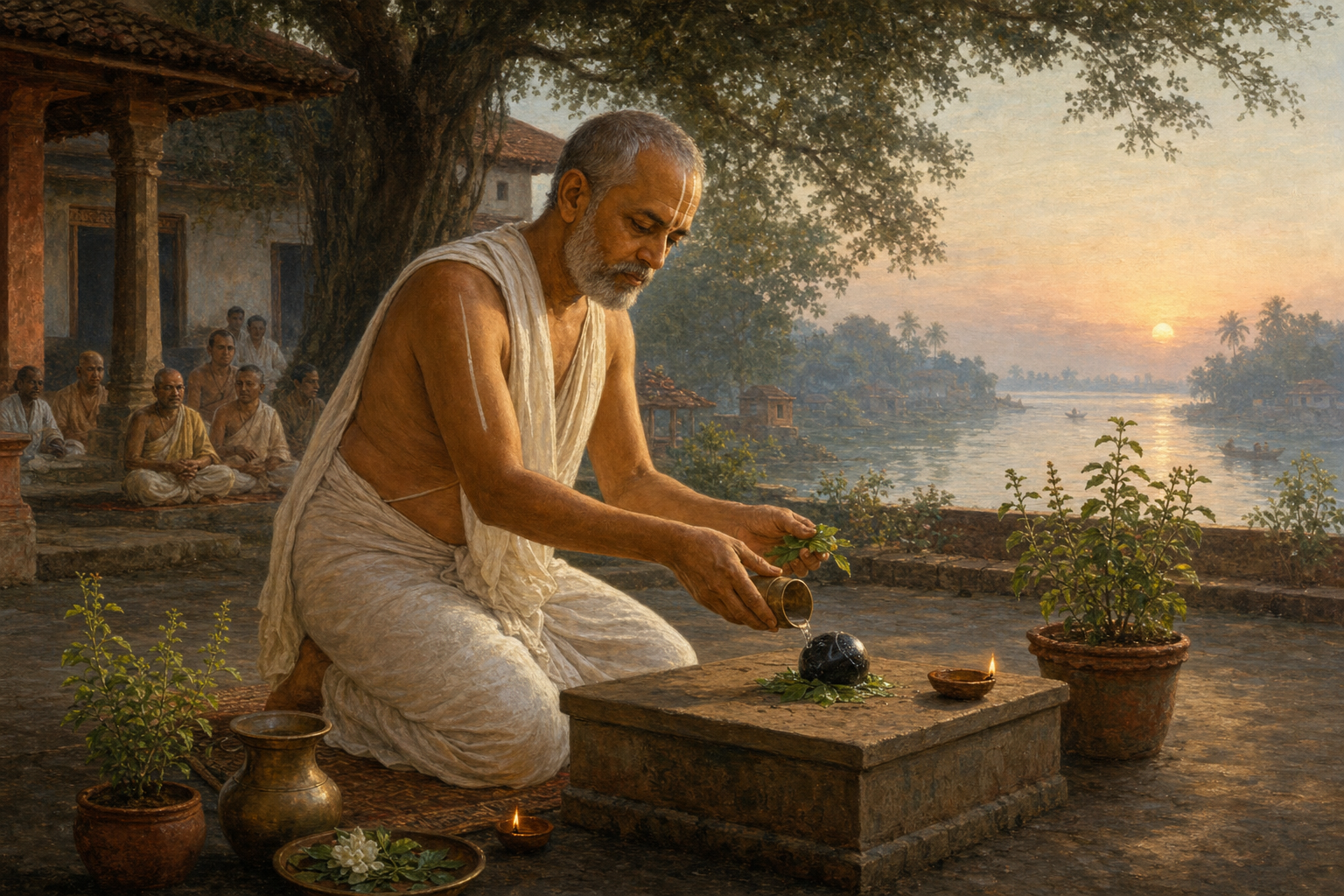
If you are trying to understand Advaita Acarya from a temple image, a family name, or a visit to Shantipur, the pieces can seem disconnected. They belong together. His place in Caitanya’s movement, his household, his worship, and his sacred form all express one life of active devotion.
Use the four-part map below to read the details correctly. It will help you understand why he is called Caitanya’s second branch, why Shantipur matters, why the names Sita-natha and Sita-pati are significant, and why a beardless deity can carry a serious claim about lineage rather than merely reflecting an artistic preference.
Key takeaways
- In the tree of Sri Caitanya, Caitanya Mahaprabhu is the trunk, Lord Nityananda the first branch, and Advaita Acarya the second branch. The image describes a living relationship of service and transmission, not a secular ranking.
- Shantipur is remembered as the place where Advaita Acarya worshipped and called for Krishna to appear as Sri Caitanya. Sri Madan Gopal, his saligrama-sila, and Harinama are therefore central to understanding the site.
- His family life is part of his sacred identity. He married Sri and Sita, the daughters of Nrsimha Vaduri, and became especially known through Sita Thakurani as Sita-natha or Sita-pati.
- The case for depicting him without a beard rests on fidelity to accepted Gaudiya precedent, especially the practice associated with Srila Bhaktisiddhanta Sarasvati Thakura. It should be understood as a parampara decision, not as a claim that every devotional community must make the same choice.
Two meanings of lineage explain Advaita Acarya’s place
Two ideas are often compressed into the word “lineage.” The first is a relational map: who stands where within the unfolding of Sri Caitanya’s mission. The second is parampara: how teachings, devotional moods, and decisions are received from earlier teachers and carried forward. Keeping those meanings distinct will prevent several common misunderstandings.
In the Caitanya-caritamrta, Krishnadasa Kaviraja Gosvami uses the image of a spiritual tree. Sri Caitanya Mahaprabhu is its main trunk, Lord Nityananda its first branch, and Advaita Acarya its second branch. A branch is neither independent of the trunk nor inert beneath it. It receives life and extends that life outward. Advaita’s position is therefore best read as a relationship of participation: he belongs to the structure through which Caitanya-bhakti grows and reaches others.
Do not turn “second branch” into “second-tier devotee.” The metaphor is organic rather than bureaucratic. Trunk and branches cooperate to bear leaves, flowers, and fruit. If you are teaching this image, draw the tree and label the relationships before discussing status. That simple order keeps the metaphor focused on shared divine work rather than on a competition for prestige.
Advaita Acarya’s theological identity adds another layer. Gaudiya tradition reveres him as an avatara of Maha-Vishnu and, because Sadasiva is understood to be present within Maha-Vishnu, also as an avatara of Sadasiva. This is a theological claim internal to the tradition, so it is clearer to say “Gaudiya Vaishnavas revere him as” than to present the identification as an unqualified biographical fact.
That formulation also helps you notice the Vaishnava-Shaiva consonance built into his identity. Maha-Vishnu and Sadasiva are not treated here as rival badges competing for ownership of the same saint. The composite identification belongs to a dharmic imagination capable of preserving distinctions without turning them into absolute separation.
Shantipur preserves the action behind the theology
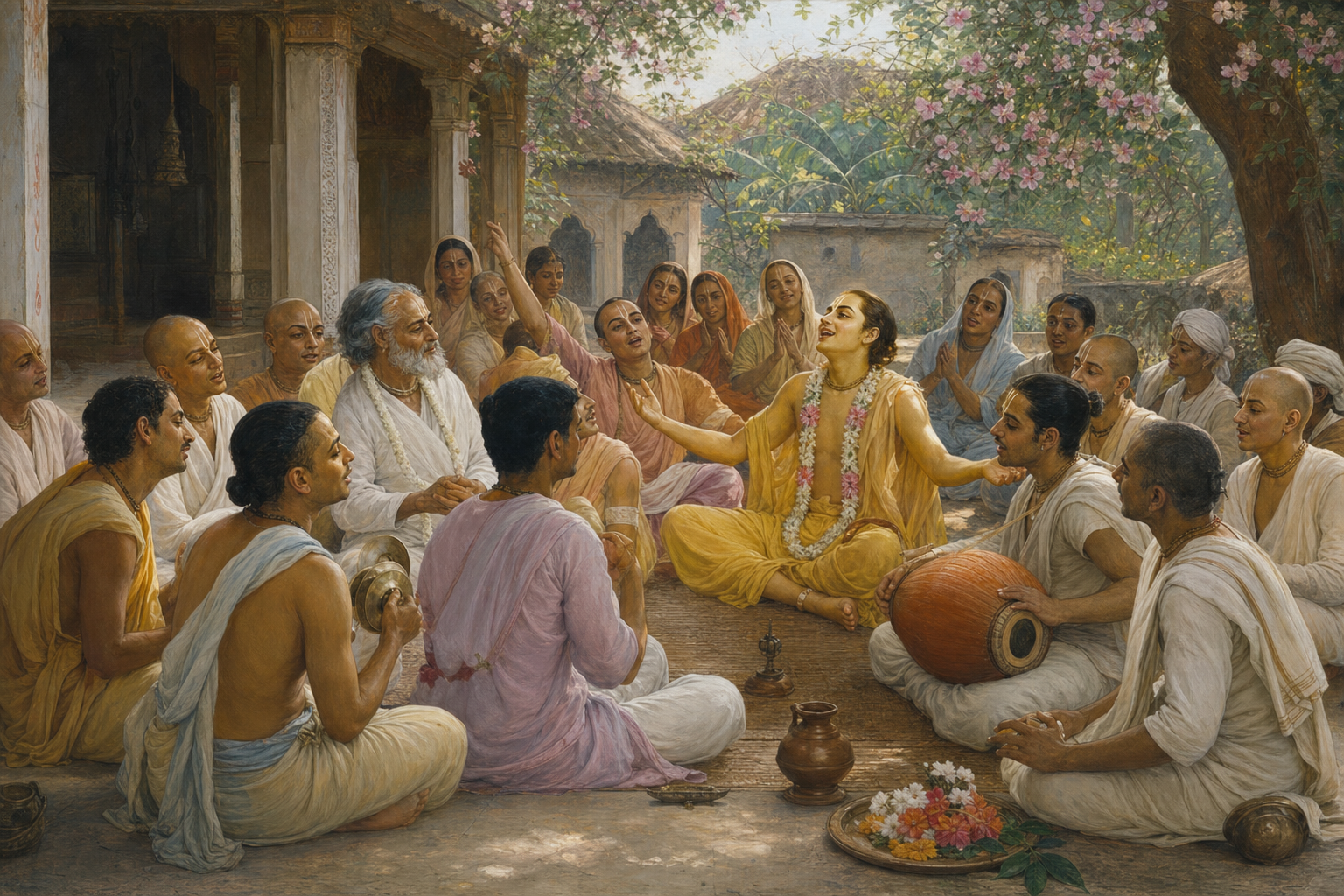
Shantipur matters because Advaita Acarya’s theology took the form of worship there. His historic home, remembered amid mango groves, is associated with his resolve to call for Krishna’s advent in Kali-yuga as Sri Caitanya Mahaprabhu. Harinama and the cultivation of pure devotion formed the substance of that appeal. The holy name was not background music to the event; it was part of the means through which he acted.
The temple’s most important points of attention are Sri Madan Gopal and the saligrama-sila worshipped by Advaita Acarya. Within the site’s devotional memory, these sacred forms are connected directly with his invocation of Sri Caitanya’s advent. That connection changes how you should approach darshan. You are not simply looking at objects associated with a famous person. You are encountering the forms around which a consequential act of bhakti is remembered.
A purposeful visit can follow three movements:
- Recall the intention before entering. Advaita Acarya was not seeking a private spiritual experience. His worship was directed toward divine intervention and the wider distribution of devotion in an age of spiritual decline.
- Identify the forms during darshan. Notice Sri Madan Gopal and the saligrama-sila by name. Hold together the worshipper, the sacred forms, and the purpose of the worship.
- Hear Harinama as the site’s continuing language. If kirtan is taking place, let it shape the visit rather than treating it as ambient sound. If you are present as a student rather than a practitioner, attentive and respectful listening still reveals what kind of place Shantipur is.
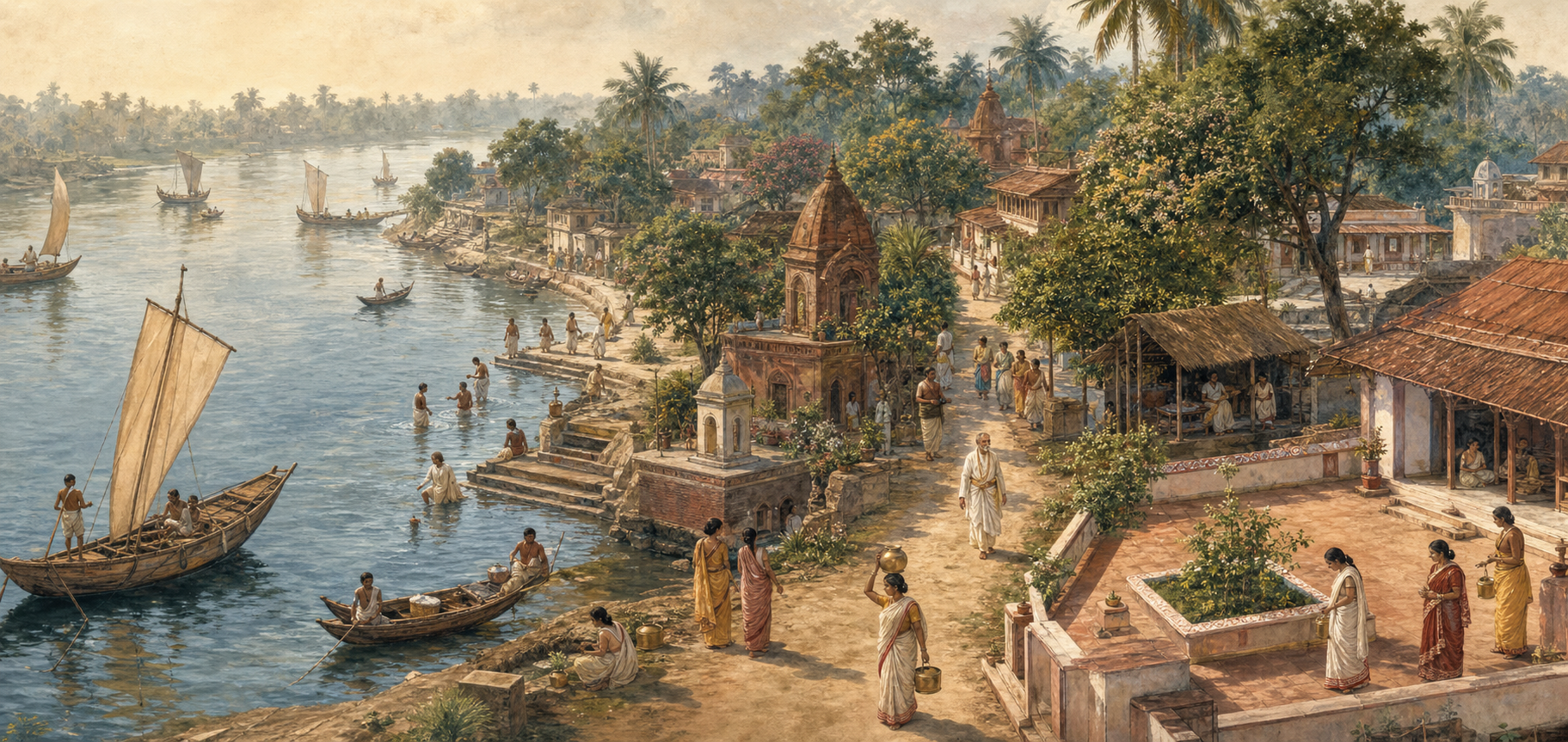
Shantipur is described as roughly an hour from Sri Mayapur Dhama and just off the Kolkata route in the Ranaghat area. Treat that as geographical orientation, not as a guaranteed journey time; confirm the route and temple arrangements locally before travelling. You may also encounter both “Shantipur” and “Santipur” in English spellings, so keep both forms in mind when making enquiries.
The essential sequence is easy to remember: a place, a vow, sacred forms, and the holy name. If your visit preserves that sequence, Shantipur becomes more than another pin on a pilgrimage map. Its geography teaches you how intention becomes worship and how worship can shape a religious movement.
Sita, Sri, and the household dimension of bhakti
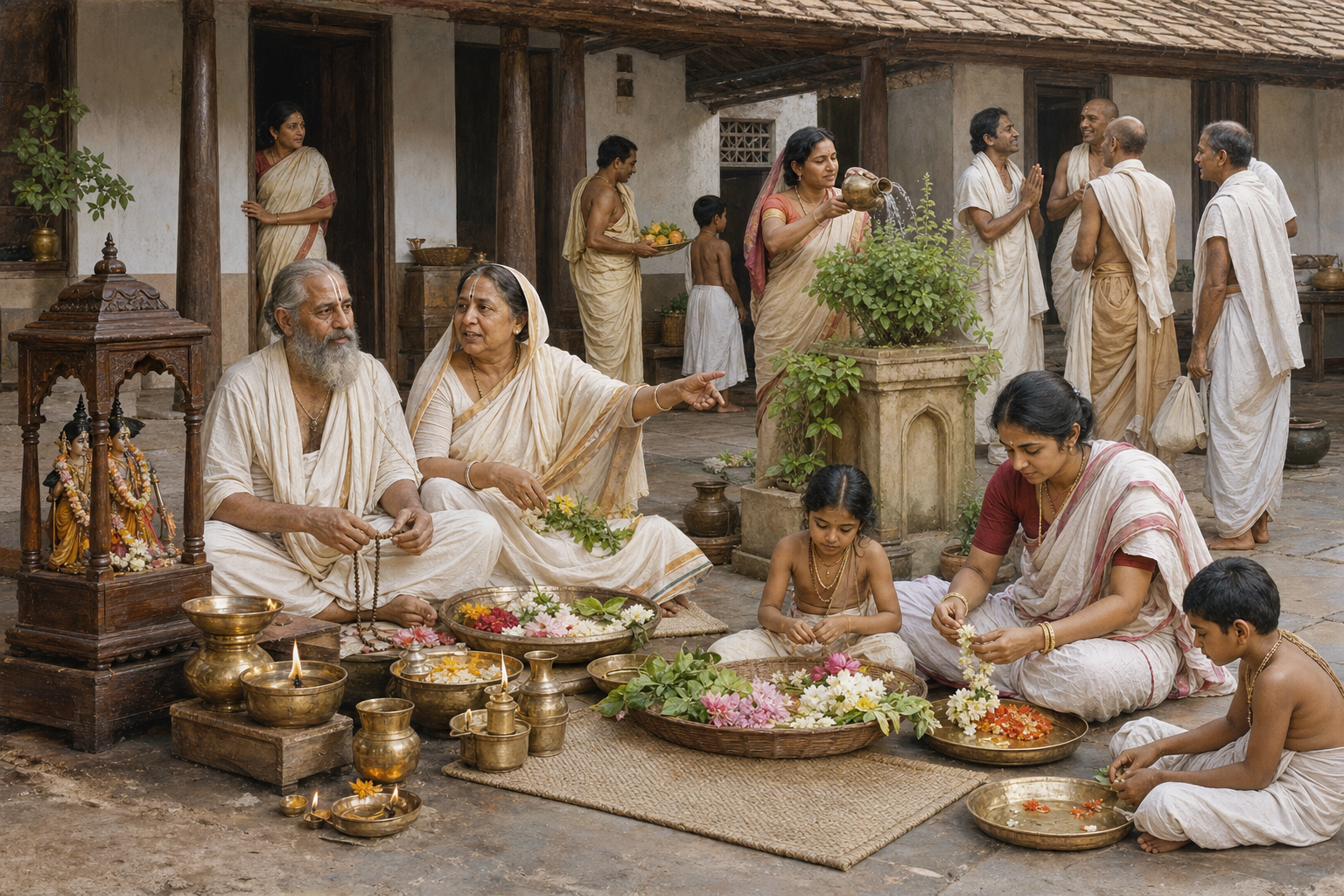
Advaita Acarya’s household should not be treated as a biographical appendix. It shows how pilgrimage, grief, family duty, and divine service could inhabit the same life. He lost his parents while young and travelled extensively to holy places. After returning, he accepted his relatives’ request that he marry.
Nrsimha Vaduri, a respected brahmana living nearby, had two daughters named Sri and Sita. Advaita Acarya married both sisters, with Sita Thakurani becoming especially prominent in Gaudiya remembrance. His names Sita-natha and Sita-pati, both of which identify him through Sita, show that the marital relationship became part of the language by which the tradition remembers him.
That prominence should not lead you to erase Sri from the account. When presenting the family, name both wives first and then explain why Sita appears more visibly in Advaita’s honorifics. This small discipline produces a more accurate account than mentioning Sita alone and leaving readers to assume that she was his only wife.
The household also carries theological meaning. Gaudiya understandings identify Sita Thakurani as an incarnation of Yogamaya and Sri as a manifestation of Yogamaya. Yogamaya here is the divine potency that arranges and sustains sacred relationships and pastimes. Family is consequently not positioned outside spiritual life, as though Advaita briefly stepped away from devotion to satisfy a social demand. His household belongs within the sacred order through which his service was expressed.
This makes his life particularly useful when you are trying to resist the false choice between serious bhakti and household responsibility. Advaita Acarya’s example does not make every family decision automatically spiritual. It shows something more demanding: domestic obligations can be received and carried as part of disciplined devotional life. The measure is not whether a duty looks worldly from the outside, but whether it is integrated with truthfulness, worship, service, and responsibility.
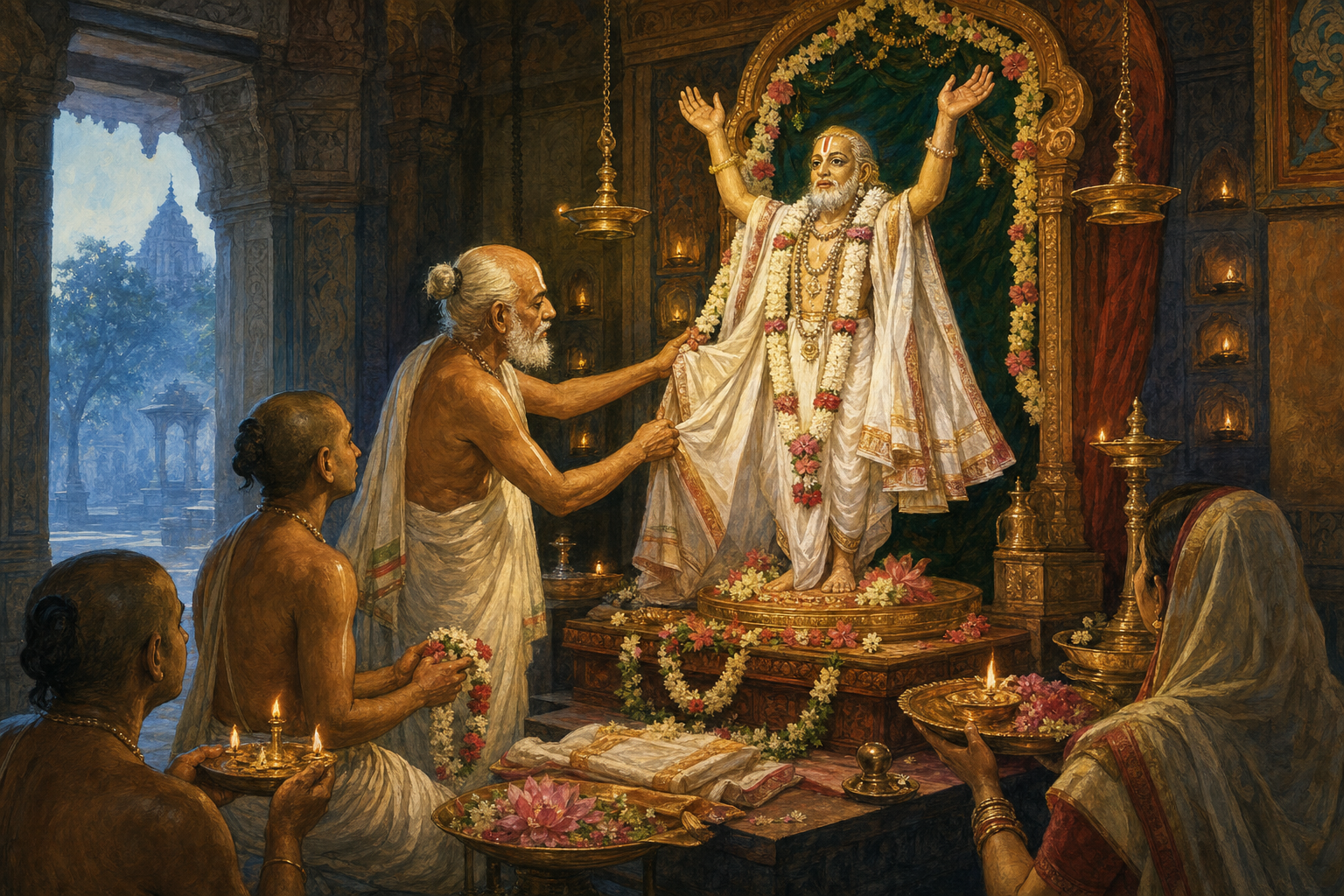
The beard question is really a question about authority
A disagreement over Advaita Acarya’s beard can appear trivial until you ask what a deity form is meant to convey. In a temple, iconography is not merely decorative portraiture. It teaches devotees how a sacred personality is received, recognized, and approached within a particular lineage.
One prominent Gaudiya case for a beardless Advaita Acarya begins with the practice established by Srila Bhaktisiddhanta Sarasvati Thakura. For ISKCON and related communities that receive this precedent, the argument is not that contemporary artists happen to prefer a clean-shaven face. The argument is that following an accepted acarya preserves continuity in worship.
The reasoning draws on the layered structure of parampara. The example of Maharaja Priyavrata is used to show that the direction of a param-guru, the spiritual master’s own spiritual master, can carry precedence in a particular situation. Srila Prabhupada likewise taught that a great devotee serves the order of the spiritual master or of the spiritual master’s spiritual master, and he invoked the Skanda Purana’s counsel to follow previous acaryas. This is not a general permission to bypass one’s teacher whenever another opinion is more convenient. It is an argument that inherited authority can operate through more than one generation.
If you are deciding how Advaita Acarya should be depicted, ask four questions in order:
- What is the image for? A worshipped deity, a temple mural, a historical reconstruction, and an educational illustration do not carry identical responsibilities.
- Which lineage receives it? Identify the sampradaya, institution, or temple community whose devotional practice the image is expected to serve.
- What precedent has that lineage accepted? Look first to established deity forms and the decisions of recognized acaryas. For communities following Bhaktisiddhanta Sarasvati Thakura’s precedent, this supports the beardless form.
- What claim will accompany the image? If an illustration departs from received temple iconography, label it as an illustrative choice rather than presenting it as the uniquely authentic form.
This process leaves room for historical inquiry while protecting the integrity of worship. A historian may ask how Advaita was physically represented in different periods. A temple community may ask which form faithfully embodies its received devotional practice. Those questions can inform one another, but they are not interchangeable.
Before you visit Shantipur, teach a class, write a caption, or commission an image, put four labels in your notes: tree relationship, Shantipur worship, household names, and visual precedent. If one is missing, your picture of Advaita Acarya is probably incomplete. With all four present, you can approach him not as a collection of disputed details, but as an acarya whose relationships, home, family, and form continue to teach.
References
- Dandavats — Shantipur Pilgrimage: Sri Advaita Acarya’s Sacred Home and the Call of Harinama
- Dandavats — Advaita Acarya’s Sacred Role: Mapping Sri Caitanya’s Tree and Dharmic Unity in Bhakti
- Dandavats — Advaita Acarya’s Sacred Union: Sita Thakurani and the Roaring Call of Yogamaya-Bhakti
- Dandavats — Honoring Parampara: The Sastric Case for Advaita Acarya’s Beardless Deity and Dharmic Unity
