
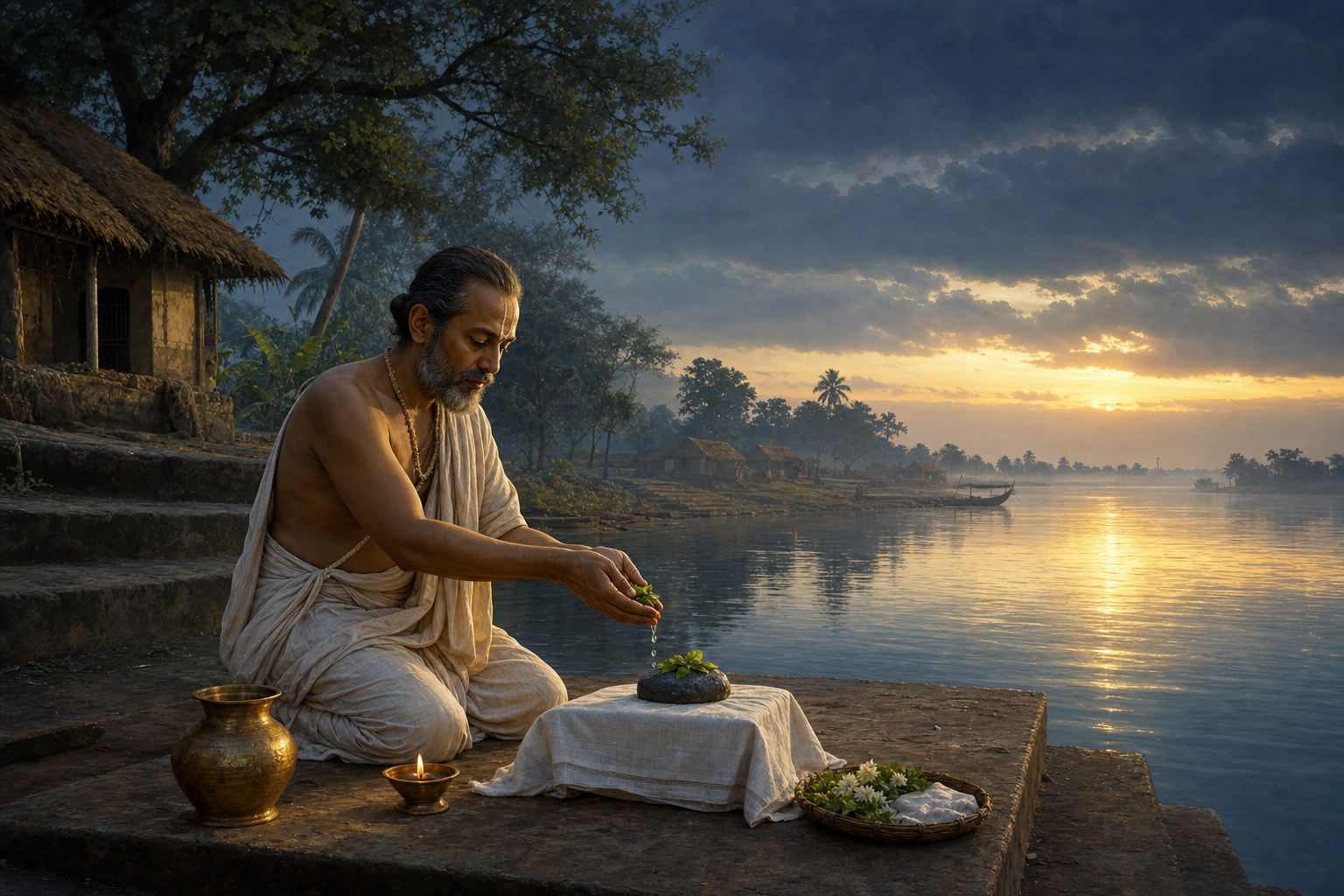
If you know Advaita Acharya only as the devotee who prayed for Sri Caitanya to appear, you know the decisive moment but not the preparation that gave it weight. His life answers a practical question every bhakti community eventually faces: what must be in place before collective renewal can take root?
His answer was not a single doctrine or public campaign. It was a life in which family duty, pilgrimage, discipleship, scriptural learning, renunciation, prayer and service reinforced one another. That pattern explains both his place in Gaudiya Vaishnavism and what you can learn from him now.
The life that prepared him to become a catalyst
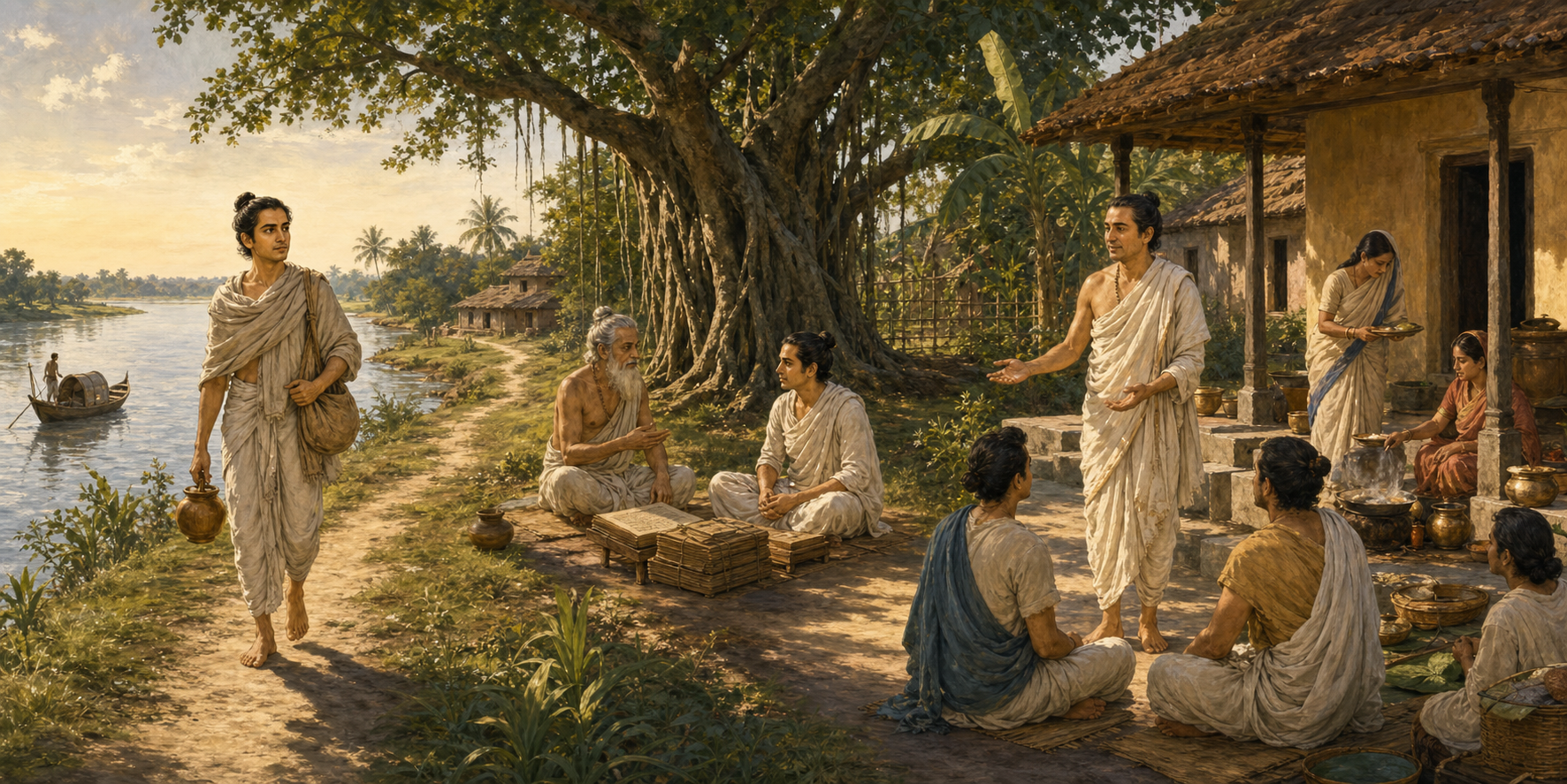
Gaudiya Vaishnavism is the Bengali current of Krishna devotion associated with Sri Caitanya and the renewal of congregational kirtan. Advaita Acharya belonged to the generation whose spiritual formation prepared the ground for that renewal.
He was born slightly more than five centuries ago in Navagram to Nabha Devi and Kuvera Pandit. Kamalaksa and Advaita were among the names by which he was known in childhood. After receiving the sacred thread, he moved with his family to Shantipur on the Ganges when he was about four years old.
His parents died while he was still young. He fulfilled his filial responsibility by performing shraddha at Gaya and then undertook a tirtha-yatra across the sacred geography of Bharat. During that pilgrimage, he met Madhavendra Puri and accepted initiation from him. This guru-disciple bond connected Advaita Acharya to the devotional current that would flower in the Caitanya movement.
The chronology matters. Family loss did not end in isolation. Ritual duty led into pilgrimage; pilgrimage led to a guru; discipleship matured into public spiritual leadership. If you are trying to understand his character, read those stages as one formation rather than as disconnected episodes.
Gaudiya devotional memory also preserves the striking tradition that his first words were the name of Sri Krishna Caitanya. That is not a claim a modern documentary biography can verify. Its purpose is theological: it presents his entire life as oriented toward the advent he would later invoke. You do not have to confuse sacred memory with archival evidence in order to understand what that memory communicates.
Just as important, Advaita Acharya is remembered as a householder-scholar, not as someone whose authority depended on abandoning society. His example therefore speaks directly to practitioners with families, livelihoods and civic responsibilities. Household life need not be the waiting room before serious sadhana. It can become the place where study, restraint, hospitality and service acquire practical form.
What it means that his devotion called forth Caitanya
Within Gaudiya theology, Advaita Acharya is venerated as Mahavishnu, the cosmic sustaining principle who guides living beings toward the Divine. The tradition credits the intensity of his devotion with invoking the compassionate descent of Sri Krishna Caitanya.
This claim should be read in its proper category. It is a theological account of divine descent, not an ordinary claim that one historical personality caused another person to begin a movement. The emphasis falls on responsive grace: a devotee perceives the need of living beings, turns completely toward Bhagavan, and becomes an instrument through whom renewal begins.
Three features of this role are worth noticing:
- His response begins with devotion rather than self-appointment. He does not place himself at the center of the renewal he seeks.
- His prayer is active preparation, not an escape from responsibility. It grows out of discipline, learning, pilgrimage and service.
- His importance is catalytic. Sri Caitanya becomes the visible center of the kirtan-centered renewal, while Advaita Acharya’s call helps explain why that renewal is understood as an answer to devotional longing.
This gives you a useful test for claims of spiritual leadership. A genuine catalyst does not need to own the result. The person may teach, gather, pray and prepare, then recognize that the next phase will be carried by someone else. Advaita Acharya’s greatness lies partly in that combination of authority and decentralization.
His teaching joined knowledge, renunciation and devotion
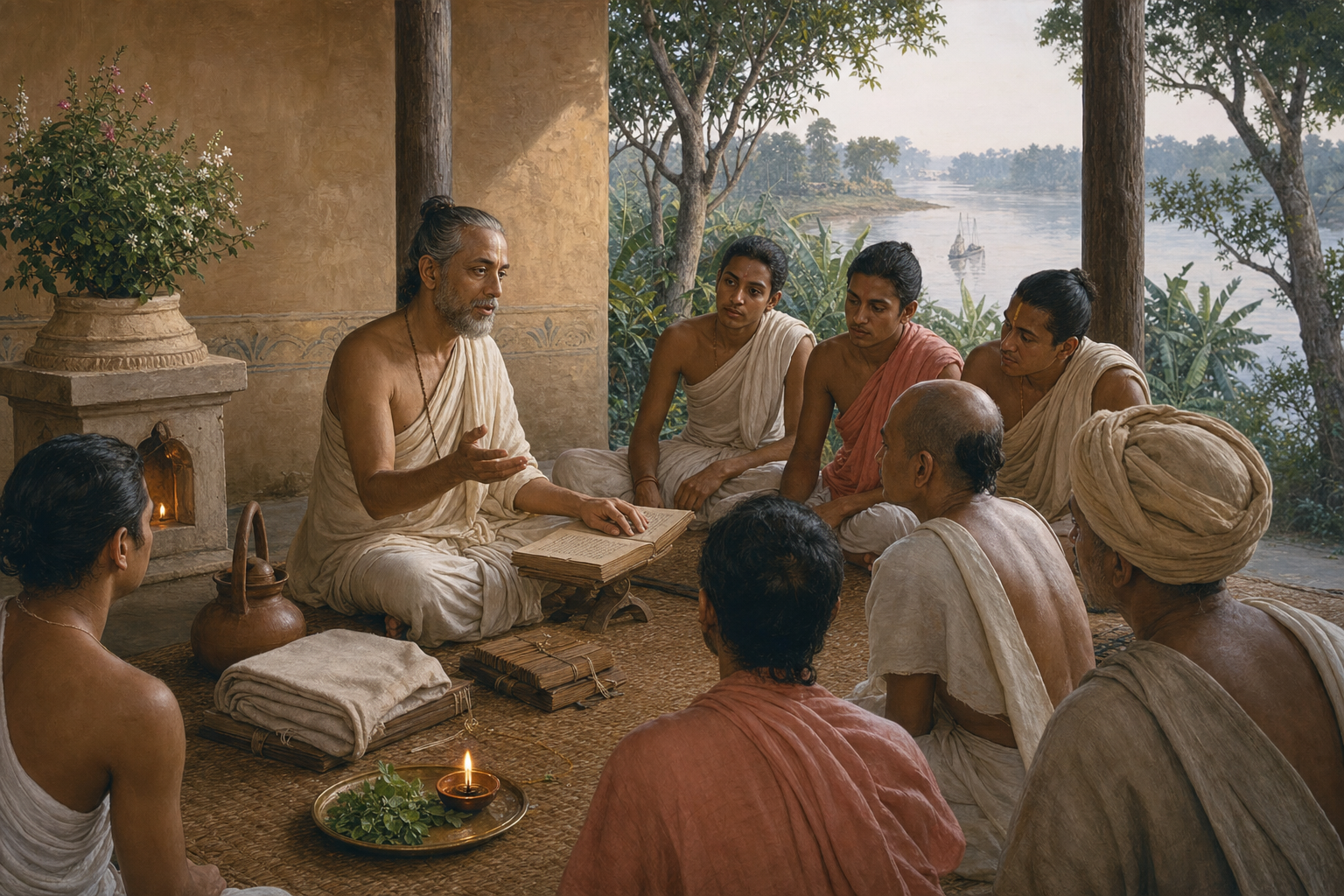
Advaita Acharya was honored as foremost among the Vaishnavas of Navadwip and as a preceptor in whom jnana, vairagya and bhakti converged. These three terms are often separated too quickly. In his devotional model, they correct and complete one another.
- Jnana, or knowledge, gives discernment. It asks what is true, what the scriptures are directing you toward, and whether your interpretation is coherent.
- Vairagya, or renunciation, removes competing attachments. It is not contempt for the world; it is freedom from whatever prevents knowledge from becoming conduct.
- Bhakti, or devotion, gives knowledge and restraint their living purpose. It turns understanding into loving attention, worship and service to Krishna.
Knowledge without devotion can become a display of superiority. Renunciation without compassion can become sterile. Devotion without discernment can become sentiment detached from Dharma. Advaita Acharya’s example asks you to test each element by the other two.
A simple way to apply that test is to ask three questions after any period of study: What have I understood more clearly? What attachment or distraction must I release? Whom or what will I serve differently because of this understanding? If the reading changes none of those, it may have informed you without yet forming you.
Traditional praise compares his authority in explaining Krishna-bhakti to that of Lord Shankara. The comparison emphasizes the reach of his discernment and scriptural command. It should not be confused with the separate Gaudiya identification of Advaita Acharya with Mahavishnu.
His name creates another common category error. Advaita Acharya should not be classified as an exponent of Advaita Vedanta merely because the word Advaita appears in his name. He is remembered here as a Krishna-bhakti preceptor within the Gaudiya lineage. A personal name, a comparison with Shankara, and a formal school of Vedanta are three different things; keeping them separate prevents a basic misunderstanding of his role.
His interpretive center was Krishna-bhakti. This does not mean discarding scripture in favor of emotion. It means allowing devotion to illuminate why scripture is studied at all. Learning should clarify relationship with the Divine, renunciation should protect that relationship, and practice should express it.
How his example can renew a community now
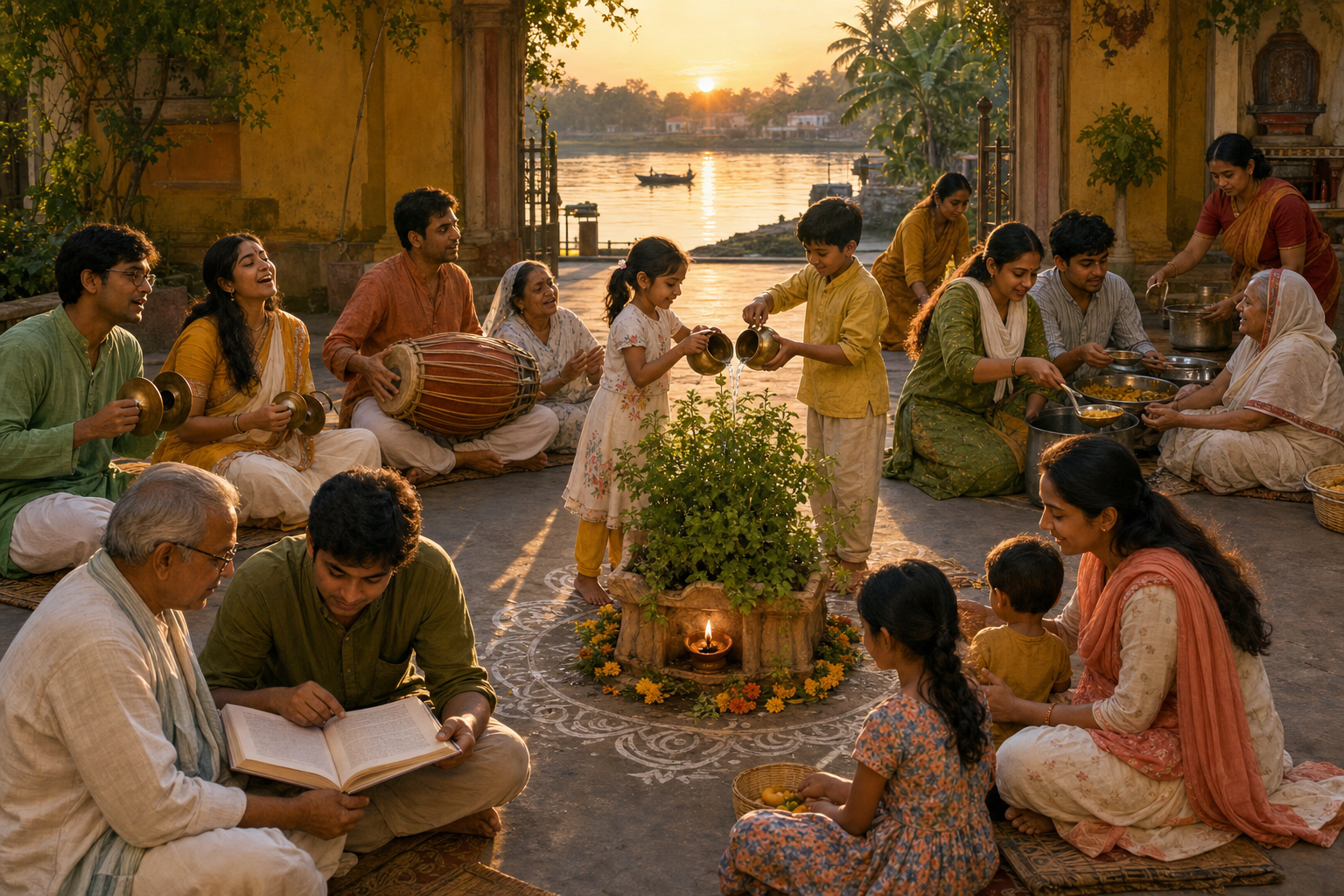
Advaita Acharya’s life shows that devotional renewal is built through connections: between a seeker and a guru, sacred geography and settled household life, learning and restraint, private prayer and shared kirtan. A community weakens when one of those connections disappears.
You can use four concrete questions to examine your own mandir, satsang or home practice:
- Where does correction come from? If everyone interprets Dharma privately, enthusiasm can drift into personal invention. Name the guru-lineage, teacher or disciplined study setting that can correct your reading.
- Does learning reach conduct? Add one question to every class or reading circle: what changes before the next gathering? The answer might concern speech, consumption, attention, family duty or service, but it should be observable.
- Is renunciation supporting devotion? Choose one recurring distraction that regularly displaces prayer or study. Set it aside during the time already reserved for sadhana rather than making a dramatic vow you will not maintain.
- Can other people participate? Kirtan and seva turn inward aspiration into shared practice. Give newcomers a clear way to sing, listen, prepare a space, serve food, clean or assist another participant.
Unity without flattening distinct traditions
Advaita Acharya’s remembrance can also deepen dharmic solidarity, provided we do not turn solidarity into the claim that every tradition teaches the same theology. Hindu, Buddhist, Jain and Sikh paths retain their own scriptures, doctrines, disciplines and historical identities. Respect does not require erasing them.
The workable meeting point is ethical practice. Non-violence, truthfulness, compassion, discipline and service provide shared ground across the wider dharmic family. When you organize an inter-tradition observance, begin with one of those practices: a service project, a disciplined dialogue, care for a sacred place or support for people in need. Then describe each tradition’s reasons in its own terms.
That approach reflects Advaita Acharya’s integration of discernment and devotion. Warmth without precision produces shallow unity; precision without warmth produces rivalry. Dharmic confidence should be capable of both clarity and hospitality.
A simple appearance-day practice
If you are observing Advaita Acharya’s appearance day at home, the following sequence can give the remembrance substance. It is a personal study framework, not a substitute for the established liturgy of your temple or lineage.
- Trace his formation in order: Navagram, Shantipur, filial duty at Gaya, pilgrimage across Bharat and initiation by Madhavendra Puri. Notice how each stage prepared the next.
- Write three headings on a page: jnana, vairagya and bhakti. Under each one, name a strength and a neglected area in your current practice.
- Participate in kirtan, or follow the chanting practice you have received within your tradition. Let the study move from analysis into devotion.
- Choose one act of seva and one limited restraint for the day. Make both concrete enough to complete rather than leaving them as devotional intentions.
- Close by asking whether your practice makes it easier for another person to approach Dharma. That is the community-facing measure of renewal.
Key takeaways
- Advaita Acharya’s authority was formed through household duty, pilgrimage across Bharat and initiation by Madhavendra Puri.
- Gaudiya theology venerates him as Mahavishnu and credits his devotion with calling forth the compassionate descent of Sri Caitanya.
- His teaching brings knowledge, renunciation and devotion into one discipline rather than treating them as rival paths.
- His name must not be confused with Advaita Vedanta; his remembered role is that of a Krishna-bhakti preceptor in the Gaudiya tradition.
- His practical legacy is a sequence you can follow: learn carefully, remove what obstructs practice, deepen devotion, join shared kirtan and make service accessible to others.
The next time you encounter Advaita Acharya’s name, do not leave him in the prologue to Caitanya’s life. Pick one missing connection in your own practice – guru-guided study, restraint, kirtan or seva – and restore it. That is how remembrance begins to become renewal.
References
- Dandavats – Honoring Advaita Acharya: A Powerful Reflection on Devotion, Wisdom, and Dharmic Unity
- Dandavats – Advaita Acarya’s Sacred Journey: Catalyst of Sri Caitanya’s Descent and Bhakti Renewal
