
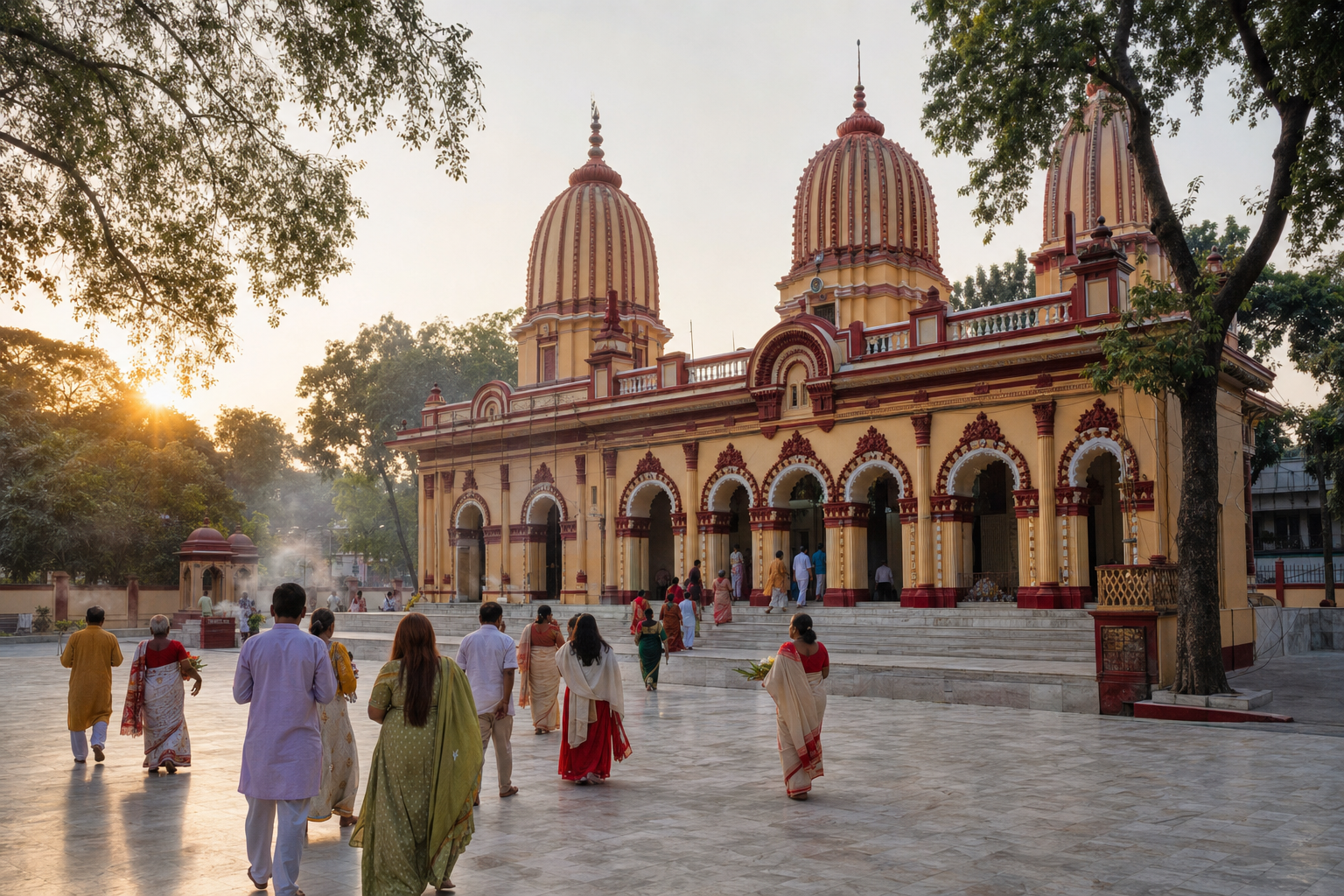
If you are trying to understand why Dhakeshwari Temple matters, looking only for an old building will give you an incomplete answer. Its deeper significance lies in the relationship among Devi, Dhaka, and the Bengali Hindu community that continues to worship there.
Read the temple through three lenses: as a living seat of Shakti, as a home for Bengali ritual culture, and as a sacred institution that has carried memory through political and social change. Those lenses will also help you visit without reducing a place of worship to a sightseeing stop.
Begin with the relationship between the goddess and the city
Dhakeshwari is understood as the Goddess of Dhaka and honored as the city’s guardian. A popular devotional etymology also interprets her name as the hidden or covered goddess, drawing on the sense of dhaka as covered. These two readings are complementary: one locates Devi at the center of the city, while the other evokes a sacred presence that may be concealed yet remains active.
Treat the hidden-goddess explanation as a devotional interpretation, not as a settled linguistic proof. Its importance lies in what it teaches worshippers to notice: divine presence is not limited to what is immediately visible. In Shakta practice, that insight turns a city into more than a collection of streets and institutions. The city can also be imagined as a protected sacred domain.
Dhakeshwari embodies Adi Shakti, the primordial feminine power, in an approachable maternal form. This is the first key to reading the shrine. The universal power of Devi is not left as an abstraction; she is encountered as a guardian with a particular name, place, community, and civic relationship. When devotees approach her for shelter and guidance, philosophy becomes lived devotion.
Tradition associates the temple’s establishment with the 12th century and the Sena dynasty. That traditional origin should not be mistaken for a claim that every visible part of the present complex has remained unchanged since then. The temple has been renewed and expanded over the centuries. Its historical value therefore rests in continuity of sacred use as much as in the age of any particular wall.
This distinction matters whenever you assess an old Hindu temple. Architectural uniformity can indicate a single building campaign, but a layered complex may reveal something equally important: successive communities kept the shrine usable. At Dhakeshwari, change and endurance belong to the same history.
Recognize Bengali Shakti heritage in the ritual grammar
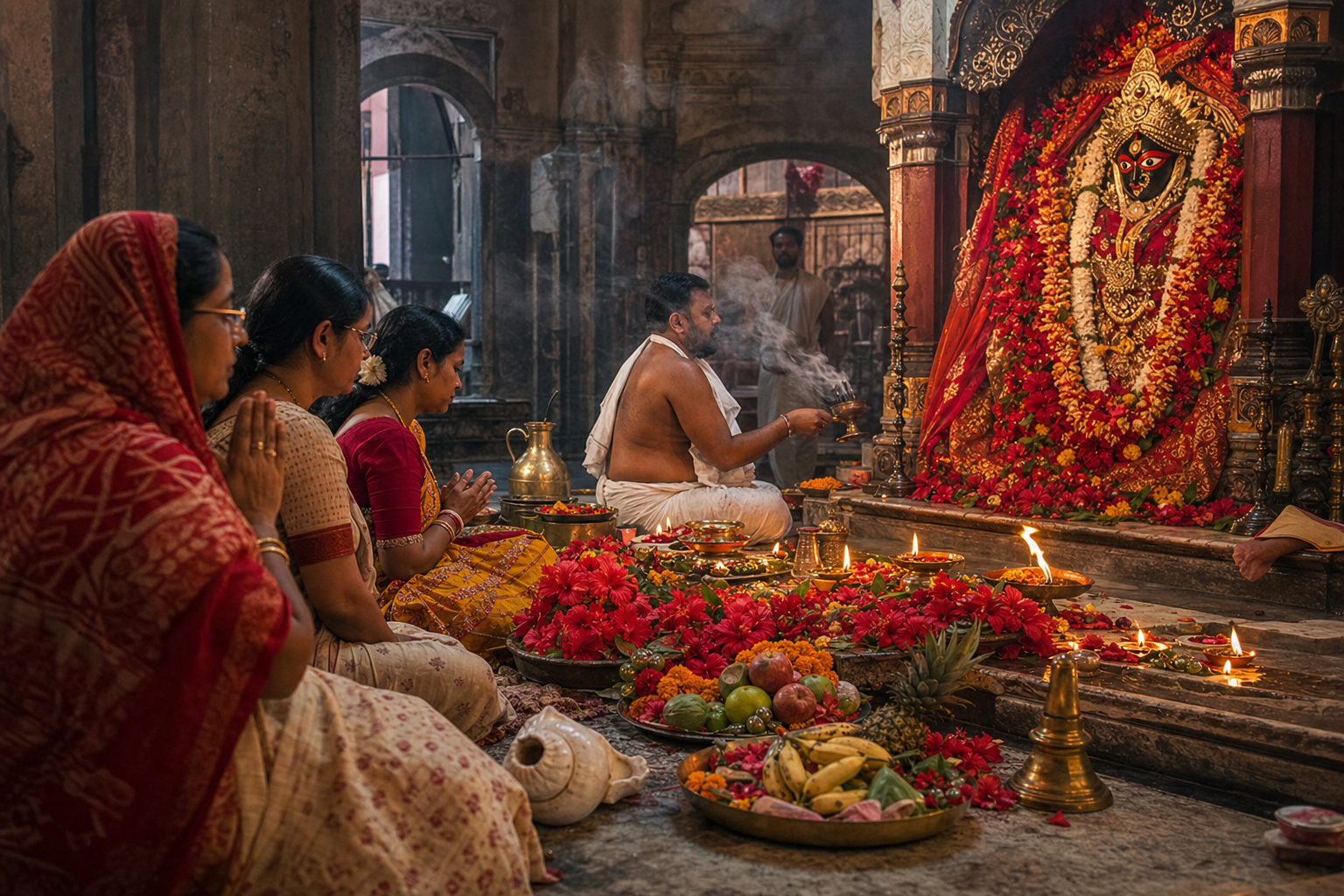
Bengali Shakti heritage is not merely an idea about the divine feminine. At Dhakeshwari, it has a daily grammar of time, sound, language, color, offering, and collective presence. You can begin to understand that grammar even if you do not know every mantra or ritual gesture.
- Time: Mangala aarti opens the devotional rhythm of the day, bhog marks the offering of food, and sandhya aarti gathers worship around the evening lamps. Notice how worship orders the day rather than appearing only on festival occasions.
- Language: Sanskrit mantras coexist with Bangla devotional songs. Sanskrit connects worship to a wider sacred inheritance; Bangla gives that inheritance a distinctly Bengali voice.
- Material offerings: Red flowers, fruit, sweets, and vermilion make devotion tangible. Red blossoms and vermilion are especially associated with the power and auspicious presence of Shakti.
- Sound and light: Bells, recitation, song, incense, and lamps involve the senses. They are not decorative additions to worship; they help turn individual attention toward a shared sacred center.
The temple’s daily cycle of aarti, offerings, mantras, and Bangla song is easy to overlook beside the scale of Durga Puja and Navaratri. Yet daily repetition is one of the principal ways heritage survives. A festival displays the community’s collective strength; ordinary worship carries the tradition from one festival to the next.
Durga Puja makes this Shakta inheritance especially visible. The temple fills with worshippers and visitors, while devotion, music, and community celebration converge. If you want to witness Bengali Shakti heritage at its most public and communal, a festival visit answers that question. If you want to study the temple’s regular devotional rhythm, attend on an ordinary day. These are not better and worse experiences; they reveal different dimensions of the same living tradition.
You may also recognize values honored across the wider Dharmic family: compassion, courage, wisdom, service, reverence, and coexistence. That kinship should not erase distinctions. Dhakeshwari is specifically a Hindu Shakti shrine, with its own deity, ritual language, and community history. The sound Dharmic approach is to recognize shared ethical ground while allowing Hindu, Buddhist, Jain, and Sikh paths to remain themselves.
Read the temple complex as a map of community life
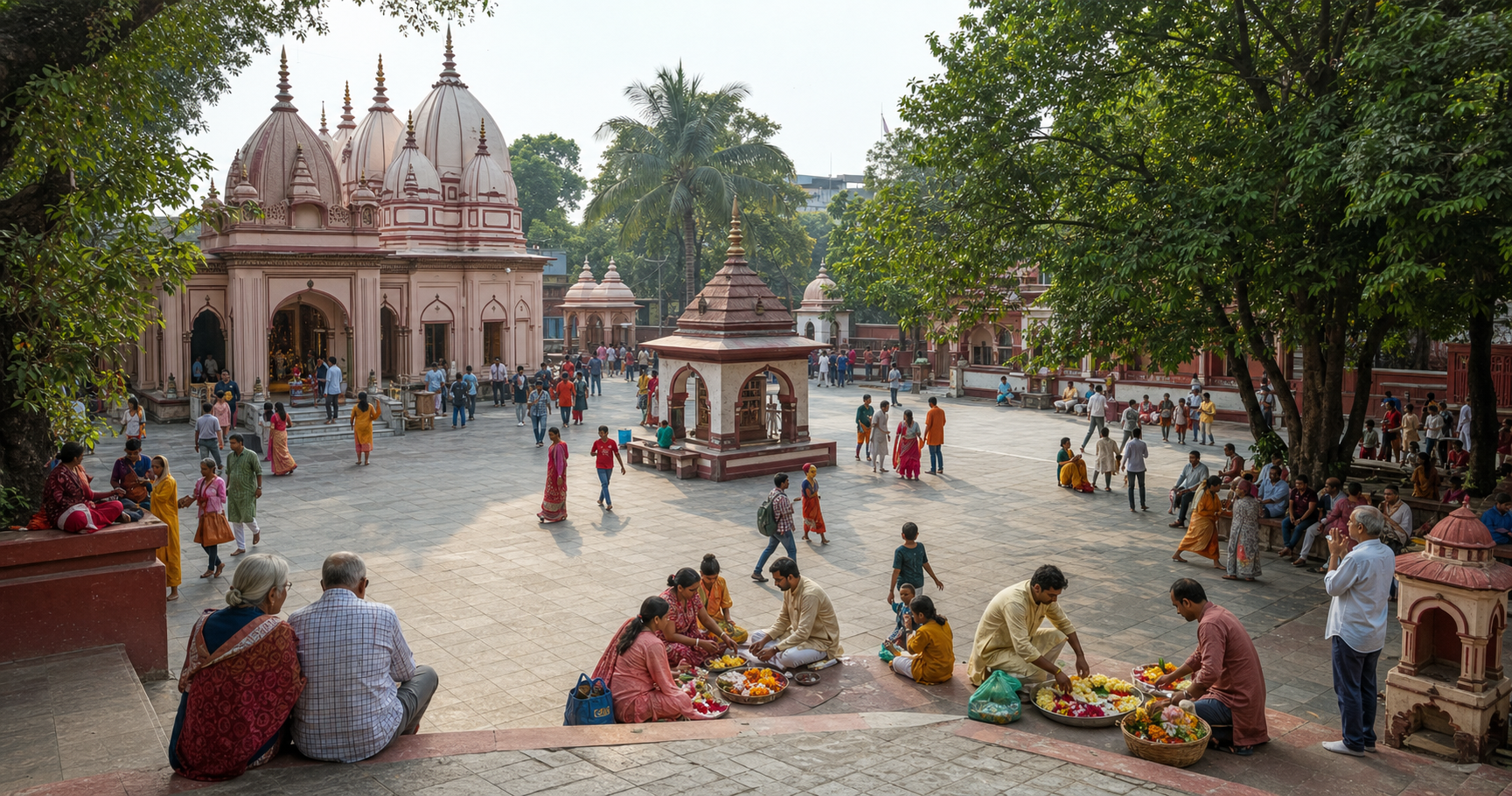
A sacred complex tells you how a community worships by showing where different actions can occur. At Dhakeshwari, open courtyards allow congregational gathering, the natmandir provides an assembly space for ritual and music, subsidiary shrines broaden the field of devotion, and the main sanctum preserves the concentrated encounter with the presiding deity.
Do not judge this arrangement by whether every element belongs to one architectural style. The complex reflects multiple historical layers because it has functioned as a sacred campus, not as a monument frozen at one date. Its spaces have had to serve worship, music, festivals, movement, offerings, and community gathering.
When you enter, notice the change in scale as you move through the complex. A courtyard supports collective visibility and movement. An assembly area supports performance and shared ritual. A sanctum narrows attention toward darshan. This movement from the communal to the concentrated is part of the temple’s meaning, not just a practical floor plan.
The same principle applies to heritage. Buildings preserve material form, but living communities preserve skills and memory. Learning, devotional music, ritual arts, offerings, festival organization, and patterns of participation constitute intangible heritage. If those practices disappear, an old structure can survive while much of the temple’s cultural meaning is lost. Dhakeshwari remains important because worship and community life continue to animate the site.
This is why the temple serves as a cultural anchor for Bengali Hindus in Dhaka. It gives dispersed forms of memory a shared location: Devi can be worshipped, Bangla songs can be heard, ritual knowledge can be practiced, and festivals can gather the community. Its sacred and cultural roles reinforce one another without becoming identical.
Visit in a way that lets the temple disclose itself
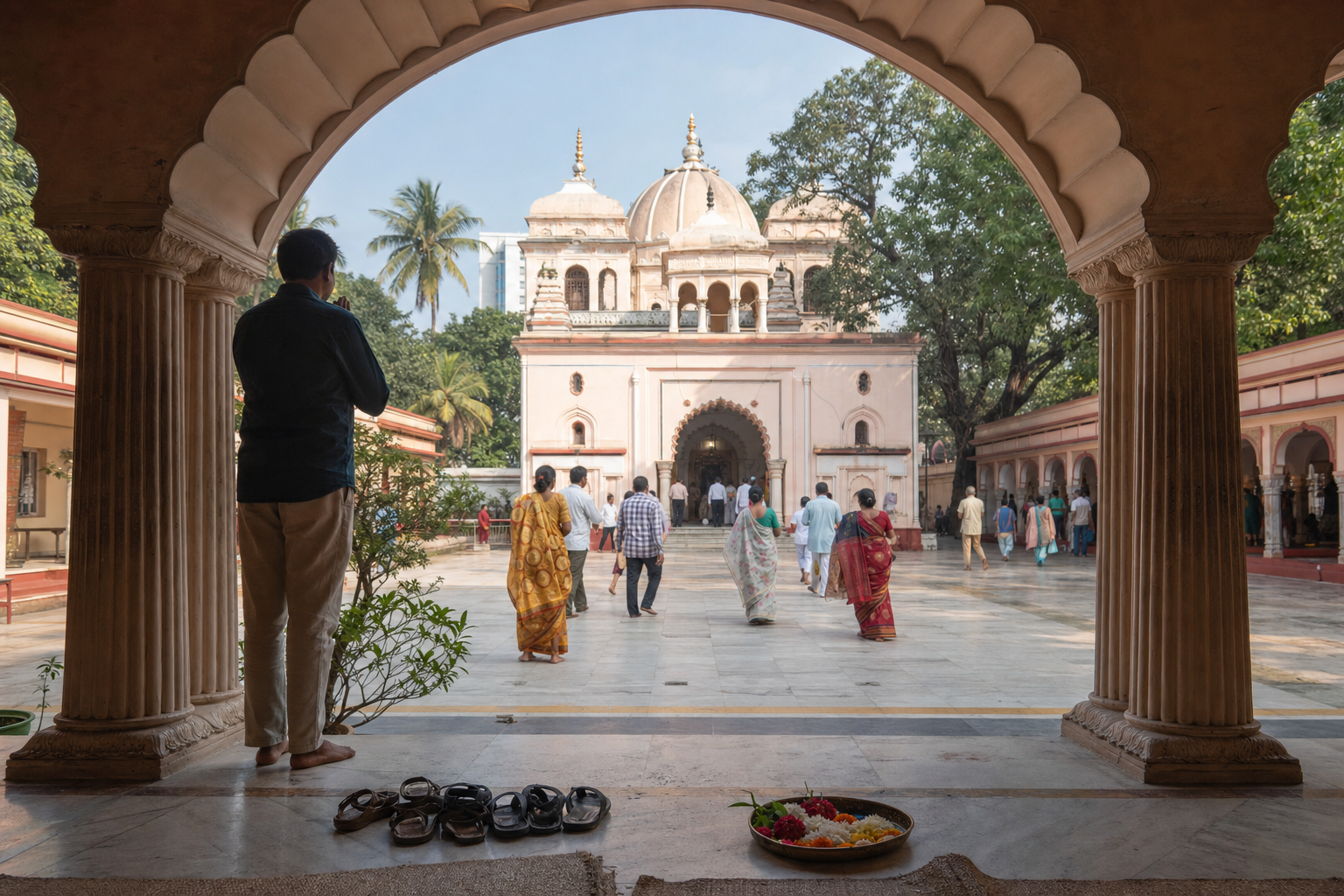
You do not need specialist knowledge to visit attentively. You do need to remember that the sanctum and courtyards are parts of an active place of worship. The following sequence will help you observe without interrupting the people for whom the visit is a religious act.
- Choose what you want to understand. Attend Durga Puja or Navaratri for the public, festival expression of Bengali Shakti devotion. Choose a regular worship day if your priority is the temple’s everyday rhythm.
- Verify the current schedule locally. Ritual times and visitor arrangements can change. If possible, plan around sandhya aarti; the evening lamps, chants, and gathered prayer make the relationship between personal devotion and community especially clear.
- Dress modestly and lower your voice before approaching the sanctum. Let the conduct of worshippers around you set the pace. A pause is often more instructive than rushing directly toward the central image.
- Ask before taking photographs. A camera may be acceptable in one part of a complex and intrusive in another. Never assume that a crowded festival or an open courtyard removes the need for consent and restraint.
- Observe the ritual vocabulary. Notice red flowers, vermilion, fruit, sweets, lamps, bells, Sanskrit recitation, and Bangla song. Instead of treating them as isolated objects, ask what each contributes to the encounter with Shakti.
- Distinguish observation from performance. You may follow clear local cues respectfully, but do not imitate gestures merely for a photograph or spectacle. When uncertain, stand back, watch quietly, and seek guidance from temple personnel.
During aarti, pay attention to where people direct their gaze, when sound intensifies, and how the atmosphere changes as lamps become the focus. You are watching a community create sacred time together. That is more revealing than collecting disconnected architectural facts.
If you bring an offering, flowers, fruit, and sweets belong to the customary vocabulary of worship, but confirm the appropriate local procedure rather than placing anything wherever seems convenient. Respect in a living temple is practical: it means allowing established ritual order to guide your actions.
Key takeaways
- Dhakeshwari is best understood through the relationship between Devi and Dhaka: Adi Shakti is worshipped here as a maternal guardian of a particular city and community.
- The shrine’s traditional 12th-century association does not mean that the whole present complex belongs to a single period. Renewal is part of its continuity.
- Bengali Shakti heritage lives in daily practice: morning and evening aarti, bhog, red flowers, vermilion, Sanskrit mantras, Bangla songs, and collective participation.
- Durga Puja and Navaratri reveal the temple’s festival scale, while an ordinary day reveals the repeated practices that sustain the tradition.
- Courtyards, the natmandir, subsidiary shrines, and the sanctum support different forms of community and devotional life.
- A respectful visit requires modest dress, quiet conduct near the sanctum, restraint with photography, and attention to local guidance.
When you visit or speak about Dhakeshwari, ask one concrete question: what has endured here because people still practice it? Follow that question from the sanctum to the songs, offerings, courtyards, and festivals. You will leave with a clearer understanding of Bengali Shakti heritage as a living discipline of remembrance, not merely a surviving object from the past.
References
