
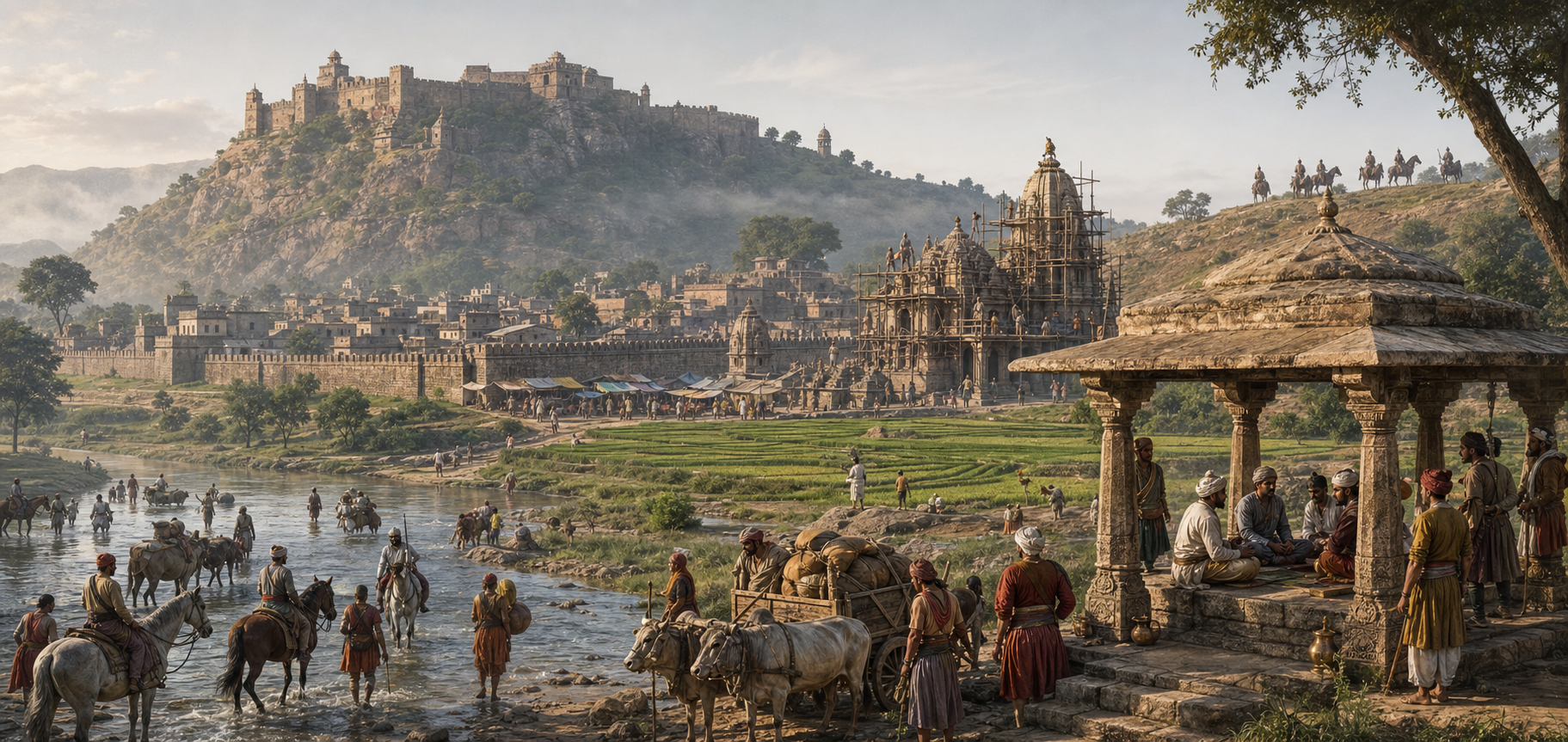
If you were taught medieval Indian history as a procession of Delhi sultans followed by Mughal emperors, you may be left with an obvious question: where did Dharmic India go during those centuries? It did not disappear. The familiar sequence follows whoever occupied an imperial capital, while much of the subcontinent remained a changing field of frontier defence, regional sovereignty, political recovery, negotiated power and institutional continuity.
To see that history clearly, you need a better question than “Who sat on the throne of Delhi?” Ask who governed which territory, for how long, through whose cooperation, against which rivals and with what reach beyond the court. That shift reveals a long contest between numerous Dharmic and Indo-Islamic polities, not a single civilizational handover.
Conquest was not the same as civilizational replacement
Invasion, battlefield victory, territorial rule and durable consolidation are four different things. A successful raid might produce tribute without permanent administration. The capture of a capital might remove a dynasty without settling every province. Even a stable imperial court could depend on regional allies, local officers and institutions it had not created.
This distinction matters from the beginning of the medieval encounter. Arab authority in Sindh and Multan did not become secure dominion over the Gangetic heartland. Chalukya, Gurjara-Pratihara and Karkota power checked further advances in different regions. Arab expansion, which had moved rapidly through West Asia and North Africa, therefore met a substantially different political geography in Bharat.
Lasting control over parts of northern India emerged only after repeated Arab, Turkic and Afghan campaigns extending from 664 CE into the late twelfth century. Even then, control was neither uniformly distributed nor permanently settled. Delhi-centred Indo-Afghan rule crystallized after prolonged warfare, while powerful dynasties continued to govern or contest other parts of the subcontinent.
When you assess any claim of conquest, hold three layers apart. The dynastic layer asks who controlled the court. The territorial layer asks which forts, routes, provinces and revenue networks that court could actually command. The civilizational layer asks whether communities could continue their institutions, learning, worship, local authority and capacity to form new states. A change in the first layer does not automatically settle the other two.
Civilizational resilience should not be romanticized as uninterrupted victory. The Shahi rulers of Uttarapatha fought the Yamini, or Ghaznavid, sultans over several generations and paid heavily for that defence. Their eventual reverses do not make the resistance imaginary. The duration and repeated renewal of the struggle show how long a frontier state could shield the lands behind it.
The honest correction to a story of effortless conquest is not a counter-myth of effortless Dharmic triumph. Medieval India saw destructive defeats, lost capitals, tribute arrangements and changing sovereignties. Its defining pattern was that defeat rarely became the final word everywhere at once. Resistance continued elsewhere, defeated powers regrouped and new centres arose.
Read the map as a series of moving frontiers
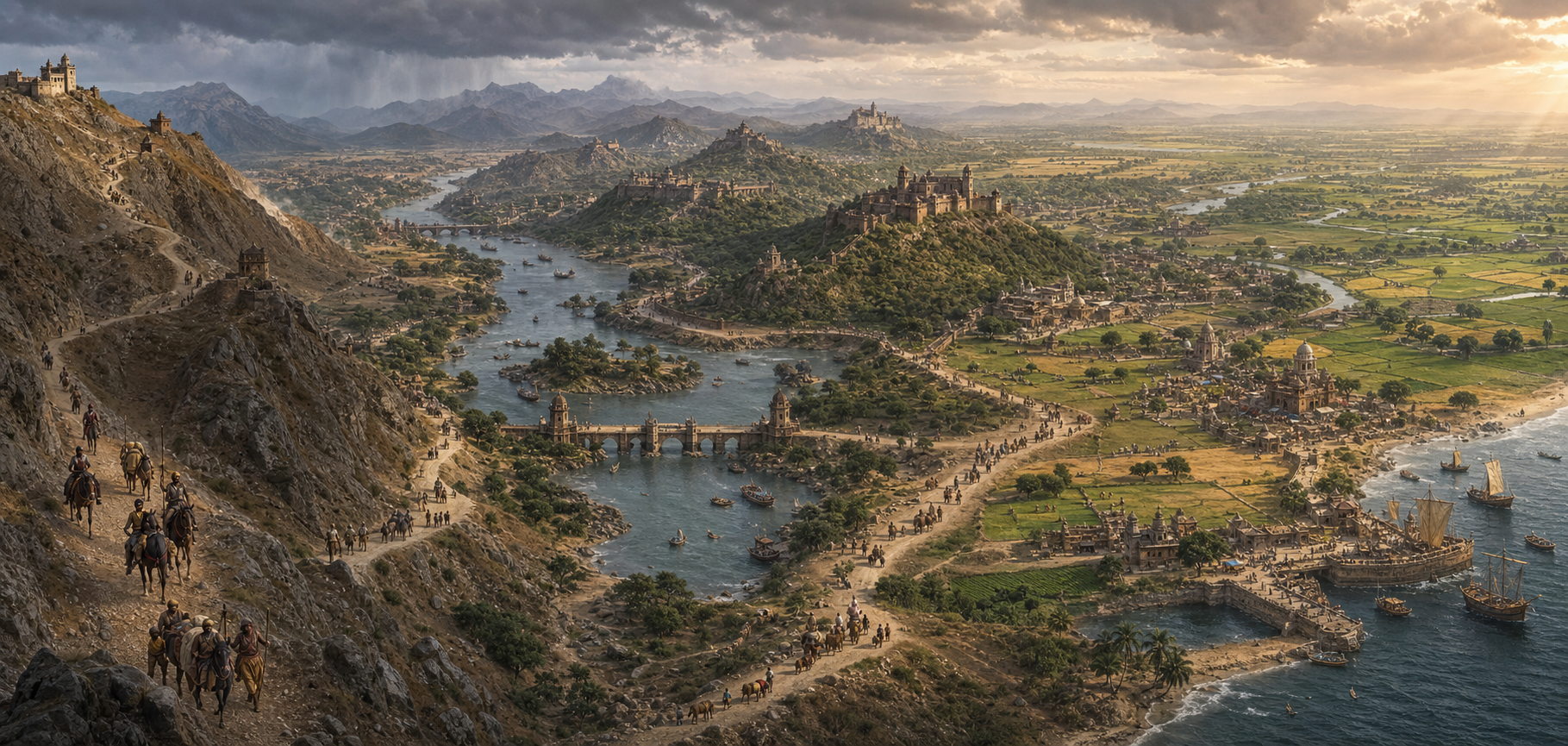
A label such as “Muslim era” paints centuries of history in one colour. A chronological map produces a different picture. The principal contest moved from the northwest to the Gangetic plain, Rajasthan, the Deccan and the south, while older conflicts continued and new coalitions formed.
| Phase | Dharmic resistance or recovery | What you should notice |
|---|---|---|
| Early medieval incursions | The Chalukyas, Gurjara-Pratiharas and Karkotas checked Arab advances from different regional bases. | Control in Sindh did not equal control of northern or southern India. |
| Northwestern frontier | The Shahis of Uttarapatha fought successive Yamini, or Ghaznavid, campaigns over multiple generations. | A frontier defeat must be placed after the decades of defence that preceded it. |
| Late twelfth-century contests | Muhammad Ghori confronted the Chauhans, Gahadavalas, Chandellas and Senas. | The fall of one opponent did not remove the other regional powers from the field. |
| Khalji expansion | The Vaghelas, Parmaras, Kakatiyas, Yadavas, Hoysalas and Pandyas faced campaigns associated with Alauddin Khalji and Malik Kafur. | Campaigns and tribute demands did not produce identical degrees of control across Gujarat, Malwa, the Deccan and the far south; Odisha and Rajasthan also remained difficult to hold firmly for long periods. |
| From 1336 | Vijayanagara consolidated power in the south for roughly three centuries. | The Krishna-Tungabhadra zone became a durable strategic boundary rather than a brief line of retreat. |
| Sixteenth-century realignment | Rana Sanga led a broad Rajput coalition against Babur; Hemu later challenged early Mughal consolidation; Maharana Pratap and Mewar maintained resistance after other Rajput houses allied with Akbar. | Rajput and other indigenous responses ranged from coalition warfare to alliance and continued independence. |
| Seventeenth and eighteenth centuries | Marathas, Jats, Sikh misls and the later Khalsa polity changed the balance of power. | By the time European companies expanded politically, indigenous powers had already transformed the Mughal-centred order. |
Do not read these phases as a relay race in which one dynasty dropped sovereignty and another carried it across all India. Several political worlds existed simultaneously. A ruler might dominate one corridor, collect tribute in another region, fight over a third and possess little practical authority beyond them.
You can test a broad historical claim with a simple map exercise. Mark only the territory a power could govern consistently. Add its independent rivals, frontier buffers and tributary states in separate colours. Then redraw the map for the next major phase instead of extending the first colour across several centuries. The gaps between those maps are where resistance, recovery and regional autonomy become visible.
Vijayanagara is especially important to that exercise. Founded in 1336, it did more than survive a moment of northern pressure. It anchored the Deccan and south, supported formidable military logistics, and fostered administration and temple-centred urban life. Its ability to confine repeated pressure beyond the Krishna-Tungabhadra line makes it a case of civilizational consolidation, not merely local rebellion.
Resistance meant fighting, rebuilding, bargaining and governing
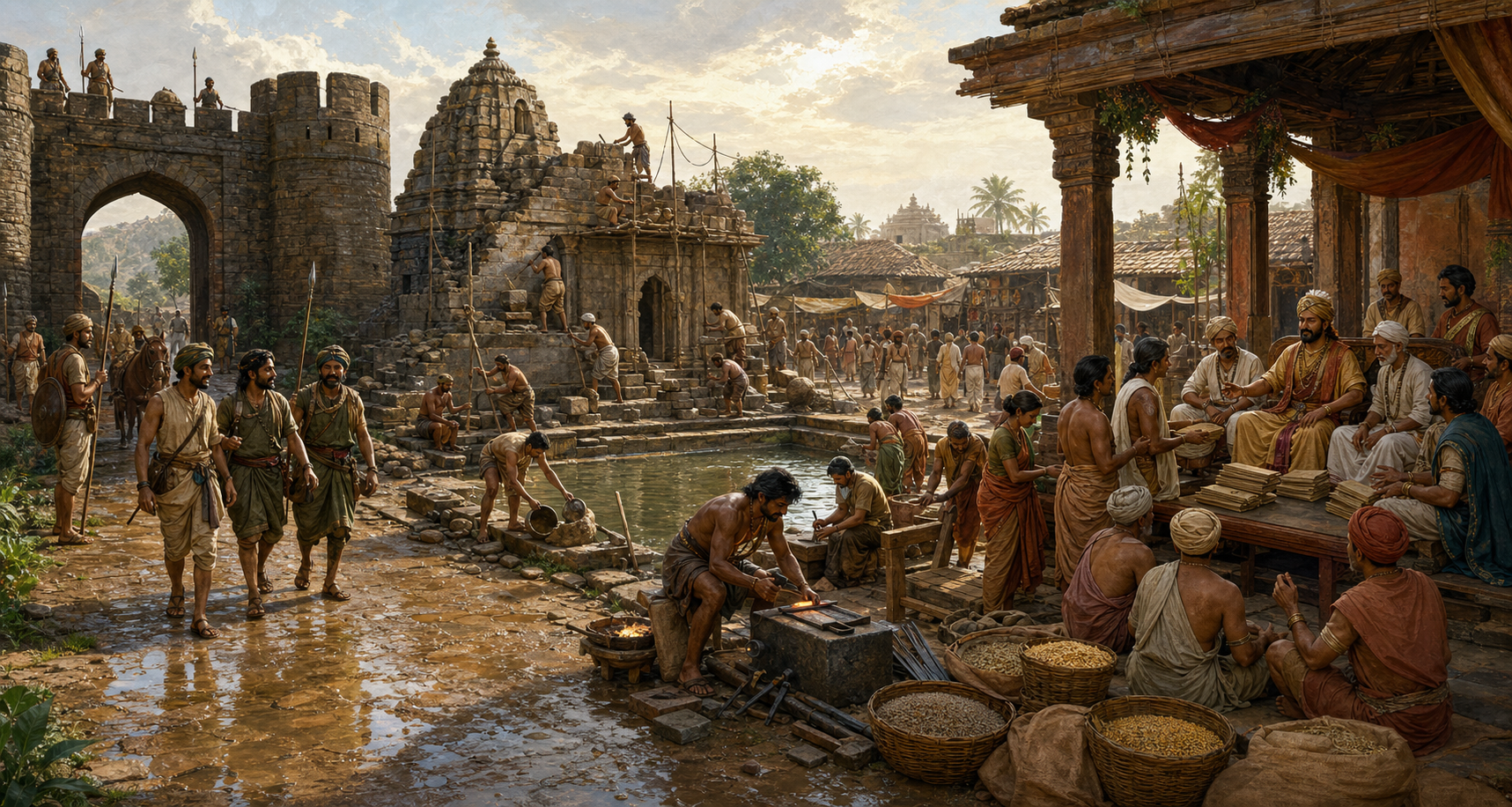
Modern retellings often recognize resistance only when it produces a dramatic battlefield victory. Medieval statecraft used a larger repertoire. Defence could delay an advance, preserve a trade route or give another region time to organize. Recovery could create a new centre after an older kingdom fell. Diplomacy could divide an enemy coalition or preserve internal authority. Service within an empire could also alter how that empire governed.
Hold the frontier long enough for the interior to endure
Frontier defence should be judged by more than the final battle. The early checks imposed by the Chalukyas, Gurjara-Pratiharas and Karkotas helped stabilize frontiers and protect important corridors. That breathing room allowed Indian institutions, learning and temple-centred economies to continue developing. Delay, containment and denial of access were strategic results even when they did not eliminate the external challenger.
Reconstitute power after a capital or dynasty falls
The capacity to rebuild may be the clearest test of resilience. Chauhans, Gahadavalas, Chandellas and Senas did not constitute one unified command against Muhammad Ghori, and their reverses were consequential. Yet those reverses did not end Dharmic state formation throughout Bharat. Vijayanagara later consolidated the south; Mewar retained an independent line of resistance; Maratha, Jat and Sikh power eventually reordered large parts of the political landscape.
This changes what you should look for after a defeat. Do not stop when a capital is captured. Look for the displaced court, surviving forts, successor houses, regional coalitions and new centres that emerge in the following phase. If political organization reappears, the relevant story is not simply collapse. It is collapse followed by reconstitution.
Distinguish strategic accommodation from disappearance
Akbar’s consolidation illustrates why diplomacy belongs inside the history of resistance and survival. His success rested substantially on conciliation, Rajput alliances and the service of Hindu commanders and administrators. Shared governance gave the Mughal state a stability that coercion alone had not secured.
That does not mean every Rajput house made the same judgement. Mewar under Maharana Pratap and the Sisodias refused incorporation and defended its independence. Alliance and refusal therefore operated at the same time within the same broad political community. Calling one response “submission” and the other “resistance” without examining their aims, terms and consequences is too crude.
When evaluating an alliance, ask what remained under local control. Did the house retain territory, succession, worship, patronage or administrative authority? What military or revenue obligations did it accept? Did cooperation create room for continuity, or did it merely postpone dispossession? Those questions are more useful than assigning a moral label from a distance.
Preserve the institutions from which recovery becomes possible
A civilization is not identical to its royal house. Temples, pilgrimage networks, teachers, local communities, commercial routes, agricultural systems and inherited forms of authority can outlast a dynasty. Political resistance matters partly because it protects the social infrastructure from which political renewal can later grow.
This is why Vijayanagara’s temple-centred urbanism and administrative capacity belong in the same account as its armies. It is also why later Maratha and Sikh expansion cannot be treated as inexplicable eruptions after centuries of absence. The institutions and communities capable of supporting renewed sovereignty had never uniformly ceased to exist.
Use “Dharmic” precisely, without creating another myth
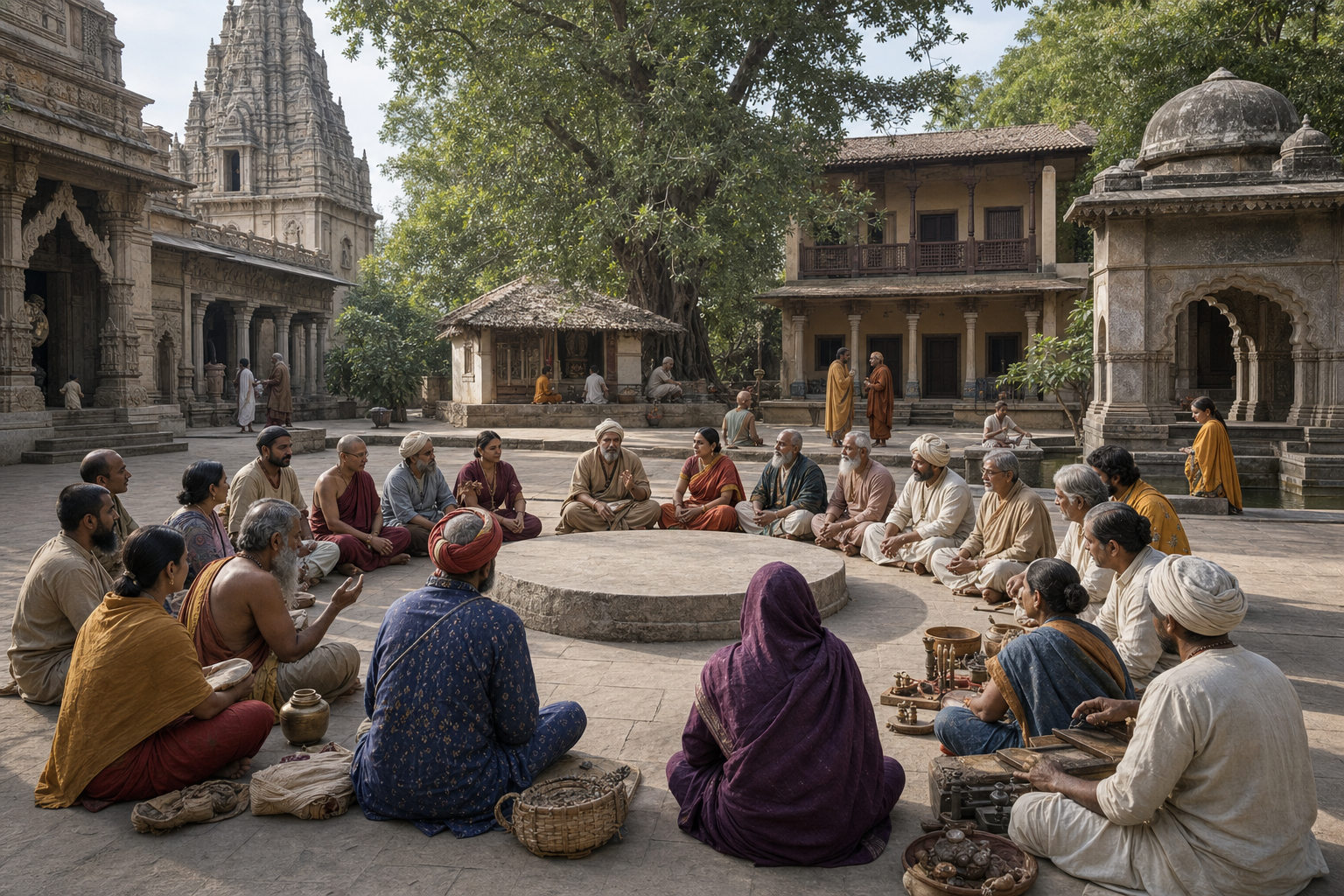
“Dharmic resistance” is useful when it identifies a shared civilizational stake in cultural autonomy, ethical rule and spiritual plurality. It can connect Hindu, Jain, Buddhist and, in the later medieval and early modern north, Sikh histories without claiming that these communities always acted as one political bloc.
The term becomes misleading if it turns every indigenous ruler into a representative of one timeless party. Dynasties competed with one another. Some made alliances across religious lines. Regional interest, succession, revenue, trade and survival affected political decisions alongside religious identity. Dharmic solidarity is therefore a civilizational interpretation of continuity, not a claim that medieval politics lacked internal conflict.
The same precision is necessary on the other side. “Muslim” does not name a single medieval state. Arab authorities in Sindh, Ghaznavid and Ghurid forces, Indo-Afghan sultanates, the Khalji regime and the Mughal empire came from different political settings and pursued different strategies. Their governments also relied to varying degrees on Indian allies, administrators and commanders. Religious description cannot substitute for dynastic, regional and chronological specificity.
Akbar’s Rajput policy and Mewar’s refusal demonstrate the point particularly well. One emperor obtained stability through conciliation; several Rajput houses entered imperial service; another Rajput house continued to resist. All three facts belong in the same frame. Removing any one of them produces either a conquest legend, a collaboration caricature or a triumphalist counter-legend.
A pro-Dharma history need not soften invasion, coercion or political loss. It should name them plainly. It also need not convert medieval conflicts into accusations against living communities. Our task is to restore the agency of those who defended and renewed Dharmic civilization while preserving the distinctions that make the history intelligible.
The later balance of power makes that agency impossible to dismiss. Marathas rose to paramount influence, Jats established durable strongholds, and Sikh misls and the Khalsa reshaped northern politics. The Mughal emperor ultimately depended on Maratha power for survival. That is not the ending expected by a narrative in which Dharmic sovereignty had simply vanished centuries earlier.
Key takeaways for reading medieval India
- Ask for the geography. “Conquered India” is not a useful claim until you know which regions, routes and capitals were actually controlled.
- Separate victory from consolidation. Winning a battle, collecting tribute and building durable administration are different achievements.
- Continue past the defeat. Look for successor houses, surviving frontiers, new coalitions and reconstituted states in the next phase.
- Count diplomacy as political action. Judge an alliance by what it preserved, what it conceded and how it changed the balance of power.
- Track institutions as well as thrones. Learning, temples, commerce, local authority and community organization help explain how civilizational recovery remained possible.
- Name the actual actors. “Arab,” “Ghaznavid,” “Ghurid,” “Khalji,” “Indo-Afghan” and “Mughal” are more informative than a monolithic “Muslim era”; “Chalukya,” “Pratihara,” “Shahi,” “Vijayanagara,” “Mewar,” “Maratha,” “Jat” and “Sikh” are more informative than an undifferentiated indigenous response.
The next time you encounter a chapter organized only around Delhi’s rulers, write three things in the margin: the territory they demonstrably held, the powers still opposing them and the institutions that continued beyond their court. Then follow the map into the next generation. You will see a history of severe pressure and real loss, but also one of containment, adaptation, political return and civilizational renewal.
That is the confidence worth carrying forward. It does not require an immaculate past. It rests on the harder fact that Dharmic communities repeatedly fought, negotiated, governed and rebuilt. Remembering those choices gives you a more accurate medieval India and a more responsible way to inherit it.
References
