

You may already chant and read scripture, yet feel that the two parts of your practice never quite meet. The mantra gathers your attention. The page gives you ideas. Then ordinary life resumes, and neither seems to guide the next difficult conversation or moral choice.
A useful remedy is to give sacred sound, scriptural testimony, reasoning, and lived conduct distinct jobs. Chant to remember. Read to understand what you are remembering. Question to protect yourself from careless interpretation. Then carry one clear teaching into action. That is how inherited knowledge begins to become lived dharma.
Give sacred sound and scripture different jobs
Sacred sound is not merely a pleasant introduction to the serious work of reading. In a living tradition, recitation is itself a mode of attention, remembrance, devotion, and participation. Scripture, meanwhile, gives that practice its theological and ethical orientation. Sound keeps knowledge from remaining purely conceptual; scripture keeps powerful feeling from becoming its own authority.
Consider Vaishnava sankirtana. Sri Caitanya carried the congregational chanting of Hare Krsna, Hare Krsna, Krsna Krsna, Hare Hare / Hare Rama, Hare Rama, Rama Rama, Hare Hare from community to community. Within that tradition, the names are not treated as interchangeable calming syllables. They are devotional address, remembrance of the Divine, and a practice understood to awaken love of God.
The same distinction matters when you encounter other Dharmic forms of sacred utterance. Hindu kirtan and nama-smarana, Buddhist recitation, Jain stavan, and Sikh Shabad can all discipline attention and gather a community, but they do not make identical claims. In Sikh tradition, Shabad is inseparable from the authority of the Guru Granth Sahib. A Jain stavan belongs within Jain understandings of the liberated ones, right conduct, and release. Similarity of practice does not erase difference of meaning.
Before reciting, therefore, identify what you are actually doing. Name the mantra, hymn, or passage. Name the tradition or lineage in which you received it. Ask what or whom it addresses, what it asks you to remember, and what kind of life should follow from it. If you cannot answer those questions, your next step is not to collect another chant. It is to study the one already in your mouth.
Use three tests when a teaching asks for your trust

Spiritual experience can be compelling, but intensity is not the same as truth. A chant may leave you peaceful without proving every interpretation attached to it. A clever argument may be valid in form while resting on a weak premise. A scriptural quotation may be authentic while being removed from the passage, genre, or lineage that gives it meaning.
Vedic epistemology gives you a disciplined way to examine such claims through pratyaksa, anumana, and sabda: direct perception, logical inference, and authoritative testimony. They are complementary means of knowledge, not three slogans to deploy against an inconvenient question.
| Pramana | What it contributes | Question to ask | Its practical limit |
|---|---|---|---|
| Pratyaksa | What you directly perceive or experience | What actually changed in my attention, choices, or conduct? | The senses are limited, and an inner state can be misunderstood. |
| Anumana | What can be inferred through sound reasoning | Does this conclusion follow from the premises, or did I smuggle in an assumption? | A valid argument cannot rescue an unsupported premise. |
| Sabda | Reliable testimony received through an authoritative tradition | What is the teaching, where does it come from, and is my reading consistent with its context? | A quotation without authentication, context, or competent interpretation can mislead. |
Within the Brahma-Madhva-Gaudiya Sampradaya, sabda is treated as primary, while perception and inference serve in support. The familiar discipline of guru, sastra, and sadhu then provides a practical cross-check: guidance from the spiritual teacher, the testimony of scripture, and the understanding embodied by trustworthy practitioners should cohere rather than pull in unrelated directions.
This does not require you to suppress doubt. It tells you how to make doubt productive. Locate the passage rather than relying on a remembered fragment. Ask how the conclusion follows. Consult someone formed by the relevant tradition, not merely someone confident on the internet. Finally, observe whether the interpretation produces the ethical qualities it praises. A claim that repeatedly excuses dishonesty, contempt, or irresponsibility deserves renewed scrutiny even when it is expressed in devotional language.
Turn chanting and reading into one practice cycle

You do not need an ever-expanding library to connect sacred sound with scriptural knowledge. You need a repeatable sequence that moves from reception to understanding and from understanding to conduct.
- Choose a bounded unit. Work with one received mantra, hymn, narrative episode, or coherent scriptural passage rather than moving rapidly among disconnected quotations.
- Identify its home. Record the name of the text, tradition, and teacher or community through which you encountered it. This makes later verification possible.
- Recite with attention to hearing. Do not race toward a desired mood. Notice the names, petitions, qualities, or teachings that the words actually place before you.
- Read for structure. Ask what the passage narrates, what it claims, what reason it gives, and what response it requests. Narrative, praise, philosophical explanation, and practical instruction should not be read as if they were the same literary form.
- Restate the teaching plainly. If you cannot explain it without repeating devotional adjectives, you may be moved by the passage without yet understanding its claim.
- Check your reading. Compare it with the surrounding scripture, reason through its implications, and seek guidance from a competent practitioner in the relevant lineage.
- Translate it into conduct. Choose an observable expression such as truthfulness in a difficult exchange, restraint when anger rises, compassion toward someone easily dismissed, or seva that meets an actual need.
- Review the fruit. At the next practice, ask not only whether you felt peaceful but whether remembrance affected what you did when the atmosphere was no longer devotional.
This cycle also works in satsanga. The sages gathered at Prayag to hear Sage Suta speak on the Shiva Maha Purana, bringing community, sacred teaching, disciplined listening, and sacred place into one act of reception. The Puranic model does not separate story from philosophy or devotion from conduct. Listening is meant to mature through reflection, vrata, meditation, pilgrimage, and service.
You can preserve that purpose in a contemporary reading circle by assigning the gathering a definite passage and question. Let someone establish the context before discussion begins. Require interpretations to return to the actual words and surrounding narrative. End by naming a practice or responsibility that follows from the discussion. This keeps satsanga from becoming either a lecture that nobody digests or a conversation in which every impression is treated as equally authoritative.
Share sacred sound without flattening Dharmic traditions
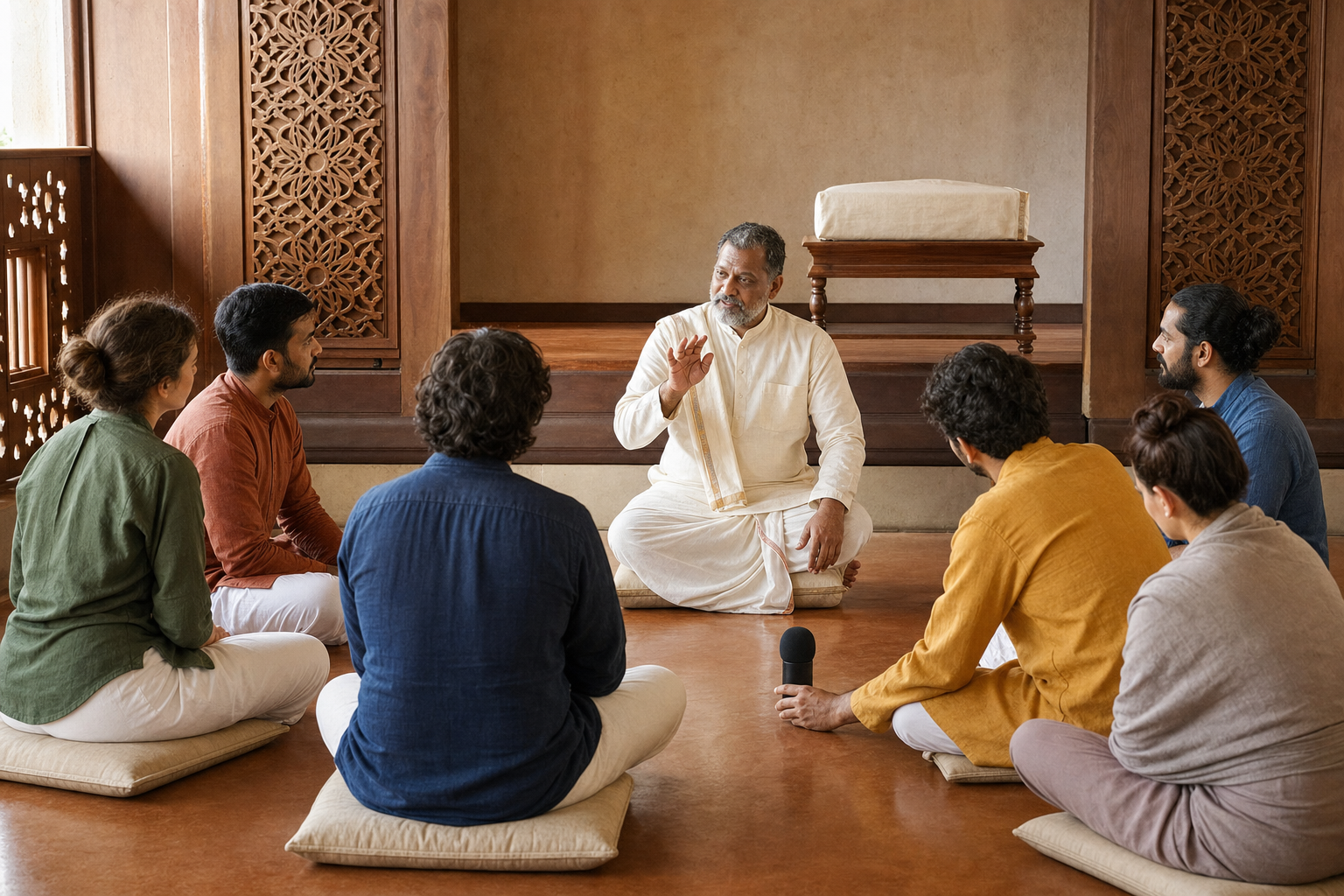
Sacred sound can create genuine fellowship across Hindu, Buddhist, Jain, and Sikh communities. Congregational recitation makes room for shared attention, humility, compassion, and seva. Yet unity becomes durable only when it is honest about difference. Treating every name, mantra, hymn, and scripture as a generic spiritual vibration may sound inclusive, but it removes the very teachings that make each practice intelligible.
- Name the tradition and text before a recitation begins. Participants should know whether they are hearing kirtan, nama-smarana, stavan, Shabad, or another defined practice.
- Let a practitioner of that tradition explain what the sacred sound means within its own theology. Do not force an immediate equivalent from another path.
- Distinguish respectful presence from assent. People may listen reverently without pretending that all traditions make the same doctrinal claims.
- Invite participation without compulsion. A sacred gathering should not turn recitation into a test of social belonging.
- Build fellowship through shared ethical action. Compassion, self-discipline, non-violence, truthfulness, and service offer practical ground for cooperation without requiring theological erasure.
This approach allows you to receive wisdom from another Dharmic path while remaining intellectually honest about your own. It also makes dialogue more interesting. Once nobody is required to manufacture sameness, participants can ask better questions about authority, liberation, devotion, right conduct, and the purpose of recitation.
Key takeaways
- If chanting produces strong feeling but leaves the teaching unclear, study the sound within its scriptural and lineage context.
- If reading produces arguments but no remembrance or change in conduct, bring the teaching into recitation, contemplation, and practice.
- If a spiritual claim rests only on private experience, examine it through pratyaksa, anumana, and sabda rather than accepting or rejecting it impulsively.
- If an interpretation conflicts with scripture, sound reasoning, and the mature counsel of the tradition, confidence alone does not make it reliable.
- If an inter-Dharmic gathering creates unity by hiding the origins and meanings of its practices, restore those distinctions.
- Judge understanding by its ethical fruit as well as its vocabulary: steadiness, compassion, truthfulness, humility, restraint, and useful service.
At your next practice, do not add more material. Choose a sacred sound you already trust and a bounded passage that explains its world. Recite it, read carefully, state the teaching in plain language, and decide what it requires in your next ordinary encounter. That small circuit is where received knowledge begins to become lived dharma.
References
- Dandavats — Sri Caitanya’s Sankirtana: Timeless Chanting Uniting Dharmic Traditions Worldwide
- Dandavats — From Doubt to Clarity in Krishna Consciousness: Navigating Vedic Proofs with Confidence
- Hindu Pad — Shiva Maha Purana at Prayag: Sage Suta’s Discourse on Moksha, Dharma, and Timeless Wisdom
