
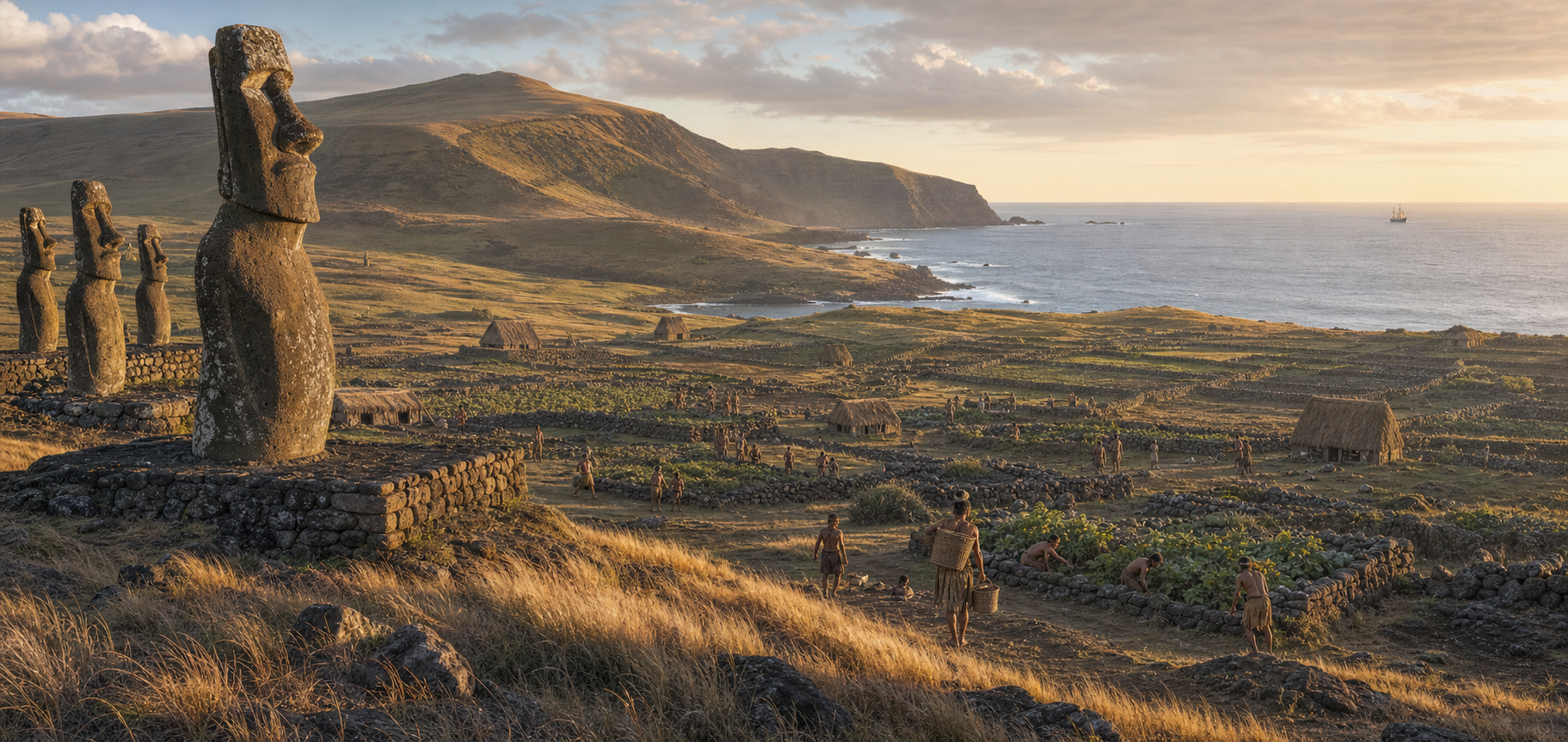
If you were taught that Easter Island’s people cut down their last trees, descended into violence and destroyed their own civilization, you were given a clean story with a broken chronology. It compresses centuries of ecological change, adaptation, foreign contact, epidemic disease, slave raiding and cultural suppression into one accusation: the islanders did it to themselves.
You do not have to deny deforestation to reject that accusation. The useful question is not whether Rapa Nui lost its forests. It did. The question is whether forest loss caused a pre-European societal collapse. Once you separate environmental transformation from the demographic catastrophe that followed contact, the familiar ‘ecocide’ explanation no longer carries the weight placed upon it.
Start with the sequence, not the morality tale
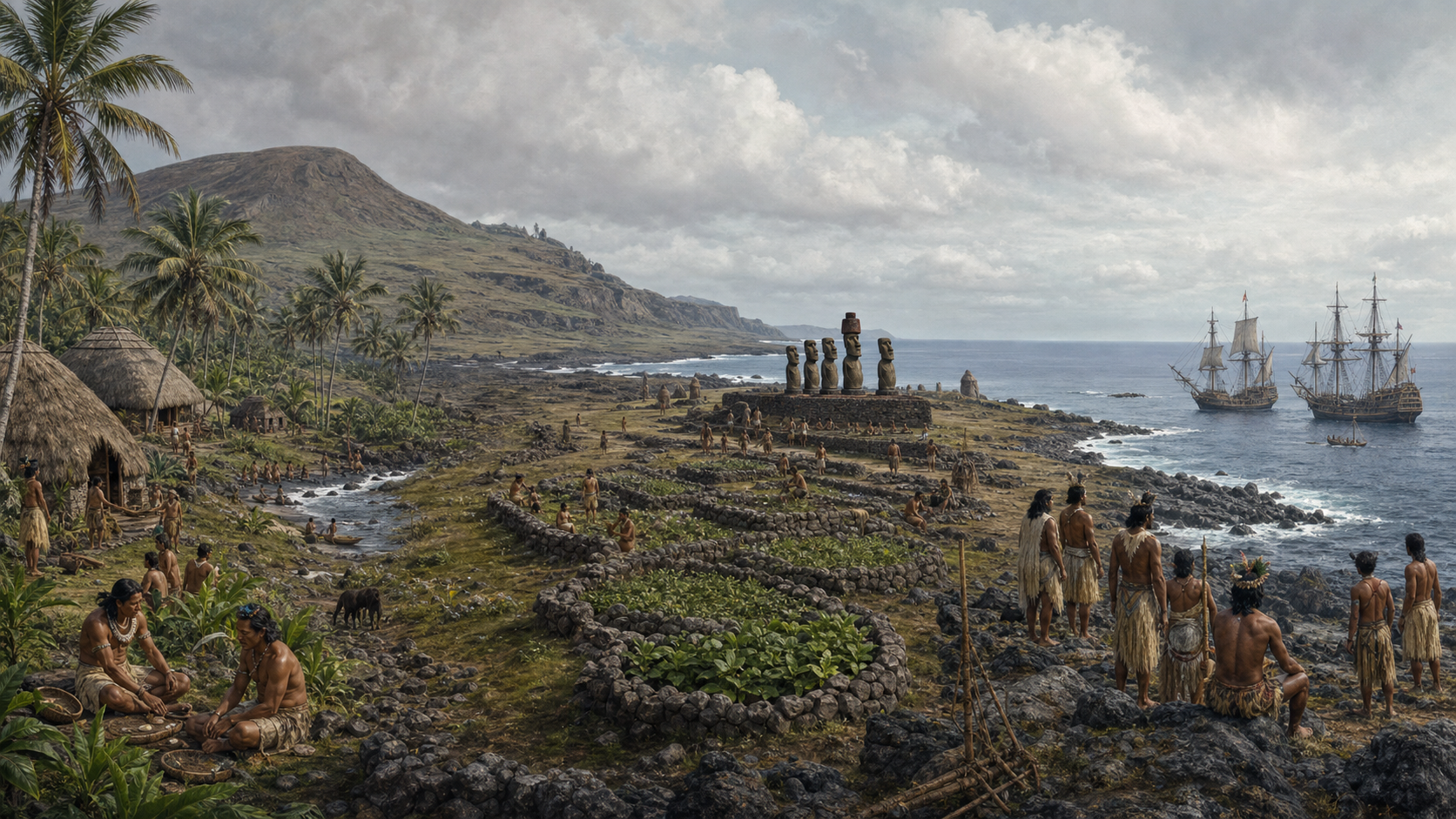
The classic scenario proposes a continuous chain: trees were felled to transport moai, the ecological base failed, food became scarce, warfare followed, and society collapsed before Europeans arrived. Each link must be demonstrated independently. A ruined landscape seen at one moment does not, by itself, establish who caused a later population collapse or how the intervening society functioned.
Extensive deforestation was real, and tree loss had begun by the 13th century. Yet when the Dutch explorer Jacob Roggeveen reached Rapa Nui in 1722, he encountered people who appeared well nourished and were cultivating yams, sweet potatoes and sugarcane. He did not encounter the unmistakable remains of a society already destroyed by famine and civil war.
That encounter cannot prove that earlier generations experienced no hunger, dispute or hardship. It does create a serious chronological problem for the claim of complete pre-contact collapse. A population growing several crops and sustaining organized communities after centuries of tree loss was not simply waiting among the ruins of an ecological suicide.
Whenever you see the word ‘collapse’ in this history, replace it with a more exact question: collapse of what? The palm forest, monument building, population, political autonomy and traditional ritual life did not necessarily decline at the same time or for the same reason. Treating them as one event is how an environmental change becomes a sweeping indictment of an entire people.
Forest loss reveals adaptation as well as environmental pressure
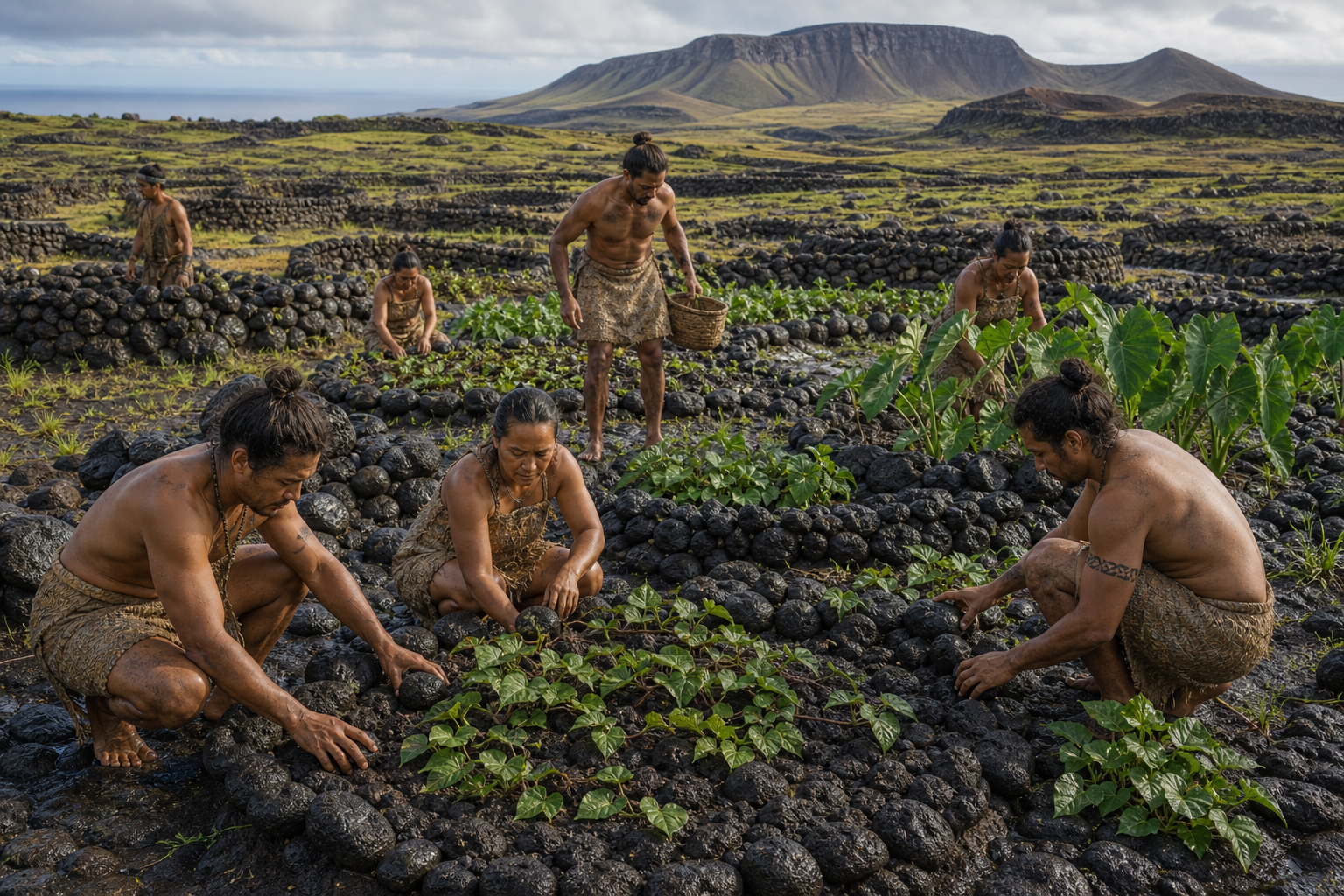
Rapa Nui’s inhabitants had to live within severe geographic limits. They were on a small, isolated island, and the disappearance of its large trees altered the resources available to them. But ecological pressure is not synonymous with social incapacity. The relevant evidence is what people did after the environment changed.
Communities continued producing food through several strategies. They cultivated crops, used caves for cultivation and drew upon substantial marine resources. These practices help explain why Roggeveen could find nourished inhabitants in 1722 despite the island’s extensive tree loss. The stronger historical picture is therefore neither pristine harmony nor instant ruin. It is environmental transformation followed by human adjustment.
The moai also demand a less mechanical explanation. Rapa Nui communities quarried enormous volcanic figures, shaped them and erected them on engineered coastal platforms. That work required specialized knowledge, coordination and a social order capable of sustaining difficult projects. Monumental construction is evidence of institutional capacity, not merely evidence of resource consumption.
The old assumption that great quantities of timber were required to roll every statue has also weakened. Experimental transport has shown that moai can be made to ‘walk’ upright with ropes, using their shape and center of gravity. An experiment does not prove that every statue traveled by that method. It does prove that a timber-intensive roller system is not the only plausible mechanism, so it cannot safely serve as the foundation of the ecocide narrative.
Resilience should not be confused with ecological innocence. A society can transform its environment, endure the consequences and develop ways to continue living. If you want an environmental lesson from Rapa Nui, make it an honest one: human communities can damage ecosystems, but the presence of damage does not license us to invent famine, civil war or demographic collapse where the timing and material evidence do not support them.
European contact changed the scale and kind of crisis
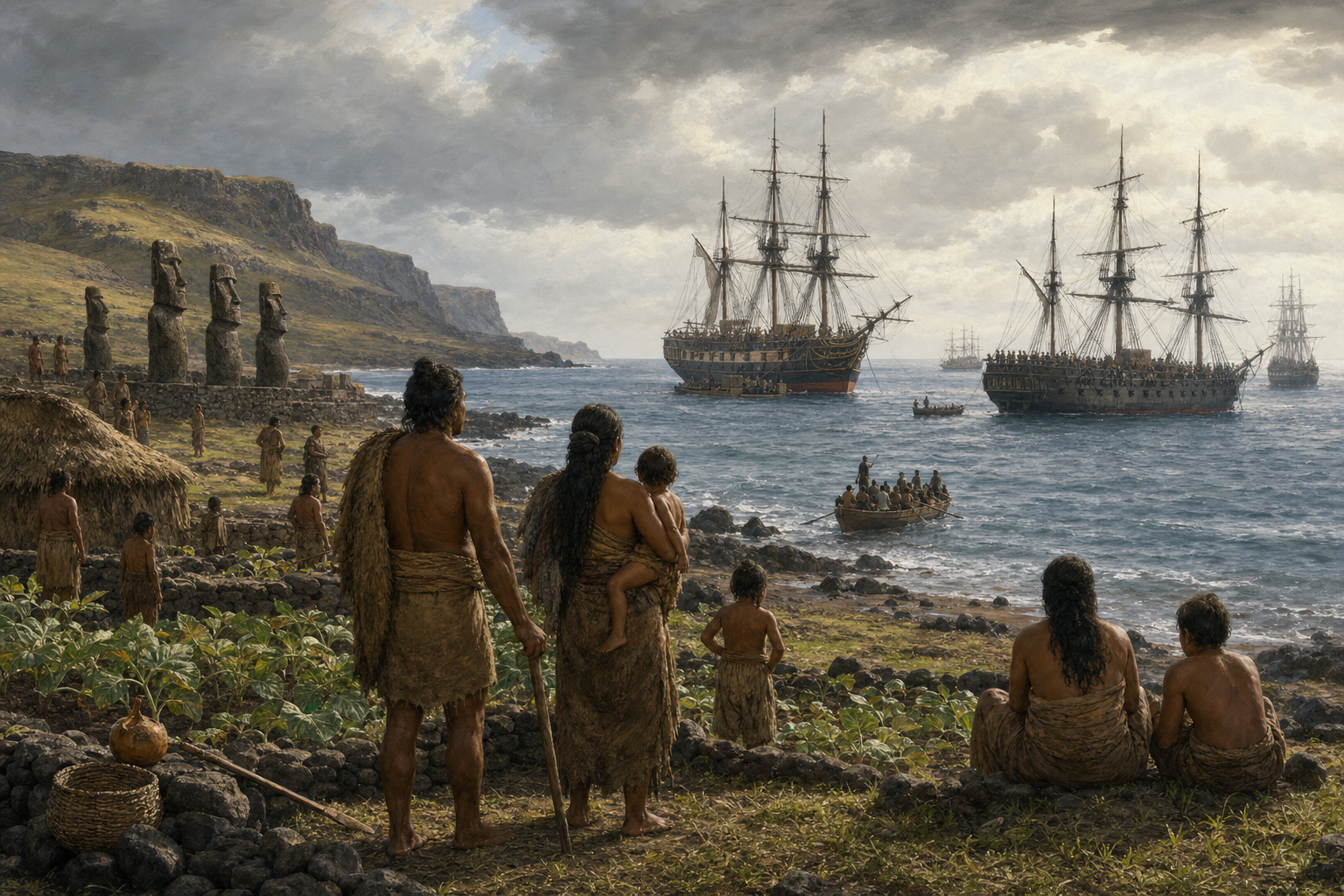
The decisive rupture came after 1722. European ships exposed an isolated population to pathogens against which it had little immunity. Later visitors encountered conditions markedly different from those Roggeveen had described. By the time Captain Cook arrived decades later, disease, malnourishment and toppled statues were visible signs of disruption. Spanish vessels, whalers and merchants brought further exposure and pressure.
The 19th century added deliberate human predation to epidemic vulnerability:
- In 1805, the American ship Nancy seized Rapa Nui people.
- During 1862 and 1863, Peruvian slavers abducted roughly 1,500 islanders for mines and plantations. For a small population, the removal of so many people also meant the loss of parents, workers, leaders and holders of cultural knowledge.
- Missionary campaigns suppressed indigenous practices, including the Birdman, or tangata manu, ritual. The placement of St. Peter over earlier iconography became a visible sign of religious replacement.
- By 1877, only 111 people remained on Rapa Nui.
- Chile annexed the island on 9 September 1888, formalizing a new political order after generations of outside disruption.
These mechanisms should not be blurred into one vague disaster. Introduced disease was not the same act as a slave raid. Abduction and forced labor involved direct coercion. Missionization targeted cultural continuity. Annexation altered sovereignty. Their effects nevertheless accumulated within the same contact and colonial era, leaving the islanders fewer people and fewer opportunities to transmit institutions, rituals and knowledge.
The word ‘genocide’ expresses the moral gravity of a population being reduced through disease, forced removal, labor exploitation and cultural suppression. If you use it, explain those mechanisms instead of asking the label to carry the whole argument. ‘Rapa Nui’s population was shattered after contact through introduced disease, slave raiding and colonial pressure’ tells the reader more than either ‘they collapsed’ or ‘Europeans destroyed them’ without further detail.
The numbers make the causal problem plain. A well-nourished agricultural population was encountered in 1722. Roughly 1,500 people were then abducted in just 1862-1863. Only 111 remained in 1877. Forest loss centuries earlier cannot adequately explain that sequence without erasing the documented interventions that occurred between its beginning and its catastrophic end.
Five familiar claims deserve more careful wording
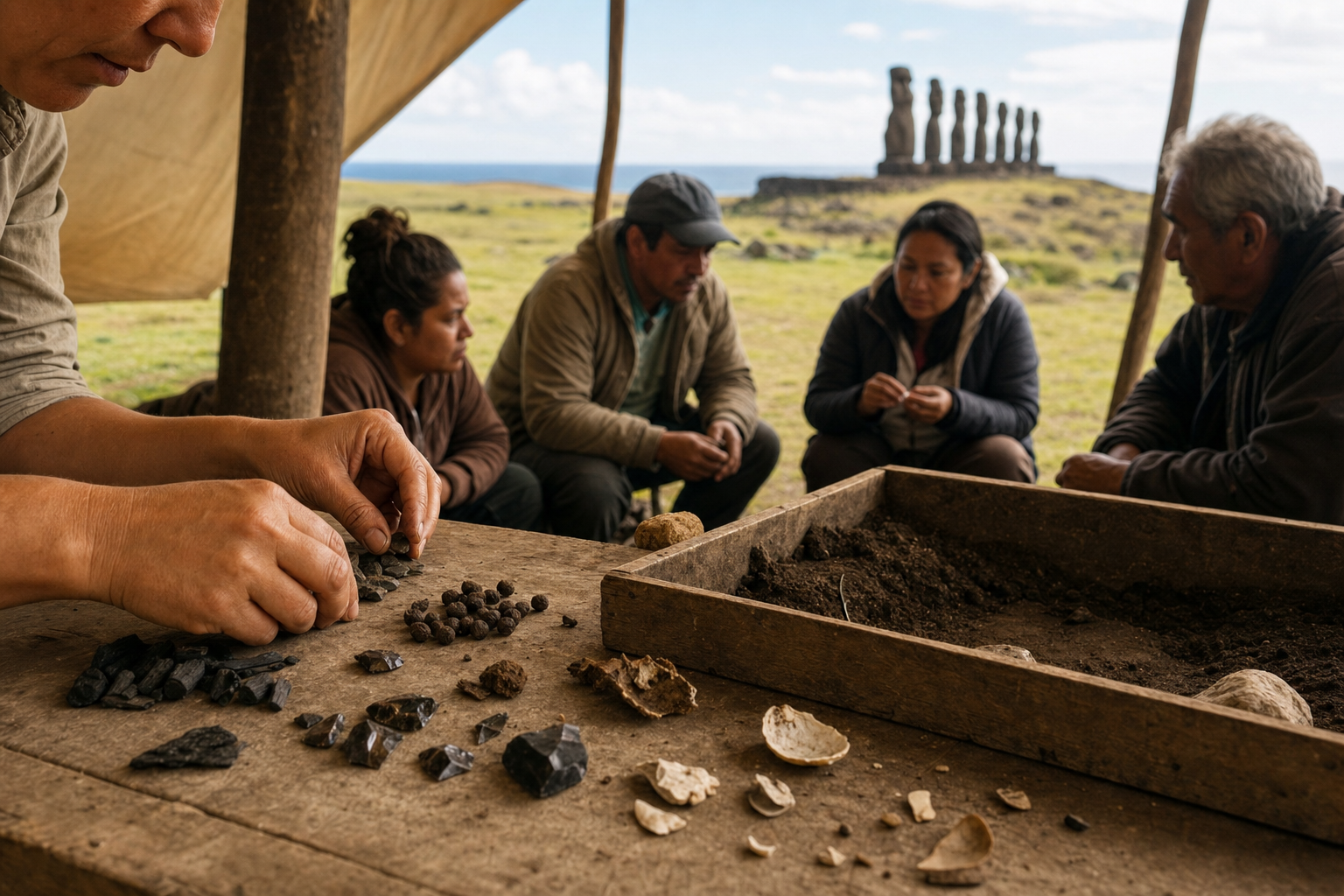
You will still encounter dramatic claims about Rapa Nui in documentaries, classrooms and environmental arguments. The problem is often not that every element is impossible, but that a possibility has been repeated as a settled fact. These are the distinctions worth keeping:
| Familiar claim | What the evidence supports | More accurate wording |
|---|---|---|
| The islanders felled the forest to roll the moai. | Deforestation occurred, but upright rope transport is mechanically plausible and does not require massive timber rollers. | The exact balance of statue-transport methods remains open; timber rollers cannot be assumed to explain the forest loss. |
| Starvation is depicted by a moai with sharply visible ribs. | The figure has been re-dated, and its form is better understood as iconography rather than a direct record of famine. | A stylized body is not reliable evidence of island-wide starvation. |
| Deforestation produced widespread civil war. | Material evidence for extensive internecine warfare is limited. | Conflict may have occurred, but a generalized pre-contact civil war should not be presented as established. |
| The inhabitants resorted to cannibalism. | Recurring allegations depend largely on European narratives rather than secure archaeological proof. | Cannibalism claims are contested and should be attributed, not repeated as fact. |
| Toppled statues prove a revolt before European arrival. | Toppled statues were visible after contact-era disruption had begun. | A fallen moai cannot, by itself, date a social conflict or identify its cause. |
A simple test will keep you from reproducing the myth. First, date the evidence as closely as the available information allows. Second, identify its type: an excavated object, a transport experiment, a foreign visitor’s allegation or a later interpretation. Third, ask whether the claimed cause is necessary. If statues could move without timber rollers, for example, then the rollers cannot be treated as a proven explanation for deforestation. If a statue’s ribs are iconographic, they cannot diagnose a famine.
What a dharmic reading should change in practice
A dharmic perspective should sharpen our truthfulness, not merely replace an environmental slogan with an anti-colonial one. Hindu, Buddhist, Jain and Sikh traditions are distinct, but truth-seeking, non-harm, responsible stewardship and the protection of living culture offer a shared ethical vocabulary. Rapa Nui calls all four concerns into view.
Truthfulness requires holding two realities together: the island underwent major ecological change, and its people demonstrated sustained adaptation. Non-harm requires us to notice when a story converts the victims of disease, abduction and cultural suppression into the authors of their own destruction. Stewardship remains important, but it loses moral credibility when it depends on a false chronology. Cultural continuity matters because reducing a population to 111 people also endangers language, memory, ritual and inherited knowledge.
This is the practical correction to make when teaching or sharing the story. Say that Rapa Nui transformed its environment and adapted to it. Say that inhabitants were still cultivating food when Europeans arrived in 1722. Then name introduced disease, slave raiding, missionization and annexation as later forces with their own evidence and dates. That sequence respects both ecological responsibility and indigenous dignity.
Key takeaways
- Rapa Nui’s deforestation was real, but environmental change and civilizational collapse are not interchangeable claims.
- The condition of the population in 1722 is crucial: Roggeveen encountered nourished people cultivating several crops after centuries of tree loss.
- The sharp demographic catastrophe belongs to the contact and colonial era, when disease, slave raids and cultural suppression compounded one another.
- Roughly 1,500 people were abducted in 1862-1863, and only 111 inhabitants remained by 1877.
- Claims of widespread civil war, cannibalism, famine imagery and timber-dependent statue transport should be presented as contested, limited or superseded rather than settled.
- The best safeguard against a collapse myth is chronological precision: ask what declined, when it declined and which mechanism connects the evidence to the claimed cause.
The next time Rapa Nui is offered to you as a one-line warning, do not choose between environmental responsibility and anti-colonial truth. Ask what changed, when it changed and through whose actions. That small discipline restores Rapa Nui’s people to history as ingenious and adaptive human beings, rather than leaving them as props in someone else’s morality tale.
References
