
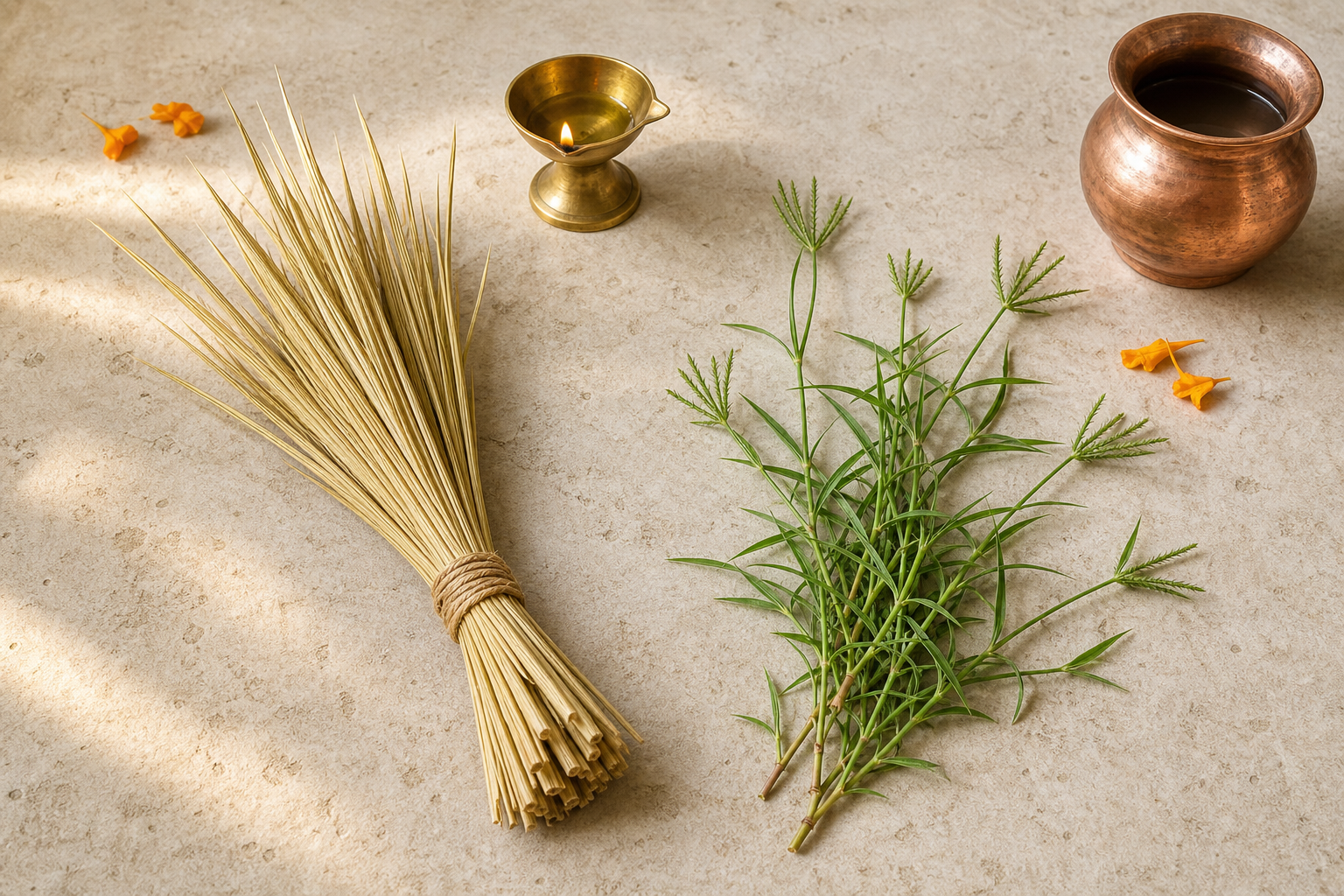
If your puja list asks for Darbha or Kusha but a shop offers you Durva, do not assume that the names are interchangeable. Regional speech sometimes blurs them, yet they are different grasses with different ritual roles.
The safest working rule is simple: use Darbha as a material of ritual purity and support, and use Durva as an auspicious offering, especially in Ganesha worship. Then follow the more specific instructions of your family tradition, temple, sampradaya, or purohit.
Start with the plant, not the shop label
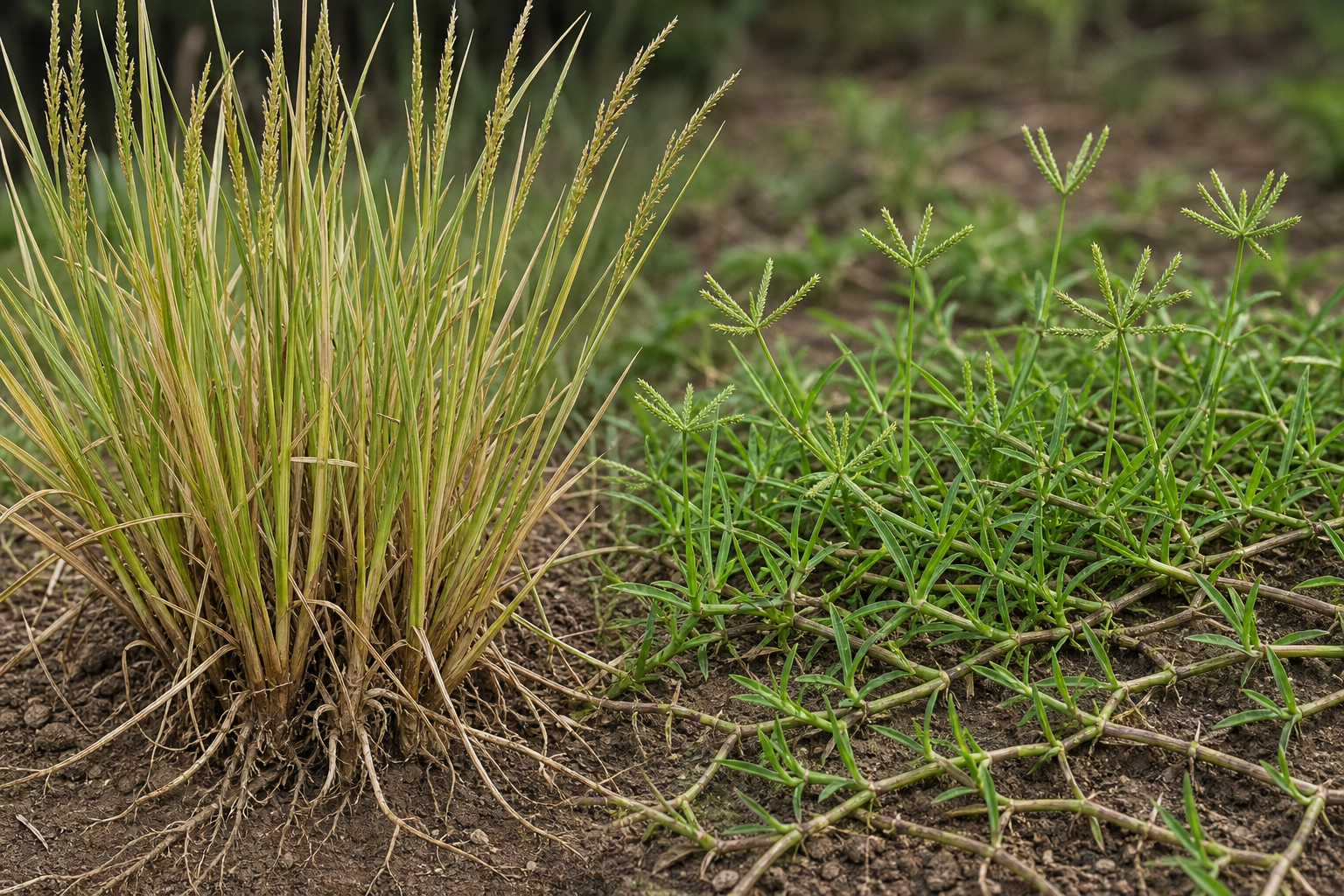
The decisive distinction is botanical: Darbha or Kusha is Desmostachya bipinnata, while Durva is Cynodon dactylon. Darbha is a hardy, tufted grass. Durva grows by creeping and spreading, a form that naturally evokes persistence and renewal.
| Sacred grass | Botanical identity | Recognizable form | Default ritual role |
|---|---|---|---|
| Darbha or Kusha | Desmostachya bipinnata | Hardy, upright and tufted | Pavitra, ritual support, sanctification and dedicated use in rites |
| Durva | Cynodon dactylon | Creeping and spreading | Auspicious offering, particularly in worship of Ganesha |
Use the table as an initial identification check, not as a substitute for reliable local knowledge. Common names can travel from one language or region to another without botanical precision. If a packet is ambiguously labelled, ask the seller which plant it contains. When the identification still is not clear, show the grass and the ritual instruction to someone who knows that practice rather than making a substitution on appearance alone.
It also helps to separate two questions. Botany tells you which grass you possess. The ritual procedure tells you what to do with it. Correctly identifying Darbha does not by itself tell you the number of blades, their arrangement, or every rite in which they should appear.
Match each grass to its proper ritual job
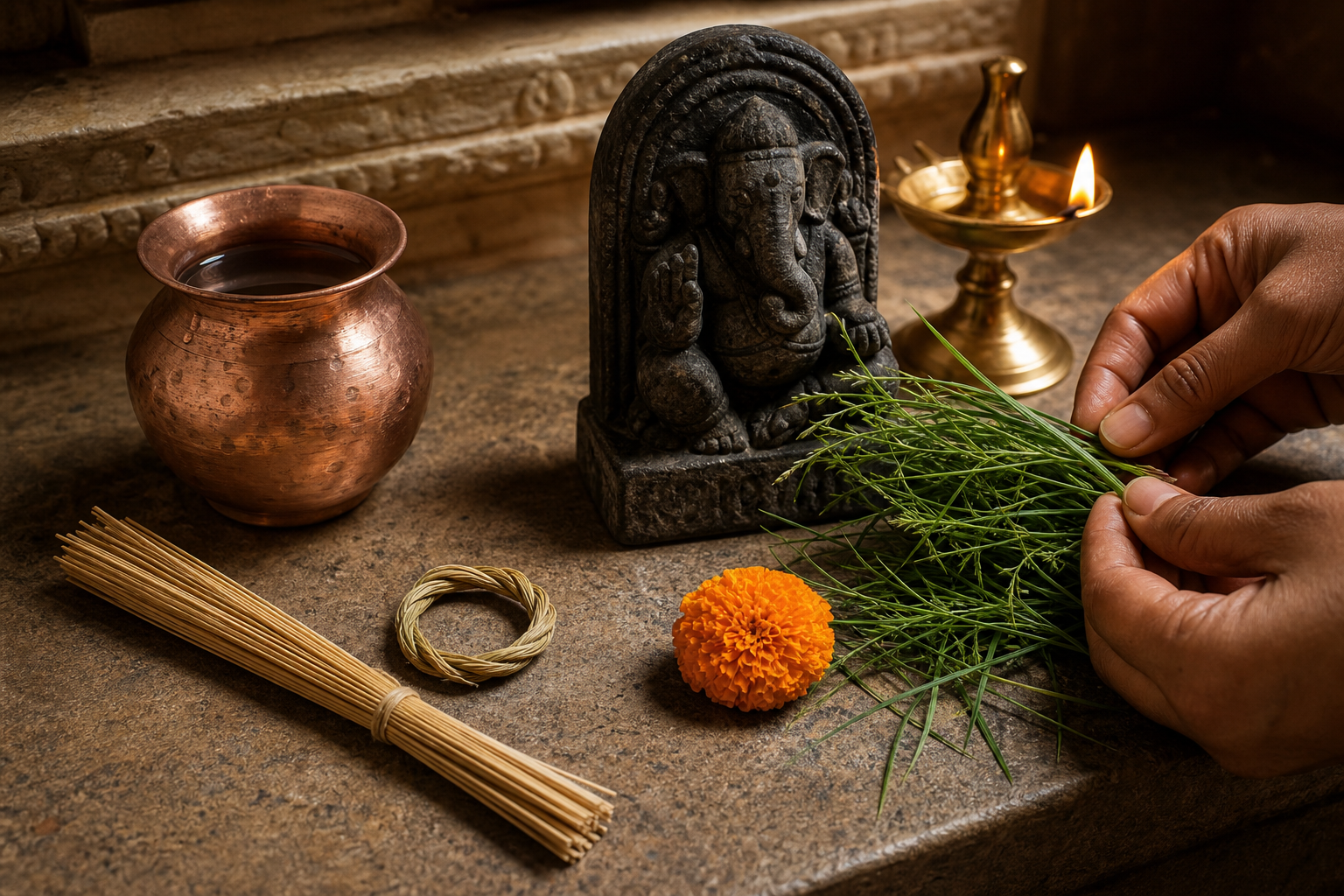
Darbha serves as a ritual implement and support
Darbha is associated with purification, sanctified space and mental composure. Its importance lies not merely in placing a plant near the altar, but in giving ritual form to boundaries, attention and preparedness.
- Pavitra: Darbha can be fashioned into a simple grass ring worn during worship as a sign and support of ritual purity.
- Kalash use: It may be placed with or used to line a kalash according to the procedure being followed.
- Offering support: Darbha can rest beneath plates or vessels holding offerings, distinguishing the sacred arrangement from an ordinary household surface.
- Asana: It can form or support a seat used for recitation and meditation, where physical steadiness reinforces collected attention.
- Dedicated rites: Separate bundles may be kept for puja, shraddha, japa and homa rather than treating the grass as an undifferentiated household material.
These uses share a pattern: Darbha usually helps establish or maintain the ritual setting. It may be worn, placed beneath something, arranged with a vessel, or reserved for a sacred activity. As a practical default, treat it as a ritual implement or support instead of assuming that it functions like Durva merely because both are grasses.
Durva is principally an auspicious offering
Durva has a particularly strong association with Ganesha worship. Its creeping growth and capacity to persist give it an apt ritual vocabulary: vitality, resilience, humility, auspiciousness and protection. When a puja procedure specifically asks for Durva, that offering has its own identity; replacing it automatically with dried Darbha loses the distinction.
The reverse substitution is equally unreliable. Durva should not become a generic replacement for a Darbha pavitra, Darbha asana, or Darbha used with a kalash unless the tradition governing that rite expressly allows it. If the requested grass is unavailable, ask whether the rite permits an alternative or whether that element should be omitted. Do not invent an exchange simply because two regional names sound similar.
Source, prepare and store sacred grass without waste
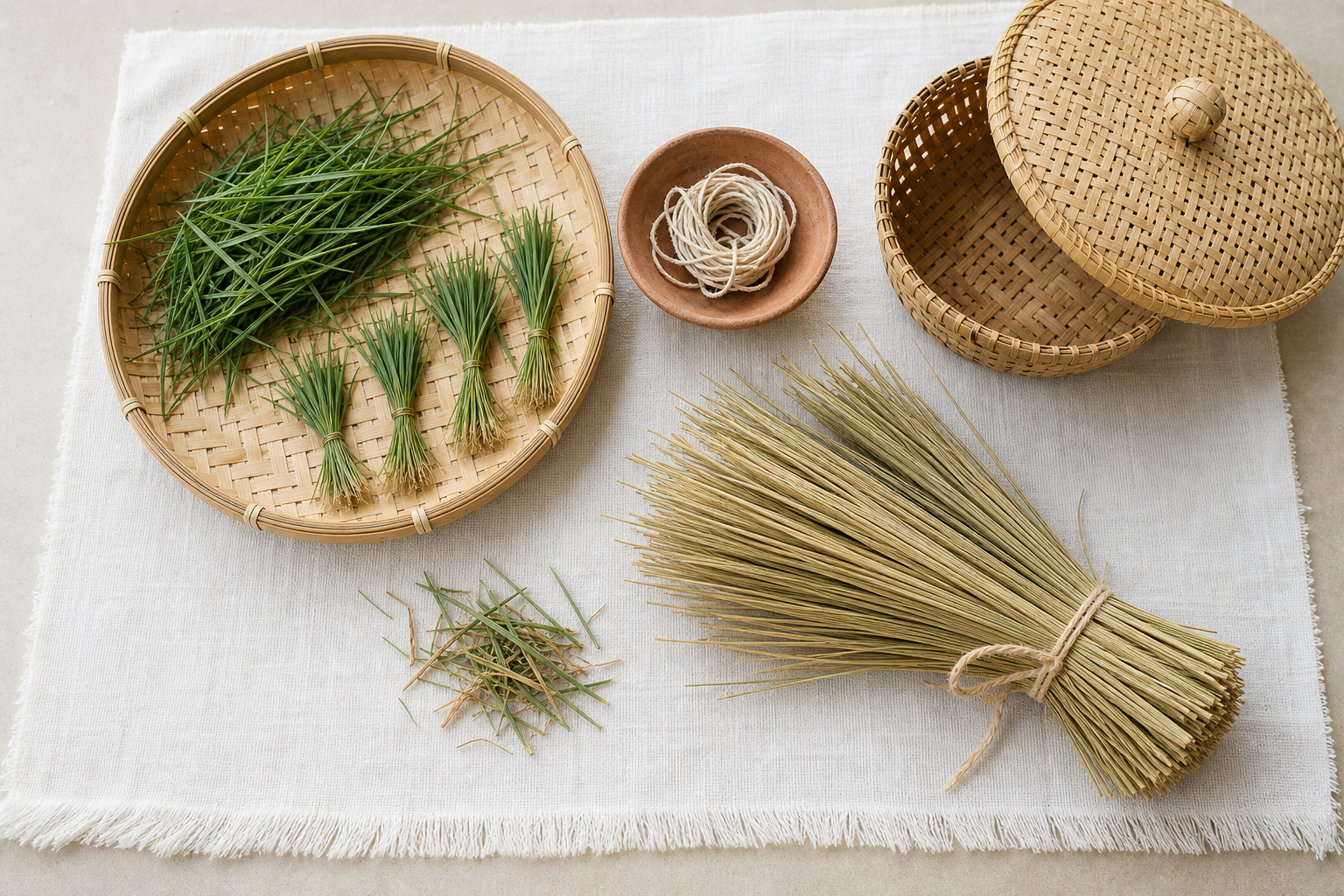
Care begins before the grass reaches the altar. A sacred material gathered carelessly, exposed to pesticides, or stored in damp conditions works against both ritual cleanliness and ecological restraint.
- Choose a clean source. Obtain the grass from a place free of obvious pollution and pesticide use. If you buy it, ask how it was gathered and stored rather than relying only on the word printed on the packet.
- Harvest without uprooting. Where responsible harvesting is permitted, take mature blades sparingly and leave the roots in place. Removing only what you need allows the plant and its surrounding habitat to continue.
- Dry Darbha thoroughly. Darbha intended for storage is traditionally sun-dried before it is bundled. Do not store it while damp. Durva requested for a specific offering should be prepared in the form that procedure requires; Darbha’s storage method does not automatically become a rule for Durva.
- Make small, dedicated bundles. Label Darbha and Durva separately. You can also keep Darbha intended for puja, shraddha, japa, or homa distinct when your practice calls for that separation.
- Keep the unused supply clean and dry. Store it away from moisture and ordinary household handling. Separate the reserved bundle from grass that has already been arranged or used in a ritual.
- Take only what the rite needs. Sacredness is not measured by excess. Careful portions reduce waste and make respectful harvesting possible over time.
Some traditional practice places clean, sun-dried Darbha near offerings or in ritual water as a support for purity and freshness. Claims about possible natural antimicrobial qualities should remain modest. Ritual use does not establish that contaminated food or unsafe water has become safe: no reliable dose, contact time, or safety threshold follows from the custom itself. Continue to use clean vessels, potable water and appropriate food handling.
This restraint belongs to a wider Dharmic ecology. The memory of a Kusha seat is associated with the Buddha’s awakening and meditative steadiness. Jain ahimsa reinforces non-destructive dealings with plant life, while Sikh teachings on seva and environmental responsibility echo the duty of stewardship. These parallels do not make the rituals identical. They show how distinct Dharmic paths can meet in reverence, restraint and awareness of interdependence.
When regional names and family customs conflict
A general guide can prevent a botanical mix-up, but it cannot replace a living ritual tradition. Regional vocabulary sometimes blends Darbha, Kusha and Durva, while a particular paddhati may assign an exact form or function. Handle that variation with a clear order of priority.
- Follow the explicit procedure for the rite. A named ritual instruction is more specific than a general account of how sacred grasses are commonly used.
- Clarify the vocabulary within your tradition. Ask whether the word being used means Kusha or Desmostachya bipinnata, Durva or Cynodon dactylon, or a locally accepted material.
- Identify the requested function. Is the grass to be worn as a pavitra, placed with a kalash, put under an offering, used for an asana, or presented as an offering? Function often exposes a mistaken label.
- Confirm details that the rite treats as exact. If a procedure specifies a number of blades, orientation, freshness, drying method, mantra, or time of placement, learn those details from that procedure. Do not import them from an unrelated puja.
- Use the broad Darbha-Durva distinction only as the fallback. Darbha is ordinarily the purifying and supporting ritual material; Durva is ordinarily the auspicious offering associated especially with Ganesha.
This approach avoids two opposite errors. One is treating every local name as botanically exact. The other is dismissing a genuine local convention because it does not match a label found elsewhere. Ask what plant is meant, what ritual role is intended, and which authority governs the observance. Those three answers usually resolve the confusion.
Key takeaways
- Darbha or Kusha is Desmostachya bipinnata; Durva is Cynodon dactylon.
- Darbha commonly supports ritual purity through the pavitra, kalash arrangements, offering supports, asanas, japa, shraddha and homa.
- Durva is an auspicious offering with a special place in Ganesha worship.
- Do not substitute one grass for the other merely because regional names overlap.
- Source grass from a clean, pesticide-free place, avoid uprooting it, and keep dried Darbha in small, clean and clearly labelled bundles.
- Treat claims about freshness or antimicrobial action as traditional practice, not as a guarantee of food or water safety.
Before your next puja, check the botanical name, the ritual function and the instructions of your own tradition. Label the two grasses separately and buy or harvest only what you need. That small act of preparation preserves ritual precision while keeping reverence for nature inside the practice itself.
References
