
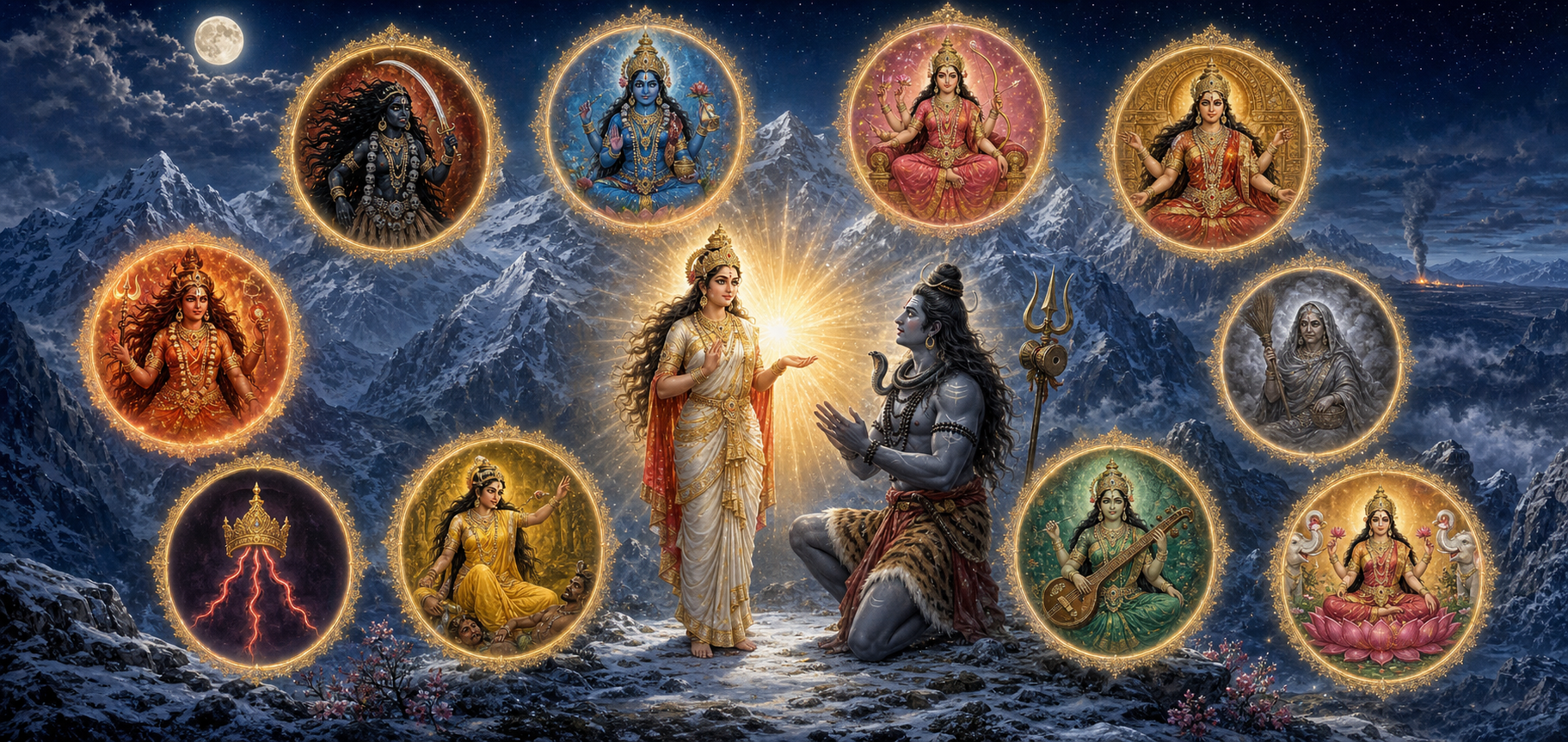
If you came to this story wondering why Sati reveals herself as ten goddesses, start with the order of events. The Sati-centered revelation happens before she reaches Daksha’s yajna and before she is insulted there. That one correction prevents the Dasamahavidyas from being reduced to an eruption of anger after public humiliation.
Read in the right sequence, the episode becomes a guide to Shakta theology and practice. Sati does not merely display power to win an argument. She discloses that the Divine Feminine cannot be confined to a dependent role or a single pleasing form. Wisdom can deliver, nourish, discipline, unsettle, silence, expose loss, and sustain prosperity. You need the whole range because spiritual life does not present only one kind of obstacle.
Key takeaways
- Sati manifests the Dasamahavidyas during her disagreement with Shiva, before the insult and self-immolation at Daksha’s yajna.
- The ten forms occupy the ten directions, expressing the completeness and all-pervading reach of Shakti rather than merely multiplying divine personalities.
- The forms range from Kali and Dhumavati to Tripurasundari and Kamala because wisdom must meet fear, loss, beauty, discipline, speech, stillness, and abundance.
- The Shakta meaning is not that Shakti defeats an inferior Shiva. Shakti is neither subordinate to nor separate from Shiva.
- The narrative becomes useful when each form leads you toward clearer conduct, steadier attention, and less attachment – not when its imagery is consumed as spectacle.
The revelation happens before Sati reaches the yajna

The sequence is the first interpretive safeguard. Without it, the ten goddesses can look like fragments of Sati’s rage. With it, they appear as a deliberate revelation of who Sati already is.
- Daksha prepares a great yajna but does not invite Sati because of his hostility toward Shiva.
- Sati wishes to attend despite the exclusion.
- Shiva cautions her against entering an assembly where disrespect and disharmony are already present.
- During this disagreement, Sati manifests the ten Mahavidyas. They surround Shiva and occupy the ten directions.
- Sati then goes to the yajna, endures Daksha’s insult, and immolates herself.
- Shiva’s grief and righteous wrath bring forth Virabhadra. The rite is disrupted, Daksha eventually repents, and cosmic order is restored.
The fourth and fifth steps must not be merged. Sati does not discover her sovereignty because Daksha humiliates her. She reveals it before confronting him. The later insult exposes Daksha’s failure to recognize a reality that has already been disclosed.
This also explains why the episode is more than a dispute about whether someone should attend an unwelcoming family event. Shiva’s caution is intelligible within the immediate situation: he foresees disrespect and disorder. Sati’s answer operates at another level. By revealing the ten forms, she shows that her agency and identity cannot be exhausted by another person’s judgment, even Shiva’s.
Calling this an origin tradition keeps its purpose clear. Sacred narrative communicates theological meaning through character, conflict, revelation, and consequence. You do not have to force it into the category of a modern historical report to take its claim seriously. Its central claim is that a sacrifice which excludes or dishonors Shakti cannot sustain harmony, however impressive its outer performance may be.
The name Sati also requires precision. Here, Sati is the proper name of the Goddess, and her self-immolation is an event within this sacred narrative. It is not a practical instruction, a moral authorization for self-harm, or a sufficient framework for judging later social history. Keeping those categories separate protects both theological understanding and ethical clarity.
Ten directions turn the dispute into a cosmic declaration

If you read the encircling of Shiva only as a threatening gesture, the symbolism shrinks to coercion: Sati wants to leave, Shiva objects, and she blocks every escape. The ten directions expand the scene beyond that quarrel. They indicate completeness. There is no direction, domain, condition, or spiritual temperament wholly outside the reach of divine wisdom.
The revelation therefore establishes Shakti’s sovereignty, but sovereignty should not be confused with separation. In the Shakta understanding, Shakti is not a secondary force that Shiva may grant or withdraw. Nor is she a rival deity who becomes supreme only by reducing Shiva. She is the dynamic divine principle through which creation, dissolution, spiritual discipline, and realization become possible.
A winner-and-loser reading simply reverses the hierarchy it claims to overcome. It makes Shiva subordinate where another interpretation made Shakti subordinate. The deeper teaching is equilibrium: Shiva and Shakti cannot be understood adequately through domination. Sati’s revelation corrects the attempt to contain Shakti without turning divine relationship into a contest for human-style status.
You can test any explanation of this episode with a few direct questions. Does it preserve the fact that the revelation precedes the insult? Does it explain why there are ten meaningful forms rather than one enlarged form? Does it preserve the non-separation of Shiva and Shakti? Does it lead toward discernment and dharmic conduct, or only toward fascination with frightening imagery? An interpretation that fails those tests has probably captured the drama while missing the teaching.
The tenfold manifestation also prevents spiritual life from being narrowed to one method. Devotion, knowledge, disciplined yoga, and tantra address different capacities in a seeker. The Dasamahavidyas make room for that plurality without suggesting that every path is vague or interchangeable. Many doors can be authentic precisely because the reality they open toward exceeds any one temperament.
Use each Mahavidya as a distinct diagnostic lens

The ten forms should not be divided into pleasant goddesses worth approaching and terrible goddesses best avoided. Each reveals a mode of wisdom required under particular conditions. The table below pairs each traditional emphasis with a question you can use for reflection. The questions are contemplative aids; none claims to exhaust the meaning, iconography, or formal practice of a Mahavidya.
| Mahavidya | Wisdom emphasis | A question for your own situation |
|---|---|---|
| Kali | Time-transcending power and fearless compassion | What change or ending am I resisting, and can I meet it without becoming cruel? |
| Tara | Deliverance and guiding grace | Where do I need to accept guidance, or become a trustworthy guide for someone else? |
| Tripurasundari, or Shodashi | Harmonious beauty and supreme consciousness | What in my life needs alignment rather than more force? |
| Bhuvaneshwari | Cosmic space and nurturing sovereignty | Can I widen my attention before deciding that the present conflict is the whole reality? |
| Bhairavi | Austerity and transformative fire | Which necessary discipline am I avoiding because transformation is uncomfortable? |
| Chhinnamasta | Self-sacrifice and instantaneous awakening | What must be released now, without confusing generous sacrifice with self-erasure? |
| Dhumavati | The veiled wisdom of impermanence | What becomes visible when loss, disappointment, or absence can no longer be disguised? |
| Bagalamukhi | Stilling turbulence and neutralizing harm | Which reaction, accusation, or impulse should be stilled before it causes harm? |
| Matangi | Inner speech and refined intellect | Is my inner narration truthful and disciplined enough to guide my outward speech? |
| Kamala | Prosperity grounded in virtue | Will the abundance I seek support dharma, or merely enlarge appetite and status? |
The contrasts are intentional. Kali and Bhairavi teach you to face transformation rather than flee it. Tara and Tripurasundari keep power joined to grace, beauty, and discernment. Chhinnamasta and Dhumavati expose grasping when sacrifice, absence, or impermanence cannot be avoided. Bagalamukhi and Bhuvaneshwari interrupt constricted reaction by stilling or widening awareness. Matangi brings discipline to thought and speech. Kamala asks whether prosperity has been placed under dharma.
Do not rank those lessons according to surface comfort. Dhumavati is not spiritually inferior because she confronts deprivation, and Kamala is not spiritually simpler because she concerns prosperity. Loss can reveal wisdom, but loss should not be romanticized. Prosperity can serve virtue, but wealth should not be mistaken for realization. The full mandala keeps any one truth from becoming a distortion.
This is why the Dasamahavidyas work as a map of integration. Human beings do not suffer only from fear, or only from ignorance, or only from undisciplined desire. We also misuse speech, cling to preferred forms, refuse guidance, react before seeing the whole field, and separate abundance from responsibility. The ten goddesses allow you to identify the actual imbalance instead of applying the same spiritual answer to every problem.
Carry the symbolism into disciplined practice
The Mahavidyas lose their force when their iconography becomes decoration detached from conduct. A practical encounter begins with the condition you are actually facing, not with whichever image appears most dramatic.
- Name the condition plainly. Is the difficulty fear of change, refusal of guidance, reactive speech, resistance to discipline, grief over loss, or an undharmic relationship with prosperity? Choose the condition before choosing the form.
- Identify the corresponding correction. Kali may call for courage joined to compassion; Bagalamukhi for stillness before speech; Matangi for truthfulness in inner and outer language; Kamala for placing prosperity under ethical purpose.
- Make the insight behavioral. Pause before the harmful reply, complete the discipline you have been evading, correct the dishonest statement, accept warranted help, or test an ambition against its effect on others. If nothing changes in conduct, the symbolism has remained abstract.
- Consult the whole mandala. A single form can expose the immediate imbalance, but the other forms prevent overcorrection. Stillness without truthful speech can become avoidance. Austerity without compassion can become hardness. Prosperity without awareness of impermanence can become attachment.
- Keep technique joined to ethics. Mantra, meditation, contemplative study of Puranas and Tantras, festival observance including Navaratri, and other disciplines should deepen discernment and devotion. Intensity by itself is not the measure of spiritual maturity.
This reflective use of the ten forms is not a substitute for formal ritual instruction. A symbolic prompt derived from Kali, Chhinnamasta, or Bagalamukhi does not authorize you to invent literal practices from their images. The safe interpretive boundary is straightforward: contemplate what the form reveals, correct your conduct, and do not turn visual symbolism into improvised physical action.
The practical test is not whether contemplation produced an unusual feeling. Ask whether you now see fear more honestly, speak with greater care, cling less tightly, accept necessary discipline, or use resources more responsibly. Shakta symbolism is doing ethical work when it transforms fragmentation into integrated awareness.
Resonances across the dharmic world should be handled with the same precision. Tara is also venerated in Vajrayana Buddhism. Ahimsa and self-mastery offer points of kinship with Jain ideals. Service, courage, and humility provide comparable points of contact with Sikh teachings. These affinities can support mutual respect, but they do not make different doctrines, lineages, or rites interchangeable. A dharmic unity strong enough to matter does not require sameness.
The next time you encounter a Mahavidya image, hymn, or retelling, place it in the Daksha sequence, name the mode of wisdom it presents, and ask what ethical response follows. Begin with the form that exposes your present imbalance. Then let the remaining forms prevent you from mistaking one doorway for the whole sacred house.
References
