
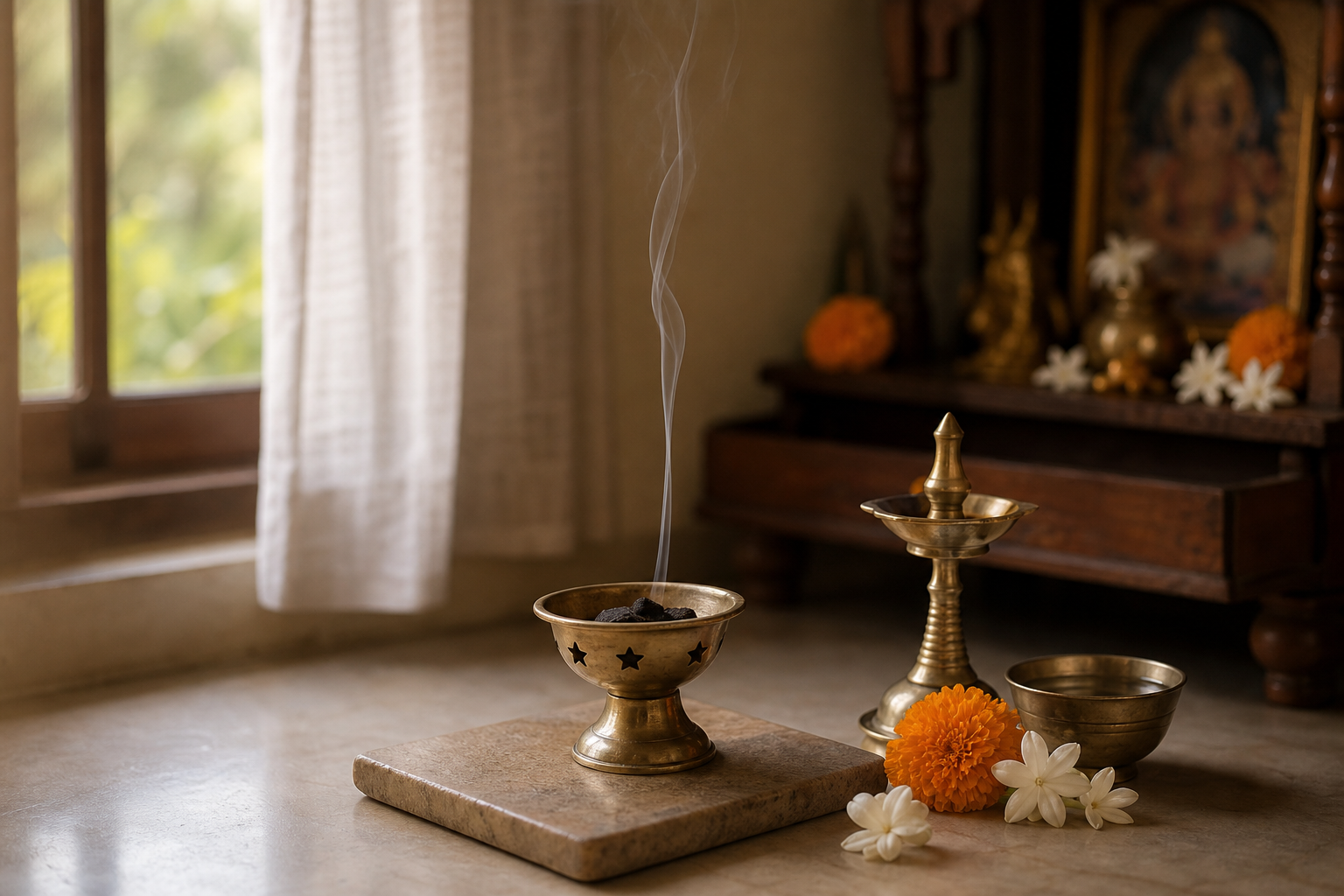
You have a packet of sambrani resin or a ready-made dhoop cup, but the practical questions remain: when should you light it, how much should you use, and how do you keep a sacred household practice from turning into a room full of harsh smoke?
The useful answer is simple. Clean and ventilate the space, burn the smallest effective amount, and connect the fragrance to a definite act such as puja, japa, meditation, study, or evening reflection. Sambrani works best as a threshold into sacred time, not as a test of how much smoke your household can tolerate.
Understand what sambrani is meant to do
Sambrani is a common name for aromatic resin traditionally associated with Sal and related benzoin-type resins. Dhoop refers to incense. The loose resin is placed on a hot ember, while ready-made cups package the burning material in a more convenient form.
Its domestic role is both ritual and sensory. Fragrant resins have long accompanied worship in temples, monasteries, and homes, as well as festivals and life-cycle observances. In the household, the change in scent marks a change in attention: ordinary activity pauses, the mind gathers itself, and prayer or contemplation begins.
This distinction matters because ritual purification is not the same claim as physical cleaning or medical disinfection. Sambrani may make a freshly cleaned room smell warm and settled, but it does not remove dust, repair dampness, or replace ventilation. If a musty smell keeps returning, deal with its physical cause instead of masking it with more dhoop.
Traditional Ayurvedic language may describe aromatic resins as clarifying or environmentally purifying. Receive that language in its proper ritual and experiential setting. It does not justify treating sambrani smoke as medicine or assuming that a stronger cloud produces a greater benefit.
Choose loose resin or a ready-made cup deliberately
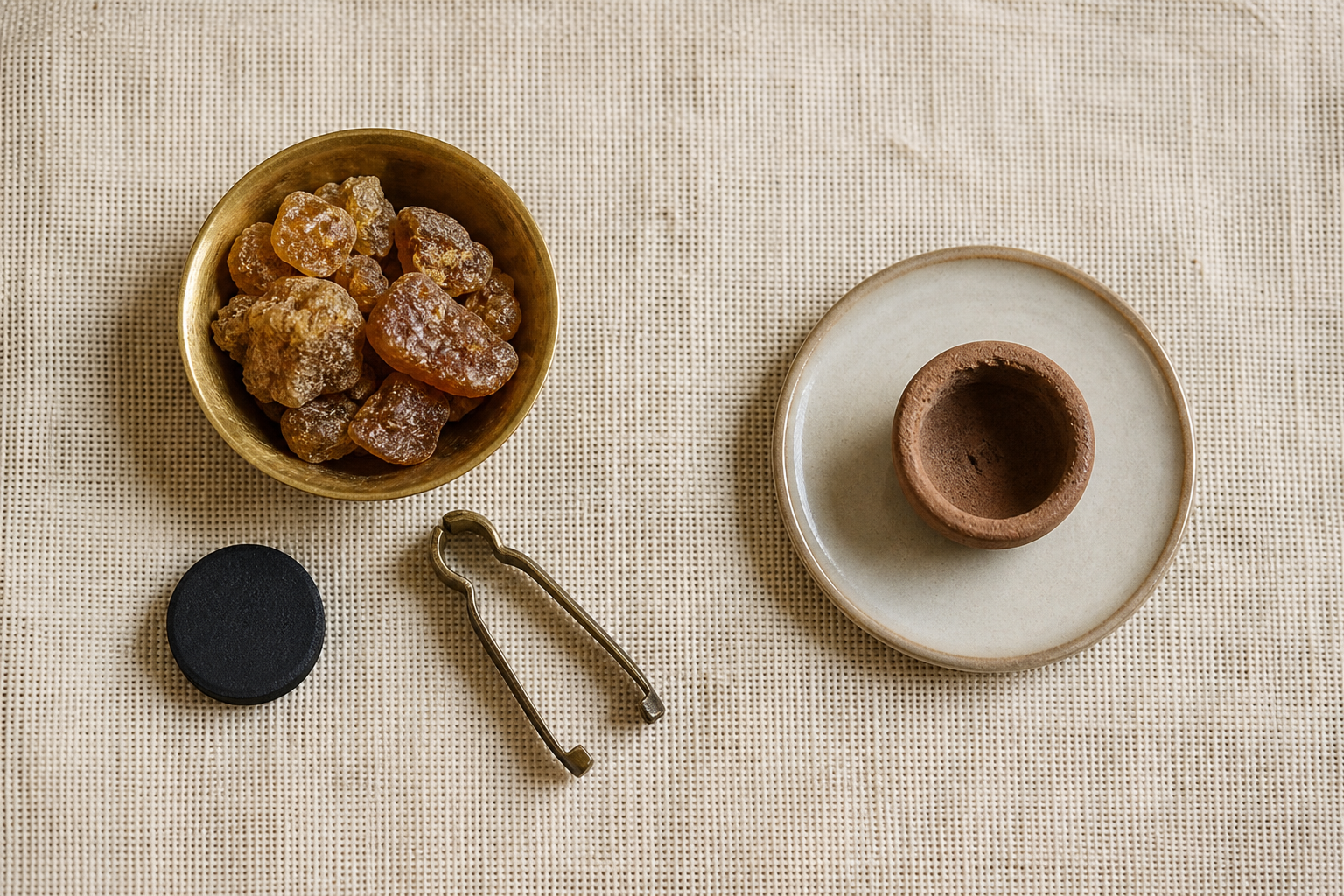
The two common forms serve slightly different households. Choose by considering control, convenience, and your ability to handle a live ember safely.
- Loose resin on charcoal: Choose this when you want to add only a few granules at a time and preserve the familiar experience of resin warming on an ember. It requires a proper burner, careful handling, and more attention to heat.
- Ready-made sambrani cup: Choose this when you want fewer separate materials. Follow the directions printed for that product rather than assuming every cup lights in the same way. The cup still becomes hot and still produces smoke.
- An inadequately labelled product: If the package does not identify its contents, do not assume that it contains only natural resin. Fragrance strength, added ingredients, and burning behaviour can vary. Use a modest amount and stop if the smell is acrid or uncomfortable.
Loose resin gives you the clearest control over quantity. That is valuable in a small puja room or apartment, where a few granules may be enough. A large mound does not make the offering more sincere; it merely creates more smoke at once.
Use sambrani safely, one small offering at a time
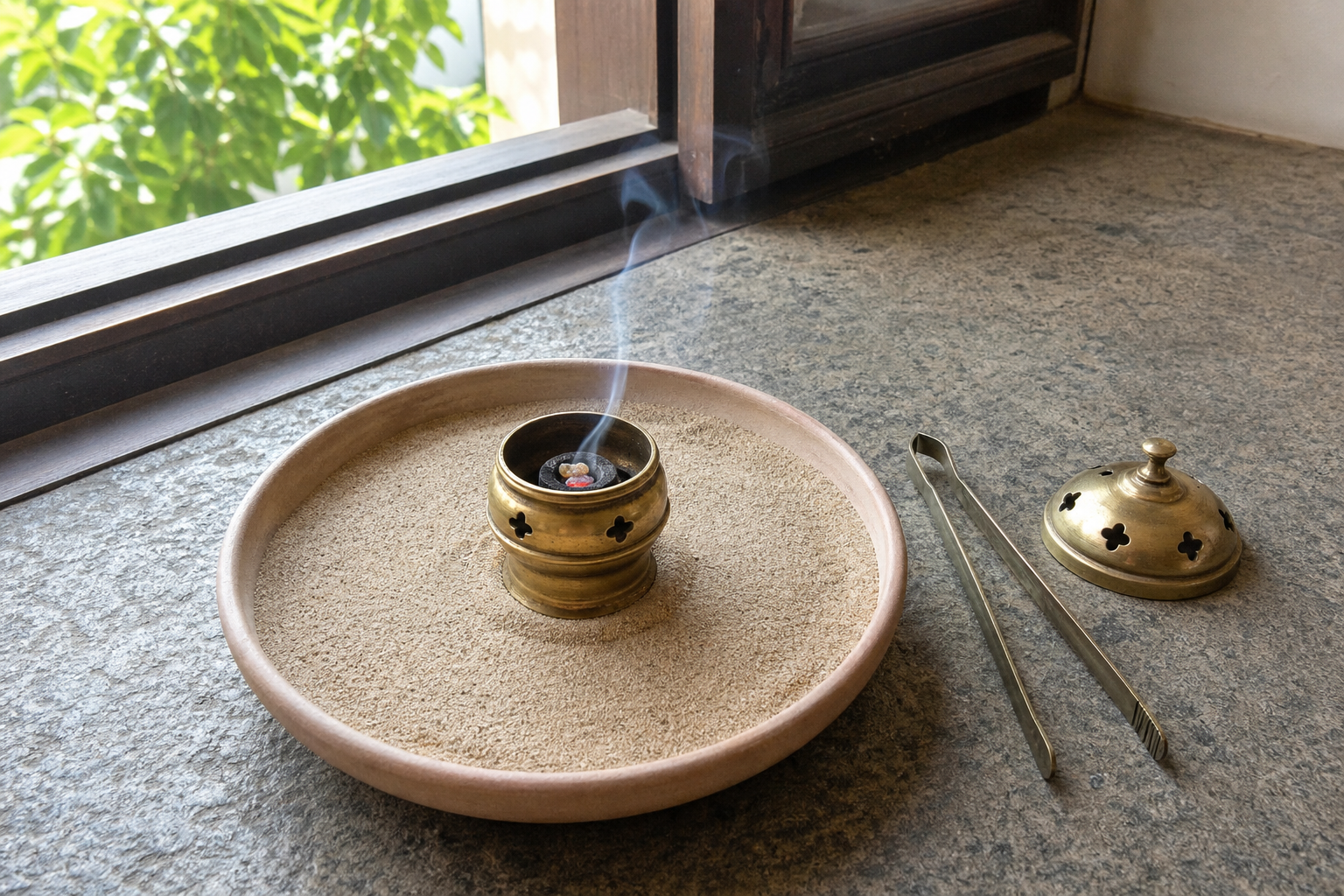
Prepare the room before you ignite anything. Once the charcoal or cup is burning, you should not have to search for a stand, move altar cloths, or open a blocked window while holding a hot vessel.
- Clean first. Finish sweeping, dusting, or tidying before lighting the dhoop. This gives the fragrance a clear ritual function: it completes the preparation of the space rather than concealing unfinished cleaning.
- Create cross-ventilation. Open a suitable door or window before lighting. The aim is a gentle aroma in moving air, not trapped smoke.
- Clear a stable surface. Put the burner on a heat-safe base, away from curtains, papers, altar cloths, loose clothing, and walking paths. Keep children away from both the flame and the vessel.
- Prepare the chosen form. For loose sambrani, place a small charcoal ember securely in the burner. For a ready-made cup, use the lighting method given on its packaging.
- Add only a few granules. Let the first amount release its fragrance before deciding whether more is needed. If the room quickly becomes cloudy or the aroma turns harsh, you have already used too much.
- Leave the burner in a safe position. A stationary burner is the safest choice for someone learning the practice. Do not leave it unattended while it remains hot.
- Let everything cool completely. An ember, cup, burner, or ash may remain hot after visible smoke declines. Keep the setup undisturbed until it can be handled safely.
Your household’s comfort is a practical limit, not an obstacle to devotion. If anyone develops coughing, eye irritation, breathing discomfort, dizziness, or a headache, extinguish the dhoop safely, move into fresh air, and ventilate the room. Do not keep burning it in the hope that the person will become accustomed to the smoke. A smoke-free flower, lamp, mantra, or moment of silence can preserve the ritual intention.
Extra care is warranted around babies, people recovering from illness, and anyone known to react poorly to smoke or fragrance. Traditional use in postpartum routines belongs to cultural memory; it should not be converted into a medical treatment or allowed to override individual clinical advice.
Give the fragrance a stable place in your ritual rhythm

Sambrani becomes meaningful through consistency. You do not need to burn it throughout the day. Attach it to one transition that your family already recognizes, then keep the sequence uncomplicated.
- Before morning puja: Tidy the altar area, ventilate the room, light a small amount, and begin the mantra or offering once the fragrance becomes perceptible.
- After evening cleaning: Use it as a boundary between the day’s outward activity and a quieter period of prayer, reading, or reflection.
- Before meditation or study: Let the rising plume serve as a brief visual anchor, then return attention to the breath, mantra, scripture, or work. The smoke is an aid to attention, not the object of the practice.
- During festivals or family samskaras: Follow the procedure preserved by your family, sampradaya, temple, or officiating teacher. A domestic habit should not be presented as a universal ritual rule.
A useful household sequence is: clean, ventilate, light, become still, and begin. Repeating that sequence teaches the mind what the fragrance announces. Over time, sambrani can become a sensory reminder to lower the voice, put aside distraction, and approach the altar with attention.
Fragrant offerings also appear across the wider Dharmic world, where they can support devotion, recollection, contemplative discipline, and reverence. That civilizational kinship should not be flattened into a claim that Hindu, Buddhist, Jain, and Sikh communities all follow one identical rite. Shared values can coexist with distinct teachings, liturgies, and community disciplines.
Nor must every member of a family experience sambrani in the same way. One person may associate it with a grandparent’s puja room; another may find even a small amount overpowering. Preserve the sacred purpose by adjusting the material form. Dharma is not served by making the home physically uncomfortable.
Key takeaways for a mindful household practice
- Use sambrani to mark a clear transition into puja, meditation, study, or evening reflection.
- Clean the room before lighting it; fragrance complements household care but does not replace it.
- Begin with a few granules or one correctly used cup, and treat gentle fragrance as sufficient.
- Provide cross-ventilation and place the burner on a stable, heat-safe surface away from fabric and children.
- Stop when smoke or fragrance causes discomfort; ritual intensity should never be measured by smoke density.
- Respect family and sampradaya-specific procedures without turning one local custom into a rule for every Dharmic tradition.
For your next puja, change only one thing: prepare the room before you light the sambrani, then offer the smallest amount that creates a quiet, recognizable fragrance. Let that modest signal call the household into attention. The continuity of the practice rests less in the size of the cloud than in the care with which sacred time begins.
References
