
You have opened a birth chart, found Mars in Lagna, a Sun-Rahu conjunction, or another imposing label, and now want to know whether it promises strength, trouble, or both. The honest Jyotisha answer is that the label alone cannot decide. It identifies a pattern that still has to be read through its house, sign, dignity, aspects, timing, and expression in your actual conduct.
The same discipline applies to remedies. Do not begin with an object, donation, mantra, or observance. Begin by identifying what the graha is doing in your life. A useful remedy should turn that energy toward dharma in a way you can practice and notice.
Read the whole pattern before naming a remedy

A planetary placement and a conjunction answer different questions. A placement tells you which graha occupies a house and therefore which area of life receives its influence. A conjunction tells you that two grahas are operating together, blending or competing within that area. Neither description tells you by itself whether the final result is constructive, difficult, or mixed.
Use this sequence whenever a chart feature worries or interests you:
- Confirm the Lagna and house. The house shows where the pattern is likely to become visible: identity, family, partnership, work, belief, resources, or another life domain.
- Name each graha’s function. Mars contributes initiative and force; the Sun contributes identity and authority; Mercury contributes analysis and speech; Venus contributes relationship, refinement, and harmony; Rahu amplifies desire, ambition, and unconventional striving.
- Assess the sign and dignity. A graha in its own sign or exaltation does not behave in the same way as the same graha in debility. Strength is not automatically goodness, however. A powerful Mars can protect or overpower, depending on how its force is directed.
- Check conjunctions, aspects, and dispositor. Ask what supports the placement, what agitates it, and which graha governs the sign in which it sits.
- Refine the reading with technical conditions. Exact longitudinal separation, combustion, retrogression, nakshatra, lordship, yogas, and special aspects can change the quality of the result.
- Add timing last. Dashas and transits indicate when a natal pattern may become more active. They do not replace the natal promise or remove your responsibility for action.
A concise working interpretation can be written as one sentence: This graha activates this house through these qualities, modified by this sign and these relationships, and becomes especially relevant under these timing conditions. If you cannot fill in each part, you do not yet have enough information for a confident remedy.
What four common configurations are asking you to notice
Mars in Lagna: turn reaction into directed strength
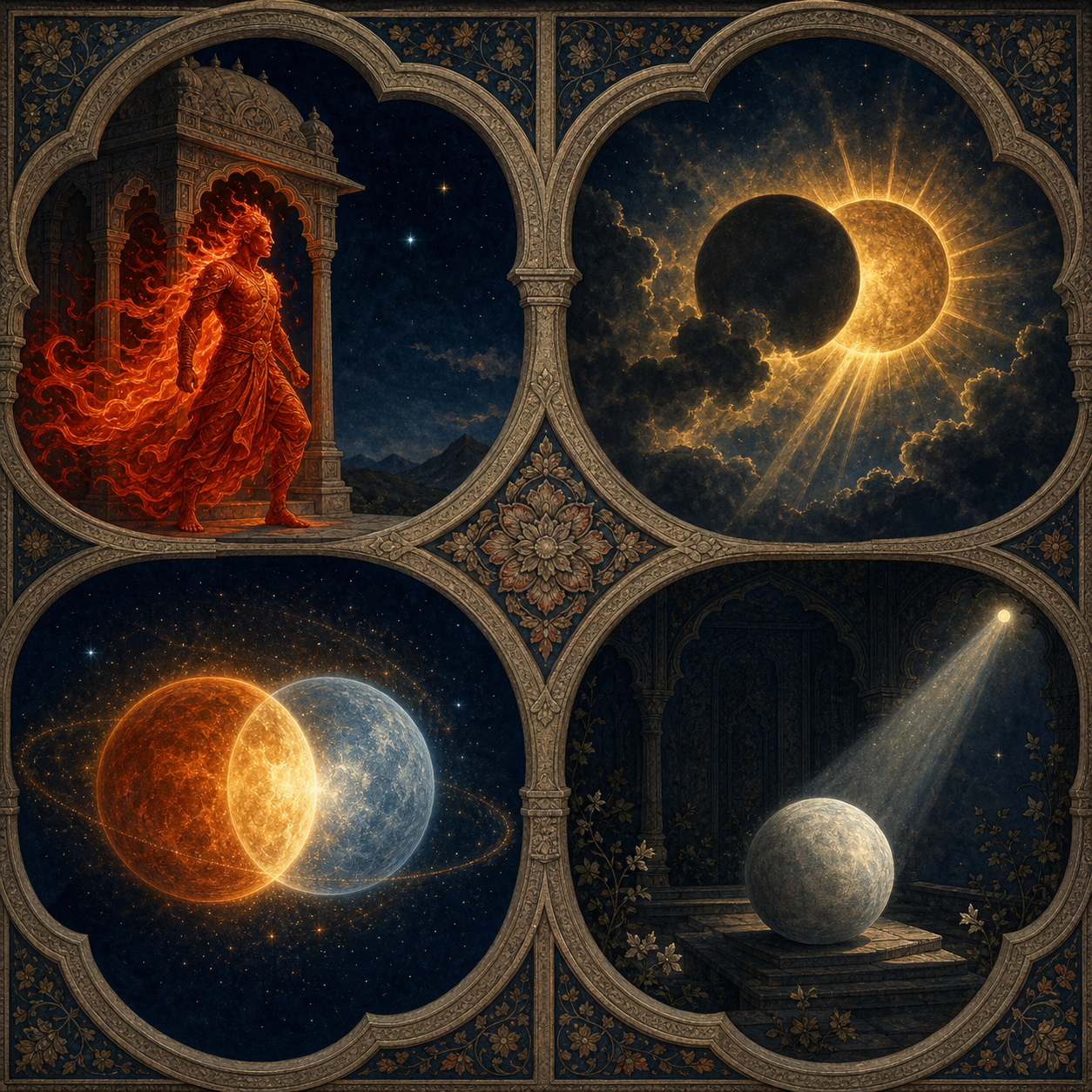
Because the first house describes visible temperament, physical constitution, and the way you enter situations, Mars in Lagna commonly intensifies initiative, courage, competitiveness, directness, and readiness to act. In constructive form, this supports leadership, physical discipline, entrepreneurship, tactical work, and the ability to mobilize during a crisis. In an unrefined form, the same speed can become impatience, aggression, or action taken before consequences have been considered.
Sign dignity makes the distinction sharper. Mars rules Aries and Scorpio, is exalted in Capricorn, and is debilitated in Cancer. In Aries or Scorpio, will and self-command may have a stronger base. Capricorn can discipline force into strategy and endurance. Cancer can connect action too closely to shifting emotion, making a pause between feeling and response especially valuable.
Mars also has special aspects to the fourth, seventh, and eighth houses. Do not read those as three automatic misfortunes. Turn them into three diagnostic questions: Does your drive disturb peace at home? Does directness become combativeness with a partner? Do you meet crisis with disciplined courage or with escalation? Those questions are more useful than simply calling the placement strong or afflicted.
Traditional interpretations also associate an overheated Mars with cuts, burns, minor injuries, or inflammatory complaints under difficult periods. Astrology cannot diagnose any of these conditions. Repeated injury, persistent pain, or inflammation belongs with a qualified medical professional; a spiritual remedy can support self-discipline but cannot replace care.
Sun-Mercury: make intelligence answer to a clear purpose
The Sun-Mercury conjunction blends authority, identity, and purpose with thought, language, calculation, and adaptability. It is often discussed as Budha-Aditya Yoga, but the name should not be treated as a guarantee of brilliance or status. House lordships, sign dignity, aspects, and the distance between the two grahas still matter.
One traditional interpretive convention gives the Sun a 2:1 prominence over Mercury and treats the combined influence as especially noticeable until about age 39. Use that as a lens, not a deadline. It can help explain why identity, education, speech, early career choices, and leadership style feel closely bound together in the first part of life. It does not mean Mercury stops functioning after the thirty-ninth year or that everyone with the conjunction follows the same timetable.
House type changes the field of expression. In a kendra, the combination may become visible through decisions and public presence. In a trikona, it may favor learning, mentorship, and principled thought. In a dusthana, the same analytical force may be directed toward service, difficult problems, introspection, or transformation. Mercury’s closeness to the Sun also makes exact separation and combustion relevant; two charts with the same broad conjunction label may therefore operate quite differently.
Your practical question is whether speech clarifies purpose or merely protects pride. Before an important message, decision, or disagreement, state the purpose in one sentence. Then remove any claim that serves only self-display. That small discipline lets Mercury sharpen the Sun’s direction without becoming its public-relations department.
Sun-Rahu: separate legitimate ambition from hunger for recognition
Sun-Rahu is commonly understood through eclipse symbolism: the Sun’s clarity, authority, and stable identity meet Rahu’s appetite for expansion, novelty, visibility, and rapid ascent. The conjunction can generate unusual ambition and a strong desire to matter. It can also make external recognition feel like proof of inner worth.
The house tells you where this tension asks for integration. In the first, self-image can swing between bold projection and uncertainty. In the seventh, partnerships can become arenas for power and validation. In the tenth, career visibility may increase, but durable authority still depends on ethical delivery. In the twelfth, restlessness may be drawn into withdrawal, sleep disruption, or intense inner searching. Across the houses, the durable remedy is to bind ambition to truthfulness, service, humility, and steady practice.
Some traditions describe Jupiter’s benefic indications as delayed until the early-to-mid forties when this conjunction is strongly formed. That is a conditional tendency, not a date on which a life automatically improves. Benefic aspects, a dignified dispositor, supportive dashas, and responsible choices can alter the expression. Do not postpone a sound decision, remain in a harmful situation, or expect automatic relief because of an astrological age marker.
When Sun-Rahu is active, test consequential ambitions with three questions: Would you still pursue this if nobody praised you? Can you explain the means as openly as the goal? Who bears the cost if the plan succeeds? If the answers expose secrecy, exploitation, or a need for admiration, Rahu is setting the agenda. If they reveal service, transparency, and patient delivery, the Sun is regaining its dharmic center.
Venus in Lagna: distinguish harmony from approval-seeking
Venus in the first house can make self-image, relationship, beauty, taste, and social grace central to the way you move through life. The higher expression is refinement joined to empathy. The difficult expression is dependence on approval, excessive concern with appearance, indulgence, or avoidance of necessary conflict.
Lal Kitab gives this placement its own remedial framework. It associates an afflicted Venus in Lagna with possible tension between maternal and spousal relationships and calls a first-house Saturn-Venus conjunction the "Crow Line" configuration. That label belongs to Lal Kitab practice; it should not be presented as a universal rule accepted identically by every Jyotisha lineage.
Do not turn a symbolic indication into suspicion toward your mother, spouse, or another woman. Notice the actual relational structure instead. Are loyalties being treated as a competition? Is one person expected to absorb the other’s discomfort? Are appearance and politeness hiding an unresolved boundary? The living Venus remedy is equitable care, honest partnership, respect for women, and speech that remains gentle without becoming evasive.
Choose a remedy that answers the visible problem
A remedy should not be chosen because its symbolism is attractive or because somebody has frightened you with a chart label. Match it to the recurring behavior you can observe. A simple remedy practiced consistently is more useful than a crowded collection of rituals that never reaches your conduct.
- Name the pattern in ordinary language. Write what actually happens: "I answer before listening," "I exaggerate to gain approval," or "I spend to repair emotional discomfort."
- Select an ethical counter-practice. Restraint counters impulsive Mars; truthful speech disciplines Sun-Rahu; careful listening joins Mercury to wisdom; relational honesty refines Venus.
- Add one embodied or devotional practice. Choose something you can sustain without neglecting work, family, health, or financial responsibilities.
- Add charity only where it cultivates the required virtue. Giving should train generosity and humility, not function as a fee paid to escape accountability.
- Review the full chart before adopting specialized measures. A remedy aimed at one isolated placement may be poorly matched when lordships, dignity, other conjunctions, or the active dasha tell a different story.
For Mars-related heat, use structured physical training, yoga, or a martial discipline with an explicit ethical code. Cooling pranayama such as sheetali or sheetkari and meditative observation can help create space between stimulus and reaction. The test is not whether the practice feels intense. It is whether you become harder to provoke and more reliable under pressure.
For Sun-Mercury imbalance, make mindful speech the central practice. Draft important messages, separate facts from self-defense, and invite correction before asserting authority. Study and mentorship can be useful when intelligence has become too closely identified with always being right.
For Sun-Rahu, traditional practices include Surya Namaskar, Aditya Hridayam, pranayama, dhyana, seva, satya, and right livelihood. Their shared purpose matters more than their quantity: they return visibility to service and desire to ethical limits. If spiritual practice becomes another way to display superiority, it is reinforcing the conjunction’s difficulty rather than remedying it.
For Venus in Lagna, Lal Kitab remedies include Friday donations of white foods, modest use of silver, cleanliness, gentle fragrance, a ghee lamp at dusk, and the mantra "Om Shum Shukraya Namah". Pair the symbolic observance with respect for women, fidelity to agreements, mindful spending, avoidance of intoxication or exploitation, and practical reconciliation where family relationships are strained. Otherwise, the ritual remains separate from the behavior it is meant to refine.
Charity should remain proportionate to your means. Do not take on debt, make a large purchase, or surrender necessary household resources for an astrological promise. Likewise, no mantra, donation, fast, or object should replace medical, psychological, legal, or financial help when the underlying problem belongs in one of those domains.
Judge a remedy by changed conduct, not dramatic promises

Keep a brief remedy log. You do not need predictions or elaborate scoring. Record four things when the relevant pattern appears:
- Trigger: What happened immediately before the reaction?
- Response: What did you say, do, avoid, or exaggerate?
- Consequence: Did the response create clarity, trust, conflict, waste, or repair?
- Correction: Which practice would have produced a more dharmic response?
This gives each configuration an observable test. Mars is improving when courage remains available but needless conflict declines. Sun-Mercury is improving when communication becomes clearer without becoming domineering. Sun-Rahu is improving when ambition can tolerate transparency and delayed recognition. Venus is improving when harmony rests on honesty rather than appearance, indulgence, or appeasement.
Be cautious when an astrologer or remedy seller does any of the following:
- Declares one conjunction permanently auspicious or disastrous without examining Lagna, house, sign, lordships, aspects, and timing.
- Uses a traditional age marker as a guaranteed deadline for success, marriage, relief, or misfortune.
- Recommends an expensive object before explaining the behavior or life domain being addressed.
- Promises that ritual can cancel consequences while leaving dishonesty, aggression, exploitation, or addiction untouched.
- Discourages you from obtaining qualified professional help for health, safety, money, or family crisis.
A competent full-chart consultation becomes especially useful when the birth time is uncertain, several conjunctions interact, the relevant graha owns important houses, or you are trying to understand a dasha-transit period. Bring a precise question and ask the astrologer to show the interpretive chain. You should be able to hear why a remedy fits the chart, not merely what you are told to perform.
Key takeaways
- A planetary label starts the inquiry; it does not finish the judgement.
- The graha shows the kind of energy, the house shows where it acts, dignity and planetary relationships modify how it acts, and dashas or transits help indicate when it becomes prominent.
- Mars in Lagna asks for disciplined force; Sun-Mercury asks for intelligence aligned with purpose; Sun-Rahu asks for ethical ambition; Venus in Lagna asks for honest and balanced relationship.
- Age 39 for Sun-Mercury and the early-to-mid forties sometimes associated with Sun-Rahu are interpretive tendencies, not guaranteed turning points.
- The strongest remedy joins conduct, sustained practice, and service. Symbolic observances should reinforce that work rather than replace it.
- Astrology is not a diagnosis and should never displace appropriate medical, psychological, legal, or financial care.
Start with the chart feature that is most visible in your present conduct. Name one recurring pattern, choose one ethical counter-practice, and support it with one sustainable observance. Let the next decision, conversation, or conflict show you whether the graha’s energy is becoming more conscious, more useful, and more aligned with dharma.
References
- Hindu Pad – Kuja in Lagna (Mars in 1st House): Powerful Ascendant Insights, Strengths & Cautions
- Hindu Pad – Decode the Sun-Mercury (Ravi-Budha) Conjunction: Timing, Strength, and Life Impact
- Hindu Pad – Sun-Rahu Conjunction Explained: Ravi Rahu in Each House, Karmic Lessons and Remedies
- Hindu Pad – Transformative Lal Kitab Remedies for Shukra in the 1st House (Lagna)
