

If you have opened a Vedic Samhita or a Dharmashastra translation and wondered whether reading it cover to cover puts you inside the tradition, the honest answer is: only partly. You have access to words, but the learning reached students through more than words alone.
To study responsibly, you need to know which layer you are handling: recited form, textual wording, ritual or social context, commentary, later citation, or your own application. Once those layers are separated, difficult passages become easier to evaluate and unsupported claims become easier to spot.
Transmission is not photocopying across centuries
The word transmission can hide several different achievements. A mantra may be preserved through disciplined recitation. Its ritual placement may be taught alongside it. A commentator may explain its grammar and meaning. An earlier Dharmashastra authority may remain known because a later compiler quotes it. Each process keeps something different alive, and each can leave a different kind of gap.
| Layer | What it carries | Question you should ask | Common mistake |
|---|---|---|---|
| Recitation | Sound, sequence, and received wording | From which Vedic branch or recitational tradition was this learned? | Treating a translation or recording as a substitute for corrected recitation |
| Exegesis | Grammar, meaning, ritual setting, and interpretive choices | Who is explaining the passage, and what problem is the explanation solving? | Confusing a commentator’s interpretation with the mantra itself |
| Intertextual citation | Earlier formulations preserved inside later works | Is this a direct quotation, an attribution, a paraphrase, or a summary? | Presenting a surviving fragment as if the complete earlier work remained available |
| Application | Ritual conduct, social duty, jurisprudence, expiation, or ethical reasoning | Who is addressed, in what setting, and for what purpose? | Turning a contextual instruction into an unqualified rule for everyone |
This distinction matters because preservation is never an all-or-nothing condition. A line may survive while its original setting becomes uncertain. A lost continuous work may remain partially visible through quotations. A commentary may preserve a traditional interpretation without becoming identical to the primary wording. When someone says that a teaching has been preserved, ask what, precisely, has survived.
Shruti and Smriti therefore require related but different habits of verification. With a Vedic passage, you ask about received wording, recitation, textual branch, grammar, and ritual location. With an attributed Dharmashastra fragment, you ask where the attribution appears, how much context survives, and whether later interpreters agree about its use.
Vedic learning joins sound, sense, and ritual placement
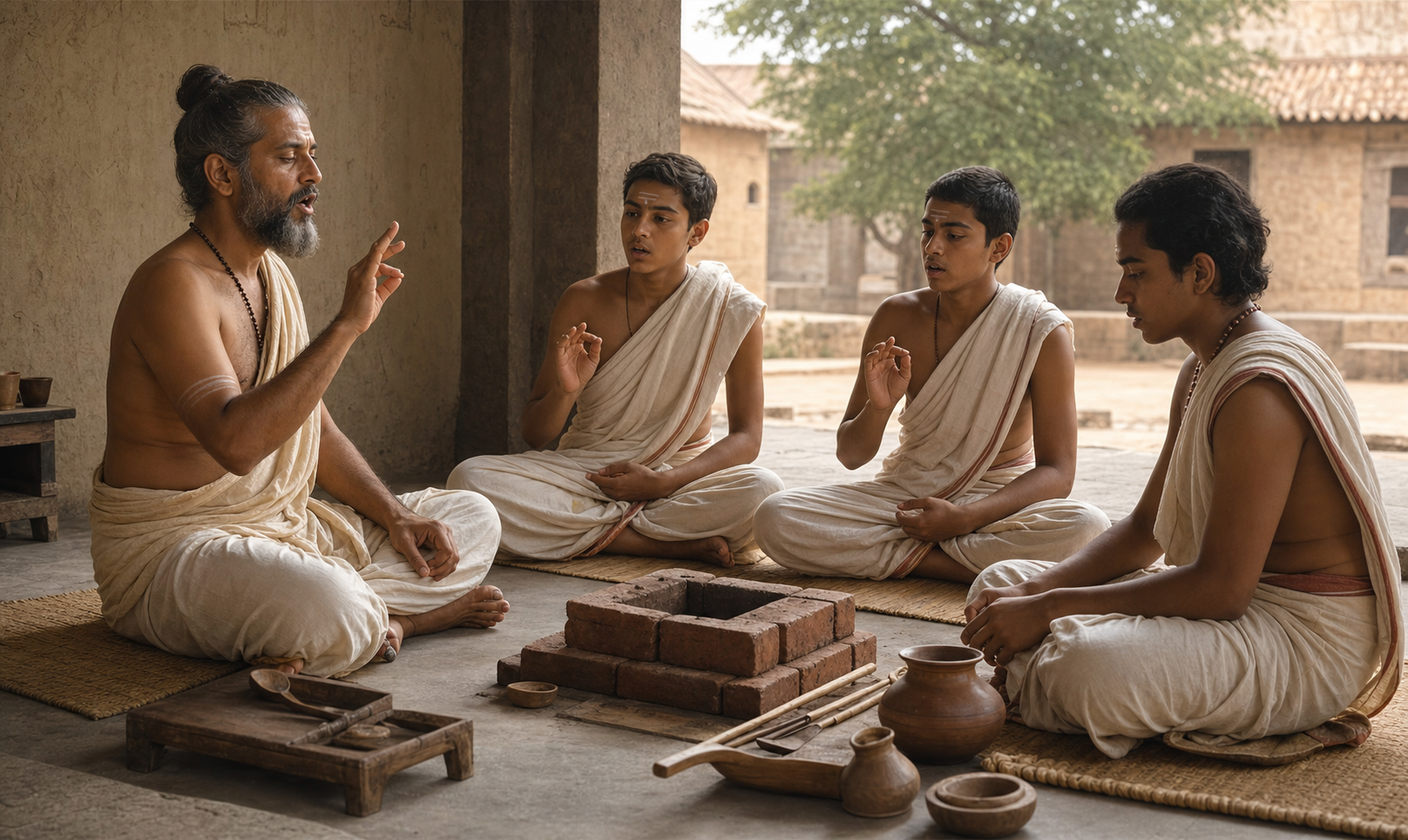
For a Vedic mantra, an English rendering is an interpretive result, not a replacement for the received Sanskrit. If your purpose is recitation, pronunciation and sequence need correction within an appropriate teaching relationship. If your purpose is interpretation, you still need to identify the words, examine their grammatical relations, locate the mantra, and understand the ritual setting in which tradition places it.
In 16th-century Kashi, Mahidhara brought these tasks together in the Vedadipa, his commentary on the Madhyandina Samhita of the Shukla Yajur Veda. His method connected linguistic attention, mantra meaning, ritual context, and received interpretation. That combination is a useful model for you: do not isolate a translation from the textual and ritual ecosystem that makes it intelligible.
Use separate fields in your notes so that one layer does not silently acquire the authority of another:
- Received text: Record the exact passage and identify its Samhita, branch, or recension where known.
- Language: Note word division, grammatical construction, and any term whose range of meaning affects the passage.
- Context: Record the ritual action, sequence, role, or setting associated with the mantra.
- Commentary: Name the commentator and summarize the particular explanation being offered.
- Translation: Keep the translator’s decisions visible instead of treating English wording as self-evident.
- Your inference: Label your conclusion as your conclusion, especially when you extend the passage into philosophy or contemporary ethics.
This simple separation prevents a common transmission failure. Notes are copied, labels disappear, and an interpreter’s useful explanation begins to circulate as though it were the primary wording. Fidelity does not require rejecting commentary. It requires remembering where the mantra ends and the explanation begins.
You should also match your learning method to your purpose. Someone learning recitation needs live correction, not merely silent reading. Someone studying grammar needs the Sanskrit construction to remain visible. Someone investigating ritual meaning needs allied explanations and practice-oriented context. Someone reflecting philosophically may begin with translation, but should avoid claiming that a personal application exhausts the mantra’s traditional function.
Dharmashastra often travels through citation and reconciliation
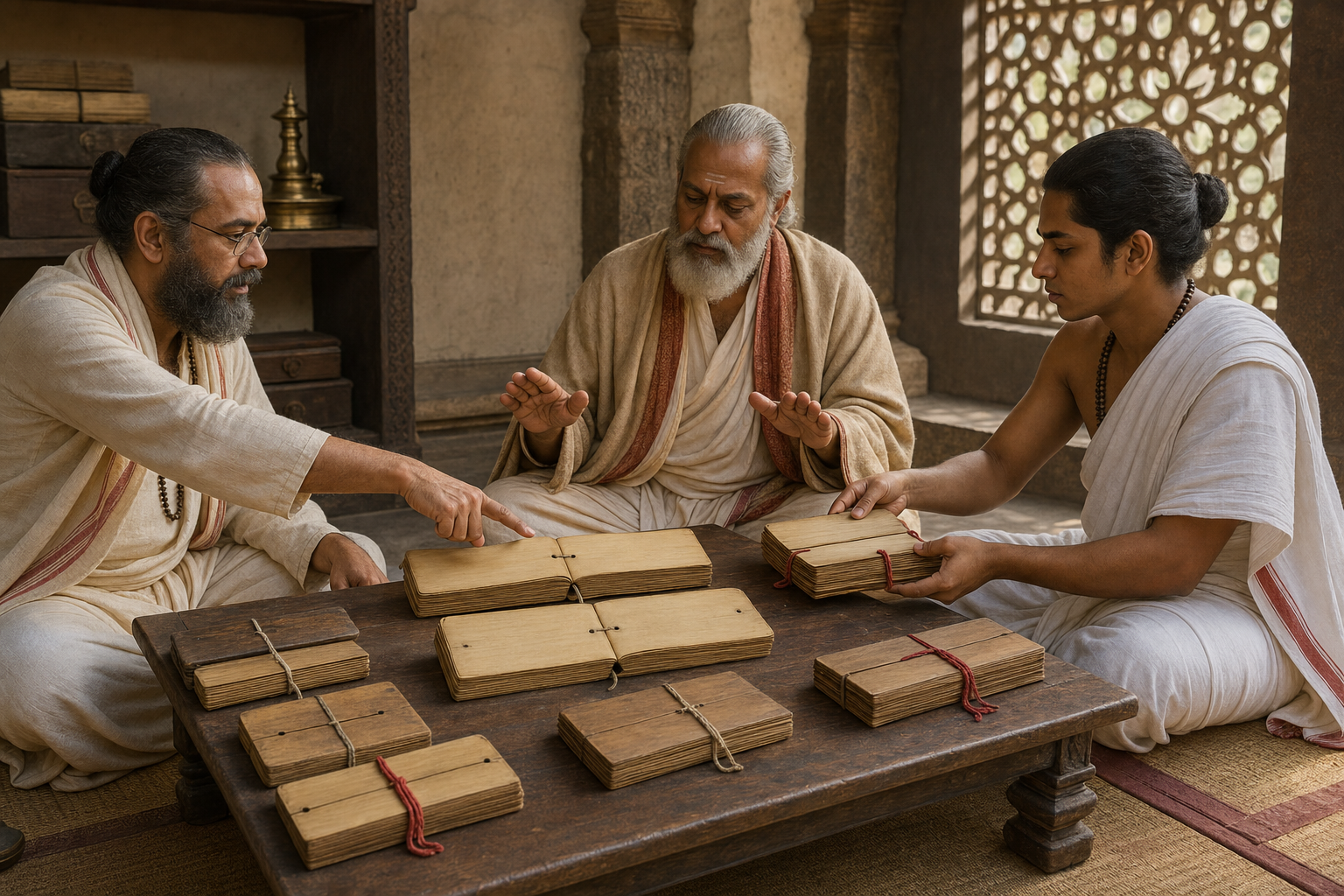
Dharmashastra presents a different preservation problem. Teachings about samskaras, observances, social duties, jurisprudence, and expiation were discussed across multiple attributed authorities. Later compilers and commentators could keep an earlier voice in circulation by quoting, comparing, or reconciling it with other positions.
The Kashyapa-attributed materials make the difficulty concrete. They are not fully extant, and much of their remembered presence depends on references and fragments preserved through later intertextual transmission. Themes such as samskaras, daily observance, varna-ashrama duty, vyavahara, and prayaschitta should therefore be treated as likely genre territory rather than a recovered table of contents for a complete surviving work.
When you encounter a claim attributed to an incompletely preserved Dharmashastra authority, audit it in this order:
- Identify the form of survival. Distinguish a direct quotation from an attribution, paraphrase, abstract, or later summary.
- Separate the voices. Determine which words are assigned to the earlier authority and which belong to the compiler or commentator preserving them.
- Check the surrounding problem. A statement quoted during a discussion of expiation should not automatically be generalized into a rule governing every aspect of daily conduct.
- Compare available witnesses. Repeated wording in more than one later setting can strengthen confidence, while differences should remain visible rather than being silently harmonized.
- Preserve the uncertainty. Say that a rule is attributed to Kashyapa or preserved under Kashyapa’s name when the complete original setting is unavailable.
- Limit your conclusion. A fragment can establish the circulation of an idea; it cannot by itself reveal the structure, full argument, or entire position of a lost work.
Later citation is both a lifeline and a filter. It can save wording that would otherwise disappear, but a compiler normally quotes material relevant to the question at hand. The quotation may not preserve what came before or after it. Silence in the surviving fragments cannot prove that the earlier authority had nothing more to say.
Truthfulness, non-violence, self-discipline, generosity, and social harmony provide recognizable points of ethical contact across Dharmic traditions. You can acknowledge that shared vocabulary without pretending that Hindu, Buddhist, Jain, and Sikh authorities always ground or apply each value in the same way. Begin with the common ethical horizon, then return to the vocabulary, discipline, and reasoning of the particular tradition you are studying.
Build a study chain that another reader can verify
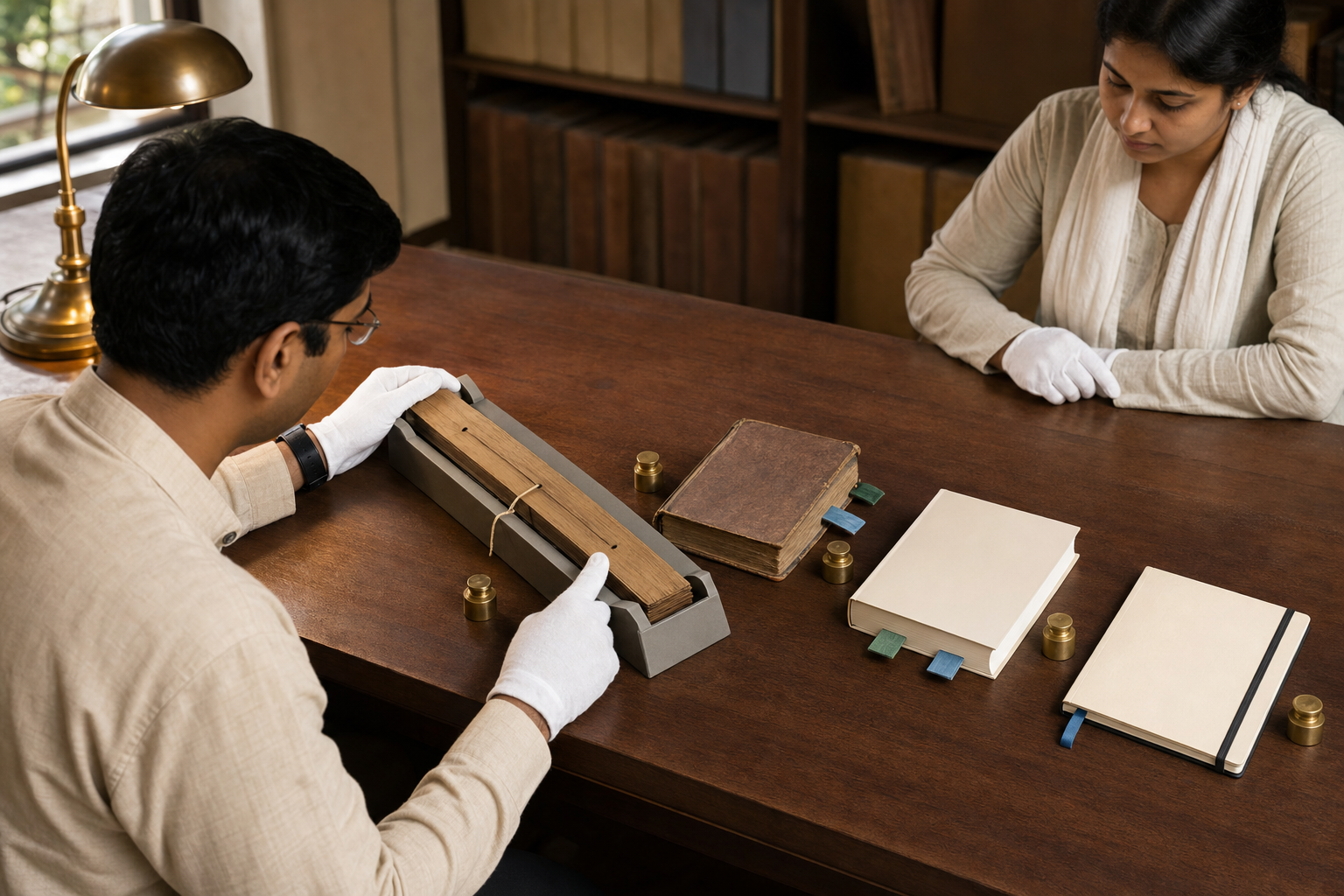
You do not need to resolve every textual problem before beginning serious study. You do need a repeatable method that shows what you received, what an interpreter supplied, and where uncertainty remains.
- Name your purpose. Decide whether you are learning recitation, reading Sanskrit, studying ritual, tracing intellectual history, examining Hindu jurisprudence, or reflecting on ethical practice. A resource suitable for one purpose may be insufficient for another.
- Identify the exact textual object. Write “Madhyandina Samhita of the Shukla Yajur Veda” when that is what you mean, rather than the much broader label “the Vedas.” Write “a later quotation attributed to Kashyapa” when a continuous Kashyapa text is not available.
- Establish its transmission status. Mark whether you have a received primary passage, a commentary, a translation, an attributed fragment, a paraphrase, or a modern inference. Do this before deciding what the passage means.
- Choose help suited to the layer. Seek corrected oral instruction for recitation, grammatical analysis for Sanskrit construction, traditional commentary for ritual and inherited interpretation, and comparison of witnesses for fragmentary Dharmashastra material.
- Keep attribution attached. When copying a note, retain the text name, commentator, translator, and location supplied by the material in front of you. An unattributed quotation becomes harder to verify every time it is shared.
- Test the scope of the teaching. Ask whether the passage is ritual, ethical, juridical, expiatory, descriptive, or prescriptive. Identify its audience and circumstance before applying it outside that setting.
- Transmit the limits as carefully as the claim. If context is missing, say so. If an interpretation belongs to a commentator, name that layer. If a contemporary application is yours, do not present it as the only meaning inherited from tradition.
This method also helps you assess online quotations. Before forwarding an impressive sentence, ask whether you can name the work, distinguish primary wording from commentary, explain how the passage survived, and state what remains uncertain. If you cannot, save the quotation for investigation rather than turning uncertainty into authority.
Reverence and critical care belong together here. Reverence keeps you from treating a living inheritance as raw material for any interpretation you prefer. Critical care keeps you from assigning certainty to a late paraphrase, a detached verse, or an unlabeled translation. The traditions remain intelligible when both disciplines are present.
Key takeaways
- Vedic transmission preserves more than semantic content; recited form, textual identity, ritual placement, and commentary must remain distinguishable.
- A commentary can faithfully transmit inherited understanding without becoming identical to the primary text.
- Dharmashastra teachings may survive through later quotations even when the earlier continuous work is no longer extant.
- An attributed fragment establishes less than a complete treatise: preserve the distinction in your notes and claims.
- Shared Dharmic values can support dialogue, but they should not be used to erase differences in doctrine, authority, or practice.
- Your own application is part of the living conversation only when you label it honestly and do not pass it off as ancient wording.
At your next study session, choose one passage and label its layers before trying to settle its meaning: received wording, textual identity, context, commentary, later witness, translation, and personal inference. If one field is unknown, leave it open and name the gap. That small discipline is how inherited learning remains trustworthy when you pass it onward.
References
- DharmaRenaissance Blog — Mahidhara of Kashi: The 16th-Century Vedic Exegete Who Illuminated the Shukla Yajur Veda
- DharmaRenaissance Blog — Kashyapa Samhita & Smriti: Unraveling Dharma’s Timeless Blueprint for Ethical Life
