
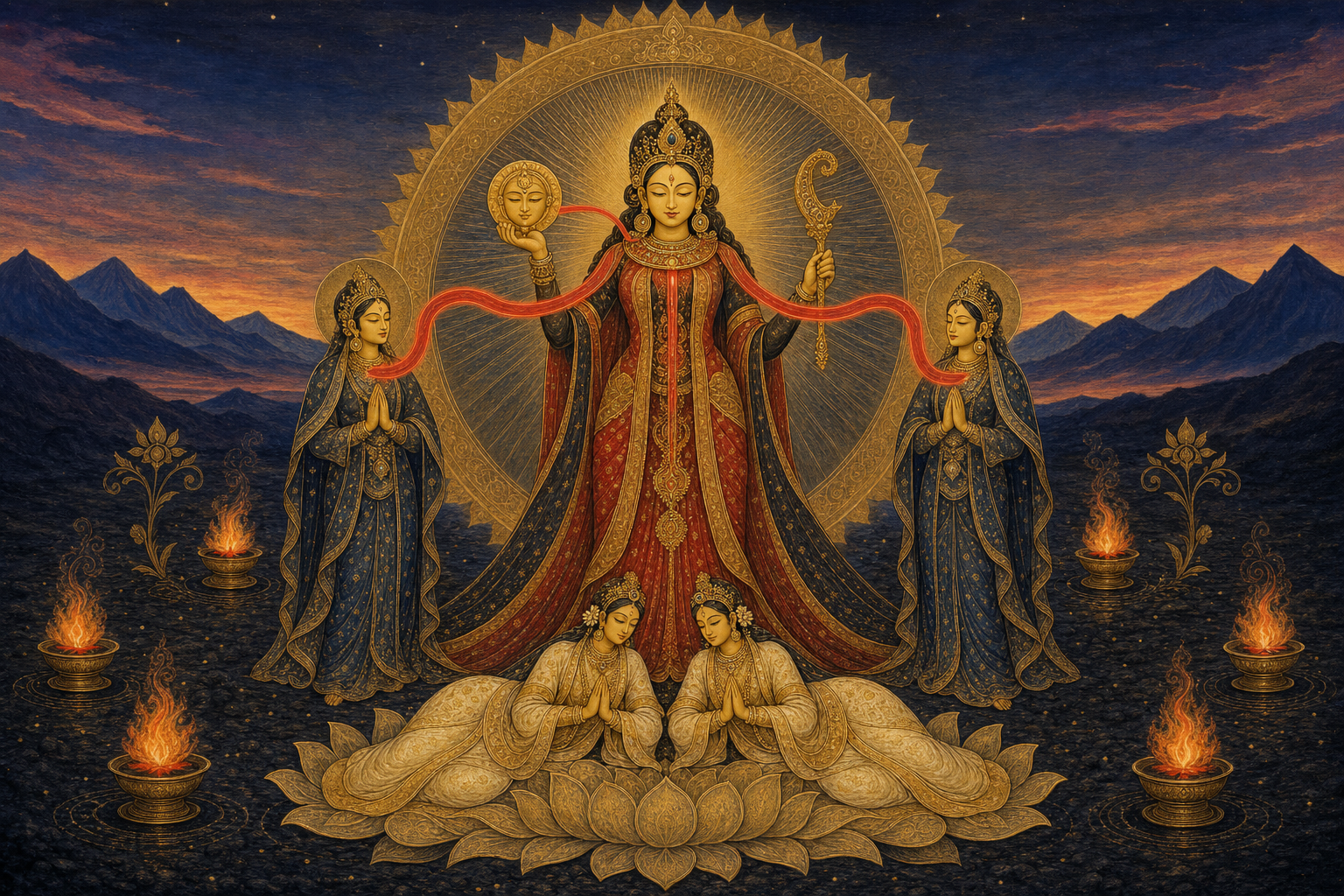
You may encounter Chinnamasta in a temple image, a book, or an online discussion and wonder whether you are looking at a celebration of violence. That reaction is understandable, but it comes from isolating the severed head and blood from the rest of the icon.
Read the full composition and a different teaching appears. Chinnamasta asks what must be cut without destroying life, how desire can be mastered without being despised, and how spiritual power can sustain both you and others without becoming possession or self-neglect.
Read the whole image before decoding one symbol
Chinnamasta belongs to the ten Mahavidyas, the great wisdom forms of Devi. Her name means “She whose head is severed.” She holds her own detached head while three streams of blood rise from her neck: one returns to the Goddess, while the other two nourish her attendants, Dakini and Varnini. She commonly stands over Kama and Rati in union, often within a cremation-ground setting.
The first rule of interpretation is simple: do not detach any one element from that complete arrangement. The severing, the continuing flow of life, the three recipients, the amorous couple, and the ground of death qualify one another. An explanation that accounts only for the blade or only for sexuality will miss the teaching held by the whole.
- Notice who performs the severing. Chinnamasta acts upon herself; the central drama concerns transformation within consciousness, not aggression toward another being.
- Notice what survives. Awareness remains active, and vitality continues to flow. The image portrays a cutting that releases power rather than an act that ends life.
- Notice who is fed. The Goddess does not give everything away, nor does she keep everything for herself. Her power circulates among self and attendants.
- Notice what remains beneath her. Kama and Rati are still present. Desire has been placed under conscious mastery, not erased from existence.
- Notice the setting. The cremation ground denies the fantasy that bodies, roles, pleasures, and possessions can be held forever.
Tantric imagery often uses shock as upaya, or skillful means. The unfamiliar form interrupts passive looking and forces you to examine assumptions that a gentler image might leave untouched. A blade, skull garland, storm-darkened setting, or sky-clad body therefore should not be read as an isolated endorsement of danger. Together they remove comforting disguises and place impermanence, desire, identity, and power in one field of vision.
A reliable interpretation should explain all five observations without contradiction. If it treats the image as permission for literal harm, praises total self-depletion, or declares embodied life inherently impure, it cannot explain why Chinnamasta remains conscious, receives nourishment herself, feeds others, and stands upon rather than eliminates the couple below her.
The severed head is the ego-position, not the destruction of awareness
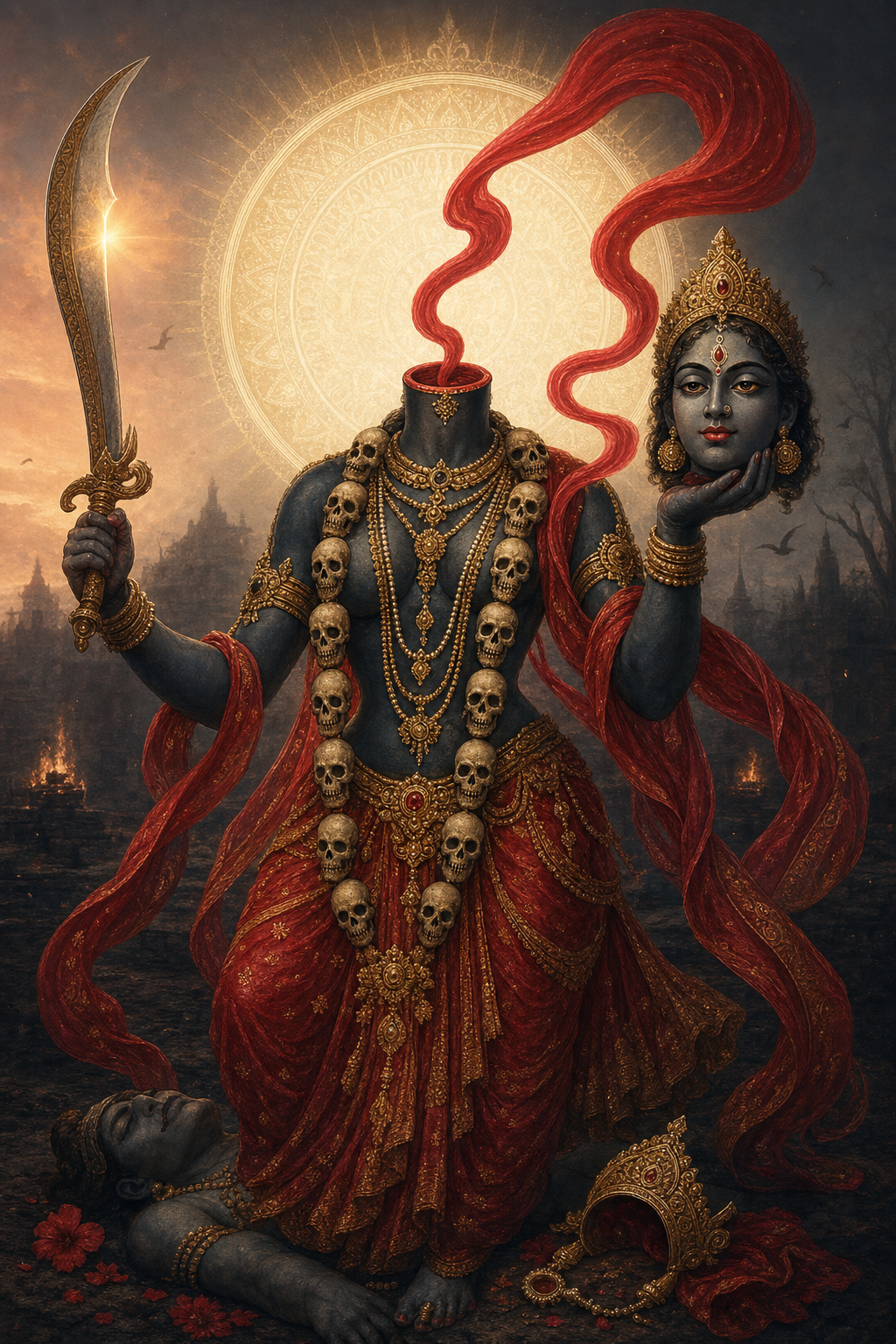
The head commonly represents the identity that says, “This role, preference, achievement, injury, or belief is the whole of me.” Sanskrit calls this ego-forming tendency ahankara. It is necessary for ordinary coordination, but it becomes bondage when the constructed identity claims ownership of consciousness and demands control over every experience.
Chinnamasta’s act cuts that claim at its apparent seat. Yet the Goddess does not become unconscious. She sees, acts, receives, and gives after the severing. The icon therefore distinguishes awareness from the identity that tries to possess awareness. What falls is not intelligence itself but the insistence that the limited self is the sovereign centre of reality.
This distinction protects the symbolism from two common mistakes. The first is to romanticize mental blankness, as though spiritual maturity meant losing judgement. The second is to turn ego-transcendence into self-contempt. Chinnamasta does not teach you to hate your personality, body, or responsibilities. She teaches you to stop treating them as absolute.
The blade expresses decisiveness. Some attachments cannot be negotiated with indefinitely because every negotiation becomes another way to preserve them. You can recognize such an attachment by asking three concrete questions:
- What identity am I defending even when it prevents me from seeing what is true?
- What do I fear would disappear if I no longer controlled how others understand me?
- Which duty becomes clearer when praise, status, resentment, or the need to win is removed from the decision?
The answer may concern a role you have outgrown, a grievance that organizes your choices, or the desire to appear spiritually advanced. The Chinnamasta response is not theatrical self-denial. It is the precise removal of the false claim so that attention and energy can return to dharma.
The boundary between symbolism and literal action must remain absolute. Self-decapitation and blood are not ritual instructions for physical injury, blood use, or reenactment. Their force lies in revealing an interior surrender: release the ego’s ownership, not the life through which dharma must be lived.
The three streams show how Shakti circulates
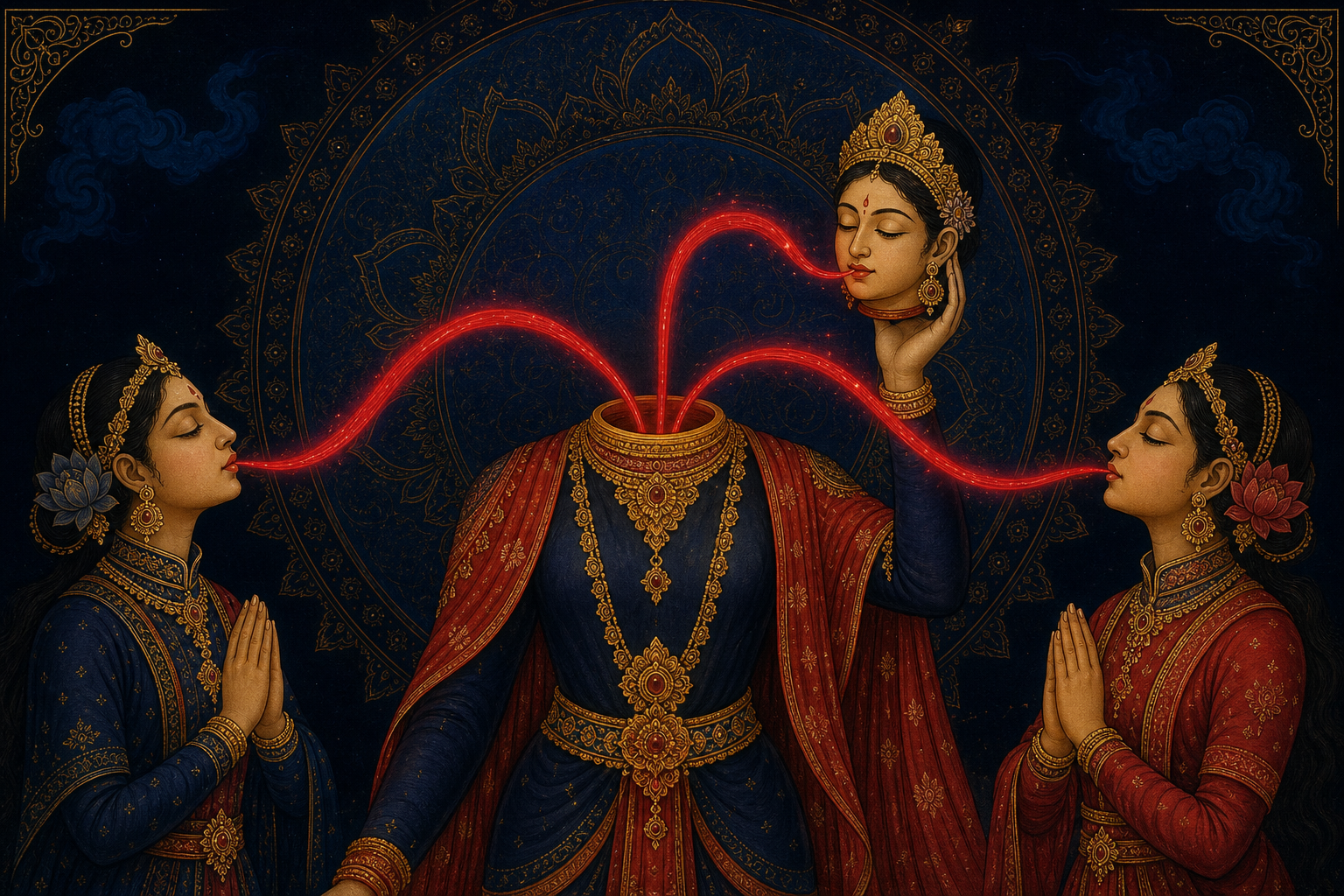
The blood streams upward, against ordinary physical expectation. That visual impossibility is a cue to look beyond anatomical realism. Blood functions here as concentrated vitality: prana, sustaining power, and sacramental amrita. Life has not been discarded. It has been freed from exclusive ownership and redirected.
One widely used subtle-body interpretation associates the three streams with ida, pingala, and sushumna. Ida and pingala represent polar currents, often described in lunar and solar terms, while sushumna is the central channel of integration. Dakini and Varnini can accordingly be read as the two dynamic sides receiving their vitality from the one Shakti.
The image does not require you to force each attendant into one fixed label. Another psychological reading connects the pair with raga and dvesha: attraction and aversion, the movements that pull experience toward what is wanted and push it away from what is feared or disliked. These are not necessarily competing explanations. One describes energetic polarity; the other helps you notice how polarity appears in the mind.
The central stream matters just as much as the two outer streams. Chinnamasta herself receives nourishment. Her giving is therefore not a model of martyrdom in which holiness is measured by exhaustion. Nor is it a model of accumulation in which power is guarded as private property. The icon holds self-maintenance and service in the same act.
That balance gives you a practical test for generosity. Before offering time, attention, money, or emotional labour, ask:
- What must remain available for my legitimate duties and inner steadiness?
- What can flow outward without producing concealed resentment or avoidable neglect?
- Am I withholding strength because it gives me status or control?
- Am I giving compulsively because being needed has become part of my identity?
The first two questions protect the central stream. The last two expose ego in opposite forms. Hoarding says, “This power is mine alone.” Compulsive sacrifice says, “My worth depends on being consumed by others.” Chinnamasta permits neither conclusion. Shakti remains sacred because it circulates wisely.
Dakini and Varnini should not be reduced to passive dependants or figures of excess. They make relationship visible. The Goddess’s power becomes intelligible through what it sustains, while the attendants’ polar energies remain ordered by their connection to the centre. The tableau is therefore less a scene of loss than a diagram of interdependence.
Kama, Rati, and the cremation ground correct opposite errors
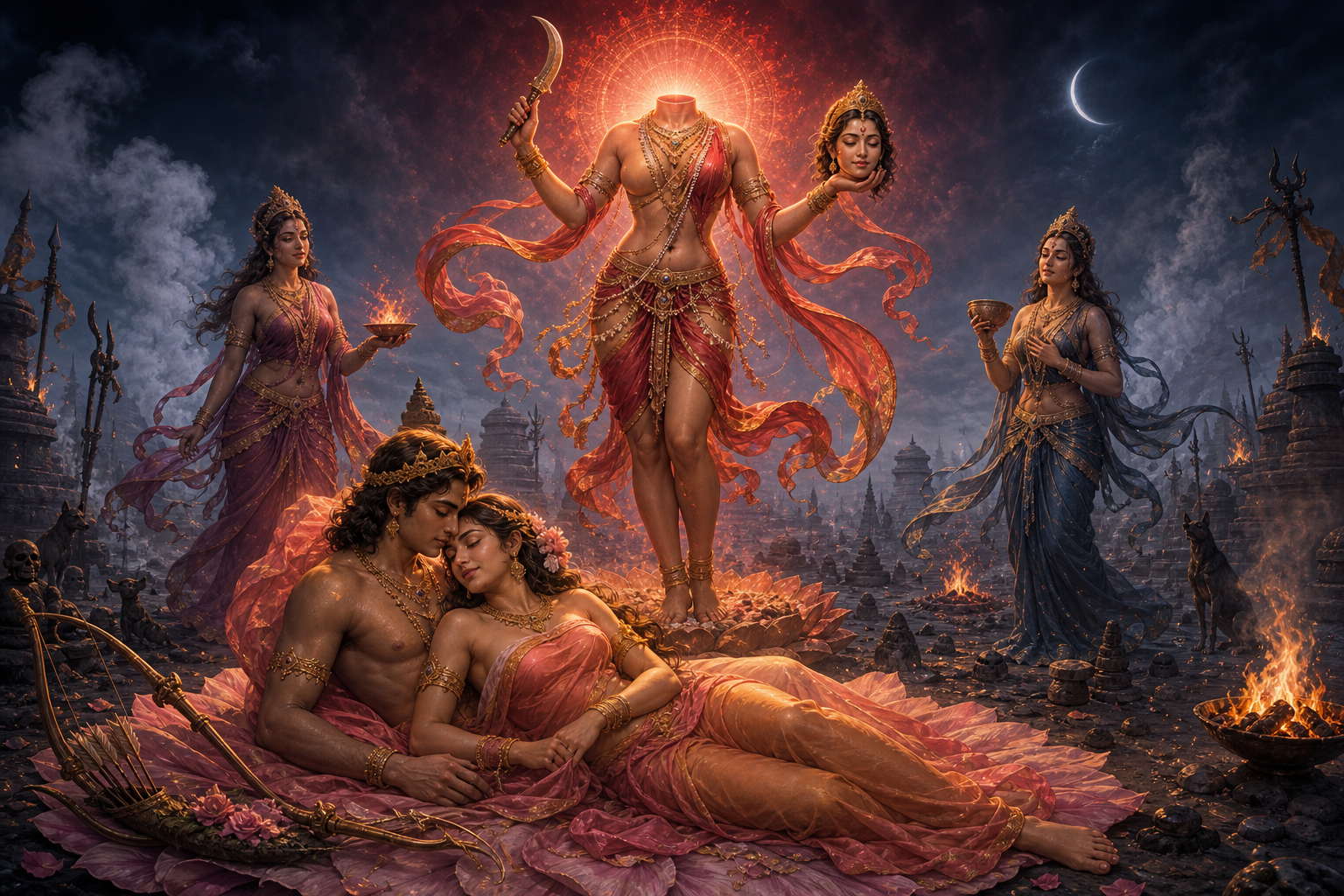
Chinnamasta’s position above Kama and Rati is sometimes mistaken for a condemnation of sexuality, affection, or embodied pleasure. But the couple has not vanished. Their energy remains part of the sacred composition. What changes is its place: desire is no longer enthroned as the ruler of consciousness.
Mastery is different from obedience and suppression. Obedience lets desire decide what is true and good. Suppression refuses to acknowledge desire and often leaves it operating in secret. Mastery sees the force clearly, accepts that it exists, and directs it toward a purpose consistent with dharma. This is sublimation: creative power is not wasted, but neither is it allowed to command the person who carries it.
You can apply that distinction to more than sexual desire. Ambition, hunger for recognition, anger, attachment to comfort, and even enthusiasm for religious identity can become forms of kama when they dictate perception. Before acting on a strong impulse, place it under four tests:
- Name the desire without decorating or condemning it.
- Separate its raw energy from the particular outcome it demands.
- Ask whether that energy can serve a duty, disciplined practice, creative work, protection of another, or honest repair.
- Refuse the desired outcome when obtaining it would require adharma, even if the energy itself can be redirected.
The cremation ground provides the second correction. If the couple shows life’s generative urgency, the cremation ground shows its limit. Every possession, social mask, bodily pleasure, and defended identity is temporary. The setting is not decorative morbidity. It asks whether you are spending a finite life on something worthy of it.
Desire without awareness of death becomes grasping. Reflection on death without respect for life’s energy becomes sterile withdrawal. Chinnamasta holds both realities at once. The result is spiritual urgency without panic: enjoy without clinging, act without pretending that outcomes can be owned, and do not postpone the surrender that truth already requires.
The sky-clad form reinforces the same demand. Nothing can be hidden behind rank, costume, or social respectability in the cremation ground. When you use the icon as a mirror, the useful question is not whether you approve of its appearance. It is what remains of your self-description when status, beauty, possession, and public recognition no longer support it.
Use the icon for disciplined reflection, not improvised Tantra
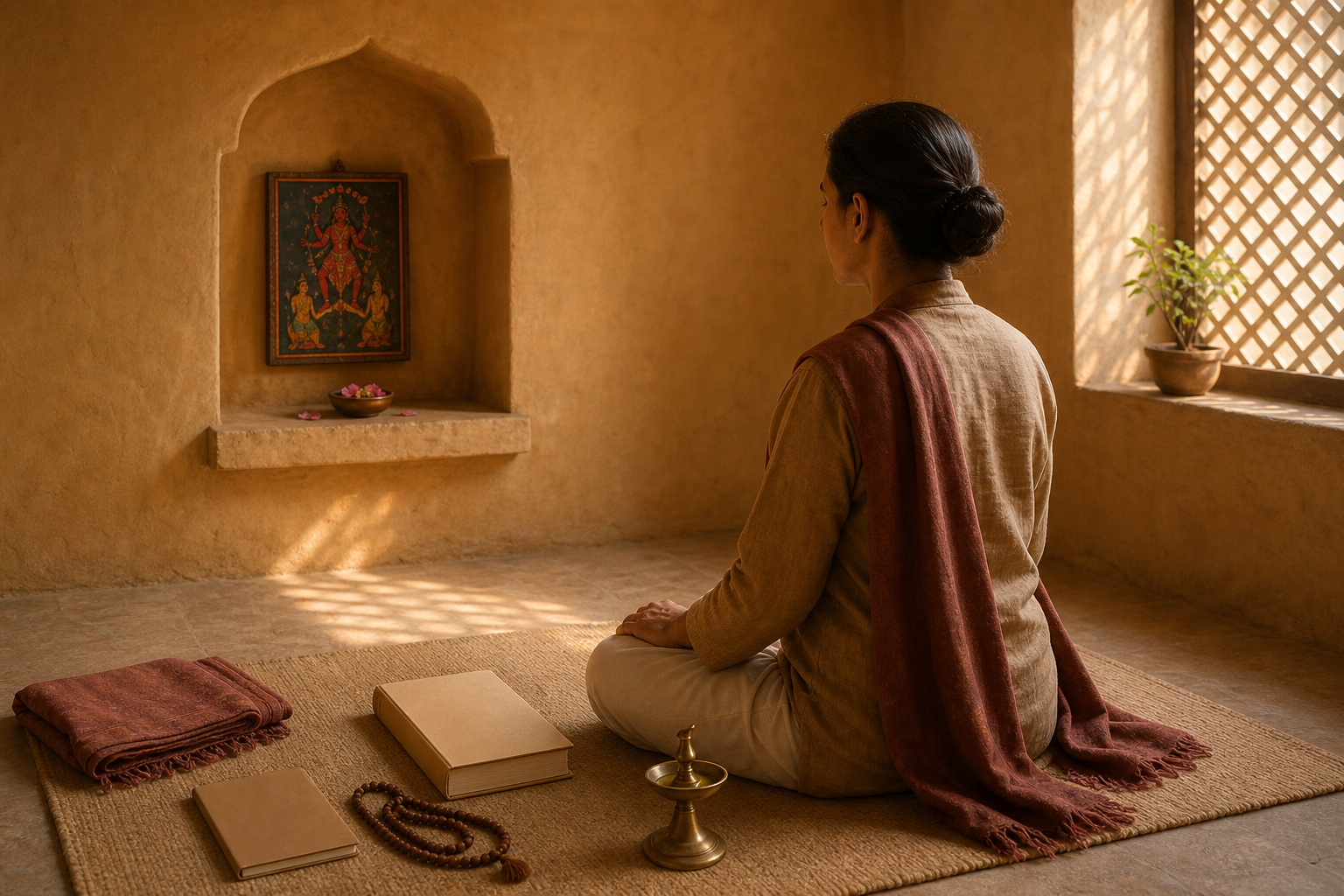
You do not need to imitate an advanced ritual or manipulate subtle energies to learn from Chinnamasta. A careful visual contemplation can remain simple, ethical, and grounded. Use the icon as a sequence of questions rather than as a technique for producing an extraordinary state.
- Sit with the complete image and breathe naturally. Do not begin by staring only at the wound or blade.
- Identify the “head” you are carrying: the role, story, grievance, or claim of ownership that currently feels non-negotiable.
- Name the two pulls around it. What are you chasing, and what are you trying to avoid? This is a practical way to observe raga and dvesha.
- Find the central commitment. Ask which dharmic duty remains when both attraction and aversion lose their authority.
- Choose one boundary that preserves necessary vitality and one act of seva through which strength can circulate outward.
- Close by returning to an ordinary responsibility. The value of contemplation appears in clearer conduct, not in how intense the image felt.
If you use ida, pingala, sushumna, or kundalini as more than contemplative symbols, do so within qualified lineage guidance. An iconographic interpretation is not a manual for forceful breathing, retention, mantra, or kundalini activation. Until appropriate instruction is available, natural breath awareness and ethical self-observation are the safer limits.
What cross-Dharmic resonances do and do not mean
Chinnamasta’s teaching can be understood more clearly beside related Dharmic concerns, provided resemblance is not mistaken for sameness. The Vajrayana figure Chinnamunda, connected with Vajrayogini, similarly presents self-decapitation as the cutting of avidya, or ignorance, and the liberation of awareness. The shared motif helps confirm that the image is concerned with awakening rather than a cult of physical harm.
Jain aparigraha offers a useful resonance with Chinnamasta’s relinquishment of possessiveness, while Jain restraint sharpens the distinction between directing energy and being ruled by appetite. Sikh teaching on haumai likewise provides a parallel vocabulary for the self-centred condition that separates service from truth. These correspondences reveal recurring Dharmic disciplines: loosen clinging, restrain egoic appetite, and convert strength into compassionate action.
They do not make the traditions interchangeable. Chinnamasta remains a Mahavidya whose icon belongs to a Hindu Tantric setting; Chinnamunda belongs to Vajrayana contexts; aparigraha and haumai carry meanings within Jain and Sikh paths that should be learned on their own terms. Comparison is valuable when it clarifies a shared ethical problem, not when it erases distinct philosophies and practices.
Key takeaways
- Read Chinnamasta as one composition. The severed head, living streams, attendants, amorous couple, and cremation ground interpret one another.
- The severing represents a decisive break with ahankara and false ownership, not the destruction of intelligence, personality, or bodily life.
- The three streams may be read as ida, pingala, and sushumna, or as a map of polar forces brought into relation with a centre.
- Because Chinnamasta feeds herself as well as Dakini and Varnini, service must include both responsible self-maintenance and generosity.
- Standing over Kama and Rati signifies mastery and redirection of desire, not hatred of love, sexuality, or embodied energy.
- The image authorizes contemplation and ethical transformation, never literal self-harm or improvised advanced practice.
The next time Chinnamasta unsettles you, do not rush to make the image comfortable. Ask which attachment needs the blade, which desire needs direction, and where your vitality should flow. Then make one decision that preserves the centre while allowing strength to become seva. That is where the icon moves from spectacle to sadhana.
References
