
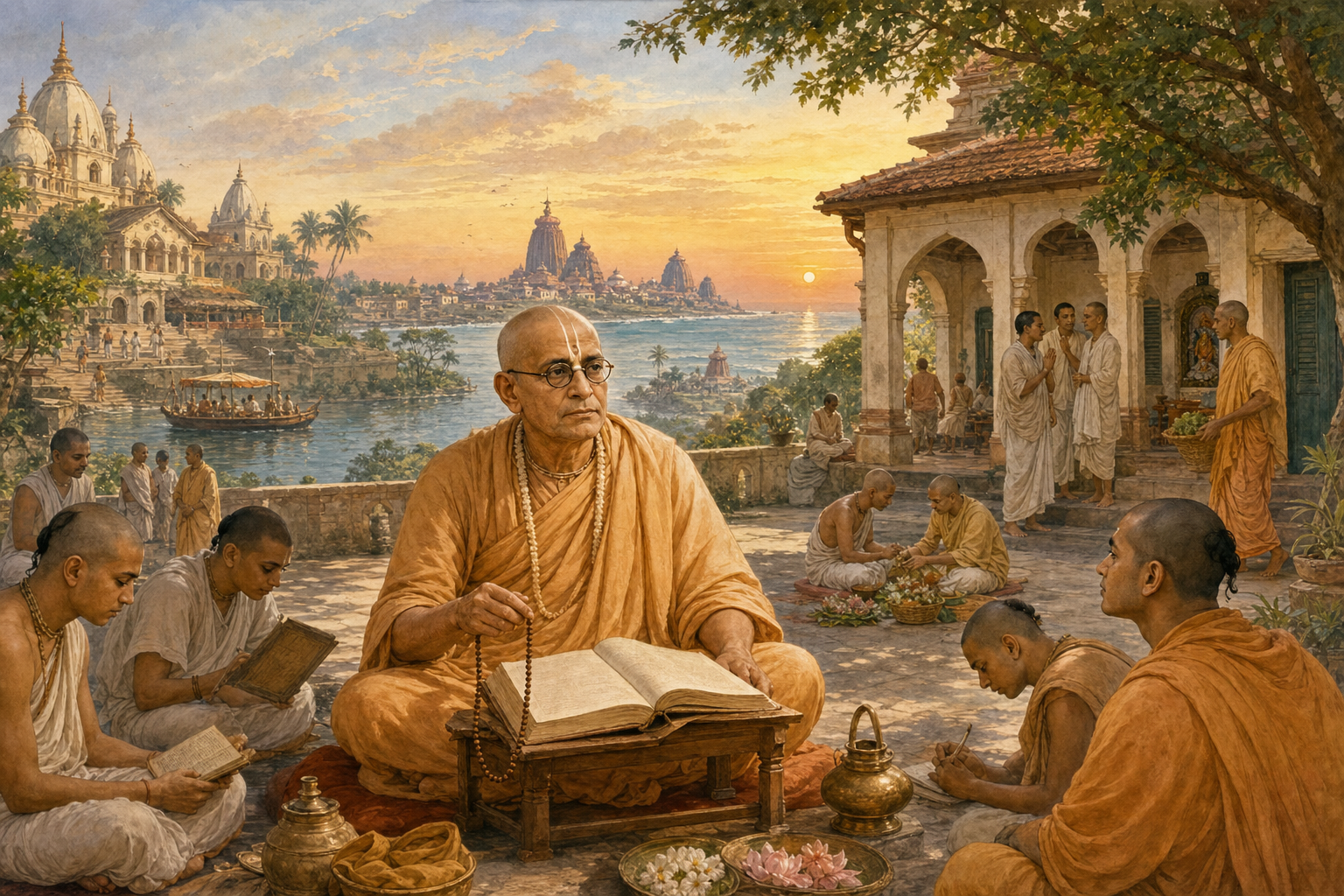
If you know Srila Bhaktisiddhanta Sarasvati Thakura mainly as a formidable Gaudiya Vaishnava teacher, it can be difficult to see how his instructions, the holy places associated with him, and the institutions he built belong to one coherent legacy. Begin with a practical question: what was each of these meant to make possible in the life of a devotee?
The answer is disciplined remembrance expressed as seva. His teachings give that orientation an inner form, Puri and Mayapur give it sacred geography, and the math gives it a durable communal structure. Once you see those three layers together, you can approach his legacy as a living path rather than a collection of quotations, buildings, and historical facts.
Begin with the operating principle: remembrance becomes service
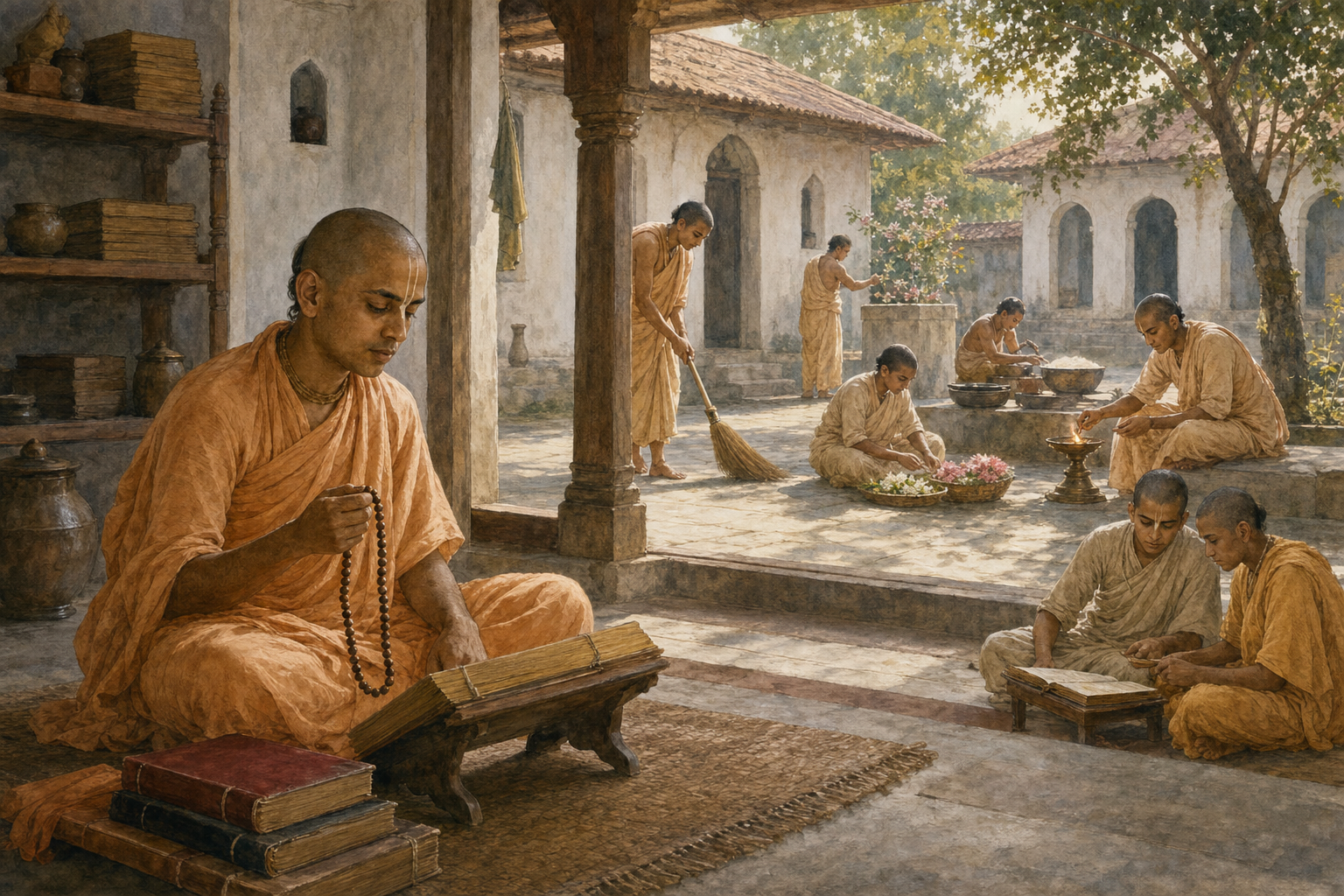
Bhaktisiddhanta Sarasvati placed Sri Caitanya Mahaprabhu’s declaration in the Sikshashtakam, “param vijayate sri-krishna-sankirtanam”, at the center of spiritual life. Sankirtana is not merely devotional music or a way to generate a temporary religious mood. Sacred sound gathers attention around Krishna, corrects the tendency to place oneself at the center, and gives a community something higher than personality around which to unite.
This leads to the theological foundation of his practical teaching. In the Gaudiya Vaishnava understanding, Krishna is the supreme enjoyer; the practitioner is not meant to seize the world for independent enjoyment but to employ life in seva. Work, learning, possessions, speech, and institutional ability are therefore judged by what they serve. The question is not simply, “Is this religious?” It is, “Does this deepen remembrance and become useful in service?”
That distinction protects you from scattered religiosity. It is possible to collect rituals, books, initiations, pilgrimages, and spiritual identities while remaining governed by self-importance. Bhaktisiddhanta’s emphasis on one-pointed purpose asks you to connect every practice to the same center. Variety need not disappear, but your motive cannot be allowed to fragment into prestige, novelty, and possession.
You can put this teaching to work without attempting an artificial overhaul of your life:
- Establish one repeatable period of nama, kirtana, or Hari-katha each day. When attention scatters, return to that anchor instead of searching immediately for a new technique.
- Before acquiring a religious object, book, or credential, name the seva it will support. If you cannot name one, postponing the acquisition may be the more faithful practice of non-possessiveness.
- When you find fault with another practitioner, apply Bhaktisiddhanta’s instruction, “Do not criticize others. Try to rectify yourself.” Identify one correction in your own speech, attention, or conduct before speaking about someone else’s failure.
- Choose devotional association that requires participation. A community becomes formative when you chant, listen, serve, and accept correction within it, not when you consume its programs as a spectator.
Constant remembrance, expressed in the phrase kirtaniyah sada harih, need not become an anxious attempt to manufacture uninterrupted emotion. For a householder or professional, it can function as a rule of return: come back to Hari after distraction, reconnect ordinary duties with seva, and refuse to let success become a new identity. Bhaktisiddhanta’s self-description of the devotee as a carrier of the dust of Hari’s feet displaces labels such as learned and ignorant, pious and sinful. Service, not self-ranking, becomes the stable identity.
Puri shows how sacred memory can shape a vocation
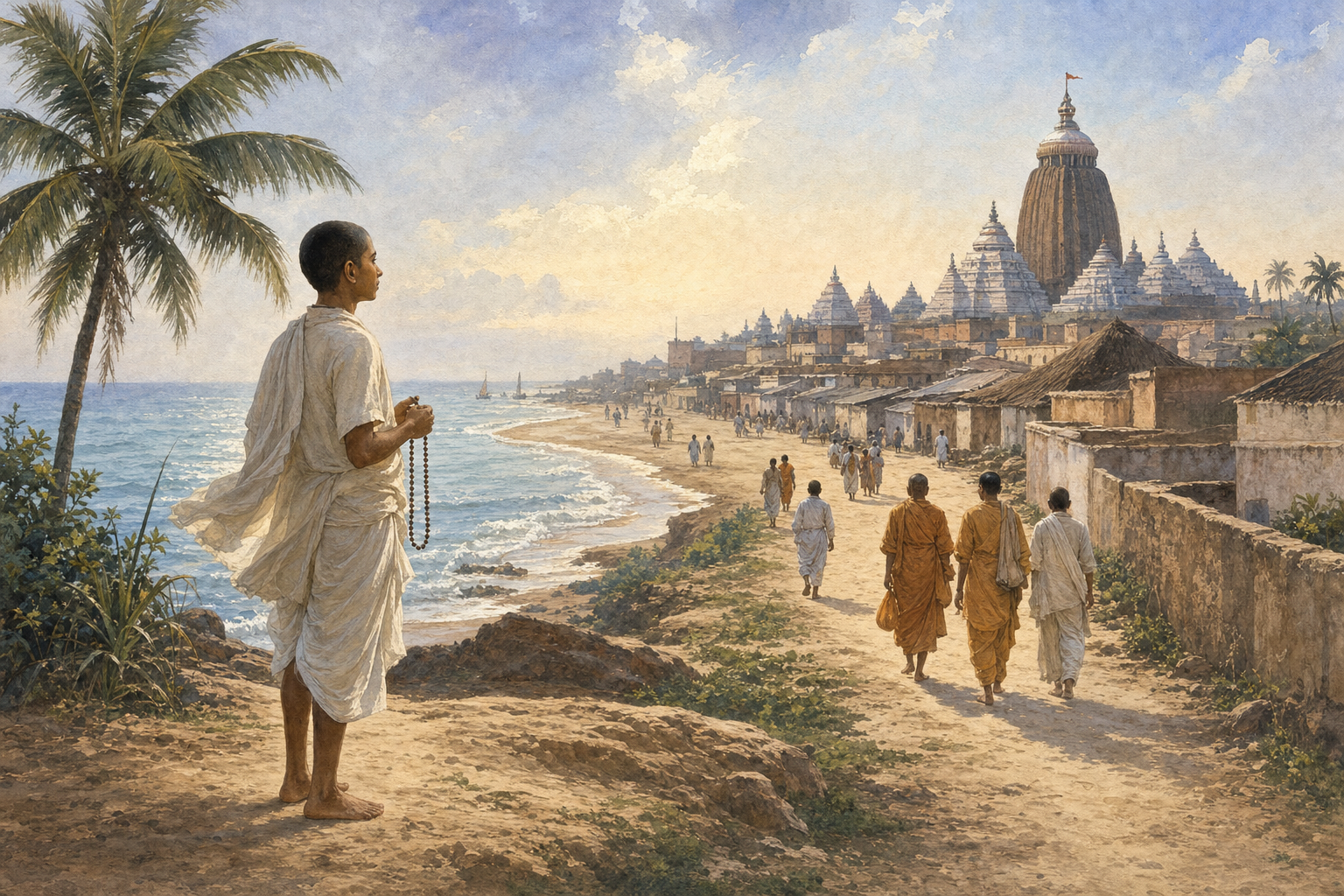
The birthplace temple in Puri gives these teachings a human beginning. The Gaudiya Matha has preserved and developed the residence associated with Bhaktisiddhanta Sarasvati’s appearance, including a temple, facilities for devotees, and daily worship of his murti at the precise birthplace. You are not looking only at a memorial marker. You are entering a place where historical remembrance continues through worship and service.
Puri’s deeper significance comes from its relationship with Lord Jagannatha. Gaudiya Vaishnava memory holds that when Bimala Prasada, the future Bhaktisiddhanta Sarasvati, was six months old, the Rathayatra chariots halted before the residence of his father, Srila Bhaktivinoda Thakura. His mother, Srimati Bhagavati Devi, placed the child at Jagannatha’s feet, and a garland from the Lord descended around him. Devotees receive the event as an early blessing upon the child’s future work.
Another cherished account concerns the temple’s foundational work, when devotees reported that a gentle fragrance of candana arose from the birthplace. This should be handled as devotional testimony: neither mocked because it belongs to sacred memory nor presented as though every visitor personally witnessed it. A mature pilgrimage can respect the community’s account while remaining honest about the difference between an inherited testimony and an observation you make yourself.
Use three distinct layers when you visit or think about the Puri site:
<!– wp:list {