
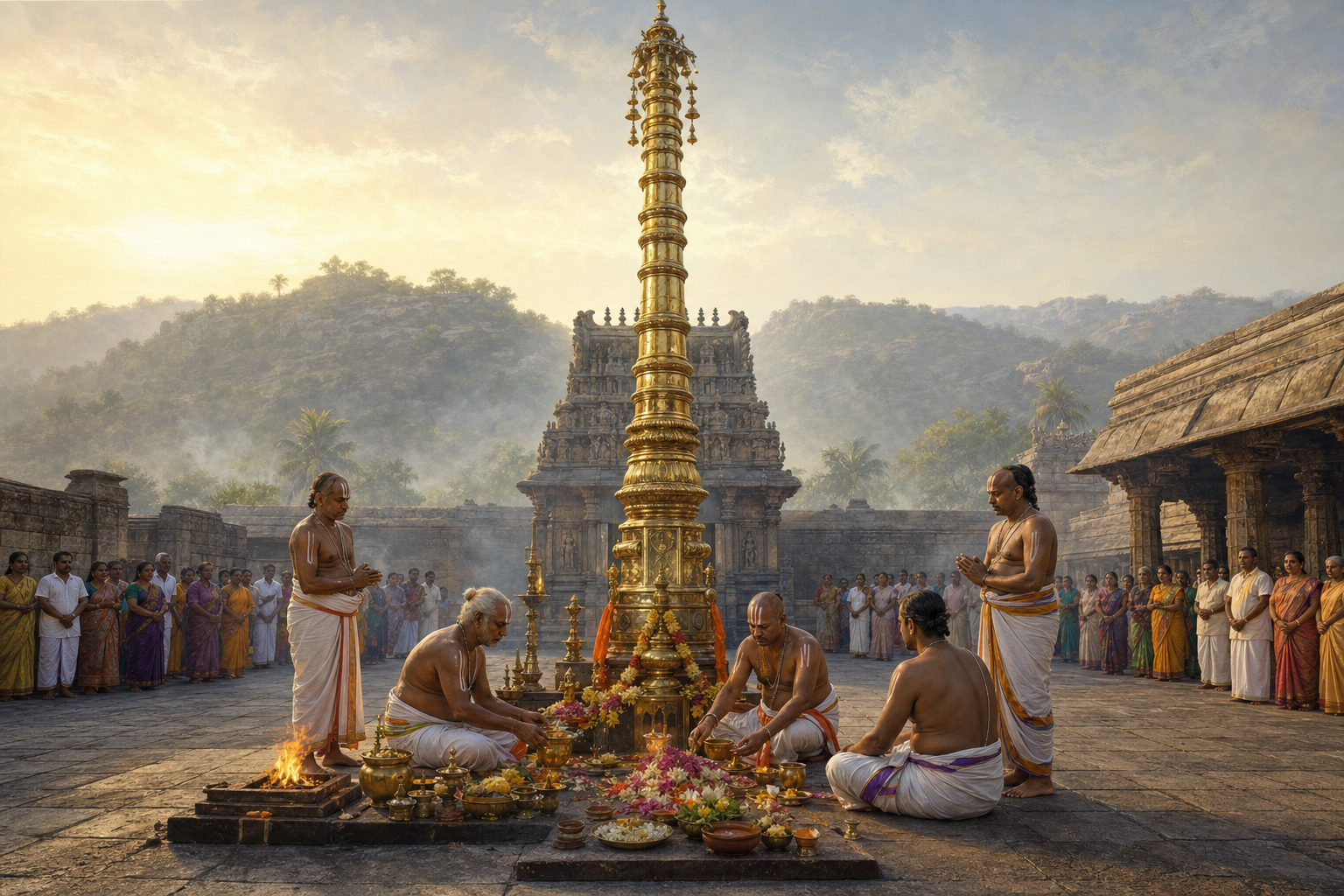
If you found the Tarigonda ceremony after its announced dates had passed, you need two answers: what the rite means, and whether those dates can still guide a visit. The first is clear. The second requires caution. A Dhwajasthambha Samprokshana Mahotsavam was scheduled for February 13-15, 2026, at Sri Lakshmi Narasimha Swamy Temple in Tarigonda, Gurramkonda Mandal, Annamayya District, Andhra Pradesh. Completion of the programme and its exact session timings cannot be verified from the facts in hand, so those dates should not be treated as a current timetable.
What remains useful is the ritual itself: why a temple flagstaff is re-sanctified, what the different ceremonies contribute, and how you can participate without reducing a living tradition to a spectacle. The central idea is continuity through renewal. The community does not begin its faith again; it renews its care for a consecrated part of the temple.
Key takeaways
- The Tarigonda observance was scheduled as a three-day mahotsavam from February 13 to 15, 2026; obtain fresh information from temple authorities before making any present-day travel plan.
- Dhwajasthambha Samprokshana is the ritual re-sanctification of the temple flagstaff, not merely a repair, decoration, or public unveiling.
- Its customary elements include Vedic recitation, homas, purification, abhisheka with sanctified water, special archana, and processional worship.
- The available sequence is a general ritual outline, not a confirmed day-by-day schedule for Tarigonda.
- Participate by following local instructions, respecting restricted ritual space, using authorized seva channels, and leaving the temple surroundings clean.
Why the flagstaff is more than a temple fixture
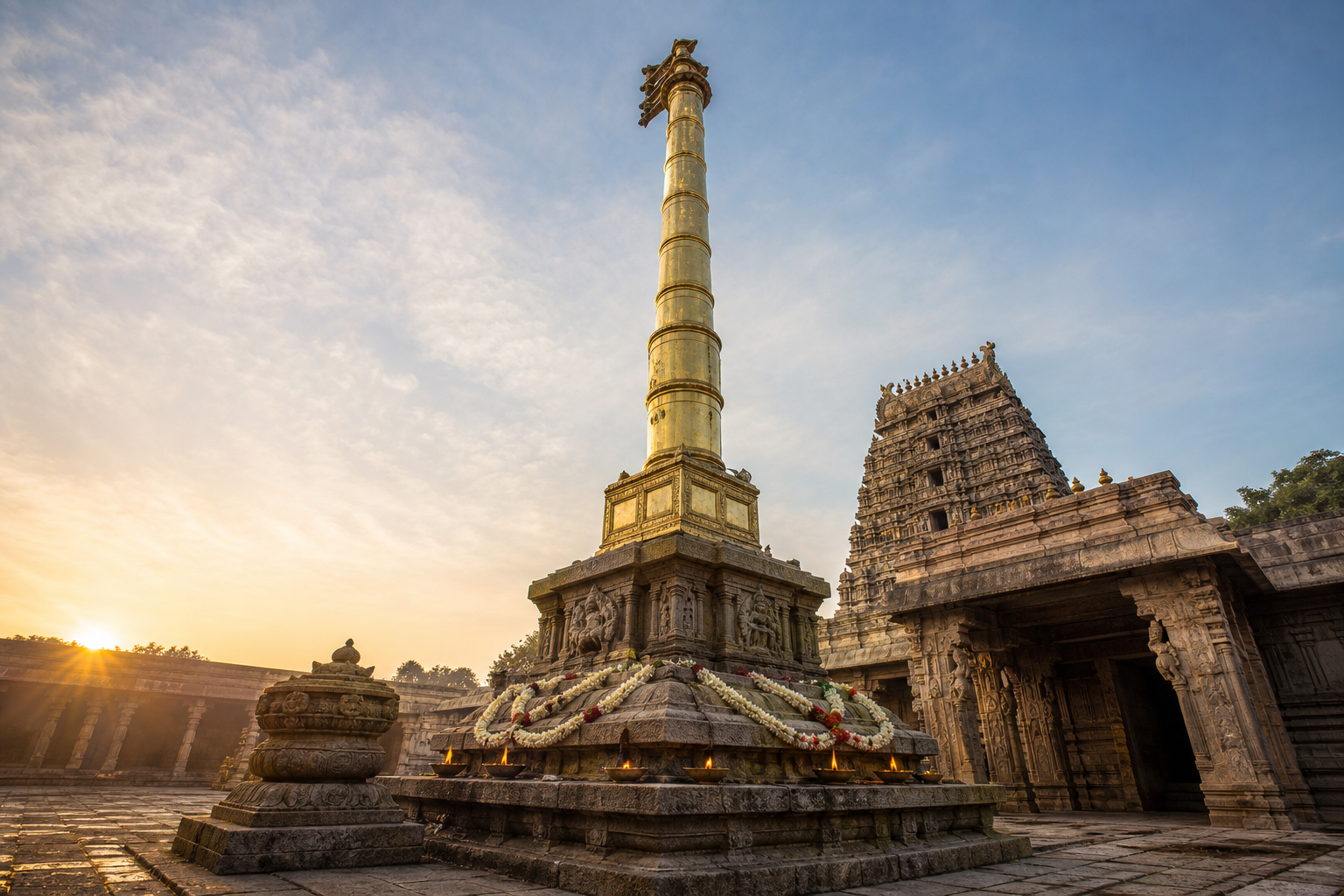
The dhvaja-stambha is easy to mistake for an architectural marker because it is physically prominent. Within temple tradition, however, its significance is ritual as well as structural. It marks sacred order, expresses the protective character of temple space, and stands as a visible reminder of the community’s commitment to the deity and to dharma.
You may encounter the spellings Dhwajasthambha and dhvaja-stambha. They refer to the same flagstaff concept rather than two different structures. In this setting, samprokshana refers to ritual re-sanctification or renewal.
Keep two layers separate when explaining the ceremony. One is the flagstaff as a material structure. The other is its consecrated place within temple worship. Samprokshana addresses that sacred identity through mantra, homa, purification, and abhisheka with sanctified water held in kalashas. The ritual name by itself does not establish whether the structure was repaired, replaced, or subjected to some other physical work. Unless temple authorities specify such work, do not add it to the story.
This distinction also explains why “re-consecration” should not be read as evidence that the temple’s earlier worship had become meaningless. Dharmic continuity does not require sacred structures to remain untouched forever. It requires their care to remain accountable to the ritual tradition. Renewal is therefore an expression of continuity, not its opposite.
How to read the multi-day ritual pattern
The planned observance drew upon a customary pattern of Veda parayanam, homas, flagstaff purification and abhisheka, utsavams, and special archana to Sri Lakshmi Narasimha Swamy. These elements form a connected ritual movement. They should not be treated as unrelated attractions placed on a festival calendar.
- Veda parayanam establishes the sacred setting. Recitation is part of the rite rather than background sound for the gathering. If you attend, listen without treating the reciters as performers competing for attention.
- Homas intensify the ritual preparation. Sacred offerings made through fire accompany the mantras and orient the observance toward purification and consecration.
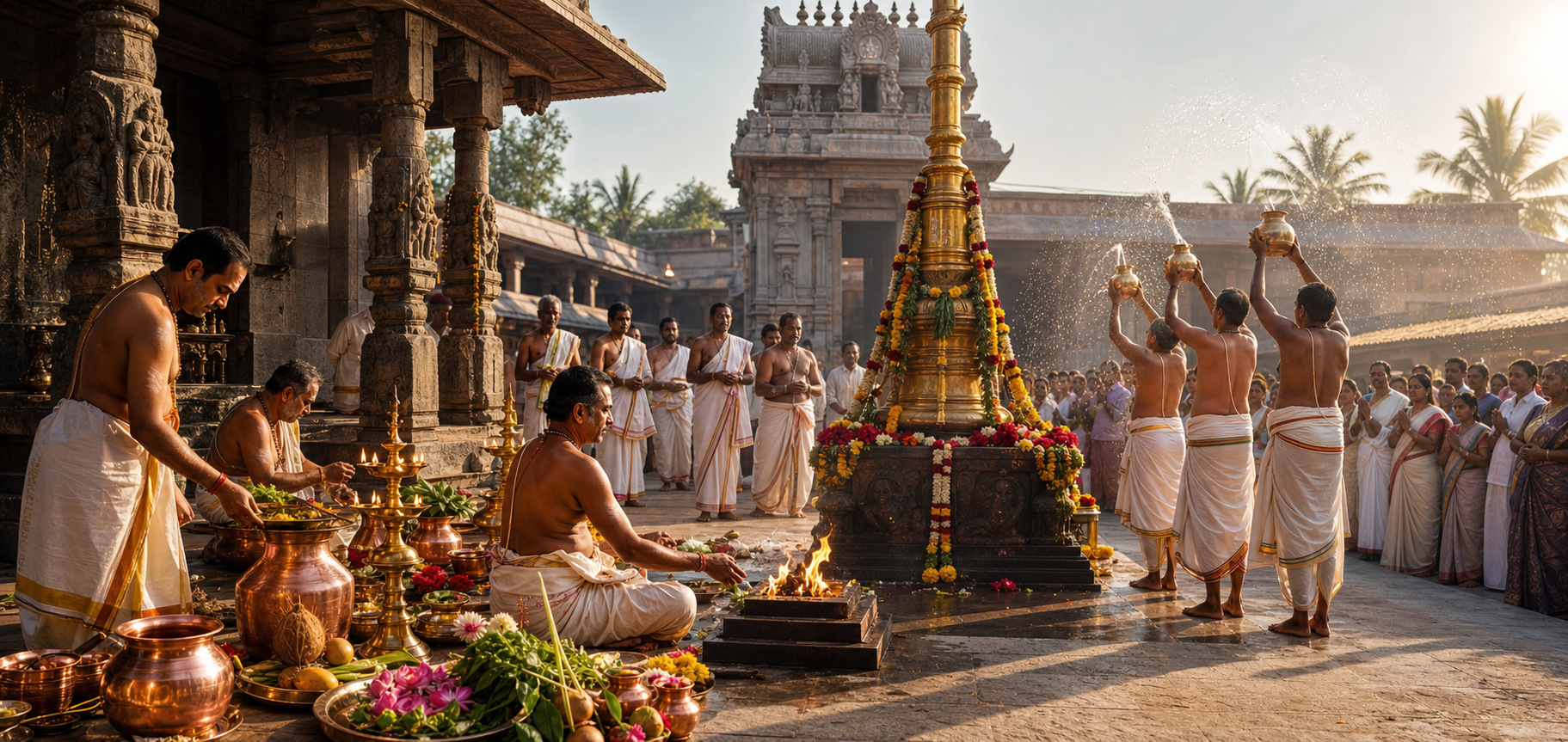
- Purification and abhisheka focus attention on the dhvaja-stambha. Sanctified water associated with the kalashas is central to samprokshana. This is the point at which the meaning of ritual renewal becomes most visible.
- Archana and utsavams connect the flagstaff to worship of the presiding deity. The centre of the Tarigonda observance remains Sri Lakshmi Narasimha Swamy. The flagstaff is not an independent object of civic celebration detached from the deity.
- The culmination gathers the community around the renewed sacred space. Devotional music, cultural offerings, and prasadam may accompany the final phase, but their presence and timing must be confirmed locally.
This outline does not assign a particular rite to a particular date. No precise Tarigonda session times are established here. If you can attend only one portion, ask the temple authorities which day and time contain the principal samprokshana rites rather than guessing from the three-day range.
It is also worth resisting the urge to arrive only for a climactic revealing of the sanctified flagstaff. The preceding recitation, homas, and purification are not disposable preliminaries. They are the ritual process that gives the culminating moment its meaning. Even when you cannot attend every stage, knowing that sequence helps you understand what you are witnessing.
How to participate with attention and respect
A crowded mahotsavam can make ordinary temple disciplines more important, not less. Your conduct affects priests, volunteers, local residents, older pilgrims, families, and everyone trying to receive darshan. Use this practical order of preparation.
- Confirm the current programme before travelling. The February 13-15, 2026 dates belong to a past scheduled observance. Seek a present announcement or direct confirmation from temple authorities before booking transport or expecting a particular rite.
- Ask for the exact ritual stage, not merely the festival name. Veda parayanam, homa, abhisheka, archana, procession, and prasadam distribution are different parts of the observance. Knowing which one is underway helps you arrive with the right expectations.
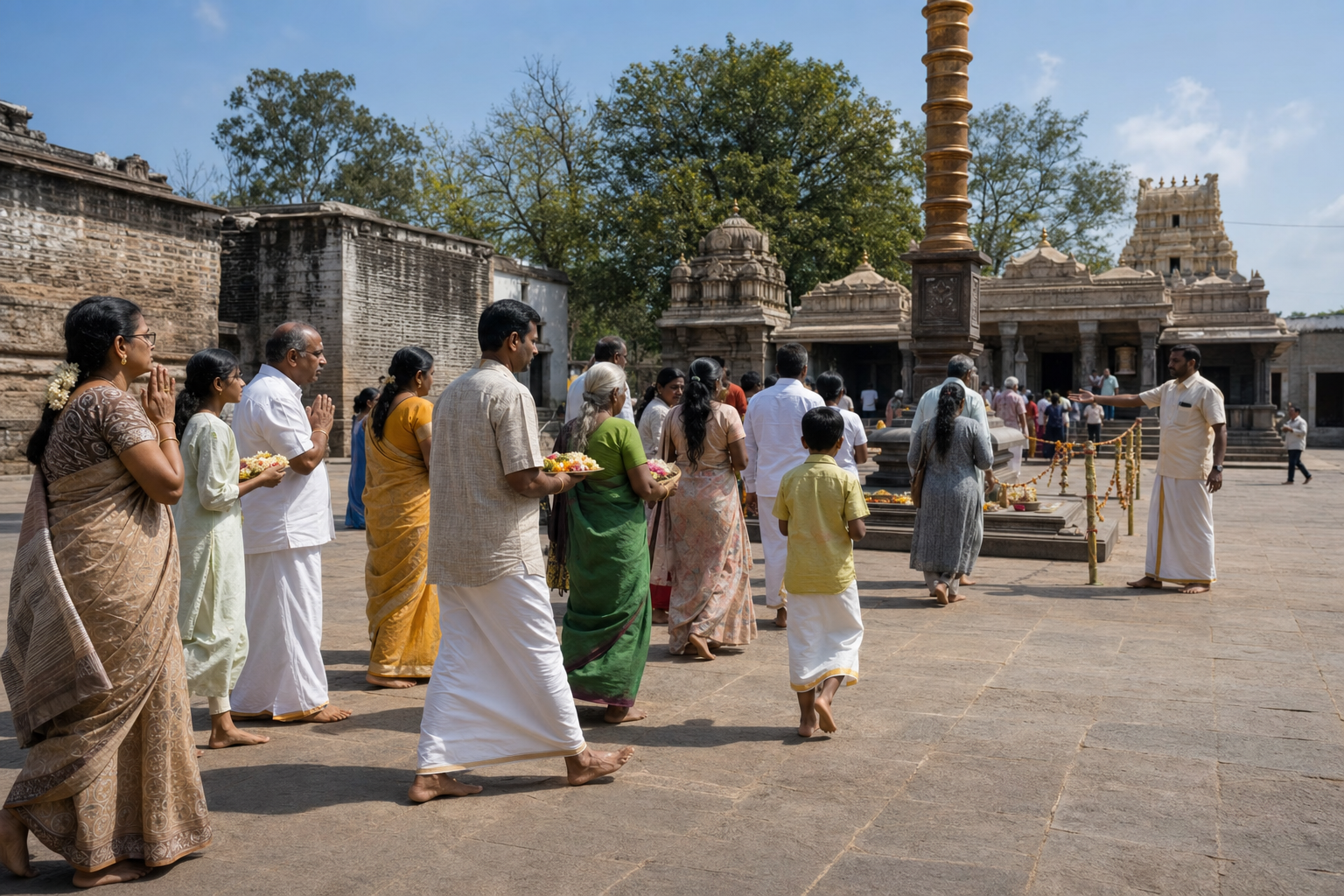
- Follow local entry and queue instructions. Do not cross barriers, enter a priestly working area, touch the flagstaff, or handle kalashas and ritual materials unless an authorized person expressly directs you to do so.
- Treat photography as permission-dependent. A visible ceremony is not automatically open for unrestricted recording. Put the phone away when photography is prohibited, when it obstructs a queue, or when it draws your attention away from instructions.
- Offer seva through designated channels. Ask volunteers or temple staff where assistance is needed. Self-assigned help near a ritual area can create confusion. Seva is service to the order of the occasion, not a route to privileged access.
- Protect the temple surroundings. Use designated disposal points, keep packaging out of worship areas, and do not leave waste along the approach. Environmental care is part of respecting the pilgrimage centre and the people who maintain it after visitors leave.
- Let local directions take precedence. General temple etiquette cannot replace the rules of a particular shrine or the instructions given for a particular ritual. When the two differ, follow the temple’s direction.
If you bring children, give them a small observation task before entering: identify the presiding deity, notice the dhvaja-stambha, listen for the difference between recitation and other sounds, and watch how volunteers keep the gathering ordered. This turns waiting into temple literacy without encouraging children to treat the ceremony as entertainment.
What the dhvaja can teach across Dharmic traditions
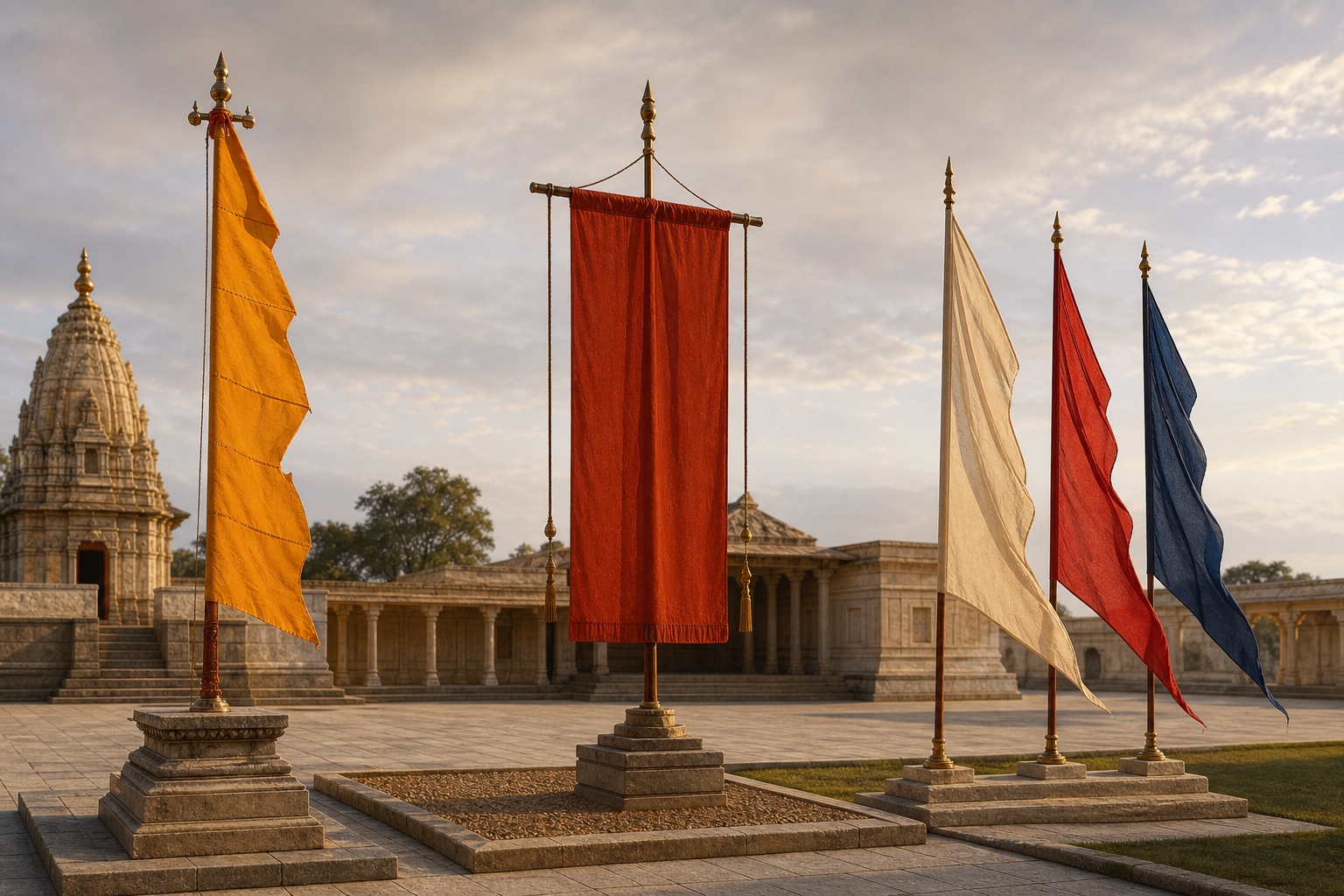
Tarigonda’s dhvaja-stambha belongs to a specifically Hindu temple and to worship centred on Sri Lakshmi Narasimha Swamy. That identity should remain clear. At the same time, visible flag traditions also appear across the wider Dharmic family: the Buddhist dharma-dhvaja, Jain dhvaja, and Sikh Nishan Sahib each carry associations with spiritual aspiration, righteous conduct, or community commitment.
The responsible comparison is analogy, not equivalence. These flags do not share one interchangeable ritual or theology. You can recognize a common use of sacred symbols to make values publicly visible while still learning the names, disciplines, and meanings proper to each tradition. Dharmic unity becomes more credible when it honours distinctions instead of erasing them.
That same discipline matters when preserving the history of Tarigonda. Keep three claims separate: a ceremony was scheduled, a ceremony was completed, and a person witnessed it. The established facts here support the first claim. They do not, by themselves, verify the other two. If you publish a caption, family account, or community notice, use “was scheduled” until an authoritative temple update confirms completion.
For a future visit, begin with the temple’s current instructions rather than an archived festival date. Confirm the day’s programme, learn which ritual stage you will encounter, and arrive prepared to follow local direction. That small act of verification protects both your pilgrimage and the integrity of the tradition you want to honour.
References
