
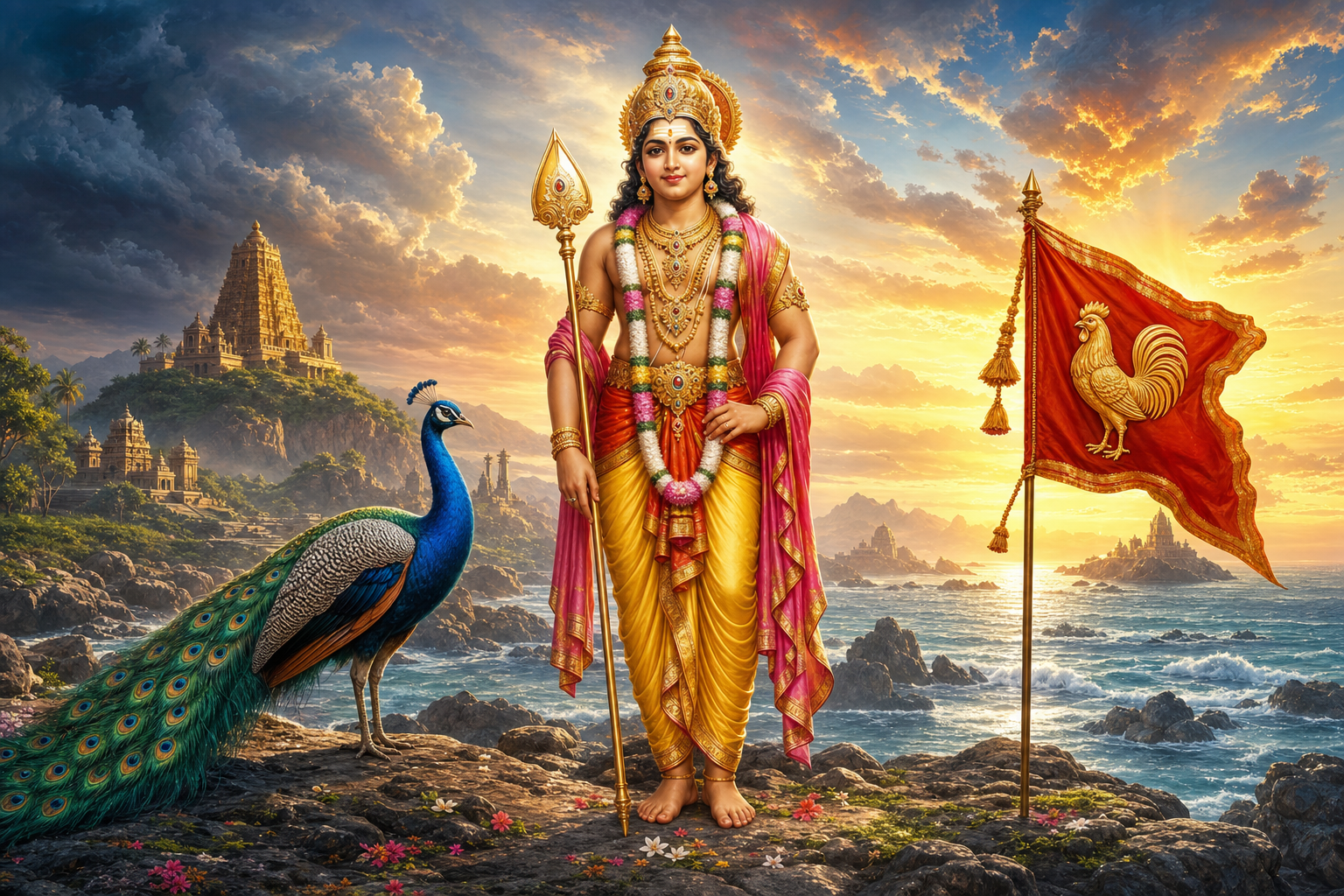
If Surapadman’s defeat is where your understanding of Lord Muruga stops, the peacock beside him and the rooster on his emblem can look like decorative details. They are actually the key to the victory: adharma is stopped, but conquered power is not wasted when it can be turned toward dharma.
What follows the battle gives you a practical spiritual sequence. Establish a boundary against harm. Leave room for genuine transformation. Balance disciplined worship with intimate devotion. Then carry what you have learned into service, pilgrimage, celebration, and the way you exercise authority.
Read the victory in the right order: stop, transform, remember
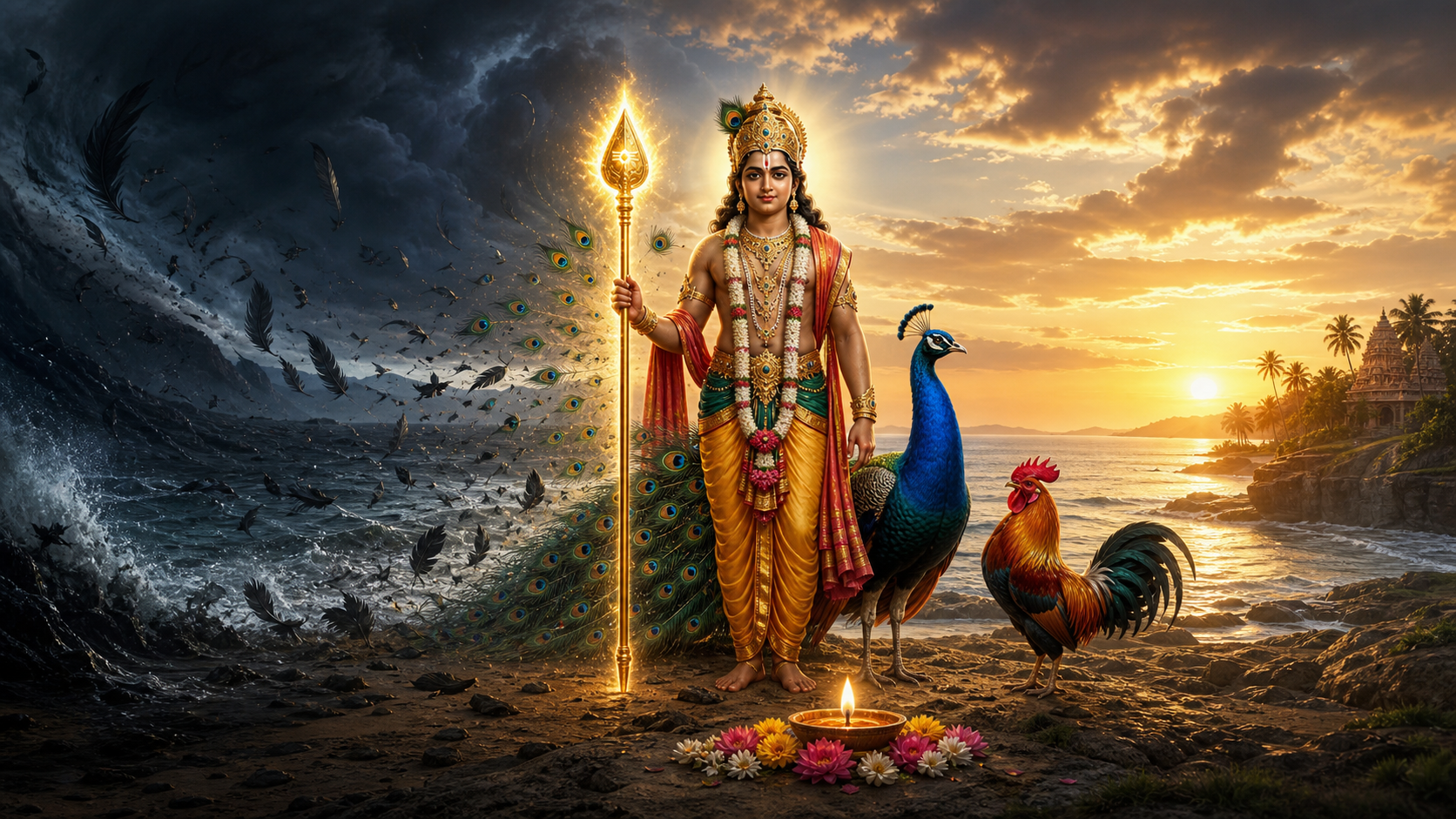
Surapadman is first subdued by the vel and then transfigured: one form becomes Muruga’s peacock vahana, while the other becomes the rooster emblem. The former adversary is not permitted to continue as before. His relationship to divine order changes completely.
That order matters. Compassion does not mean pretending that destructive conduct is harmless. Grace comes after the threat has been overcome. The legend therefore avoids two opposite errors: cruelty that seeks nothing beyond an enemy’s ruin, and sentimentality that offers reconciliation without first stopping the harm.
You can use the same order when facing a conflict, a harmful habit, or a misuse of your own strength:
- Stop what violates dharma. Name the conduct rather than condemning an entire person. Set the boundary needed to protect your duty, family, community, or integrity.
- Ask what can be redirected. Energy, courage, influence, and determination may have served a harmful purpose without being inherently useless. If accountability and sincere change are possible, place those capacities in service of something worthy.
- Keep an honest reminder. The peacock and rooster remain visible after the battle. In the same way, do not erase the lesson once a crisis has passed. Decide what sign would warn you that the old pattern is returning.
This reading also turns the story inward. Anger can become firmness without hatred. Pride can become responsibility rather than self-display. Fear can become vigilance rather than paralysis. Transformation does not romanticize the original fault; it denies that the fault must have the final word.
Ma Devasena and Ma Valli keep devotion whole
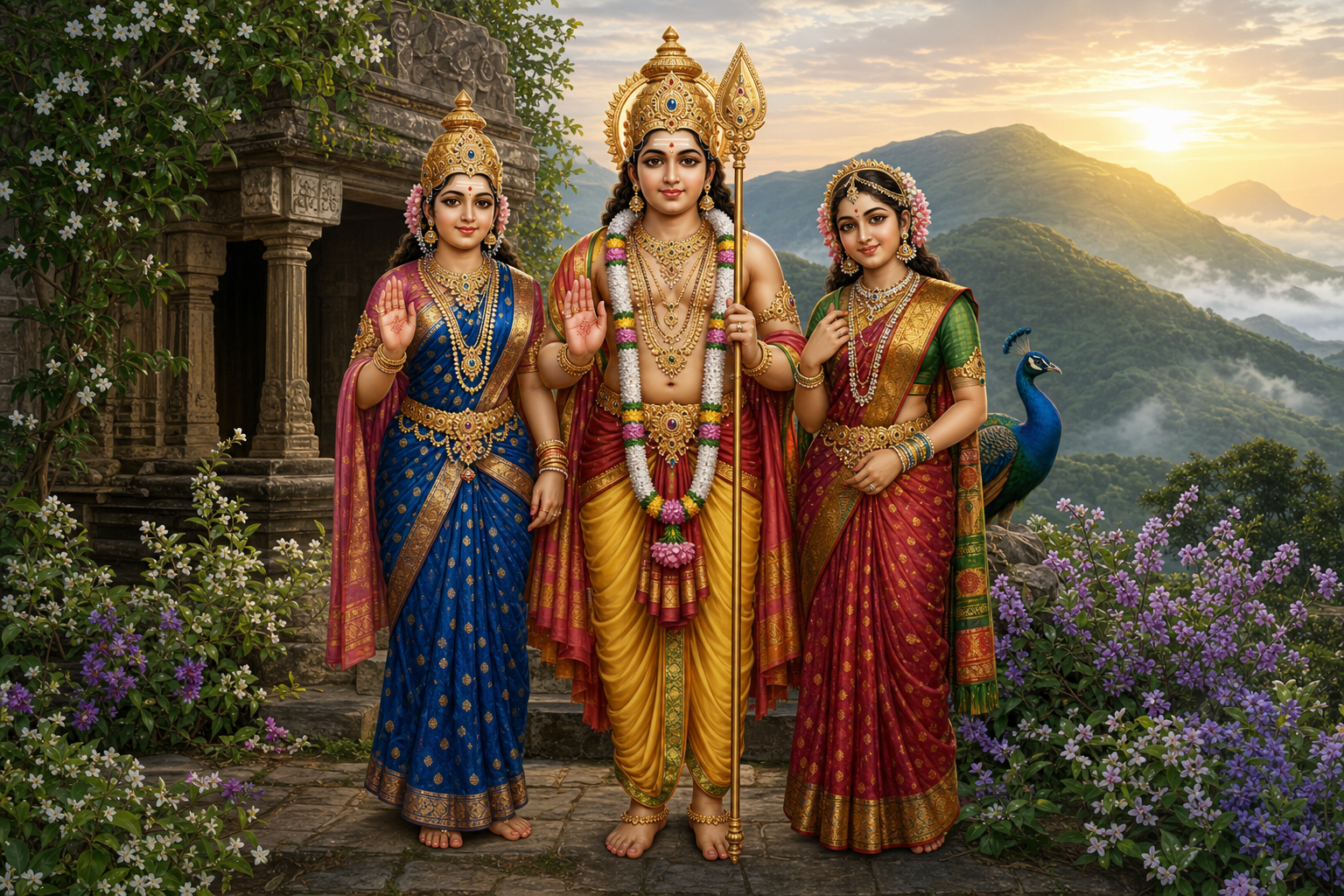
Muruga’s life after the battle cannot be understood through martial victory alone. His celestial union with Ma Devasena at Thirupparankundram and earth-rooted union with Ma Valli at Tiruttani bring two modes of devotion into one sacred household.
Ma Devasena’s presence connects Muruga with cosmic order and the devas. Ma Valli’s presence honours intimate, community-rooted bhakti. Their places in the tradition resist a false choice between formal lineage and heartfelt love. Ritual does not need to become cold, and personal devotion does not need to become unstructured or self-invented.
Use the two marriages as an audit of your own practice:
- Examine form. Which prayer, vow, discipline, or inherited observance do you keep consistently, including when enthusiasm is absent?
- Examine relationship. Does that practice make you more attentive, grateful, and available to the people around you, or does it remain an isolated performance?
- Examine integration. Choose one disciplined practice and connect it to one concrete act of patience, service, or reconciliation.
If your observance is precise but leaves you harsh, its inner purpose needs attention. If your devotion feels sincere but disappears whenever life becomes inconvenient, it needs steadier form. Ma Devasena and Ma Valli together show why mature bhakti needs both fidelity and nearness.
Use the six sacred abodes as a map of spiritual maturity

The Arupadai Veedu are more than six destinations to collect. Each abode holds a distinct moment in Muruga’s sacred life, so the pilgrimage can become a disciplined passage through victory, commitment, knowledge, renunciation, intimacy, and grace.
| Sacred abode | Episode or form | Question to carry |
|---|---|---|
| Thiruchendur | Victory over Surapadman | What harmful pattern now requires a clear ending? |
| Thirupparankundram | Marriage to Ma Devasena | What commitment would bring my strength into right order? |
| Swamimalai | Skanda as teacher of the pranava | Am I allowing wisdom to govern the power I hold? |
| Palani | Dandayudhapani, the renunciate sage | What must I set down so that desire no longer commands me? |
| Tiruttani | Marriage to Ma Valli | Where has my devotion retained form but lost intimacy? |
| Pazhamudircholai | Forest shrine of fulfilled grace | Can I receive fulfilment without losing humility and gratitude? |
If you are able to undertake the pilgrimage, carry one question into each temple instead of treating arrival as the entire achievement. Let the place challenge a real decision waiting at home. The ocean setting of Thiruchendur, the demanding steps associated with Palani, and the forest setting of Pazhamudircholai engage the body and senses as well as the intellect.
If travel is not possible, use the abodes for six separate periods of reflection. At each sitting, recall the associated episode, name one situation in your life that it illuminates, and write one sentence describing the action it calls for. This is not a replacement for pilgrimage. It is a way to prevent sacred geography from becoming remote until you can visit.
Let the vel, peacock, rooster, and festivals shape practice
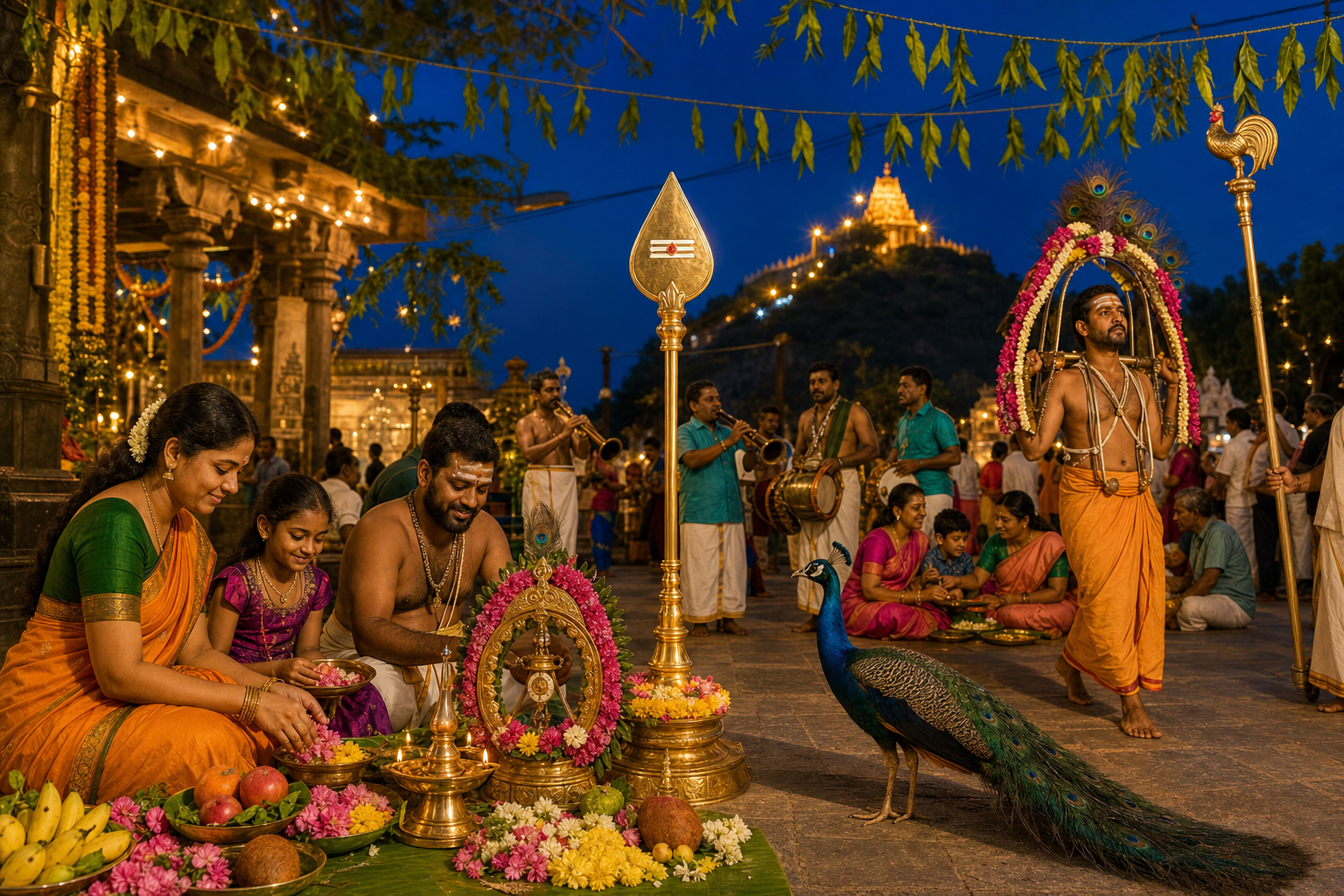
Muruga’s legacy remains living because its symbols are encountered in temples, homes, festivals, flags, processions, music, and dance. Each can do more than identify the deity. It can train a particular spiritual capacity.
- The vel trains discernment. Before a difficult action, ask three questions: What is actually true? What is mine to protect? Which part of my reaction is attachment, pride, or fear? The aim is not indecision but a cleaner use of strength.
- The peacock trains vigilance after success. Resolving a crisis is not the same as removing every condition that produced it. Identify the earliest sign that the old pattern could return, and decide how you will respond before it does.
- The rooster trains timely clarity. A warning given early can prevent a larger rupture. Say what needs to be said plainly, without humiliation, exaggeration, or concealed hostility.
The festival cycle gives these capacities communal form. Skanda Sashti at Thiruchendur re-enacts the defeat of the asura through vows and collective prayer, allowing devotees to confront what must be overcome rather than admiring victory from a distance. Thaipusam places disciplined vows and kavadi processions in public view. Karthigai Deepam fills the landscape with flame and directs attention toward divine light. Mayil Attam honours the peacock through embodied art.
Choose an observance by identifying the work in front of you. If you need to end a destructive pattern, approach Skanda Sashti with a precise vow rather than a vague wish. If you are carrying a vow through Thaipusam, be clear about the discipline it is meant to cultivate. When lighting lamps, name the confusion that requires illumination. When witnessing sacred dance, notice how a community can preserve theology through movement, rhythm, and shared memory.
Carry Muruga’s pattern into leadership and conflict
Muruga is Deva-Senapati, but command is not his only mode. He restores order, grants refuge to the repentant, and at Swamimalai appears as guru. Power, instruction, protection, and compassion therefore belong to the same model of leadership.
This is a demanding standard. Winning an argument while damaging the family is not complete victory. Removing a wrongdoer while leaving the same incentives untouched does not restore order. Forgiving someone without accountability may merely return power to the harmful pattern. Muruga’s victory asks what the situation becomes after force has done its necessary work.
Key takeaways for your next difficult decision
- Define the adharma precisely. Address the act, pattern, or breach of duty instead of using spiritual language to justify personal dislike.
- Establish protection before reconciliation. Compassion cannot transform what is still being allowed to cause harm.
- Keep accountability and a path back. Genuine repentance should lead to changed service, not merely changed words.
- Put wisdom above status. Swamimalai’s teacher-form reminds you that authority remains answerable to knowledge.
- Judge the aftermath. Ask whether your decision produced greater clarity, steadier duty, and a community less likely to repeat the conflict.
This pattern also offers a careful way to speak across dharmic traditions. Hindu, Buddhist, Jain, and Sikh paths should not be flattened into identical theology. You can instead name the specific Hindu sacred narrative and then recognise its ethical resonances: non-cruelty in victory, disciplined knowledge, steadfast service, and authority restrained by compassion. Shared values become a basis for respect without erasing the freedom and distinctiveness of each path.
Choose one unresolved conflict today and write three lines: what must stop, what can be transformed, and what reminder must remain. Then take the smallest honest action that answers the first line. That is where Muruga’s living legacy moves from an admired story into practiced dharma.
References
