
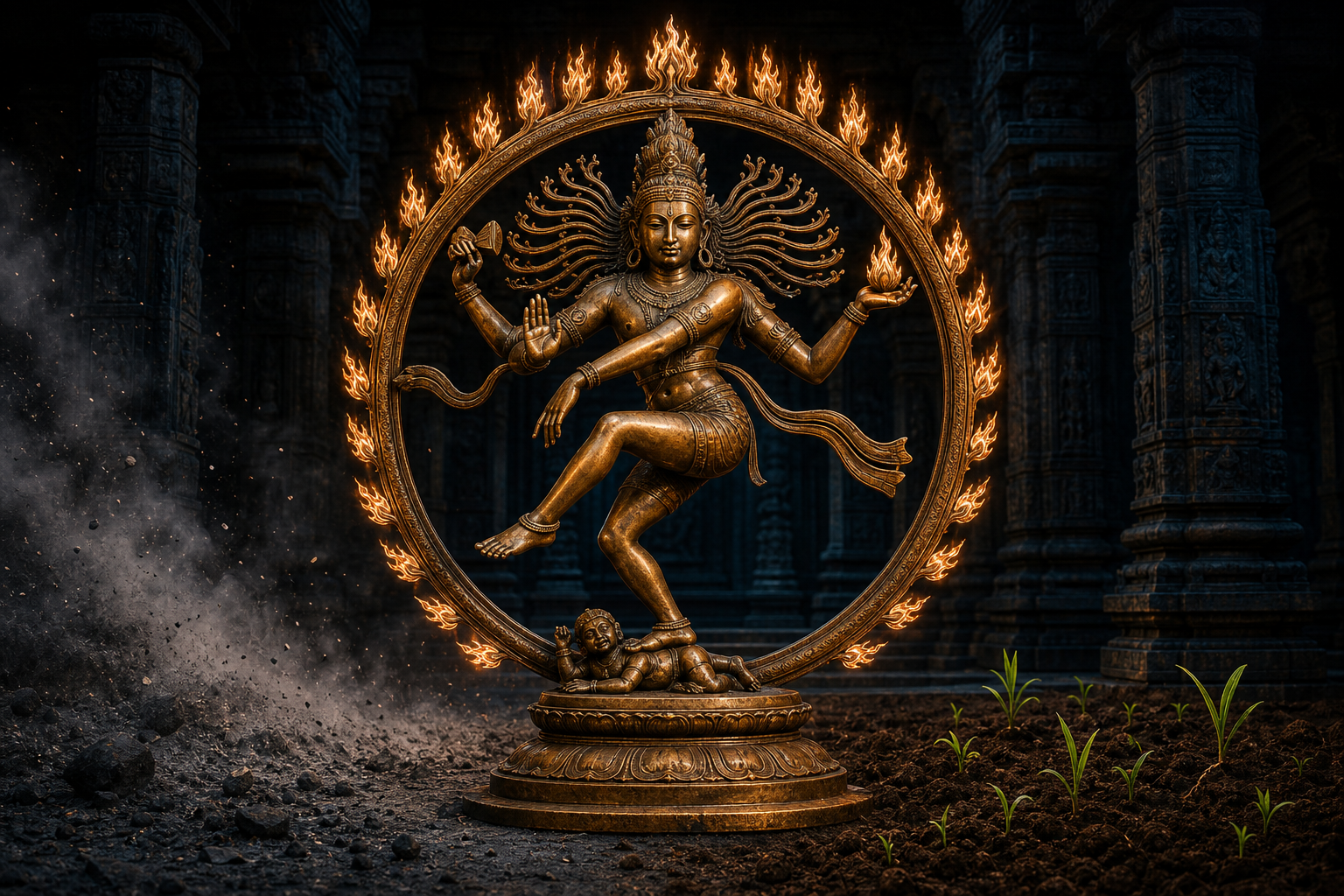
If a fierce Shaiva murti has ever left you wondering why sacred art would show skulls, flames, weapons, cremation grounds, or even a severed head, begin with a better question: what is this image asking you to release, and what becomes possible after that release?
The common mistake is to treat every attribute as an isolated symbol. Shaiva iconography works through relationships and sequences. Something is formed, challenged, dissolved, mastered, restored, or carried beyond its previous limit. Once you learn to follow that movement, forms such as Ganesha and Mahakala stop looking like collections of strange objects. They become precise visual teachings about identity, time, fear, discernment, and renewal.
Begin with the change, not the weapon
Dissolution in Shaiva imagery is not necessarily a fall from order into meaninglessness. It can mark the end of a form that has completed its role, the removal of an obstruction, or the exposure of something more enduring than the form itself. Transformation is what follows when that ending produces a new capacity, a clearer relation, or a restored order.
This distinction keeps you from making two opposite mistakes. One is to soften every fierce image into a vague message about positive change. The other is to assume that frightening features represent malevolence. Shaiva imagery often refuses both readings. It lets dissolution remain severe while showing that severity within a larger movement toward wisdom, protection, or liberation from clinging.
When you encounter a Shaiva image concerned with destruction or death, read it in this order:
- Identify what is being dissolved: a body, an identity, ignorance, egoic resistance, fear, or attachment to transient form.
- Notice the agent of dissolution: time, a weapon, fire, a divine confrontation, or the force of discernment.
- Look for what remains: consciousness, sacred order, a restored person, a protective presence, or a rhythm that continues after one form passes.
- Ask what the new state can do that the old state could not.
The final question is decisive. If nothing changes except appearance, you may be looking at ornament or variation. If the figure acquires wisdom, mastery, protection, or freedom from a former limitation, the icon is presenting transformation rather than simple replacement.
Ganesha shows transformation at the scale of identity
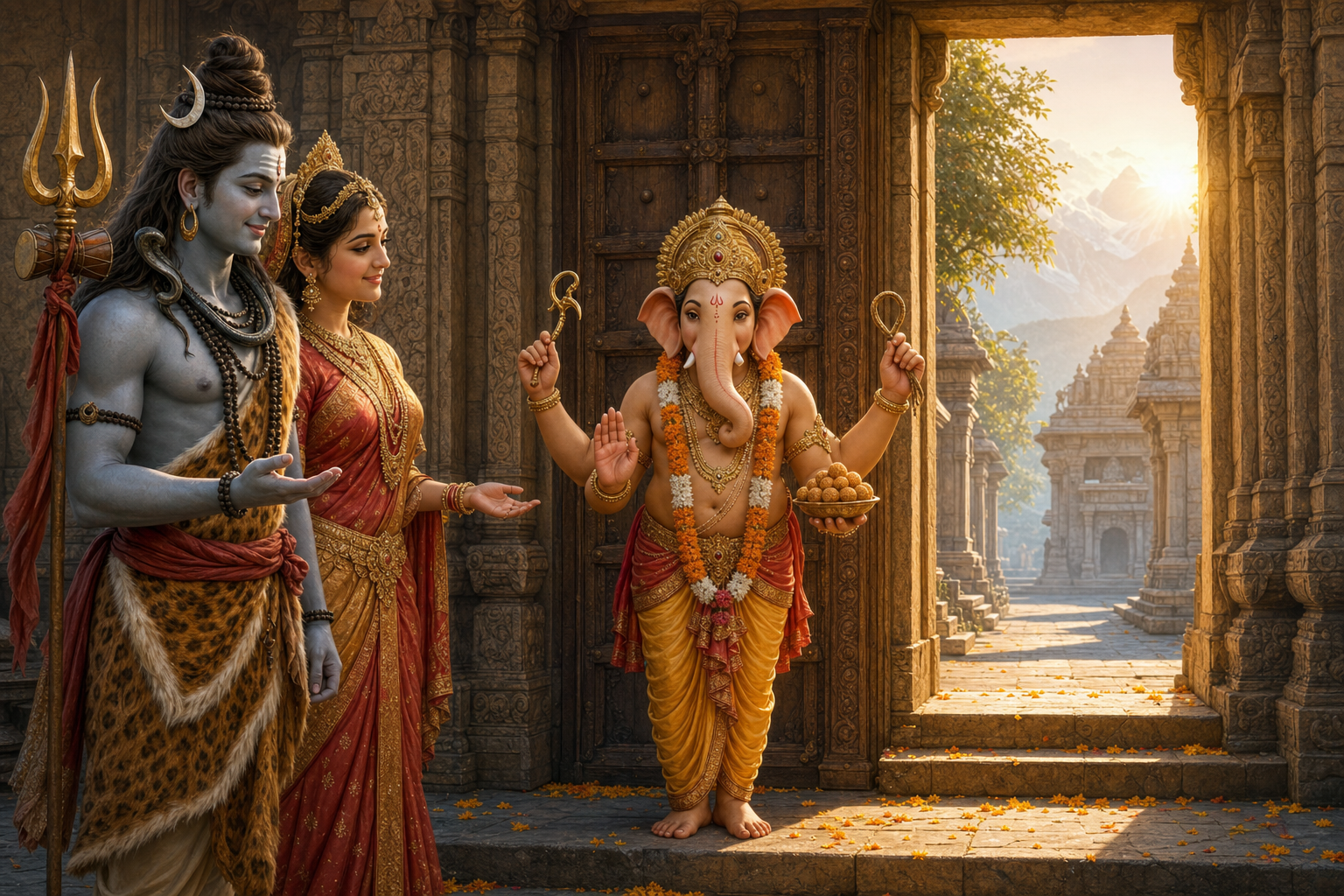
Ganesha’s form has to be read as the outcome of a story. Parvati fashions a boy from sacred turmeric paste and appoints him to guard her privacy. When Shiva returns, the guardian refuses him entry. The confrontation ends in beheading; Parvati’s grief and demand for restoration are answered when Shiva revives the child with an elephant’s head and establishes him as Ganesha, foremost among the ganas and remover of obstacles. The full movement is creation, boundary, rupture, restoration, and a new sacred office.
The crucial visual fact is that the first head does not return. Restoration does not erase what happened or recreate the earlier form. The child remains continuous with the guardian Parvati created, yet he now possesses a form and function that exceed his original assignment. That makes Ganesha’s body an unusually clear image of transformation: continuity without sameness.
One symbolic reading treats the beheading as the removal of ahamkara, the identity that mistakes its limited standpoint for the whole. The elephant head then represents buddhi, the discerning intelligence capable of seeing more widely. This reading does not condemn boundaries. The boy’s guardianship serves a real purpose. It shows instead that a boundary enforced without sufficient knowledge can become an obstacle, while discernment can preserve what matters and integrate it into a larger order.
That distinction is useful whenever you are protecting a role, belief, institution, or personal commitment. Ask whether the boundary still serves dharma or whether defending it has become inseparable from defending your own position. Ganesha does not teach that every boundary should disappear. His movement from guardian to remover of obstacles teaches that protection must mature into wise discrimination.
The rest of Ganesha’s form develops that lesson through capacities rather than abstractions. His large ears, small eyes, curved trunk, ample belly, and single tusk can direct your attention toward listening, concentration, adaptable strength, the ability to digest varied experience, and the willingness to relinquish what is unnecessary in service of truth. The remembered association between the broken tusk and the writing of the Mahabharata makes sacrifice purposeful: something is given up so that something of greater value can be completed.
Read these features together. Listening without focus becomes distraction. Focus without adaptability becomes rigidity. Adaptability without the capacity to absorb experience becomes restless reaction. Ganesha’s composite body holds those faculties in balance. The icon therefore asks for more than admiration of individual symbols; it asks whether those qualities are becoming integrated in you.
The beheading should never be detached from grief, restoration, and transformed responsibility. Treated in isolation, it could be misused as a romantic image of violence or as permission to glorify suffering. Within the complete sequence, however, rupture is not the final word. The decisive act is the bestowal of life, intelligence, belonging, and a vocation that benefits others.
Mahakala shows dissolution at the scale of time
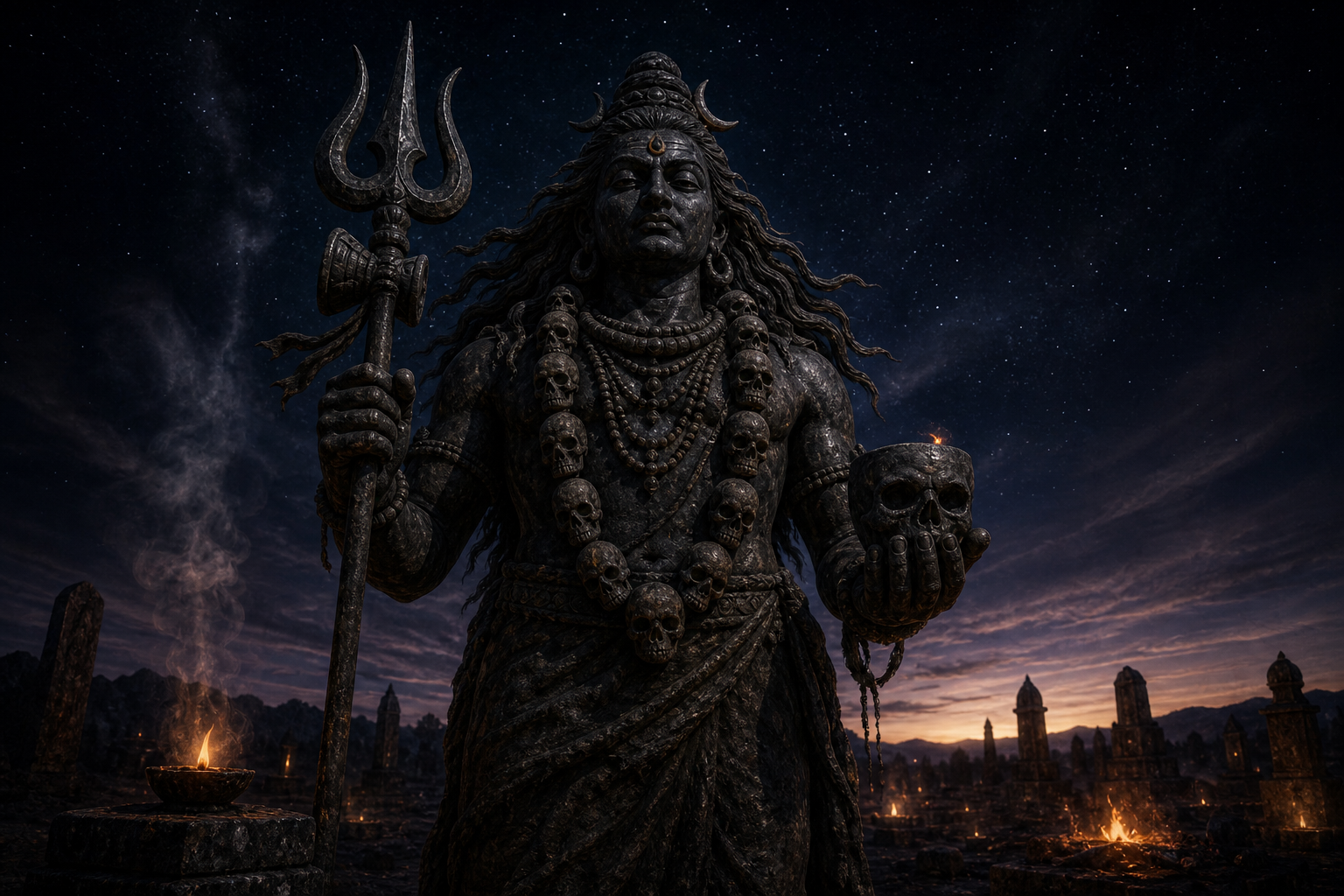
Ganesha’s metamorphosis concerns a particular identity. Mahakala enlarges the field until every formed thing stands within time. Maha signifies the great or supreme, while kala signifies time; Mahakala is therefore the Great Time before which no finite form can claim permanence. Yet the figure is not merely time as a devourer. Shiva as Mahakala also points toward the timeless ground within which arising and passing take place.
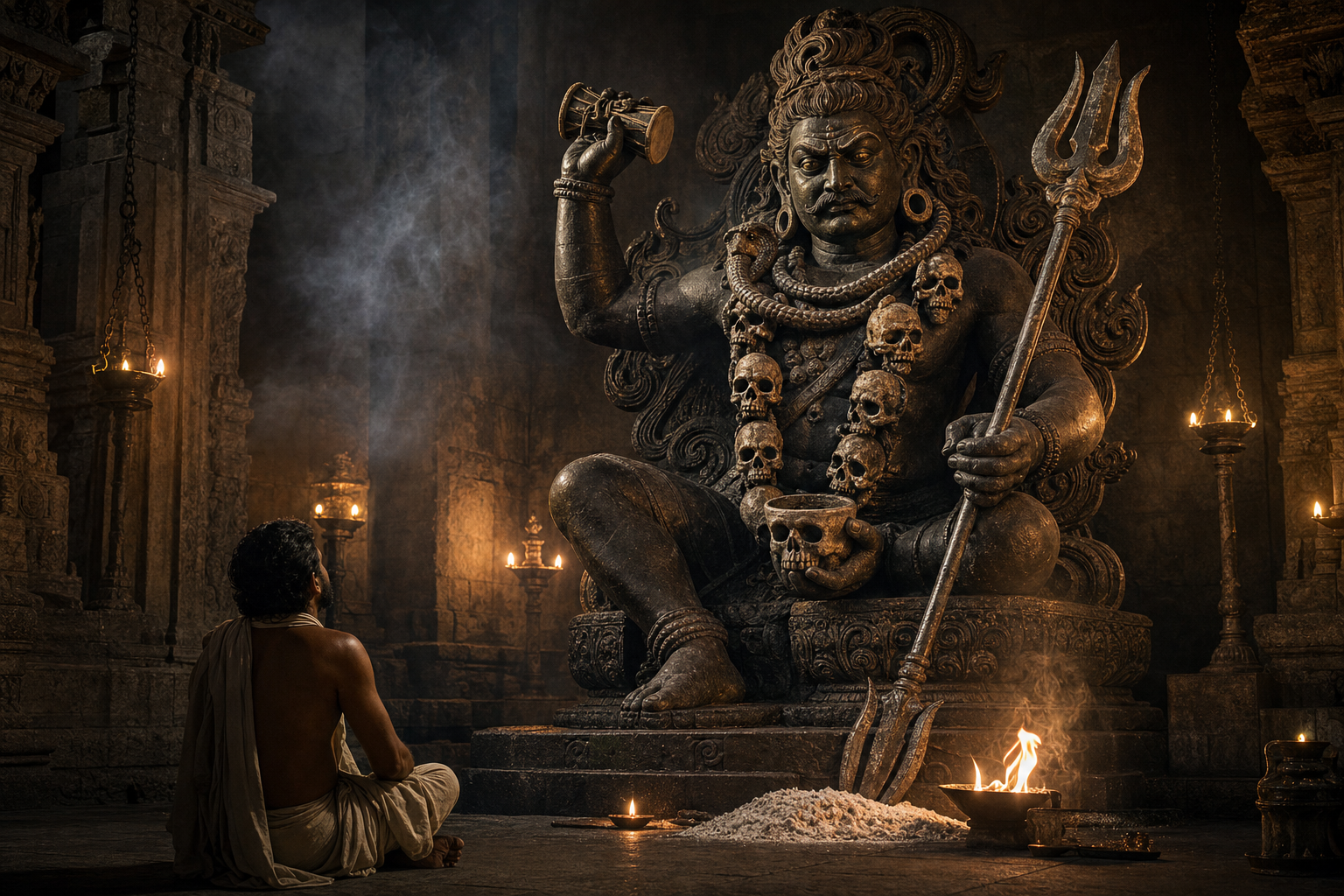
This double meaning explains why Mahakala can appear terrifying and reassuring at once. A black or blue-black complexion, fierce face, blazing third eye, matted locks, serpents, skulls, and tiger skin confront you with powers that ordinary life tries to keep at a safe distance. The image does not promise that time will spare what you love. It places sovereignty precisely where fear expects only annihilation.
The cremation ground is essential to that teaching. It is the place where social rank, possession, bodily beauty, and personal ambition lose their claims to permanence. When Mahakala stands amid flames or the signs of death, the setting trains attention on impermanence without allowing impermanence to become nihilism. The divine presence remains. What passes is form; what the icon directs you toward is the ground that is not exhausted by the passing of forms.
A prostrate figure beneath Mahakala should likewise be read relationally. The composition asks what has been placed below and what now stands above it. In the symbolic grammar supplied by this form, ego and fear are not allowed to occupy the governing position. Their subjugation makes room for steadiness. The result is not self-hatred but a corrected hierarchy: transient identity no longer pretends to be ultimate.
The implements extend that visual argument. The trishula conveys penetrating power; the damaru makes dissolution part of a continuing cosmic rhythm; the kapala brings mortality into ritual awareness; the khatvanga evokes ascetic power; and a chopper can represent the severing of ignorance. A weapon in this context should not be read automatically as aggression. Ask what it cuts, what it protects, and how its function relates to the rest of the image.
This is also why fierce iconography can serve devotion rather than horror. Mahakala’s heat is purifying because it burns through evasions. You are not asked to enjoy loss or pretend that grief is unreal. You are asked to see that refusing impermanence cannot stop time. The practical response is to give greater weight to conduct that can remain meaningful amid change: truthfulness, compassion, disciplined effort, and service rather than the accumulation of passing advantage.
Put the symbols together before interpreting them
A symbol dictionary can tell you that a skull means death or that an elephant suggests intelligence, but it cannot tell you what a particular composition is doing. Meaning emerges from scale, sequence, setting, posture, and relationship. Ganesha and Mahakala demonstrate the difference clearly.
| Question | Ganesha | Mahakala |
|---|---|---|
| What is dissolved? | A former bodily form and an ego-bound standpoint | The claim that any time-bound form can remain permanent |
| What is the visual hinge? | The original head is replaced rather than simply returned | Signs of death surround a divine presence that is not defeated by them |
| What emerges? | Discerning intelligence, integration, and the capacity to remove obstacles | Fearlessness, detachment, vigilance, and orientation toward the timeless |
| What mistake does the image correct? | Rigidly confusing one’s limited duty or identity with the whole order | Living as though mortality and change can be indefinitely avoided |
| What response does it invite? | Listen, focus, adapt, and surrender what blocks wiser action | Face impermanence and place enduring ethical duties above fleeting gain |
Use the comparison as a method, not as a rigid code. Begin with the central figure and identify the condition being revealed. Move outward to the setting. Then inspect the face, posture, hands, implements, ornaments, surrounding flames, and any figure beneath the deity. Finally, return to the whole image and ask what relationship all those elements establish.
This second look often reverses the first impression. A skull can move from being a token of morbidity to a discipline of remembering mortality. Fire can move from punishment to purification. A chopper can move from violence to the cutting of ignorance. An elephant head can move from apparent incongruity to the visible evidence that restoration has produced a more capacious mode of being.
Context also prevents a shallow division between pleasant and unpleasant deities. A serene face is not automatically more compassionate than a fierce one. Mahakala protects by refusing illusion. Ganesha blesses through a form produced by rupture. In both cases, grace does not consist of keeping every existing form untouched. It consists of directing change toward a truer order.
There is another caution worth keeping in view: iconographic interpretation is not a license to reduce a murti to psychology. For a devotee, the murti is approached through reverence and worship, not merely decoded as a diagram of the mind. Symbolic interpretation can deepen that encounter, but it should not explain away the sacred presence to which the form belongs.
Key takeaways for contemplation and conduct

- Dissolution and transformation are related but not identical. Dissolution ends or removes a form; transformation appears when that ending permits a new capacity, relation, or order.
- Ganesha teaches continuity without simple reversal. The child is restored, but the old head is not restored; wisdom emerges through a form that bears the history of rupture.
- Mahakala presents time on two levels: all finite things pass, while Shiva points toward that which is not exhausted by their passing.
- Fierce features are not shorthand for evil. Read weapons, skulls, flames, and cremation grounds by asking what they overcome, reveal, or protect.
- No attribute should be interpreted alone. Setting, posture, implements, surrounding figures, and narrative sequence determine how the symbol functions.
- The ethical test of an interpretation is the conduct it encourages. A sound reading should deepen discernment, courage, non-clinging, compassion, or service rather than glorify violence or passive resignation.
You can turn this way of seeing into a simple contemplative discipline. Before naming individual symbols, identify the form or assumption that the composition places under pressure. Then name the value that survives the change. In Ganesha’s case, a narrow guardianship opens into discerning protection and service. In Mahakala’s case, attachment to permanence gives way to steadiness before time.
Bring the same distinction to a decision in your own life. Do not ask only what you fear losing. Ask whether you are defending a dharmic responsibility or merely the identity built around it. Do not call every disruption transformative; look for the faculty it actually develops. If no greater clarity, compassion, discipline, or service emerges, the language of transformation may be disguising disorder rather than illuminating it.
Nor should acceptance of dissolution become passivity. Mahakala’s realism about time makes present conduct more urgent, not less. Ganesha’s adaptability does not mean abandoning truth for convenience. The proper response joins non-clinging to responsibility: release the form that has become obstructive while preserving the duty, truth, or relationship that should continue in a wiser form.
The next time you stand before a Shaiva murti, remain with one relationship long enough to see its movement: the new head and the old body, the living deity and the cremation ground, the rhythmic drum and the signs of death, or the weapon and the ignorance it cuts. Then carry one corresponding act into your day. Listen before defending, surrender an unnecessary claim, complete a neglected duty, or give time to service. That is where iconography begins to become practice.
References
- DharmaRenaissance Blog — Ganesha’s Sacred Sacrifice: How Parvati’s Creation and Shiva’s Gift Illuminate Transformation
- DharmaRenaissance Blog — Mahakala Murti Iconography: Unveiling Shiva’s Fierce Time and Cosmic Dissolution
