
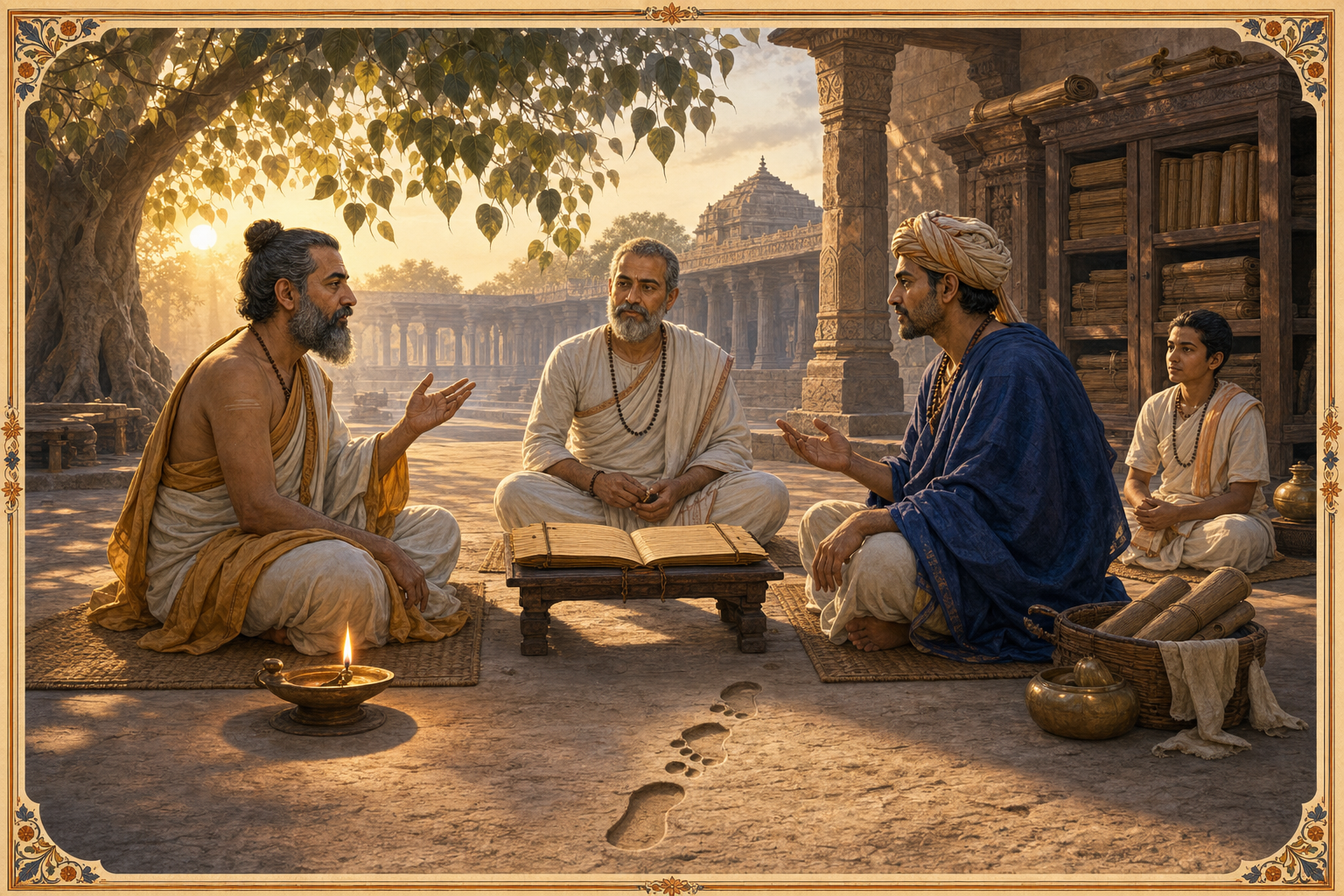
You have a Vedic passage before you and two confident readings of it. One person calls it a binding command. Another calls it symbolic praise. Each keeps quoting more Sanskrit, yet neither has explained what would make one interpretation stronger than the other.
You can get past that stalemate by asking the questions in the right order: What kind of claim is being made? Which pramana can support it? What job is the sentence doing? What is the purport of the larger passage? Has the strongest opposing interpretation been answered fairly? This method will not eliminate disagreement among Dharmic schools, but it will show you where the disagreement really lies.
Match each claim to the pramana that can support it

Begin by writing the disputed claim in one sentence. If you cannot do that, you are not yet debating a proposition; you are reacting to a cluster of impressions. Separate a mixed claim into textual, empirical, inferential and theological parts before evaluating any of them.
Classical pramana theory gives you several distinct routes to knowledge. Nyaya foregrounds pratyaksha, anumana, upamana and shabda. Mimamsa and Vedanta also employ arthapatti and anupalabdhi. These are not decorative Sanskrit labels for evidence in general. Each answers a different kind of question.
| Question being asked | Likely starting pramana | What you must test |
|---|---|---|
| What is directly present or observable? | Pratyaksha, perception | Keep the observation separate from the interpretation added to it. |
| What follows from a sign, reason or established relation? | Anumana, inference | State the reason, its connection to the conclusion and possible counterexamples. |
| How can an unfamiliar thing be understood through similarity? | Upamana, comparison | Identify the relevant similarity without pretending that similarity proves identity. |
| What does trustworthy verbal testimony communicate? | Shabda, testimony | Establish the wording, context, authority and intended force of the statement. |
| What must be posited to explain facts already accepted? | Arthapatti, postulation | Show that the postulate is needed, not merely convenient. |
| Can an absence be known where something should have been available? | Anupalabdhi, non-cognition | Show that the conditions for detecting the absent thing were actually present. |
The practical rule is simple: do not make one pramana perform another’s work. A scriptural statement may establish an injunction within a tradition, but identifying that injunction still requires semantic and contextual interpretation. An analogy can illuminate a doctrine, but it does not prove that the two things compared are identical. An inference can extend what you know, but it loses force when stronger evidence contradicts it.
Consider the claim, “This act is obligatory because a revered narrative praises it.” That sentence hides at least three propositions: the narrative praises the act; the praise presents the act as valuable; and the praise independently imposes an obligation. The first two may be well supported while the third fails. You cannot assess the third until you determine whether the passage is a vidhi or an arthavada.
Schools do not accept every pramana in precisely the same way. State the framework you are using before appealing to it. If one participant accepts scriptural testimony and another does not, repeating the testimony will not settle the disagreement. The dispute has moved to the authority or scope of shabda, and intellectual honesty requires you to say so.
Read a Vedic sentence by its function, not its intensity
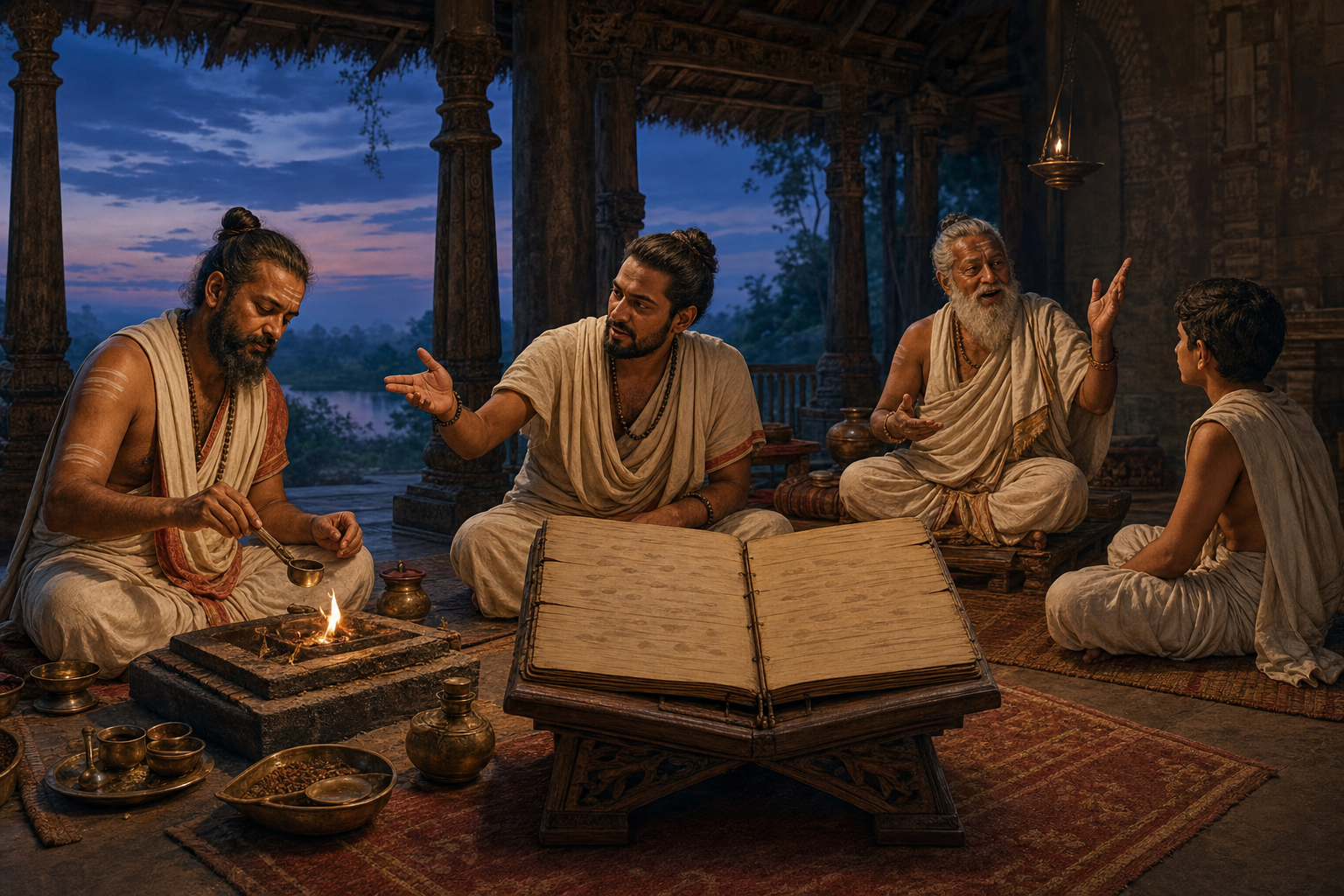
A forceful or beautiful sentence is not necessarily an independent command. Mimamsa asks what a statement does within the textual and ritual unit. Its functional classification coordinates injunction, arthavada, mantra and namadheya, allowing the parts to be read as an intelligible whole.
- Vidhi prescribes an act. Nishedha or pratishedha forbids one.
- Mantra is recited as an integral part of performance. It may contain praise-like words while remaining a mantra by ritual use.
- Namadheya fixes a name or designation so that the intended deity, rite, implement, metre or other referent is identified.
- Arthavada praises, censures, explains or narrates in support of an injunction or prohibition.
Arthavada is therefore neither a freestanding command nor meaningless embellishment. As stuti, it commends an act and strengthens resolve. As ninda, it depicts a prohibited act as unworthy or harmful and reinforces restraint. As narrative background, it places practice within a memorable world of deities, sages, actions and results. A known fact may also be reiterated as anuvada when that repetition serves a new injunctive setting; classifications of this last use can vary across expositions.
When you classify a disputed sentence, work through five questions in order:
- Does the sentence itself prescribe or prohibit an action, and who is qualified or addressed?
- Is it assigned for recitation during the act? If so, its praise-like language may still function as mantra.
- Is it fixing the identity or name of a ritual element?
- Is it praising, censuring, explaining or narrating around an instruction found nearby?
- Is it restating something already known so that a more specific instruction can operate?
The familiar Agnihotra pattern shows why sequence matters. A statement such as “one who desires heaven should perform the Agnihotra” supplies an operative direction. Surrounding language that extols the rite’s centrality or result can function as stuti, while a narrative of exemplary performance can reinforce commitment. The praise helps you understand the value and purpose of the act; it does not automatically create an unrelated second obligation.
Two opposite errors become visible here. A maximalist reading converts every exalted result and sacred narrative into a new command. A reductionist reading labels praise as rhetoric and discards it. The first multiplies obligations without establishing a vidhi. The second removes the prayojana, phala and motivational setting through which an injunction becomes intelligible and livable.
Classifying a passage as arthavada is also not a declaration that it is false. It is a judgment about its role in action-guiding discourse. Preserve whatever cognitive, theological or narrative content the words bear while determining how that content relates to the instruction. Function and truth are connected questions, but they are not the same question.
Establish the passage’s purport before extracting a doctrine

An isolated sentence can support several plausible readings because isolation removes the signals that limit meaning. Before citing a line as doctrine, map its immediate sentence, topic, surrounding directions, repeated terms, stated result and place in the larger textual movement.
At the local level, Mimamsa pays attention to vakya, the syntactic unity of a sentence; linga, an indicative word or feature; prakarana, the governing topic; sthana, textual position; abhyasa, repetition; and samakhya, an established designation. These cues help answer whether nearby statements belong to one operation, whether a phrase qualifies another, and whether a name carries a technical rather than casual sense.
For the larger purport, an allied Vedantic set of six checks is especially practical:
- Upakrama-upasamhara: Do the opening and conclusion point toward the same central concern?
- Abhyasa: What is repeated, and does that repetition mark emphasis rather than incidental wording?
- Apurvata: What distinctive teaching or purpose is the passage trying to communicate?
- Phala: What result does the passage associate with understanding or action?
- Arthavada: What praise, censure or narrative support reveals the value attached to the teaching?
- Upapatti: What reasoning, explanation or illustration makes the proposed meaning coherent?
Use these as converging signs, not as six votes in a mechanical election. Repetition may strongly support one reading, while the opening, conclusion and reasoning reveal what exactly is being repeated. A promised result can clarify the aim of a practice, but it does not by itself determine every detail of performance.
When two statements appear to conflict, first check whether they concern the same act, person, condition, stage and scope. Then ask whether one is an operative prescription while the other supplies praise, censure or explanation. Vidhi and nishedha generally carry priority in determining what must or must not be done; arthavada helps establish why the act matters and how the textual ensemble should be understood.
Do not use “literal” and “symbolic” as opening moves. Those labels often conceal the analysis that should precede them. Ask first whether the sentence enjoins, names, accompanies performance, praises, censures, explains or narrates. Only then decide what level of literal, figurative, ritual or theological meaning the context permits. If you call something symbolic, identify the contextual signal that authorizes the move and explain what meaning the symbol preserves.
A useful interpretation note should therefore contain more than a translation. Record the proposed function, the governing topic, the decisive contextual cues, the relation to nearby instructions and the best competing reading. This makes your conclusion reviewable. It also prevents a later discussion from collapsing into competing assertions about what a verse “obviously” means.
Make the opposing case before you answer it
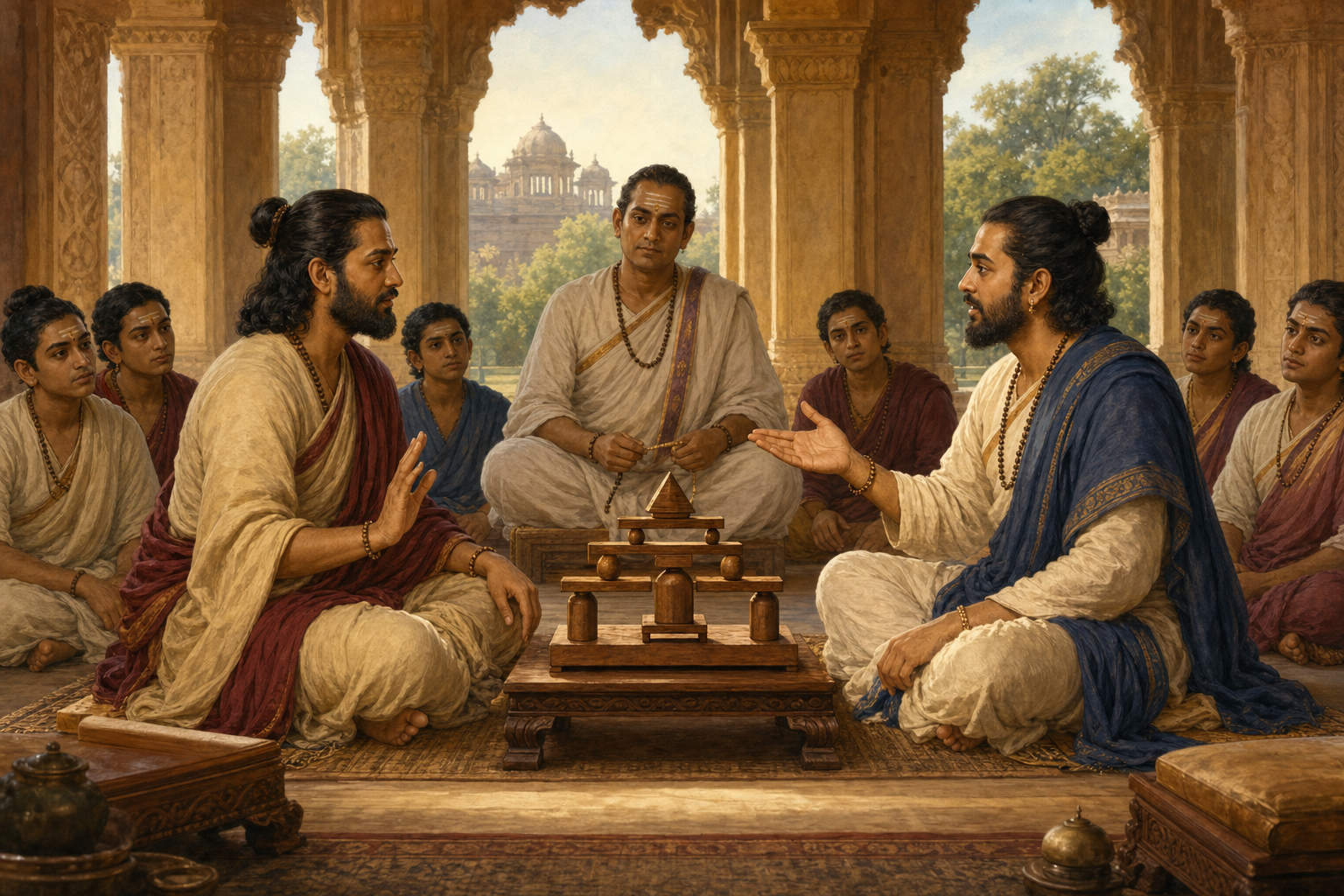
Questioning is not foreign to Dharmic learning. Nachiketa’s inquiry, the discussions associated with Gargi and Maitreyi, and Arjuna’s sustained conversation with Krishna all place serious questions inside the path to clarity. Their example supports samvada and shastrartha as disciplined inquiry rather than personal combat.
Purva-paksha is the first protection against caricature. Before refuting another interpretation, state its conclusion, strongest textual basis and reasoning in terms its defender would recognize. Then ask whether your presentation is accurate. If the other person has to spend the next reply correcting your account of the position, you have not yet reached uttara-paksha.
A proper purva-paksha should let the reader answer three questions:
- What exactly does this interpretation affirm or deny?
- Which passages, pramanas and contextual cues give it its strongest support?
- What inference connects that support to its conclusion?
Once the alternative has been stated fairly, Nyaya’s five-part form can make your reply accountable. Suppose a passage genuinely occurs beside an existing injunction and supplies praise rather than another operative direction. Your argument could be arranged as follows:
- Pratijna, thesis: The disputed statement functions as arthavada rather than as an independent vidhi.
- Hetu, reason: It commends an already directed act and supplies no separate operative prescription.
- Udaharana, example: In the standard Agnihotra pattern, statements praising the rite’s role or result support an explicit injunction.
- Upanaya, application: The disputed statement likewise stands with an existing direction and performs the same supporting work.
- Nigamana, conclusion: It should therefore be read as value-bearing support for the injunction, not as a new obligation by itself.
The five limbs improve presentation; they do not guarantee truth. Every premise and connection still needs examination. Run the reason through the classical hetvabhasa audit before treating the conclusion as established:
- Savyabhichara, inconclusive reason: Does the stated reason also occur where the conclusion is absent?
- Viruddha, contradictory reason: Does the reason actually imply the opposite of what you are trying to establish?
- Satpratipaksha, counterbalanced inference: Is there a valid opposing inference that neutralizes the present one?
- Asiddha, unproved reason: Have you merely asserted the premise on which the argument depends?
- Badhita, defeated reason: Is the conclusion contradicted by a stronger pramana, such as clear perception?
Do not turn these names into Sanskrit-flavoured insults. Saying “asiddha” is not an argument. Identify the unproved premise and show why it matters. Saying “badhita” requires you to name the stronger evidence and demonstrate the contradiction.
The same discipline applies to conduct. Chhala exploits ambiguity or equivocation. Jati substitutes a futile rejoinder for a relevant answer. Nigrahasthana identifies a point at which an argument can no longer proceed under the agreed rules. These safeguards distinguish vada, cooperative truth-seeking, from jalpa, debate aimed at victory, and vitanda, attack without a positive thesis.
The traditional account of Adi Shankara debating Mandana Misra under Ubhaya Bharati’s adjudication is valuable here as a procedural ideal, whether its details are treated as historical or partly hagiographical. It imagines serious disagreement with a recognized adjudicator and meaningful closure. In a classroom, study circle or public forum, appointing a neutral chair and agreeing on the question, pramanas and stopping conditions can serve the same purpose.
Use one protocol from first question to final judgment
A technically valid argument can still become adharmic in its use. Satya requires truthful representation. Ahimsa rules out needless injury through ridicule and misrepresentation. Titiksha gives you the forbearance to hear a difficult objection. Shraddha treats knowledge and sincere inquiry with respect. None of these virtues requires timid agreement; they require firmness without falsification.
Other Dharmic traditions sharpen this discipline without becoming interchangeable. Jain anekantavada and syadvada train you to ask from which standpoint, in what respect and under what conditions a claim holds. That is not permission to treat all contradictions as equally true. Buddhist pramana traditions intensify scrutiny of perception and inference. Sikh gurmat vichar situates scripture-centred reflection within sangat and truthful action. The shared lesson is procedural humility, not the erasure of real doctrinal differences.
For your next disputed passage, use this one-page protocol:
- Write the exact question. State whether you are deciding meaning, obligation, truth, practice or historical occurrence.
- Define the contested terms. If “symbolic,” “eternal,” “ritual” or “authority” has two meanings, settle the intended meaning before arguing.
- Split mixed claims. Give textual, empirical, inferential and metaphysical propositions separate lines.
- Assign a pramana to each proposition. Record the actual evidence and the rule connecting it to the claim.
- Classify each relevant sentence as prescription, prohibition, mantra, namadheya, arthavada or another clearly justified function.
- Map the context. Note syntax, topic, position, repetition, opening, conclusion, result, praise and supporting reasoning.
- Write the strongest purva-paksha and obtain confirmation that it is fair before preparing the answer.
- Present the reply in thesis-reason-example-application-conclusion form, then test every reason for hetvabhasa.
- Close with a decision record. State what is established, what remains uncertain and what evidence would justify revision.
Your decision record can use a fixed sentence: “We provisionally accept X on the basis of Y; the strongest objection is Z; it does not prevail because Q; issue R remains open; evidence S would require reconsideration.” That wording prevents confidence from outrunning the argument. It also lets another reader disagree at the exact point where your reasoning turns.
If participants cannot agree on a pramana, definition or scope, record that foundational disagreement instead of pretending the textual question was settled. If someone changes definitions, refuses to state a positive position, ignores the agreed evidence or substitutes personal attack for reasoning, the chair should pause the discussion. Naming a procedural breakdown is more truthful than manufacturing consensus.
Key takeaways
- State one precise claim and assign it the pramana capable of supporting it.
- Distinguish an operative injunction from mantra, naming and arthavada before deciding what a Vedic passage requires.
- Establish purport through syntax, topic, repetition, opening, conclusion, result, praise and reasoning rather than an isolated quotation.
- Present the strongest purva-paksha, answer with an explicit inference and treat revision as a success of vada rather than a personal defeat.
Take one disputed passage, not ten, and complete the protocol before entering your next discussion. If your interpretation survives functional classification, contextual reading, purva-paksha and the pramana audit, you have earned a defensible conviction. If it does not, revising it is not a retreat from Dharma. It is Dharmic reasoning doing its work.
References
- DharmaRenaissance Blog – Timeless Dharmic Debate: From Vada to Anekantavada, a Fearless Path to Truth and Unity
- DharmaRenaissance Blog – Arthavada in Mimamsa: Unlocking the Purposeful Praise That Animates Vedic Ritual
