
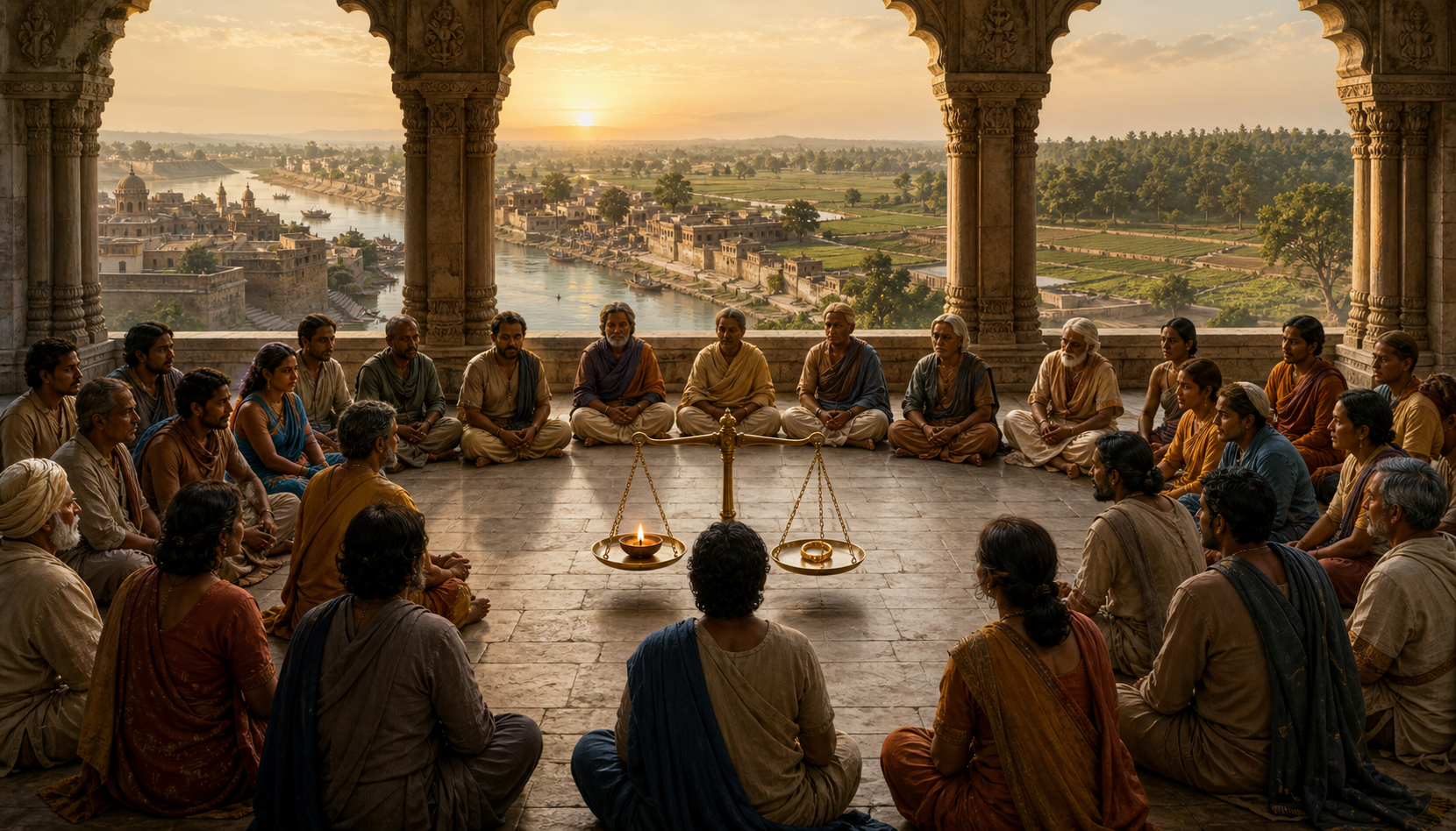
You may be trying to decide whether a forceful leader deserves your trust. The leader promises order, invokes civilizational duty, and points to enemies or obstacles that must be overcome. The difficult question is not whether strength is necessary. It is how to distinguish dharmic strength from power that merely calls itself dharmic.
Keep one distinction in view: restoring order is a duty; escaping judgment is not. Dharmic statecraft asks what a leader protects, what limits the leader accepts, how wrongdoing is answered, and whether public power leaves society more capable of living by Dharma after the crisis has passed. You can use those questions to examine a government, a community institution, a religious body, or your own exercise of authority.
The first duty is to keep life flowing
The conflict between Indra and Vṛtra gives political thought a precise image. Vṛtra is the enveloper: the force that blocks light, water, movement, and life. Indra breaks the obstruction and releases the waters. The ruler’s first responsibility is therefore not domination for its own sake. It is the removal of conditions that prevent ordinary life from continuing.
This changes how you should evaluate claims of strong leadership. Ask what is actually blocked. Is it drinking water, food production, physical safety, worship, honest work, access to justice, or the normal functioning of institutions? A leader who cannot identify the obstructed public good may be manufacturing a permanent enemy rather than solving a public problem.
The image of released water also corrects a common mistake in political argument. Defeating an opponent is not the same as restoring order. If a campaign ends but cultivators remain insecure, public offices remain arbitrary, water systems remain neglected, and communities remain afraid, the obstruction has merely changed form. Dharmic success must be visible in the renewed circulation of life.
- Name the protected good. State whether the decision protects life, livelihood, justice, worship, knowledge, social peace, or an ecological common.
- Identify the real obstruction. Separate deliberate wrongdoing from disagreement, administrative delay, incapacity, and lawful dissent. They require different remedies.
- Define the stopping point. Emergency authority without a clear end can turn the removal of one obstruction into the creation of another.
- Measure restored normality. Look for functioning services, secure communities, repaired institutions, and the return of lawful civic activity—not merely a declaration of victory.
Do not use Vṛtra as a convenient label for every rival. The moral value of the image lies in diagnosing obstruction, not demonizing a person or community. Once political language makes an entire population synonymous with evil, restraint begins to look like weakness and collective punishment begins to look permissible. That is already a departure from Dharma.
A good outcome does not erase a wrongful means
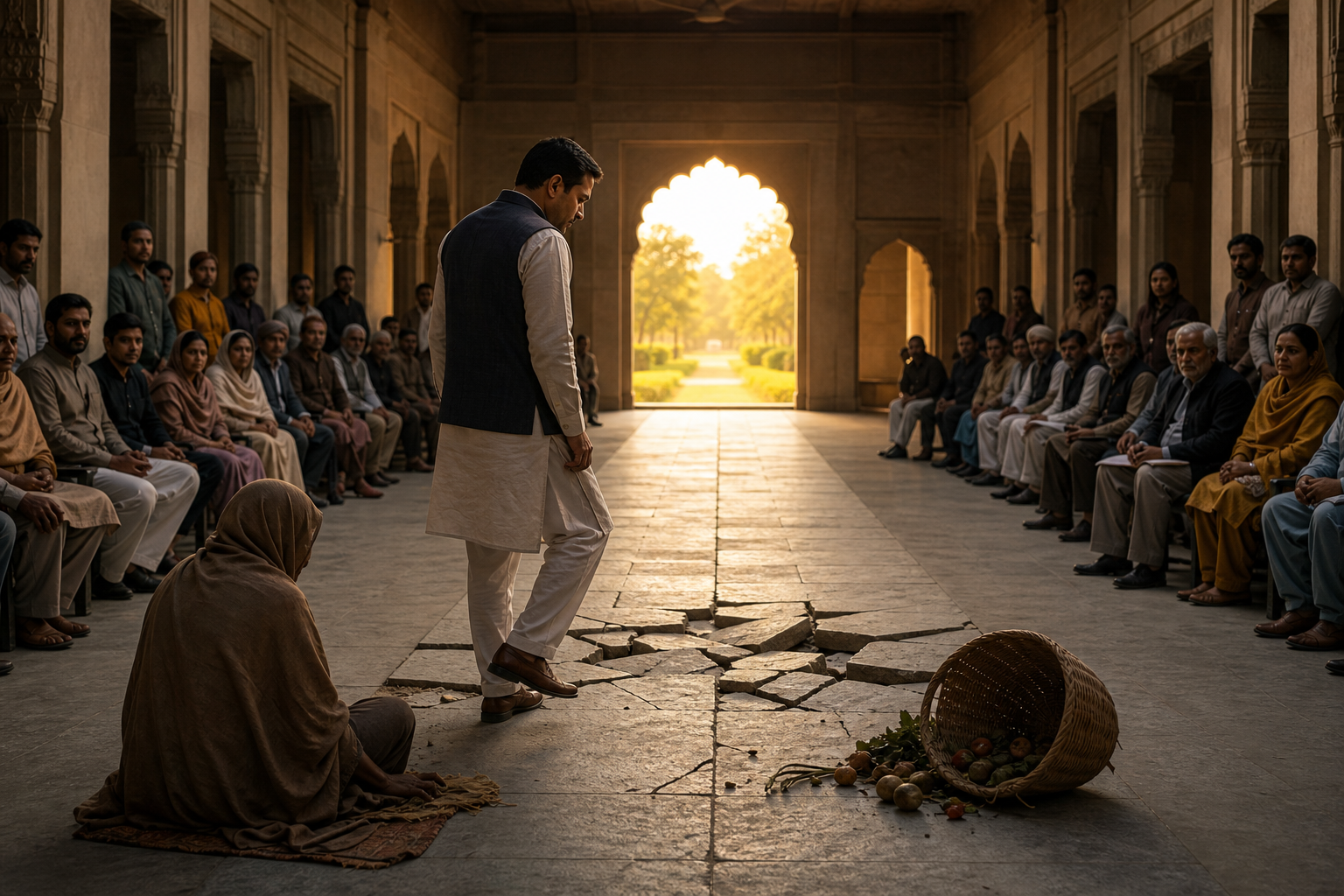
Indra releases the life-giving waters, yet the Purāṇic tellings do not grant him moral immunity. Their accounts vary in important details: Vṛtra may be treated as a Brāhmaṇa, may be engaged in tapas, or may be made vulnerable through intoxication. The stable ethical point is that Indra incurs a serious moral burden and must withdraw for purification.
This is one of the sharpest Dharmic corrections to consequentialism. A necessary result does not make every method righteous. The protector may deserve credit for stopping a danger and still owe an account for the boundary crossed while doing so. Both judgments can be true at once.
You should be wary whenever a leader’s defenders refuse that double judgment. Victory cannot be used to erase abuse, and misconduct cannot automatically erase every public good achieved. Accountability begins when a polity can hold the achievement and the violation in view without falsifying either.
Indra’s withdrawal also exposes a second danger. A leader who disappears into private guilt without arranging continuity leaves the public to bear the consequences. In the narrative, the vacancy at the center contributes to wider disorder. The devas lose coherence, the rhythms of yajña fall silent, and terrestrial life suffers drought, famine, and social dislocation. Remorse is ethically serious, but remorse without an orderly transfer of responsibility is not enough.
Nahusha then supplies the complementary warning. One hundred Aśvamedha sacrifices qualify him for Indra’s office, but qualification does not give him self-command. Power exposes his entitlement. He demands Śacī, consents to being carried by the Saptarṣis, and kicks Agastya in arrogant impatience. His transformation into a serpent makes the political psychology unmistakable: the person appointed to overcome disorder can become its next embodiment.
Credentials establish eligibility. They do not establish fitness. Electoral success, ritual merit, administrative experience, military achievement, scholarship, wealth, or family reputation may open the door to office. You still have to examine how the candidate behaves when contradicted, delayed, embarrassed, or denied.
- Does the leader accept correction from people who have nothing to gain by flattering the office?
- Are exceptions to ordinary rules explained, recorded, limited, and later reviewed?
- Can subordinates report harm without depending on the goodwill of the person accused?
- Does the leader treat women, critics, minorities, and weaker institutions as persons under protection, or as possessions and impediments?
- After a mistake, does the leader repair the damage and change the process, or merely stage an expression of regret?
Tapas in public life should therefore mean disciplined correction, not theatrical suffering. Its institutional forms can include a truthful account, temporary recusal, independent examination, protection for those harmed, proportionate consequences, restitution where possible, and a rule change that makes repetition harder. The exact remedy will differ with the office and violation. The principle does not: purification must alter conduct.
Public form is part of government, but it must remain public

Accountable statecraft is expressed through ceremonies as well as statutes. Condolences, honours, commemorations, apologies, public holidays, and official attendance teach citizens whose service deserves remembrance. These gestures can soften partisan bitterness and affirm that contribution to the polity is larger than agreement with the government of the day.
The death of former Mysore Diwan Sir Mirza Ismail on 5 January 1959 produced a revealing dispute about this responsibility. Large crowds joined the funeral procession, yet the state did not declare the kind of public holiday associated with the deaths of earlier Diwans. D.V. Gundappa appealed to Chief Minister B.D. Jatti on 11 January, not on the ground that a holiday was legally compulsory, but because public courtesy helps form civic character.
When the Chief Minister attributed the decision to Government of India instructions, DVG returned to the matter on 12 January. His objection reached beyond mourning protocol. A responsible state government should be able to understand and answer the sentiments of its own people rather than use distant procedure as a substitute for judgment.
The lesson is not that every respected public figure must receive a holiday. A closure imposes costs, and symbolic recognition can become partisan patronage. The lesson is that public officials cannot escape responsibility by saying that the rulebook made judgment unnecessary. Protocol without judgment becomes bureaucratic evasion; discretion without fair rules becomes favouritism.
- Apply a general principle. Honour service to the polity under a standard that could also recognize a political opponent.
- Check precedent without becoming captive to it. If earlier practice is changed, explain why the new principle is fairer or more workable.
- Let the proper level of government decide. Local knowledge matters when the event, public sentiment, and administrative consequences are primarily local.
- Separate dignity from personality cult. A commemoration should strengthen civic memory, not demand personal loyalty to a living ruler or party.
- Match the symbol with conduct. Praise for service means little when the government neglects the institutions, communities, or public goods that the person served.
This is federalism as an ethic of responsibility. Authority should sit close enough to perceive the people affected, while remaining constrained by standards that prevent local power from becoming arbitrary. Central uniformity and local discretion are both instruments. Neither is a substitute for answering to the public.
Turn compassion, restraint, and stewardship into operating rules
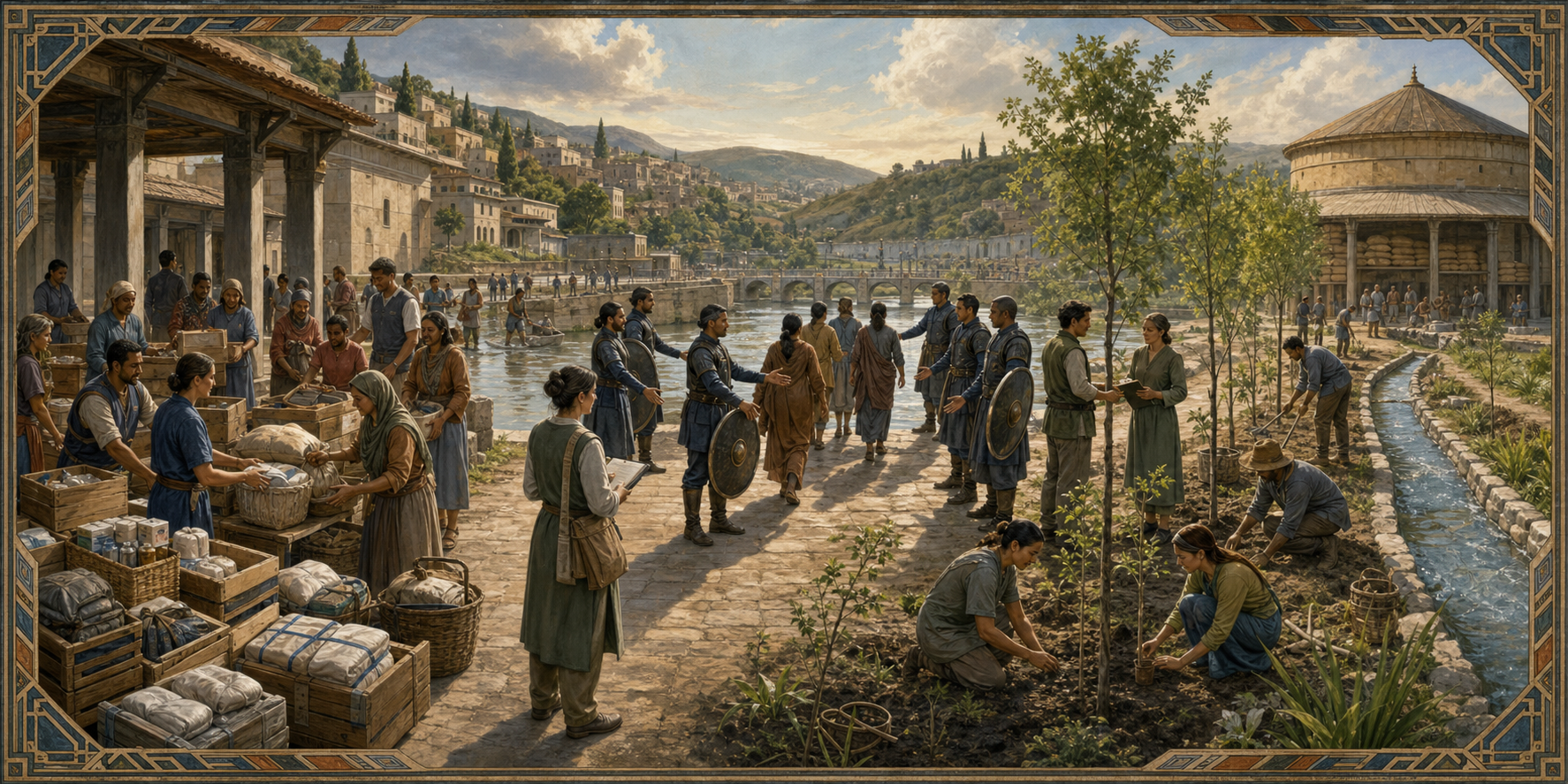
Virtue becomes statecraft only when it changes an order, budget, appointment, review process, or remedy. A leader can speak movingly about Dharma while administering through fear, ecological depletion, and personal discretion. The reliable test is whether moral language survives contact with routine government.
Compassion must govern the use of force
Administrative orders, grants, later chronicles, and public memory associate Shivaji’s rule with restraint toward non-combatants, protection of places of worship, dignified treatment of captives, and support extending to temples, maṭhas, dargāhs, and Sufi institutions. These norms matter because compassion was not confined to private feeling. It shaped what power was permitted to do.
For a present-day decision, require the responsible authority to name the protected population, the forbidden methods, the complaint channel, and the person empowered to stop an abuse. If those safeguards exist only in speeches, they will usually disappear at the moment of greatest pressure.
This does not require passivity. Kṣatra-dharma recognizes the duty to confront aggression and protect the vulnerable. The moral distinction is between force governed by a protective purpose and force governed by hatred, plunder, humiliation, or revenge. A restrained action can be firm; an unrestrained action can undermine the very order it claims to defend.
Ecology must be treated as part of security
The water systems of Raigad and Rajgad joined defence to survival through rain capture, rock-cut cisterns, reservoirs, and catchment management. Sindhudurg used the features of its coastal setting rather than pretending that strategy could be separated from geography. Such infrastructure carries a practical warning: a state that exhausts water, soil, forests, or local livelihoods is consuming its own security.
Before approving a major public project, ask for its water demand, effect on local livelihoods, maintenance responsibility, and performance during scarcity. A monumental structure without a credible plan for the surrounding commons may display power while weakening resilience. Ecological stewardship is not an ornamental addition to rajadharma. It protects the material conditions that make social order possible.
Humility must be distributed through institutions
The Ashta Pradhan council represents an enduring administrative intuition: important functions should not collapse into the ruler’s personality. Councils do not automatically prevent misconduct, but clearly assigned responsibilities create places where advice can be tested, records can be kept, and failures can be traced.
Institutional humility requires more than surrounding a leader with advisers. Ask who appoints them, whether disagreement is recorded, what information reaches them independently, and whether their objections can delay or alter a decision. A council that exists only to applaud is ceremony, not restraint.
The wider Dharmic family offers convergent disciplines without erasing doctrinal differences. Hindu kṣatra-dharma binds courage to protection and restraint. Buddhist karuṇā makes suffering morally visible. Jain ahiṃsā and aparigraha challenge both harmful action and acquisitive power. Sikh sevā, nimratā, and sarbat dā bhalā orient authority toward humble service and the welfare of all. A plural polity does not need to turn these traditions into one theology. It can build public institutions around their shared refusal to treat power as self-justifying.
Key takeaways: seven questions before you grant trust
Use this audit on one actual policy, appointment, security action, commemoration, or institutional dispute. Demand concrete answers rather than another recital of ideals.
- What life-giving flow will this decision restore? Look for a named public good such as safety, water, livelihood, worship, justice, education, or institutional continuity. An undefined promise to restore greatness is not enough.
- What is the precise obstruction? Require evidence that distinguishes aggression and corruption from lawful opposition, incompetence, procedural delay, or social difference. Treating every problem as treachery invites excessive force.
- Which people and boundaries remain inviolable? The decision should specify protections for non-combatants, dissenters, captives, sacred places, vulnerable communities, and ecological commons wherever they are affected.
- Who can challenge the leader while the decision is operating? Identify the council, court, legislature, auditor, ombudsman, local authority, or other reviewer with access to independent information and the ability to change the outcome.
- What happens if the action succeeds through a wrongful method? A credible system can preserve a legitimate achievement while investigating the violation, repairing harm, imposing proportionate consequences, and correcting the rule.
- Does public symbolism honour service or demand loyalty? Apply the same standard across party, sect, caste, region, and community. A gesture that cannot survive that test is closer to patronage than civic pedagogy.
- What will remain after the leader leaves? Look for maintained water systems, predictable procedures, protected livelihoods, preserved records, functioning councils, and a peaceful transfer of responsibility. Personal charisma is not institutional renewal.
Write one sentence answering each question for the decision in front of you. If its defenders can name the victory but cannot name the boundary, reviewer, consequence, or repair, do not grant a blank cheque. Support the kind of strength that can be examined, corrected, and handed on. That is how public power serves Dharma without pretending to stand above it.
References
- DharmaRenaissance Blog — Vṛtrāsura, Indra, and Ṛta: Timeless Dharmic Lessons on Leadership, Anarchy, and Renewal
- DharmaRenaissance Blog — What D.V. Gundappa’s 1959 Letters Reveal: Protocol, Federalism, and Public Decency
- SikhNet — 396th Birth Anniversary Tribute: Shivaji’s Compassion, Ecology, and Moral Courage for Dharmic Unity
