
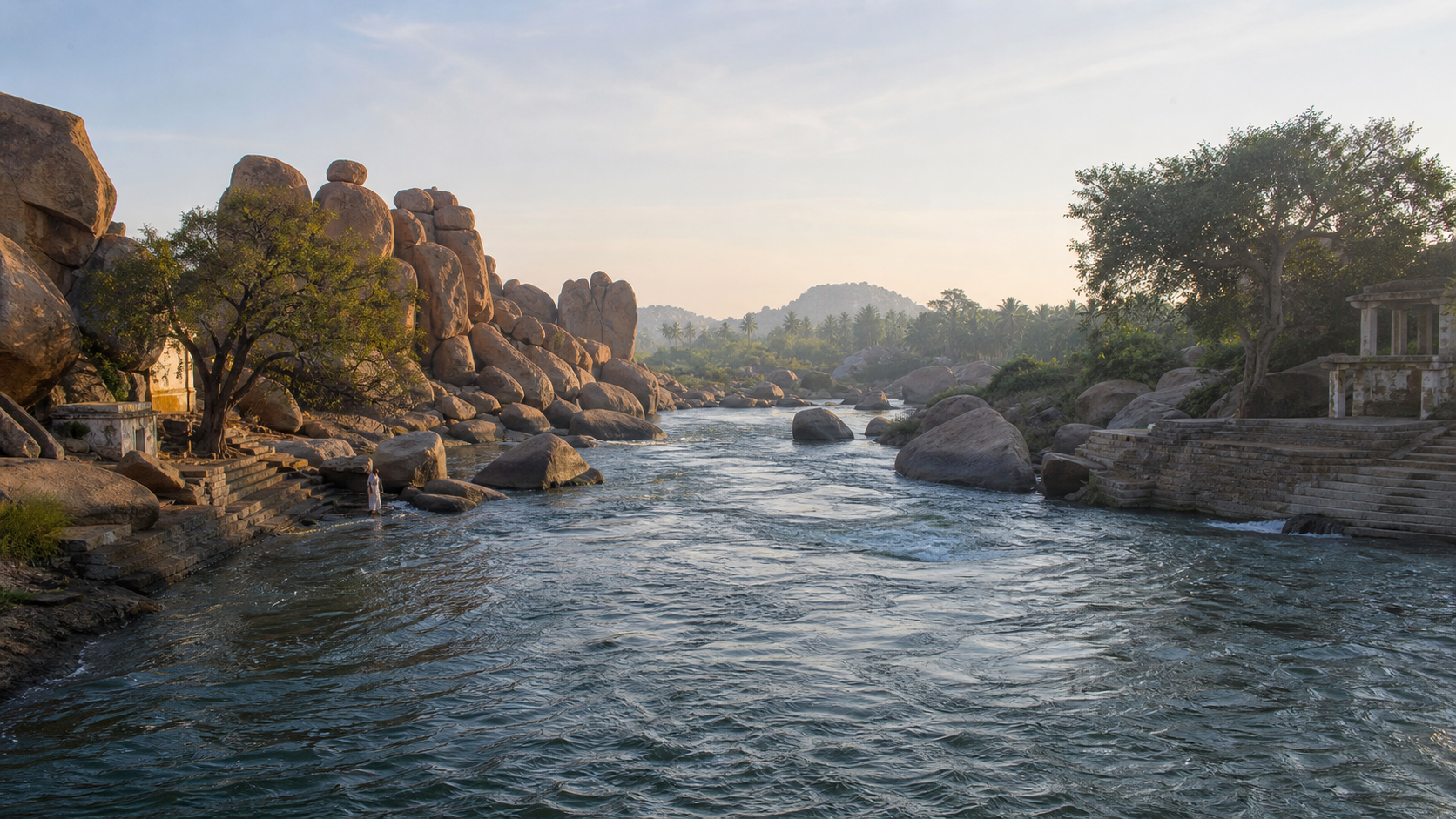
You may arrive in Hampi expecting ruined courts, temple towers and granite boulders. At Chakratirtha, however, the most important monument is moving: the Tungabhadra River. The ford reveals how Vijayanagara joined water, worship, philosophy and public life within one sacred landscape.
If you want to understand Vyasaraja’s legacy, don’t treat Chakratirtha as a scenic stop between larger monuments. Read the riverbank as a place of disciplined practice, the Mukhyaprana tradition as a theological framework, and the nearby Hanuman images as a network of sacred protection. That approach will also help you visit with greater care.
Begin with the river, not the ruins
The name Chakratirtha contains the first lesson. Chakra can evoke both the circular movement of water among the rocks and Vishnu’s Sudarshana Chakra. Tirtha means a ford or crossing, but its Dharmic meaning exceeds physical geography. It is a place where passage through water becomes a way of thinking about passage from confusion toward clarity.
Neither sense of chakra cancels the other. The eddy belongs to the visible river; the divine discus belongs to sacred memory and ritual imagination. Their meeting is characteristic of a tirtha: nature isn’t merely used as a symbol after the fact. The physical place participates in the meaning.
When you approach Chakratirtha, look for four relationships rather than searching for one perfect viewpoint:
- Water and rock: Notice how the Tungabhadra’s flow changes as it encounters Hampi’s granite channel. The movement helps explain why the chakra image belongs here.
- River and steps: The dressed-stone approaches make access to the water part of the built landscape. They served ritual movement, civic use and the practical management of a riverbank.
- Shrine and route: Rock-cut sacred forms and nearby shrines are connected to paths of approach. They were not designed as isolated museum pieces.
- Individual and community: A pilgrim may come with a private vow, yet bathing places, processions and shared steps place that vow within public religious life.
This changes how you read Vijayanagara. The sacred city was not a collection of temples surrounded by neutral infrastructure. Water access, civic order and pilgrimage movement could occupy the same node. Chakratirtha made the metaphor of spiritual crossing physically usable.
If your time in Hampi is limited, resist the urge to photograph the river and immediately move on. Spend several quiet minutes watching how people approach, pause and depart. The pattern of movement may tell you more about the continued life of the site than an unobstructed photograph ever could.
Vyasaraja joined scholarship, sadhana and public responsibility
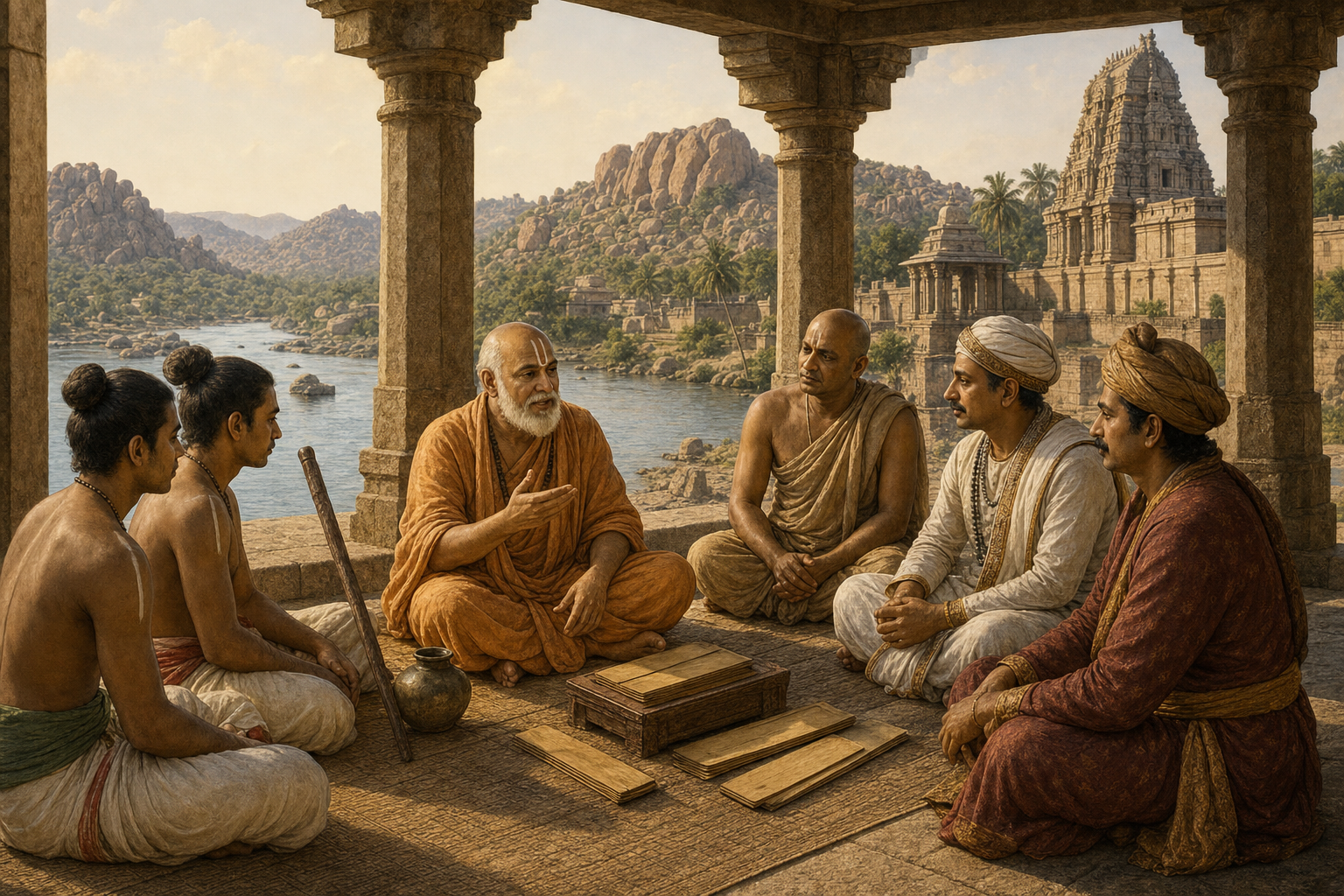
Sri Vyasarajaru, also known as Sri Vyasatirtha, lived approximately from 1460 to 1539. He was an eminent teacher of Dvaita Vedanta, a Rajaguru of the Vijayanagara Empire and an adviser associated with Emperor Krishnadevaraya. His major philosophical works include Nyayamrita, Tarka-tandava and Tatparya-chandrika. Yet his remembered life at Chakratirtha also includes early-morning snana, sandhyavandana, japa and meditation.
That combination matters. Vyasaraja’s legacy cannot be reduced to either court influence or personal mysticism. He represents a model in which rigorous reasoning, repeated discipline and responsibility toward a larger political community reinforce one another.
You can read his presence in Hampi through three connected roles:
- The philosopher: He developed and defended Dvaita thought through demanding works of logic and interpretation.
- The practitioner: His authority was remembered through daily observance at the river, not through intellectual production alone.
- The public teacher: He connected philosophical precision with accessible devotion and participated in the religious life of an imperial capital.
Mukhyaprana supplies the theological link between these roles. In Dvaita Vedanta, Vayu is the foremost among individual souls and serves Vishnu with unsurpassed fidelity. Madhva tradition understands this service through three manifestations: Hanuman in the Ramayana, Bhima in the Mahabharata, and Madhvacharya in the present age. Hanuman is therefore more than a general emblem of physical power. He embodies strength governed by knowledge, devotion and service.
This is why the association between Vyasaraja and Mukhyaprana is intelligible within Dvaita rather than being an ornamental legend attached to a famous saint. The scholar’s reasoning, the devotee’s breath and attention, and the guardian’s alert strength all point toward rightly ordered service to Vishnu.
For a present-day reader, the practical lesson is demanding. Knowledge that never changes conduct remains incomplete, while devotion that refuses disciplined thought becomes vulnerable to exaggeration. Vyasaraja’s example asks you to keep study and practice accountable to each other.
Read the vision tradition with devotion and historical honesty
Local memory and hagiographic tradition recount that Vyasaraja received a vivid dream-vision of Mukhyaprana during his disciplined practice at Hampi. The vision affirmed his devotion, connected Hanuman with the surrounding Kishkindha landscape, and directed him to establish an icon beside Chakratirtha for the protection of devotees and the sanctification of the ford. Vyasaraja is then said to have consecrated Mukhyaprana Devaru on the riverbank.
You don’t have to collapse every kind of truth into one category to take this tradition seriously. A responsible reading distinguishes three layers:
- What can be encountered at the place: the river, steps, shrines, images, routes and continued acts of devotion.
- What sacred memory attributes to Vyasaraja: his discipline at the ford, the dream-vision and the resulting consecration.
- What the tradition means theologically: Mukhyaprana strengthens the devotee, mediates service to Vishnu and protects a sacred crossing.
The second layer is not the same kind of evidence as a dated inscription, and it shouldn’t be presented as though it were. That distinction does not require you to dismiss the account as meaningless folklore. Hagiographic memory tells you how a community understands a saint, a deity and a place in relation to one another. It can shape centuries of pilgrimage even when modern historical methods cannot verify every element of the vision.
Two opposite mistakes become possible here. One is to demand that a sacred vision behave like an administrative record. The other is to convert every remembered detail into a settled archaeological claim. Avoid both. You can honour the tradition in its own theological register while remaining exact about the kind of claim you are making.
This distinction is especially useful when speaking about Chakratirtha to children, fellow pilgrims or heritage visitors. Say “tradition remembers” when discussing the vision. Say “the site preserves” when pointing to what remains visible. Say “Dvaita teaches” when explaining Mukhyaprana. Those three phrases protect both faith and factual clarity.
One Hanuman image opens onto a larger sacred network
How to read Yantroddharaka Anjaneya
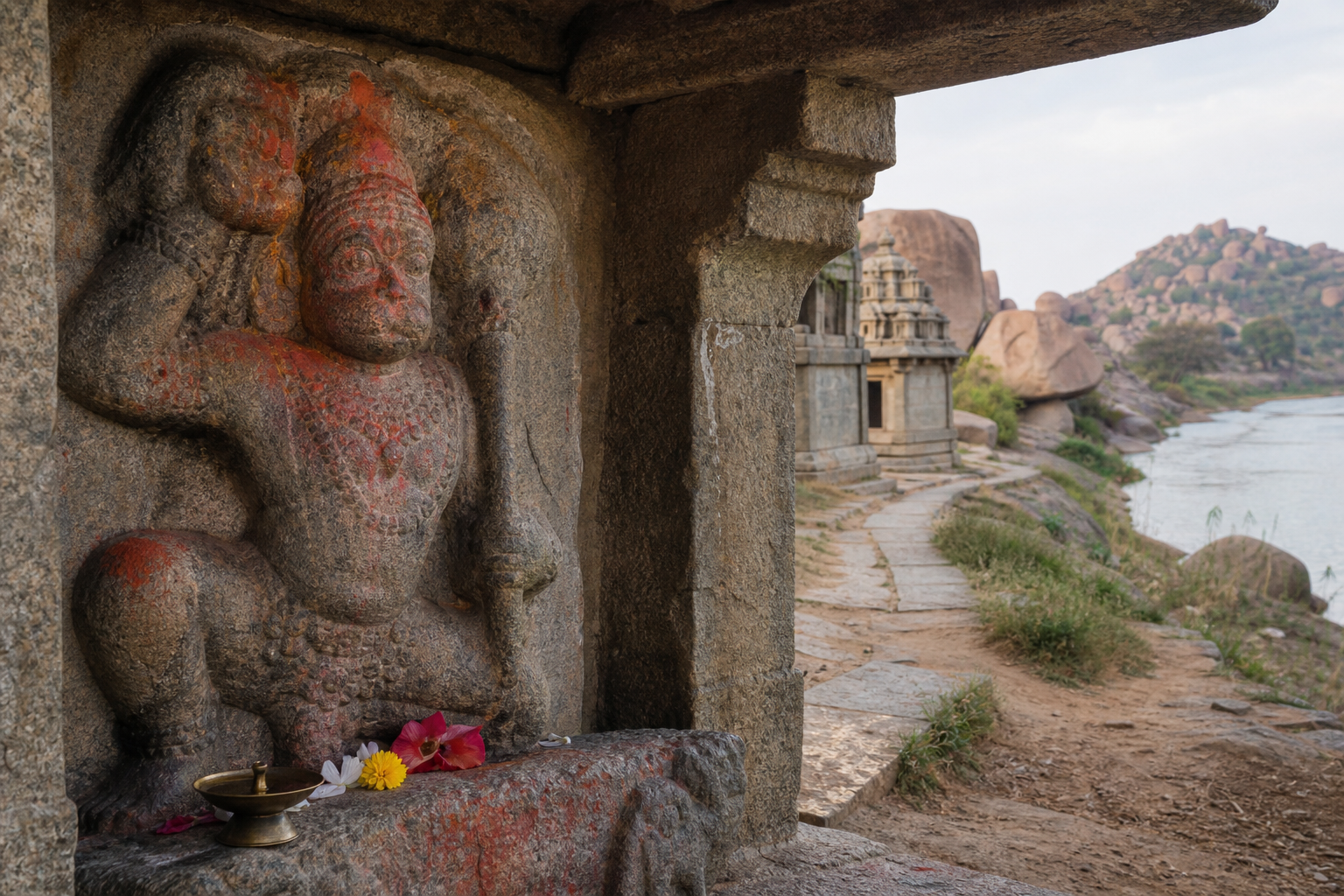
Near Chakratirtha, Yantroddharaka Anjaneya brings Vyasaraja’s legacy into a concentrated visual form. The rock-cut Hanuman is enclosed within a sacred geometric diagram, or yantra, overlooking the Tungabhadra. Local lore remembers that attempted depictions of Hanuman would not remain fixed until Vyasaraja bounded the figure within the yantra and consecrated it through disciplined sacred practice.
The point isn’t simply that geometry restrained a restless image. The yantra expresses order while Hanuman embodies directed spiritual energy. Form and force belong together. Power becomes protective when it is bounded by dharma, attention and service.
Before looking for individual attributes, pause over the whole composition. Notice the relationship between the figure and its geometric enclosure. Then use the broader iconographic vocabulary associated with Vyasaraja-lineage Hanuman forms:
- Abhaya, the gesture of assurance, presents strength as protection rather than intimidation.
- The gada, or mace, represents force available for a dharmic purpose rather than aggression without restraint.
- The arched tail can be read as alert energy and the ascent of prana rather than bodily power alone.
Local images vary, so don’t force every feature into a fixed checklist. Use these attributes as interpretive aids only where the form before you supports them. Careful darshana begins with seeing what is actually present.
From a single consecration to protective geography
Tradition credits Vyasaraja with the installation of more than seven hundred Anjaneya images across the Vijayanagara region. That number should be identified as a traditional attribution rather than treated as a modern audited inventory. Its importance lies partly in the scale of the memory: Vyasaraja’s Hanuman installations came to be understood as a protective garland around settlements, gateways and river crossings.
These were kshetrapala forms, guardians of place. Their distribution joined spiritual vigilance to the safety and moral order of inhabited space. In that framework, Hanuman at a boundary does not merely keep danger outside. He also reminds those who pass through that courage must remain answerable to dharma.
The network belongs to a larger Vijayanagara landscape in which Vaishnava, Shaiva, Shakta and Jain establishments coexisted. That coexistence should not be romanticised as an absence of theological difference. It shows something more concrete: multiple sacred communities could participate in the spatial, economic and ritual life of the same imperial centre.
Across the Tungabhadra, Anjanadri Hill near Anegundi is locally revered as Hanuman’s birthplace within the Kishkindha landscape. From Chakratirtha, the relationship among river, Hanuman shrine and epic geography becomes visible. You are not merely looking from one attraction toward another. You are seeing how a community placed the Ramayana, local terrain and continuing worship within one field of memory.
How to make your Chakratirtha visit more deliberate
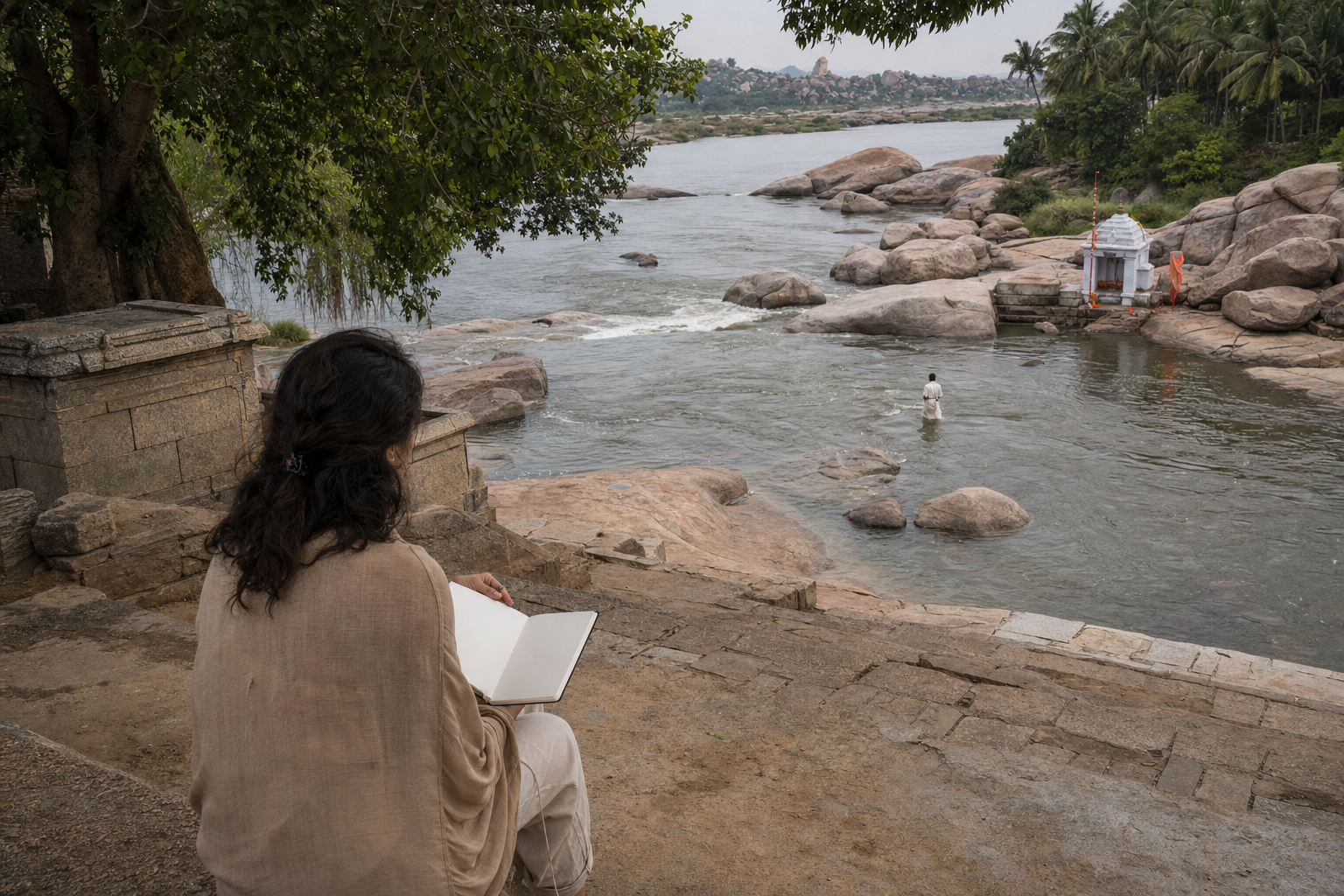
Decide before you arrive whether you are approaching primarily as a pilgrim, a student of heritage, or both. The choice doesn’t rank visitors by sincerity. It tells you what kind of attention to bring and prevents the site from becoming a hurried backdrop.
Karthika Masam and Magha Purnima traditionally bring increased pilgrimage activity, especially around dawn. If you value communal observance, that intensity may belong to the experience you seek. If you need extended quiet for study or contemplation, recognise that a major sacred occasion may not provide it. Current access conditions and local instructions still need to be checked at the time of your visit.
- Bring one clear question. Ask, for example, how disciplined strength differs from uncontrolled power, or how private sadhana becomes public responsibility. One real question will focus your attention better than a long list of facts to collect.
- Read the physical tirtha first. Observe the current, rocks, steps, shrines and paths before opening a camera. Identify how a person moves from settlement to water and from water toward darshana.
- Treat snana as observance, not performance. A flowing river can be dangerous. Enter only where access is clearly permitted and conditions are safe, and obey on-site restrictions. Remaining respectfully on the bank is wiser than taking a risk to reproduce an imagined pilgrimage photograph.
- Choose a practice appropriate to your tradition. An initiated practitioner may perform the observance prescribed by their sampradaya. Others may undertake japa or a respectful recitation associated with Hanuman, such as the Sundara Kanda or Hanuman Chalisa. Don’t accumulate practices merely to make the visit feel complete.
- Give the image unhurried attention. At Yantroddharaka Anjaneya, begin with the relationship between deity and yantra. Then notice the attributes that are actually visible. Let form lead interpretation.
- Leave without damaging what received you. Don’t mark the stone, obstruct worship, treat an icon as a prop or leave offerings as litter. Sacred heritage survives when devotion includes restraint.
After darshana, translate one Hanuman virtue into a specific commitment. Seva could mean completing an unglamorous task that benefits others. Shraddha could mean keeping one discipline you have repeatedly postponed. Bala could mean using influence without humiliating someone weaker. Buddhi could mean verifying a historical claim before forwarding it. A tirtha becomes a crossing when something in your conduct crosses with you.
Key takeaways
- Chakratirtha is both a sacred ford and part of Vijayanagara’s practical river infrastructure.
- Vyasaraja’s legacy joins Dvaita scholarship, repeated sadhana, accessible devotion and responsibility within public life.
- His Mukhyaprana vision belongs to local and hagiographic tradition; identify it as sacred memory rather than disguising it as an inscriptional claim.
- Yantroddharaka Anjaneya is best read through the relationship between ordered geometry and disciplined divine energy.
- The many Hanuman installations attributed to Vyasaraja express a protective geography extending beyond one shrine.
- A worthwhile visit combines reverence, accurate language, river safety and care for living heritage.
Before leaving Chakratirtha, stand where you can see water, stone and sacred form together. Then choose one act of disciplined service to carry into the next week. That small decision is closer to Vyasaraja’s Vijayanagara legacy than another photograph without attention.
References
