

If you have heard that Goddess Meenakshi saved a British Collector and wondered whether to call it history, miracle or legend, your real question is probably one of trust: what can you repeat confidently, and what should remain a matter of tradition?
You do not have to force the story into a single category. The Meenakshi-Peter Pandian tradition carries a historical setting, an orally transmitted miracle narrative and a distinctly Tamil judgement about righteous rule. Keeping those layers together makes the account more meaningful, not less.
The core tradition has one pattern and several tellings
Raus Peter was a British East India Company officer associated with Madurai in the early nineteenth century. Local memory portrays him as a compassionate and capable administrator and remembers him by the striking name Peter Pandian.
In the best-known telling, severe monsoon weather has settled over Madurai. A persistent knock wakes Peter at his residence during the night. At the door is a young woman, or in some narrations a girl, who urgently warns him that the city faces danger. The warning concerns a threatened breach in the Vaigai River bund.
Peter responds as an administrator should. He gathers workers, mobilises materials and supervises emergency reinforcement of the bund. Madurai is spared the feared destruction. When he later goes to the Meenakshi Amman Temple in gratitude, he recognises the maternal presence of the goddess as that of the visitor who summoned him to duty.
Other tellings alter the immediate danger. One makes the warning about an ambush. Another introduces a dream connected with the recovery of a temple jewel. Yet another shifts the crisis toward civic disorder. These differences matter if you are trying to reconstruct an exact event, but they do not change the narrative’s stable sequence: danger appears at a liminal hour, divine grace issues a warning, the person holding authority acts for the common good, and the identity of the protector becomes clear at Meenakshi’s sanctuary.
That stable sequence is the first thing to notice when someone tells you a different version. Do not assume that every variation is a rival claim that must defeat the others. Oral traditions often preserve their moral centre more consistently than their circumstantial details. Here, the centre is neither Peter’s nationality nor the spectacle of a supernatural encounter. It is his willingness to answer an inconvenient summons and protect Madurai.
Why the name Peter Pandian matters
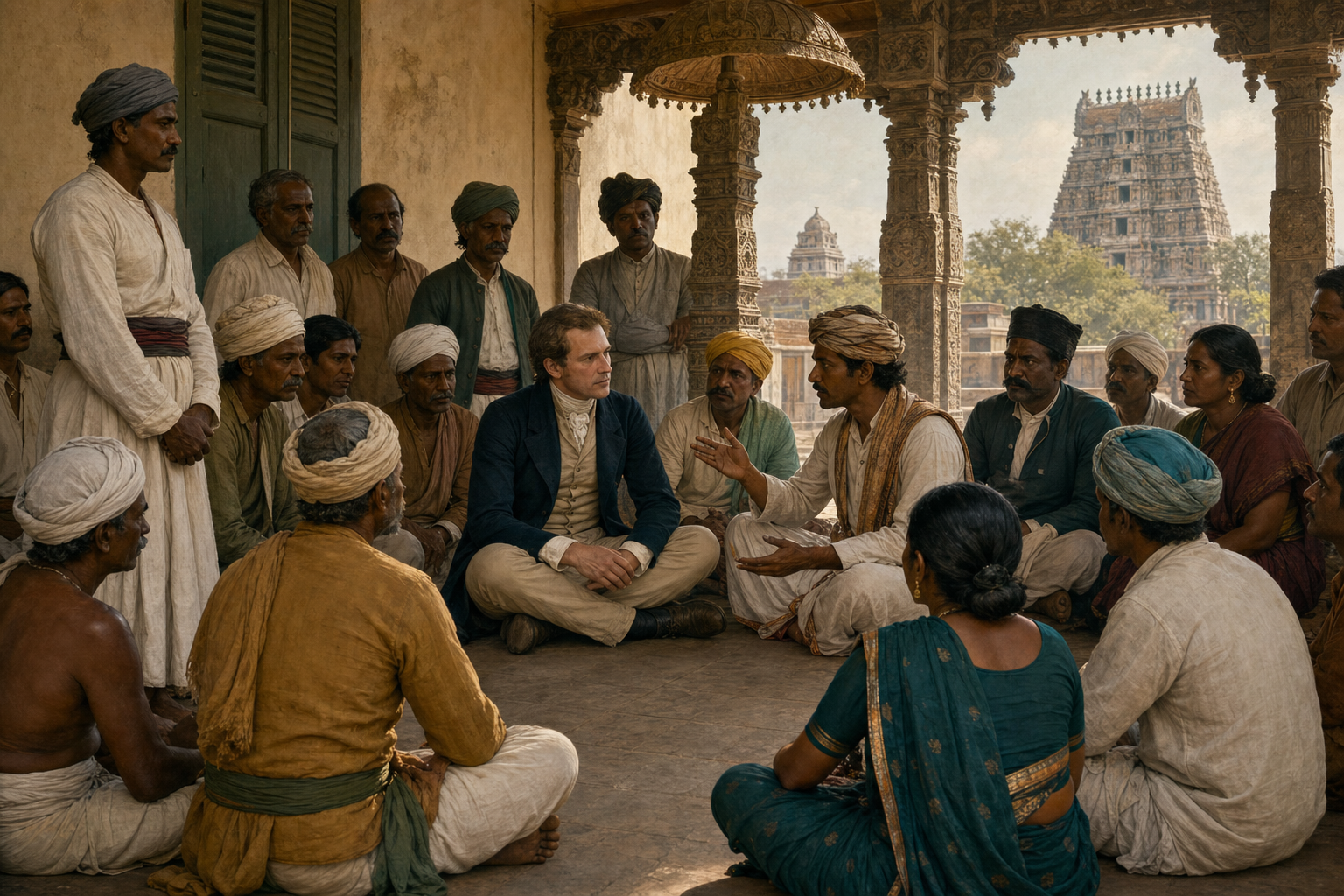
Pandian is not a decorative suffix in this tradition. It evokes the Pandya lineage and Madurai’s inherited language of kingship. By calling a foreign official Peter Pandian, the city’s memory evaluated him through a Tamil standard of governance: power becomes worthy of honour when it protects the people.
This does not turn an East India Company officer into a Pandya king, erase the realities of colonial rule or require approval of the political system he represented. It does something more precise. It places the conduct attributed to one administrator inside the moral grammar of rajadharma, the duty attached to rule. The honour belongs to service, courage, fairness and attentiveness rather than to imperial office.
Nor does the name establish that Peter converted to Hinduism. The remembered relationship is one of ethical kinship rather than religious conversion. Meenakshi’s protection reaches a person outside the Hindu community, while Peter’s response places him within Madurai’s expectation of responsible rule. Neither side has to surrender its identity for the encounter to possess meaning.
This distinction prevents two common misreadings. A narrowly colonial reading treats the Tamil honour as mere gratitude toward a benevolent official. A triumphalist religious reading turns the miracle into a conversion story that the tradition does not require. The name expresses something subtler: Madurai retains the authority to define good government in its own civilisational vocabulary, even when the officeholder comes from outside that civilisation.
That is also why Peter remains secondary to Meenakshi. The tradition does not make a British officer the spiritual centre of Madurai. It remembers him because, at a decisive moment, he is said to have listened to the Mother of Madurai and fulfilled the duty of his office.
What can responsibly be treated as history

The cleanest way to assess the tradition is to separate historical setting, remembered event and interpretation. These are related, but they do not carry the same kind of evidence.
| Layer | What you can responsibly say |
|---|---|
| Historical setting | Early nineteenth-century Madurai had entered the East India Company’s administrative order after the Polygar Wars and the wider restructuring of the Carnatic. |
| Administrative context | Company officials dealt with land revenue, irrigation, policing and public order. Protecting a river bund therefore fits the practical responsibilities of the period. |
| Temple-centred tradition | Meenakshi warns Peter during a night-time crisis; he acts to protect Madurai and subsequently recognises his protector at her temple. |
| Unsettled particulars | An exact date, verbatim dialogue and one conclusively established form of the emergency are not available in accessible Company-era records. |
| Civic and devotional meaning | Meenakshi protects the city, while Peter earns the name Pandian by answering the call of public duty. |
The setting gives the flood version practical plausibility. Madurai’s officials did have to attend to irrigation, channels, bunds and monsoon risk. The Meenakshi Amman Temple was also more than an isolated place of worship: its festivals, ceremonial circuits and social role made it a central institution in the life of the city. A story joining the temple, the river and the administrator therefore belongs naturally to Madurai’s civic landscape.
Plausibility, however, is not corroboration. Administrative records can establish offices, responsibilities and historical conditions without verifying a midnight manifestation of the goddess. The absence of the miracle’s exact details from accessible official prose does not disprove a sacred encounter, but neither does it justify presenting every detail as archival fact.
A careful formulation you can use is this: Madurai’s temple-centred oral tradition remembers Raus Peter as an administrator protected and guided by Meenakshi during a night-time emergency, most commonly associated with the Vaigai bund. That wording identifies the kind of claim being made, preserves the best-known form of the story and leaves room for its variants.
This approach does not demote oral memory to failed history. Oral memory answers a different question: how did Madurai choose to remember this person? The survival of the name Peter Pandian shows that the community’s judgement about his conduct became more durable than the disputed particulars of the night. For a historian, that remembrance is evidence of civic memory. For a devotee, it may also testify to Meenakshi’s grace. One reading need not impersonate the other.
The midnight knock is a test of rajadharma

The miracle is often treated as the most important part of the account, but the warning alone does not save Madurai. Peter has to get out of bed, take the danger seriously, assemble people and materials, and remain engaged until the immediate threat is contained. Divine grace and human duty are not substitutes in this structure. Grace summons; duty responds.
That sequence gives the tradition continuing practical force. The person in authority does not dismiss a warning because it arrives at an inconvenient hour or through someone without visible rank. He does not turn uncertainty into an excuse for delay. He uses the capacity of his office to prevent harm before the feared disaster becomes irreversible.
If you hold responsibility for other people, the story offers a useful three-question test when an uncomfortable warning reaches you: What harm follows if the warning is true? Who will bear that harm first? What protective action can be started while the facts are still being checked? This is not a literal emergency manual. It is a way to translate the tale’s ethical logic into ordinary leadership without pretending that every alarm is a divine message.
The same logic explains why the tradition honours action rather than identity. Peter’s foreign origin does not exempt him from duty, and it does not prevent the city from recognising good conduct. In the dharmic understanding expressed here, an office acquires legitimacy through protection of life and social order. A title alone is insufficient.
Meenakshi’s role is equally important. Devotional Madurai understands her as the city’s mother and guardian, not as a deity concerned only with those who already belong to a particular community. Her warning to Peter represents protective grace crossing a boundary without dissolving that boundary. The miracle is inclusive because the threatened city is her concern.
You can also recognise moral resonances with Buddhist karuna, Jain ahimsa and Sikh seva: compassion, the prevention of harm and selfless service all illuminate why an administrator’s response could be remembered as dharmic. These concepts are not interchangeable doctrines, and the Meenakshi tradition remains specifically rooted in Madurai’s Hindu sacred world. Their resonance shows how several dharmic traditions make the welfare of living beings a serious test of ethical action.
How to tell and encounter the tradition without weakening it
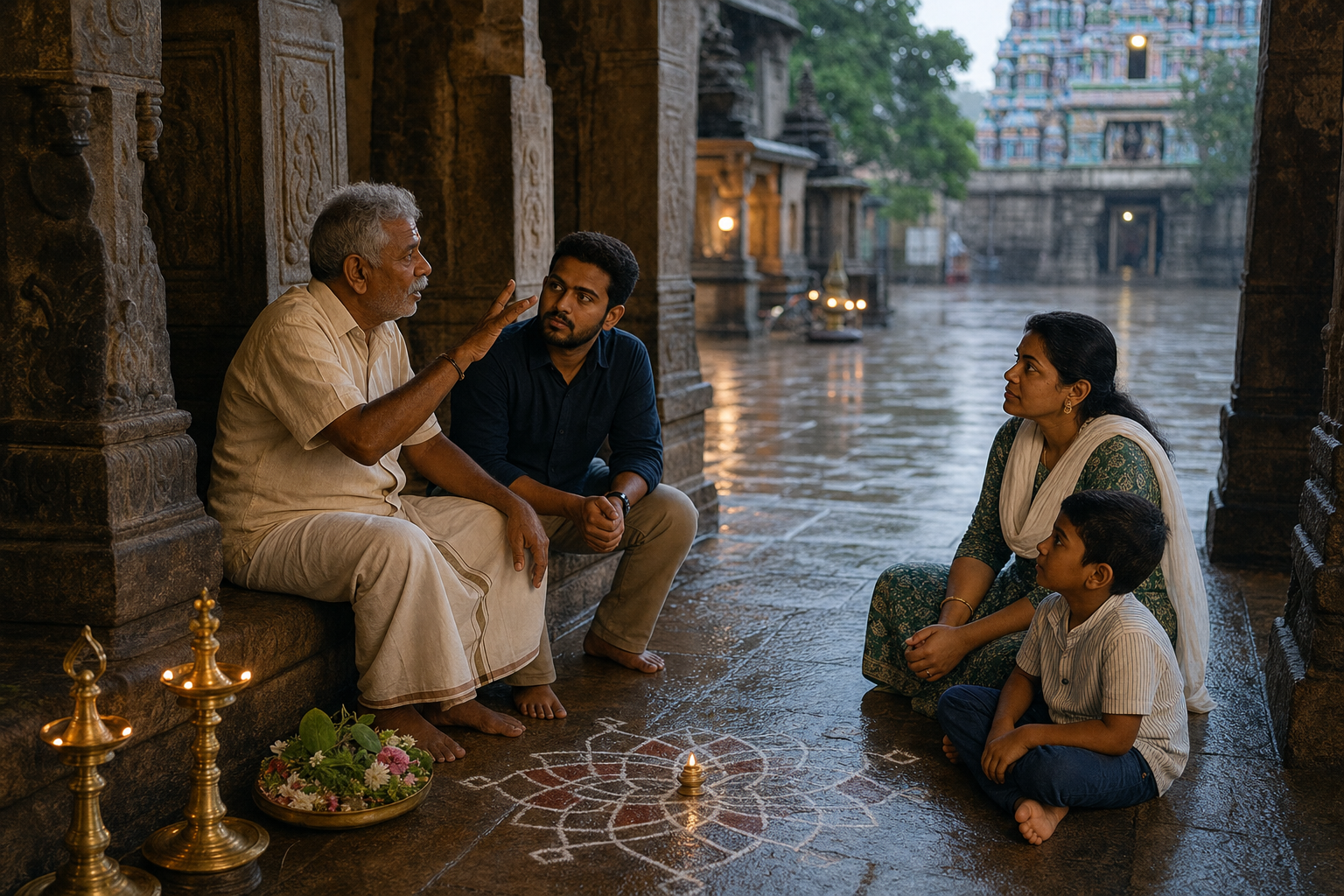
If you are recounting the story to a child, a visitor or an online audience, name its genre at the beginning. Call it a living Madurai temple tradition or temple-centred oral history. Do not label it a conclusively documented incident, and do not reduce it to fiction merely because its sacred dimension falls outside the normal language of Company records.
Tell the Vaigai-bund version first because it most clearly joins Meenakshi’s guardianship to Peter’s administrative duty. Then mention, briefly, that other narrations speak of an ambush, a temple jewel or civic danger. This order gives the listener a coherent account while being honest about transmission.
Do not manufacture an exact date, a dramatic speech or a conversion scene. Such additions may make a retelling sound more cinematic, but they weaken its credibility and shift attention away from the tradition’s actual strength. The received pattern is already complete: warning, response, protection, recognition and public honour.
If you visit Madurai, keep the temple and the Vaigai in the same mental map. The account links sacred geography with civic infrastructure. At the temple, remember that Peter is a supporting figure in Meenakshi’s continuing relationship with her city. Near the river, notice how the apparently mundane work of maintaining bunds and channels can become a matter of collective survival. The story lives in the connection between those two places.
When a local narrator gives you a version different from the one you know, ask which part of the tradition was emphasised in the telling they received. That question is more fruitful than trying to catch the narrator in an inconsistency. It helps you distinguish a change in circumstance from the preservation of the same ethical structure.
Key takeaways
- Peter Pandian refers to Raus Peter, an East India Company officer remembered in Madurai for compassionate and responsive administration.
- The best-known miracle tradition places Meenakshi’s warning during a night-time threat to the Vaigai bund, followed by Peter’s emergency action and recognition of the goddess at her temple.
- Other versions change the danger, but retain the movement from divine warning to public duty and protection.
- Pandian is an ethical Tamil honour, not evidence of religious conversion or a claim that colonial rule became legitimate.
- The historical setting is plausible, while the exact date, dialogue and details of the miracle should remain identified as oral tradition.
- The tradition’s practical lesson is to hear an inconvenient warning, assess the possible harm and use authority promptly for the protection of others.
The next time you hear the name Peter Pandian, listen for the judgement Madurai placed inside it. Then carry the tradition forward with its boundaries intact: honour Meenakshi as the guardian, Peter as the servant who responded, and public protection as the conduct that made the name worth remembering.
References
