
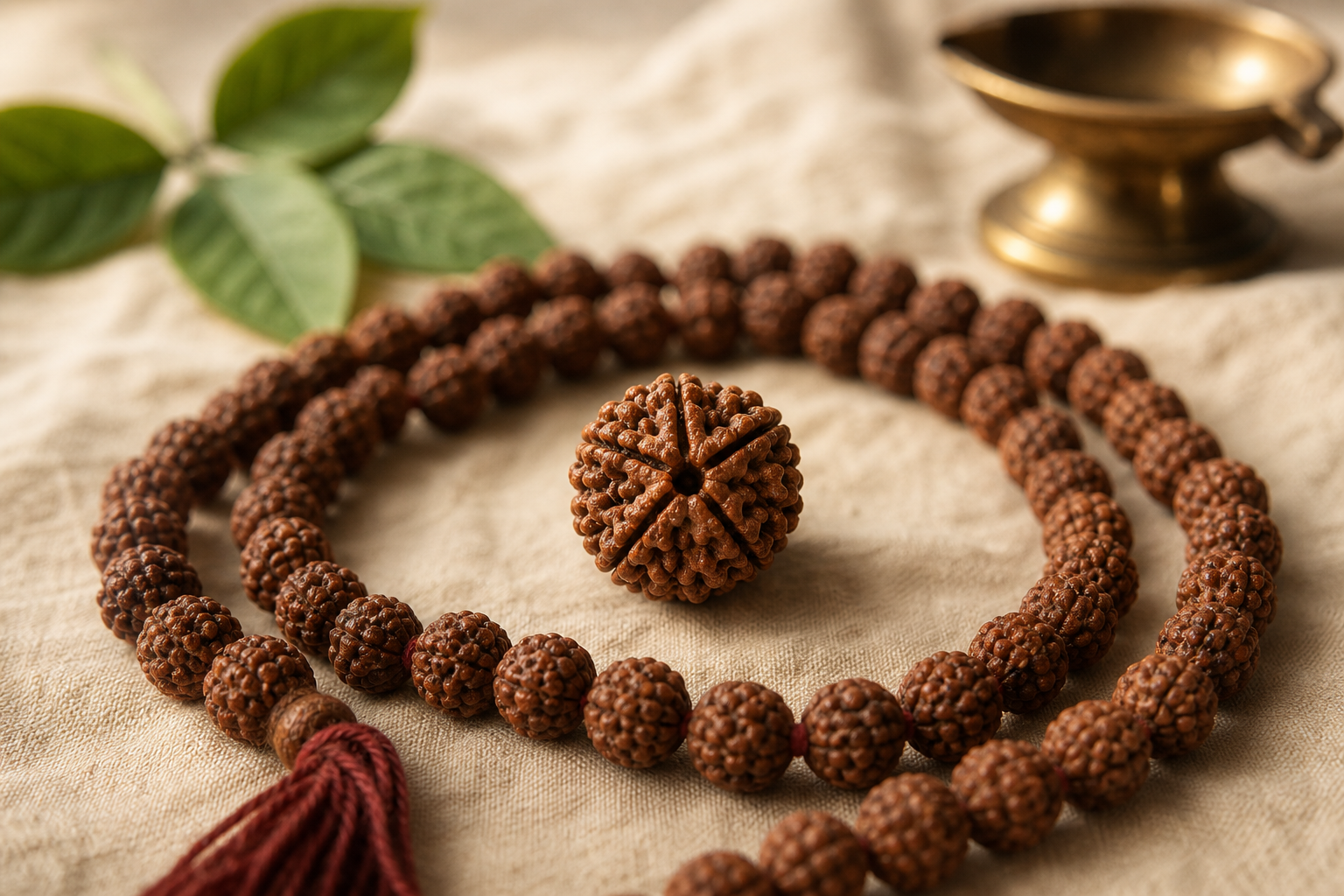
You may be holding a five-faced Rudraksha and wondering what you are actually meant to do with it. Does it require an elaborate consecration? Which mantra should you use? How can you tell whether the bead is natural rather than carved or glued?
The practical answer is reassuringly simple. Choose an authentic bead, clean it carefully, make a clear sankalpa, and use it for steady japa. Panchavaktra Rudraksha is not difficult to approach, but it asks for something more demanding than ceremonial display: regular practice joined to truthful, non-harming conduct.
What the five faces are meant to remind you of
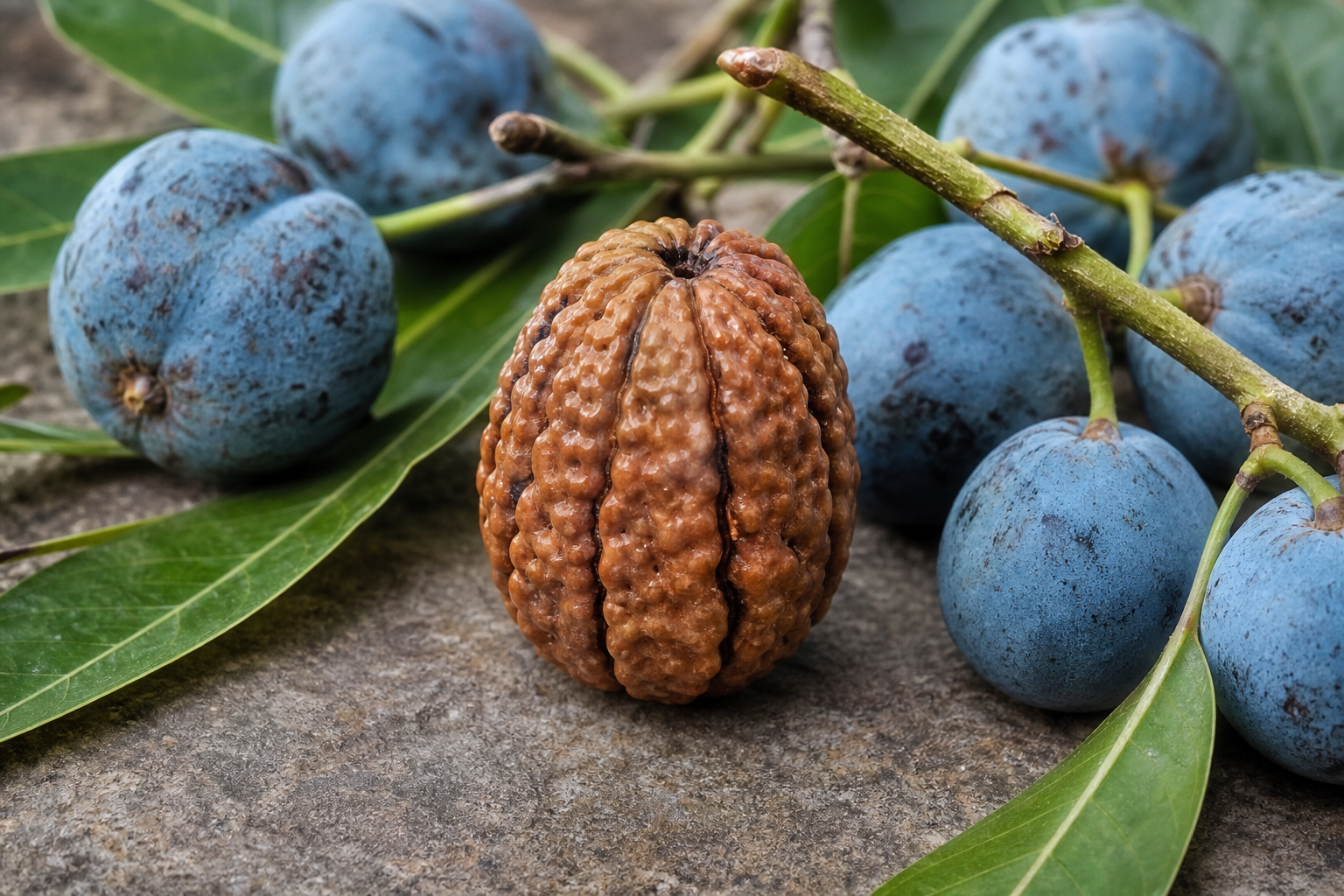
Panchavaktra means five-faced and is often used interchangeably with Panchamukhi. The five faces are not painted symbols or pieces attached to the seed. They are five naturally formed clefts in the matured endocarp of Elaeocarpus ganitrus, a tree found in the Himalayan foothills and other parts of South and Southeast Asia.
The Shiva Purana, in section 1.25, identifies the five-faced bead with Rudra and calls it Kalagni Rudraksha. Kalagni evokes Rudra as the fire that consumes impurities bound to time. For a practitioner, that image is best understood as a demand for inner purification. The bead should remind you to burn through distraction, inertia, carelessness, and self-deception through disciplined awareness.
The five facets also recall Shiva’s five cosmic faces: Sadyojata, Vamadeva, Aghora, Tatpurusha, and Ishana. Together they express the balance of creation, preservation, dissolution, veiling, and grace. This is not merely decorative theology. When the bead passes through your fingers during japa, it returns attention to the larger order within which personal desires, fears, and successes come and go.
The number five carries several further associations within Hindu thought. Panchavaktra Rudraksha is frequently connected with the five great elements, or pancha-mahabhuta; the five vital airs, or pancha-prana; and the five sheaths, or pancha-kosha, taught in the Taittiriya Upanishad. These correspondences should not be forced into a single literal map. Their practical value is mnemonic: body, breath, mind, discernment, and the inward search for bliss must participate in sadhana together.
This is why the five-faced bead belongs naturally with mantra, breath, and ethical discipline. Wearing it can be meaningful, but wearing it is not the whole practice. Its deeper purpose is to interrupt heedlessness and bring you back to remembrance of Shiva.
How to choose a genuine and responsibly sourced bead
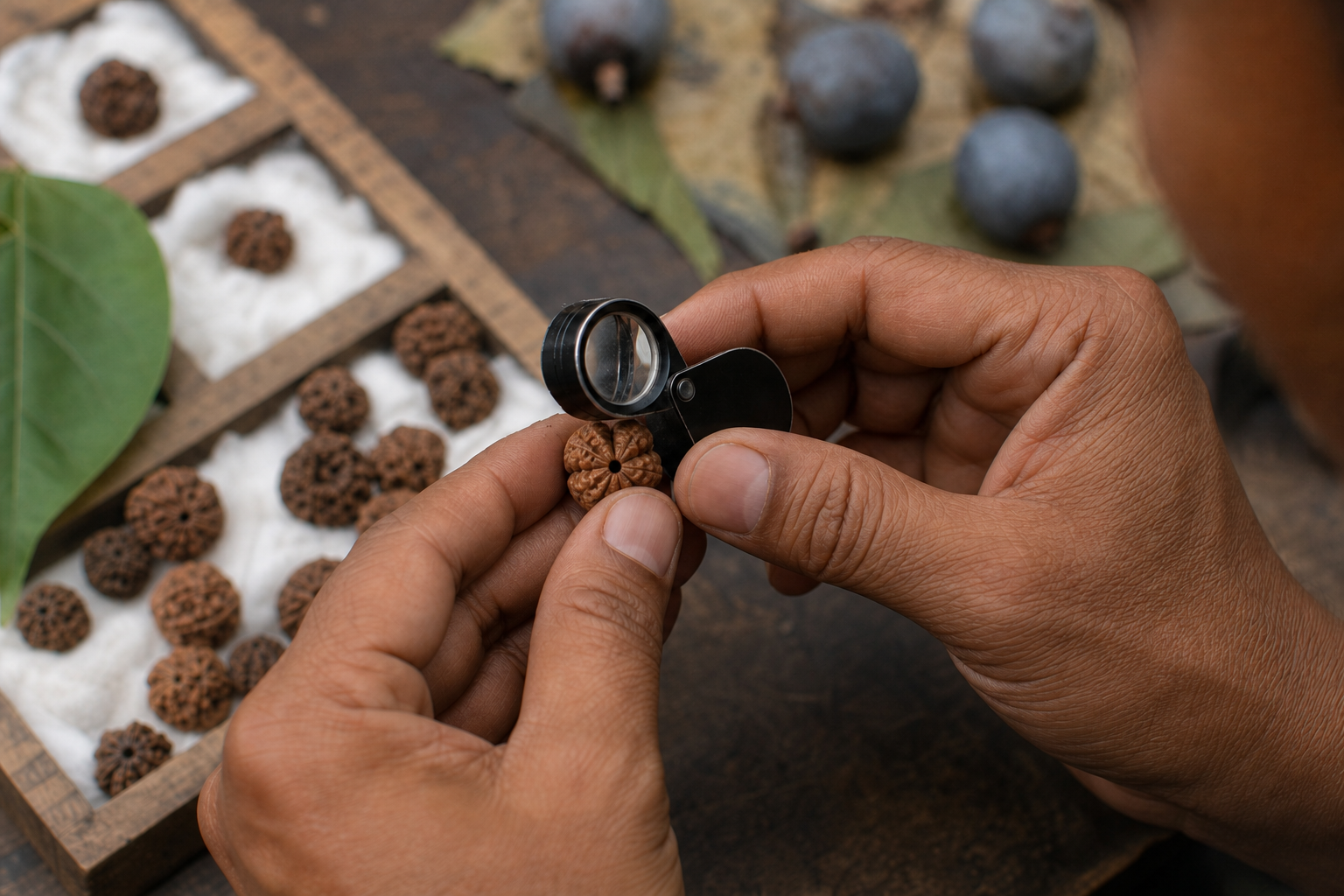
A Panchavaktra Rudraksha does not become spiritually superior because it is unusually large, expensive, or sold with dramatic promises. Authenticity matters; spectacle does not. Before paying a premium, inspect the bead itself and ask the seller direct questions about provenance and treatment.
Use this authenticity checklist
- Count five distinct clefts. Each mukhi line should be naturally formed and continue from one end of the seed to the other rather than stopping as a shallow scratch.
- Look closely for glue lines, joined sections, artificial carving, filled cracks, or faces that appear mechanically enhanced.
- Prefer transparent provenance. A responsible seller should be able to identify the region of origin and disclose whether the bead has been dyed or chemically treated.
- Use X-ray verification when unusually high cost or certainty makes it worthwhile. Imaging can confirm whether the internal segmentation agrees with the external faces.
- Do not rely on a floating test. A genuine bead can behave differently according to its density, drying state, and surface conditions, so floating or sinking is not a dependable verdict.
Nepal-origin beads are generally larger, more deeply textured, and marked by sharper mukhi lines. Javanese or Indonesian beads are usually smaller, smoother, and lighter. Both regional forms are used in sadhana. A natural Javanese bead is not a lesser spiritual object, and a large Nepalese bead does not compensate for irregular practice.
Let your purchase express dharma
Ask whether the fruits were harvested without harming the trees and whether local communities benefit from the trade. Avoid chemically altered beads and sellers who conceal origin behind mystical marketing. Responsible harvesting protects the living source of the seed; fair dealing protects the people whose work brings it to you. Ahimsa and satya should begin before the mala reaches your hand.
After purchase, keep the bead clean and dry. Avoid harsh chemicals and chemical polishes. If it needs conditioning, use only a drop of natural oil. Store it respectfully when it is not being worn or used for japa.
A simple way to begin Panchavaktra Rudraksha practice
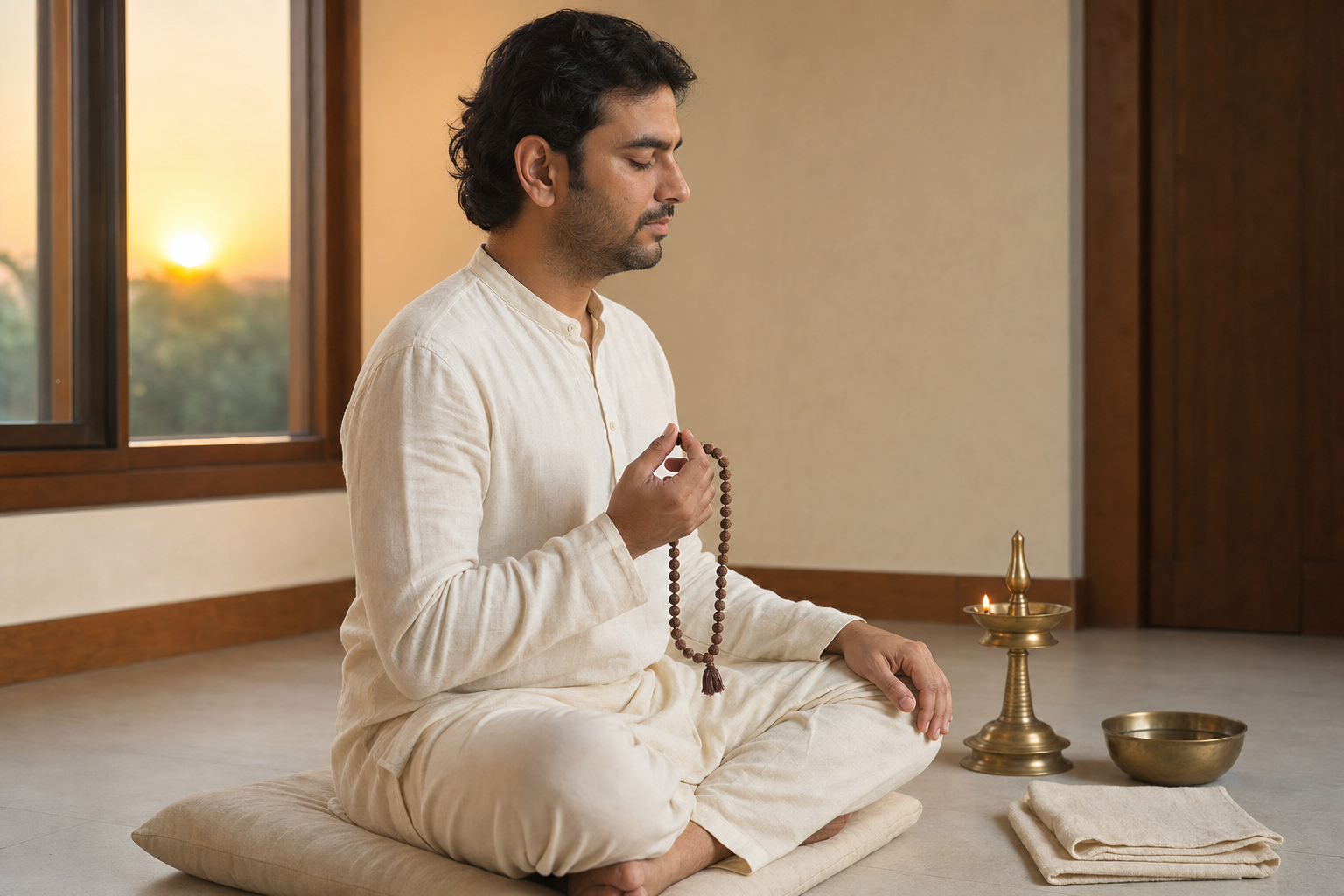
Household practice does not require you to imitate a temple consecration. Detailed rites of prana-pratishtha belong to particular lineages and should be learned within those lineages. For an unaffiliated or household practitioner, careful cleaning, a sincere sankalpa, and mantra recitation provide a sound beginning.
Prepare the bead for first use
- Inspect all five mukhi lines in good light before using the bead.
- Rinse it gently in clean water. Some traditions optionally use a mixture of milk and water, but an elaborate bathing sequence is not mandatory.
- Dry the seed thoroughly. Do not leave moisture sitting in its natural grooves.
- If the surface is very dry, apply one small drop of natural oil rather than soaking or coating it.
- Place the bead before you or hold it respectfully, then state a plain sankalpa. You might resolve to undertake daily japa for steadier remembrance, clearer conduct, and devotion to Shiva.
- Select one mantra. Om Namah Shivaya is the most accessible Shaiva choice; Om Hreem Namah is another mantra commonly associated with the five-faced Rudraksha.
- Recite the chosen mantra with attention. This completes a sufficient first-use observance for ordinary household sadhana unless your sampradaya gives different instructions.
Build a routine that survives ordinary days
Rudraksha malas commonly contain 27, 54, or 108 beads, often with an additional meru bead. Choose the count you can maintain without rushing. If 108 repetitions turn your practice into an occasional project, begin with 27 and complete them carefully. A smaller daily commitment does more for attention than a large count repeatedly postponed.
- Sit at a quiet, repeatable time in a posture you can keep stable without strain.
- Let your breathing settle naturally before beginning. Do not force inhalation, exhalation, or breath retention.
- Recite your chosen mantra once for each bead. Move at an even pace instead of speeding up to finish the count.
- If you coordinate mantra and breath, fit the words gently into the natural rhythm of breathing. The breath serves attention; it is not a test of endurance.
- Complete one deliberate round, then pause long enough to notice the condition of your mind before returning to the day.
- Keep the same mantra and count long enough for the routine to become familiar. Constantly changing the method makes it harder to see whether your attention and conduct are actually becoming steadier.
The bead supports japa through touch, while the mantra gives attention a stable sound and the breath gives practice an embodied rhythm. None of those elements needs to be dramatic. The relevant measure is whether you become less scattered during practice and less reactive outside it.
Review the routine after several weeks, not after a single sitting. Changes practitioners commonly notice include steadier focus, clearer self-observation, and less reactivity. Treat these as possible fruits of repeated mantra, posture, breath awareness, and ethical effort, not as guaranteed effects emitted by the seed.
How to judge spiritual, astrological, and healing claims
Traditional reverence does not require credulity. Panchavaktra Rudraksha is an aid to remembrance and purification, not a contract promising wealth, status, a particular relationship, or the removal of every difficulty. Be cautious when a seller attaches guaranteed material outcomes to the bead or claims that a higher price produces stronger grace.
Astrology-oriented traditions often associate the five-faced Rudraksha with Guru, also called Brihaspati or Jupiter. The connection emphasizes wisdom, ethical judgment, learning, and the ability to take a longer view. It can be used as a framework for self-examination: Are your decisions becoming more truthful, patient, and discerning? It should not be turned into a deterministic promise that wearing one object will automatically change your destiny.
Claims about chakras or subtle energy are likewise most useful when they direct you back to observation. Notice your posture, breath, agitation, concentration, and behavior. Do not convert symbolic language into a medical diagnosis. A Rudraksha is not a substitute for medical or psychological care, and a health concern should be taken to an appropriately qualified professional.
There is no universal prohibition limiting this bead by caste, gender, or age. Family customs and sampradaya disciplines can differ, so follow the commitments of your own lineage where applicable. For a sincere practitioner, the more meaningful tests of readiness are bhava, or intention; ahimsa, or non-harm; and satya, or truthfulness.
The practice can also help you recognize a shared Dharmic insight without erasing important differences. Hindu japa, Buddhist and Jain uses of meditation malas, and the Sikh emphasis on naam or simran all affirm the formative power of disciplined remembrance. Their theologies and disciplines are not interchangeable. The point of connection is more modest and more useful: repeated sacred sound, ethical restraint, and compassion can train human attention away from heedlessness.
For a Shaiva practitioner, Panchavaktra Rudraksha remains specifically rooted in remembrance of Rudra-Shiva. Respect for parallel disciplines should deepen that commitment rather than turning every Dharmic practice into the same practice under different names.
Key takeaways for your practice
- Panchavaktra or Panchamukhi refers to five natural faces; Kalagni names the purifying aspect of Rudra associated with the bead.
- Check for five continuous, naturally formed clefts and reject glued, carved, dyed, or chemically altered examples.
- Do not use floating as an authenticity test. Inspect morphology and provenance, and use X-ray verification when stronger assurance is justified.
- Nepalese and Javanese beads differ in appearance, but either can support sincere sadhana when naturally formed and responsibly sourced.
- For household use, clean and dry the bead, make a sankalpa, and begin with Om Namah Shivaya or Om Hreem Namah.
- Choose 27, 54, or 108 repetitions according to what you can sustain with an even pace and unforced breathing.
- Judge the practice by steadier attention, less reactivity, and better conduct, not by price, spectacle, or guaranteed material results.
Your next step can be small and exact. Inspect the bead, choose one mantra, set a repeatable count, and complete the first round without hurry. Then return tomorrow. Let the meaning of Kalagni become visible not in claims made about the bead, but in the distractions you stop feeding and the clarity you carry into action.
References
