
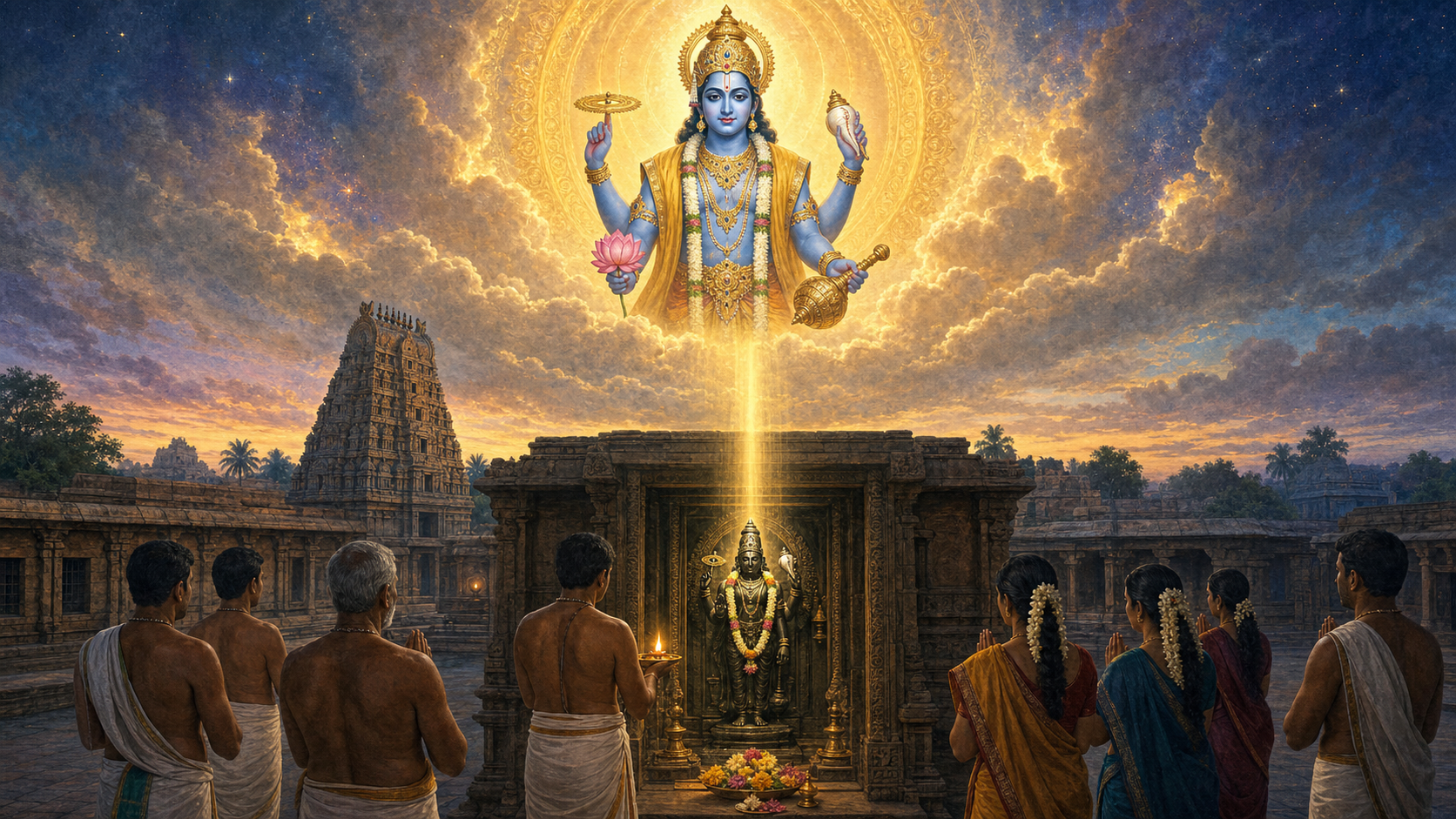
You may accept that Vishnu descends and still hesitate before the practical question: when you read about Kapila or stand before an Ugra Narasimha murti, what exactly are you encountering? Is it a past event, a sacred symbol, the presence of Bhagavan, or a form intended to change how you live?
The Vaishnava answer is clearest when these possibilities are distinguished without being separated. Avatara is purposeful divine descent. Lila reveals what that descent accomplishes. Murti makes worship possible through embodied acts of seeing, hearing, offering, remembering, and serving. Sacred presence becomes spiritually fruitful when you answer those gifts with clearer understanding and disciplined action.
First separate divine descent from the form that receives worship
The Sanskrit word avatara conveys descent. In Vaishnava theology, this does not mean that the Supreme becomes an ordinary embodied being compelled by karma. Bhagavan appears by divine purpose while remaining Bhagavan. The descent makes transcendent reality accessible without reducing that reality to the material conditions familiar to us.
This is why the Bhagavad Gita treats the Lord’s appearance and activity as divya, divine, and why understanding them in truth is spiritually liberating. The important word is understanding. Recognising a name in a list of avataras is not the same as grasping why the Lord appears, what disorder the appearance addresses, and what response the lila asks from you.
A murti belongs to the same devotional world, but it should not be confused with a newly occurring biographical descent. Many Vaishnava traditions use the language of arca, the worshipable manifestation through which the Lord accepts service and grants access to devotees. Precise metaphysical formulations vary among sampradayas, yet the practical point is stable: a temple murti is approached relationally, through darshan, offering, mantra, reverence, and seva. It is not treated as a decorative sculpture onto which a visitor may project any private meaning.
Calling the murti symbolic does not settle the question. Sacred symbols can communicate real theological meaning, and a form can be symbolically intelligible without being only a symbol. The word only causes the problem. It turns a relationship of worship into an exercise in interpretation and leaves the devotee as a spectator.
- Avatara identifies the Lord’s purposeful descent or appearance.
- Lila discloses the acts, relationships, and mission of that appearance.
- Murti or arca identifies the form approached through established worship.
- Darshan and seva identify your response: attentive seeing joined to service.
You therefore do not have to choose between event and meaning, or between form and presence. A traditional Vaishnava reading allows a divine appearance to be real, revelatory, and perpetually instructive. It likewise allows iconography to carry meaning while the murti remains more than an object for aesthetic analysis.
Read each avatar by the work the form performs
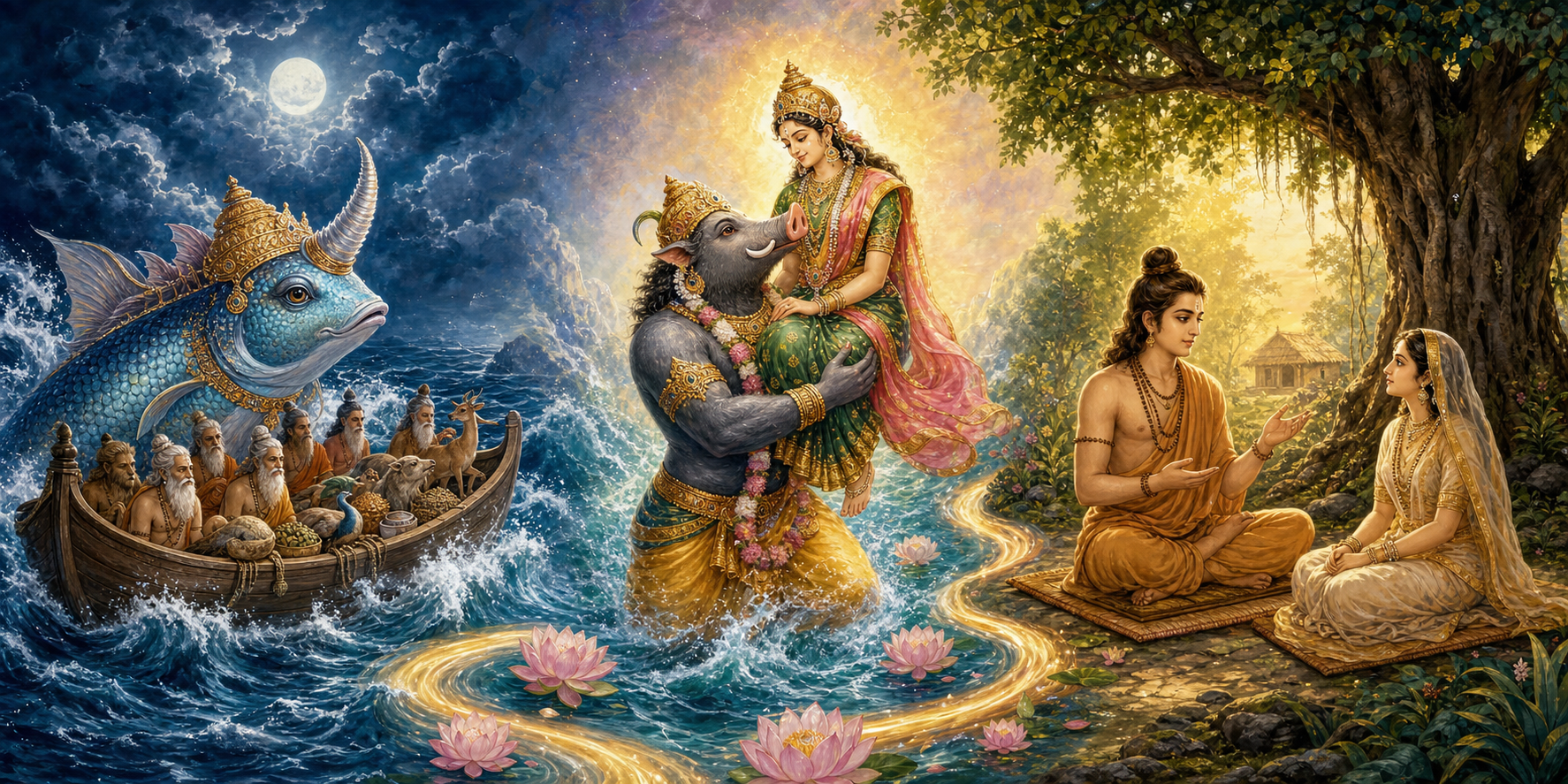
The fastest way to misunderstand an avatara is to concentrate on supernatural appearance while overlooking purpose. Ask three questions instead: What disorder is being answered? Who is being protected or instructed? What form of grace does the situation require?
Kapila answers confusion through teaching. In the Srimad-Bhagavatam, his descent into the household of Kardama and Devahuti prepares the way for a theistic Sankhya that analyses embodied existence so the seeker can recover a right relationship with the Supreme. Mahat-tattva, ahankara, mind, senses, subtle elements, and gross elements are not catalogued to make the reader proud of a complicated system. They help the practitioner stop confusing the machinery of prakriti with the conscious self.
This matters whenever you encounter the word Sankhya. Do not assume that every system bearing that name has the same theology or destination. Some classical lines tend toward non-theistic dualism. The Bhagavata’s Kapila is Ishvara teaching an analysis whose culmination is bhakti-yoga. Knowledge does not replace devotion; it removes the confusions that obstruct devotion. If your study ends in intellectual self-importance, you have stopped before Kapila’s intended destination.
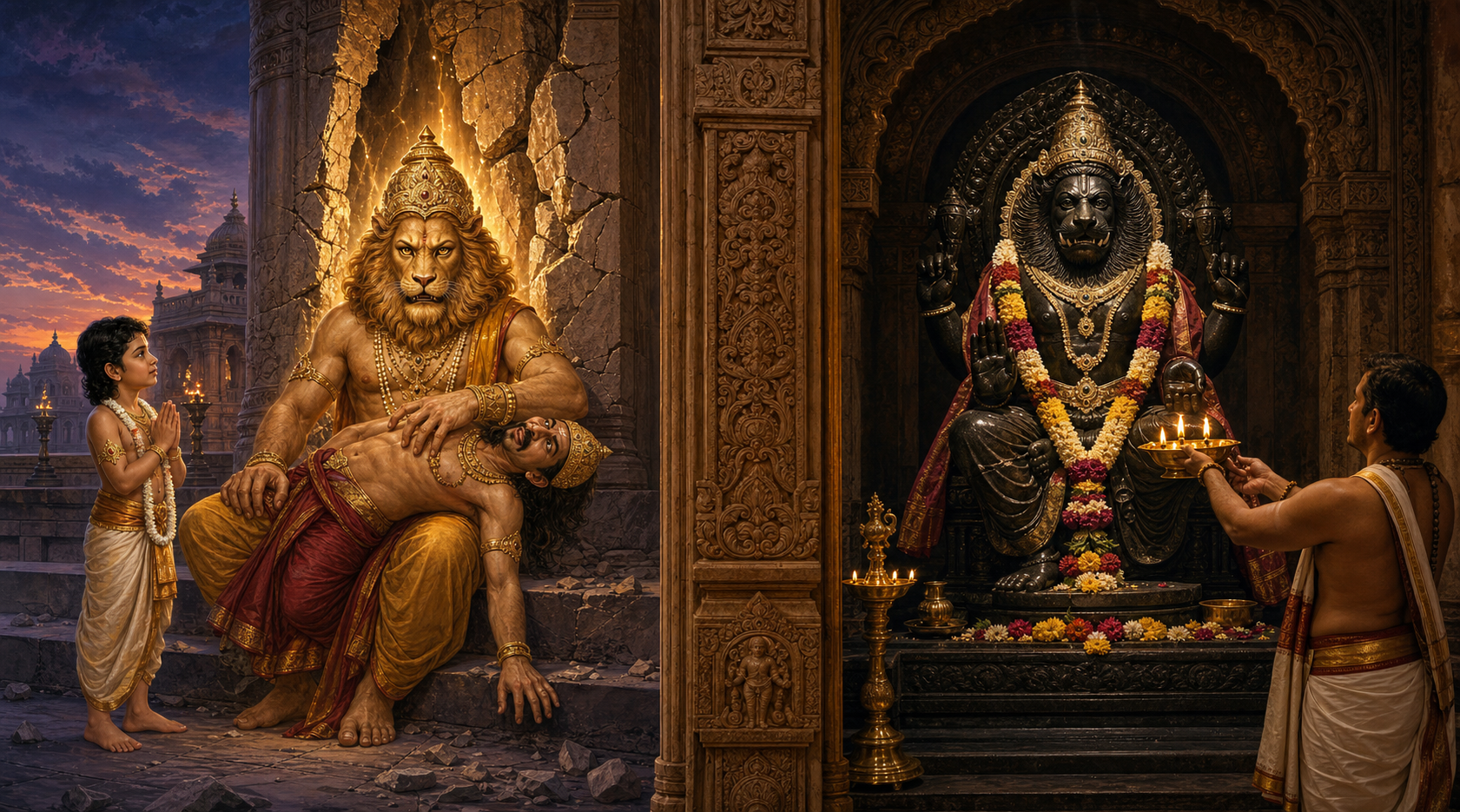
Narasimha answers a different disorder. Here grace assumes the form of protection. The human-lion appearance, emergence from the pillar, intense gaze, multiple arms, weapons, and defeat of Hiranyakashipu make one truth unmistakable: temporal power cannot make adharma inviolable. The Lord’s ferocity is directed, morally bounded, and ordered toward the protection of Prahlada and the restoration of dharma.
At Maddur, Ugra Narasimha fixes attention on the climactic protective act. The icon’s leonine face, forceful posture, multiple arms, and martial attributes create controlled visual intensity. South Indian forms such as Ugra Narasimha, Yoga Narasimha, and Lakshmi-Narasimha do not present competing deities. Changes in posture, expression, companions, and attributes reveal different dimensions of the same divine agency: intervention, composure, guardianship, and grace.
This distinction gives you an ethical test. Ugra does not mean uncontrolled. Narasimha cannot be recruited to sanctify personal rage, cruelty, or hatred toward a convenient enemy. Divine wrath protects the vulnerable and stops tyranny; it is not self-indulgent, and it does not continue merely because anger enjoys its own momentum. If anger seeks humiliation after protection has been secured, it no longer resembles the theological logic of the form.
Kapila and Narasimha therefore reveal two forms of divine intervention. One cuts through misidentification by discriminating knowledge. The other cuts through oppressive power by protective force. One teaches you to see the components of bondage accurately. The other teaches you that courage must be governed by dharma. Both redirect the devotee from ego toward refuge in Bhagavan.
Sacred presence does not erase different kinds of truth
A temple can hold scriptural memory, Agamic form, regional history, oral tradition, and present worship at once. Trouble begins when every claim is forced into the same category. Respect does not require you to call an oral legend a passage from a critical text, just as historical caution does not require you to dismiss the spiritual meaning a community has carried through a place.
| Kind of claim | Question it answers | How to handle it responsibly |
|---|---|---|
| Scriptural avatara narrative | Why does the Lord appear, and what does the appearance reveal? | Read the episode in its theological and narrative setting rather than extracting a dramatic image alone. |
| Agamic and iconographic form | Why does the murti have this posture, expression, gesture, or attribute? | Interpret the details through the relevant worship tradition and its established visual grammar. |
| Sthala-katha or local sacred memory | How has a community connected an epic virtue or divine act to this place? | Receive it as a place tradition unless textual or historical corroboration is specifically available. |
| Historical claim | When was a structure built, altered, or patronised? | Look for inscriptions, architectural evidence, and corroborated records; ritual continuity alone cannot establish a precise date. |
The Maddur tradition illustrates the value of this discipline. Local memory connects Arjuna with worship of Ugra Narasimha and with the cultivation of fearless, dharma-governed resolve. That precise Maddur episode is not located in the critical edition of the Mahabharata. You can honour its work as sthala-katha without presenting it as a critically attested Mahabharata passage. The distinction protects both devotion and historical integrity.
The same care is needed when speaking across the dharmic family. Buddhist analysis of aggregates can resemble Sankhya’s disciplined examination of experience, but the metaphysical conclusions are not automatically identical. Jain tattva teachings also analyse bondage and liberation, while Sikh naam-simran and seva resonate with Vaishnava remembrance and service. The lion’s fearless force can recall the Buddhist simha-nada and the Sikh sant-sipahi ideal, yet Narasimha remains a specifically Vaishnava revelation of Vishnu’s protective descent.
Use those parallels to begin a serious conversation, not to erase differences. A good inter-dharmic exchange names both the shared discipline and the distinct claim. You might say that several traditions unite spiritual clarity with ethical courage, then explain that Vaishnava theology grounds Narasimha’s courage in Bhagavan’s vow to protect the devotee. Unity becomes more credible when it does not require vagueness.
Turn darshan and study into a disciplined response
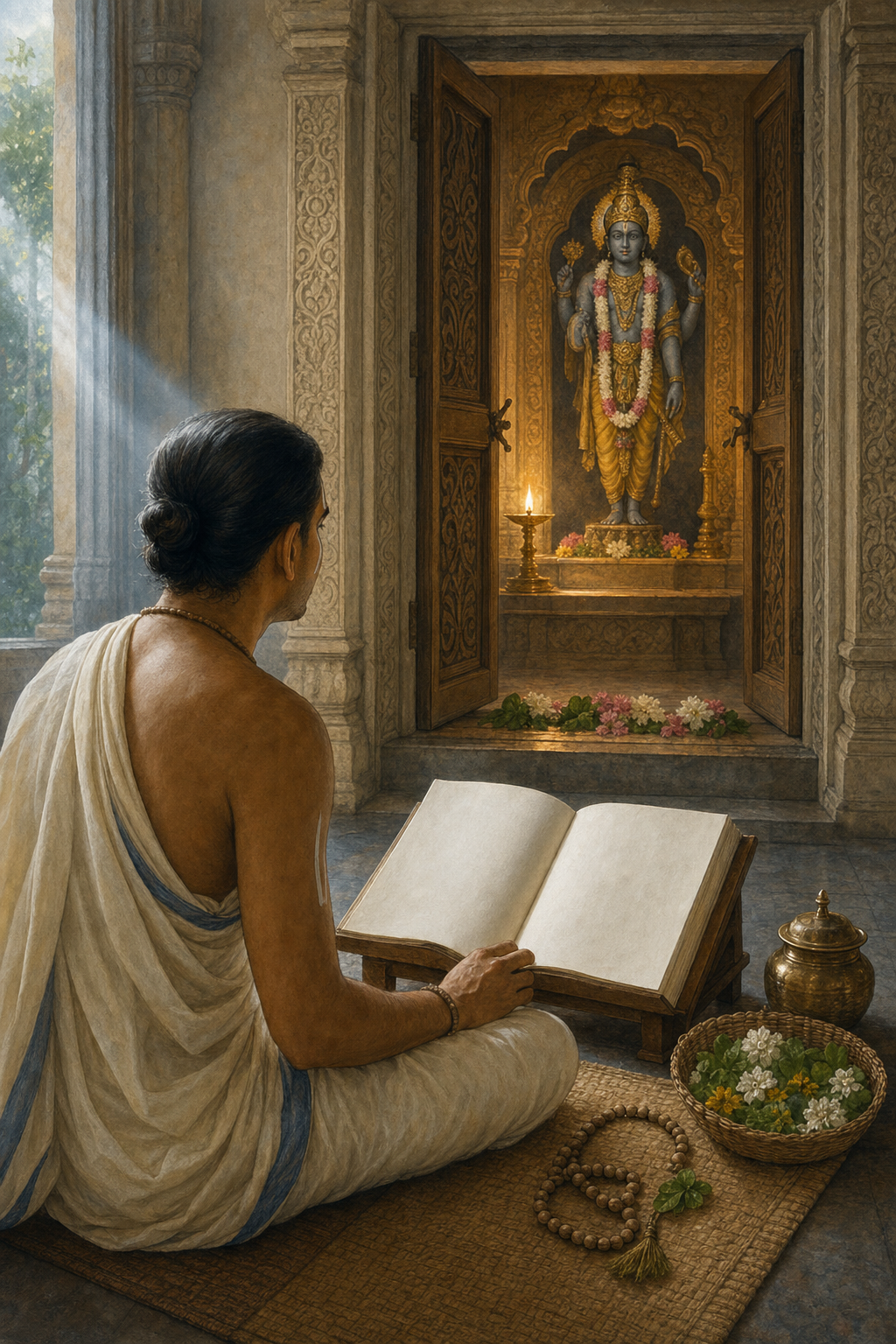
Sacred presence is not measured by how overwhelmed you feel. A fierce murti may awaken fear and consolation together. A philosophical avatara may initially engage your intellect more than your emotions. Neither intensity nor quietness, by itself, tells you whether the encounter has borne fruit.
Brahma offers a more reliable pattern before Kapila’s descent: worship precedes speech. His senses are gladdened and his heart purified before he gives guidance. The sequence is practical. First orient the senses toward Bhagavan. Then seek understanding. Let understanding govern what you say and do. Devotion here is not an alternative to reason; it prepares the conditions in which reason is less likely to serve vanity.
You can apply that sequence to scriptural reading, home worship, or temple darshan:
- Name the encounter. Be specific about whether you are reading an avatara-lila, studying a philosophical teaching, or approaching a murti for darshan. This prevents several distinct modes of presence from dissolving into vague religious feeling.
- Prepare the senses. Pause before analysis. Offer pranama, recite or hear the relevant name, and give the form or passage undivided attention. At a temple, modest dress, quiet within the shrine, and patience during archana help turn seeing into reverent reception.
- Identify the divine purpose. Ask what ignorance, danger, or disorder is being answered. With Kapila, watch how analysis separates consciousness from prakriti and leads toward devotion. With Narasimha, watch how force is constrained by the purpose of protection.
- Receive one correction. Do not leave with ten abstract themes. Name one concrete distortion the encounter exposes in you: identification with status, delight in argument, fear of necessary action, uncontrolled anger, neglect of duty, or passive acceptance of injustice.
- Complete the encounter through seva. Translate the correction into one fitting act. Study with greater humility, fulfil a neglected household responsibility, protect someone without indulging hostility, restrain harmful speech, or offer time and resources in service.
For a focused study of Kapila, read Srimad-Bhagavatam 3.24-3.33 alongside Bhagavad Gita Chapter 4. Track two movements. First, observe how divine descent is linked to purposeful activity and transmission of knowledge. Then notice how the analysis of matter, mind, ego, and self is brought toward remembrance and bhakti rather than left as a detached metaphysical exercise.
For Narasimha, read the Prahlada narrative in the Seventh Canto before examining an Ugra murti. At the shrine, look in sequence: facial expression, posture, principal action, secondary hands, weapons or emblems, and the position of the protected devotee. The sequence keeps graphic intensity from becoming spectacle. Each feature should return you to the form’s governing purpose.
This practice does not belong only to a monastery. Kapila appears within a household, and that setting makes a direct claim on the householder: grace need not wait until family and professional responsibilities disappear. Attach remembrance to duties already present. Hearing, japa, kirtana, scriptural reflection, and service can reorient the senses within ordinary life rather than becoming excuses to escape it.
Review the fruit after the encounter. Kapila’s teaching should make it harder to mistake ego and mental movement for the whole self. Narasimha’s form should make courage more protective and less vindictive. Darshan should deepen responsibility, not merely add an intense memory to your day. When understanding, restraint, and service grow together, sacred presence has entered practice.
Key takeaways: five tests for a sound Vaishnava reading
- The descent test: if an explanation makes the avatara an ordinary being trapped by karma, it has lost the Vaishnava meaning of divine descent.
- The purpose test: if a dramatic form is discussed without asking whom it teaches or protects, spectacle has displaced theology.
- The presence test: if the murti is reduced to an art object or private metaphor, darshan and seva have been removed from the encounter.
- The fruit test: if Kapila produces pride or Narasimha licenses hatred, the response contradicts the work those forms perform.
- The evidence test: if scripture, Agama, local legend, and historical dating are treated as interchangeable claims, both scholarship and devotion become less trustworthy.
- The dharmic dialogue test: if shared values can be named only by suppressing real metaphysical differences, the claimed unity is too thin to sustain an honest conversation.
At your next reading or darshan, choose one form and ask what work Bhagavan is performing through it. Receive one correction, then answer it with one act of seva. That small movement from seeing to service is where avatar theology stops being an idea and begins to order a life.
References
- DharmaRenaissance Blog – Brahma’s Joy, Kapila’s Descent: A Powerful, Unifying Study of Srimad-Bhagavatam 3.24.11
- DharmaRenaissance Blog – Ugra Narasimha of Maddur: Fierce Divinity, Temple History and Arjuna’s Living Legend
