
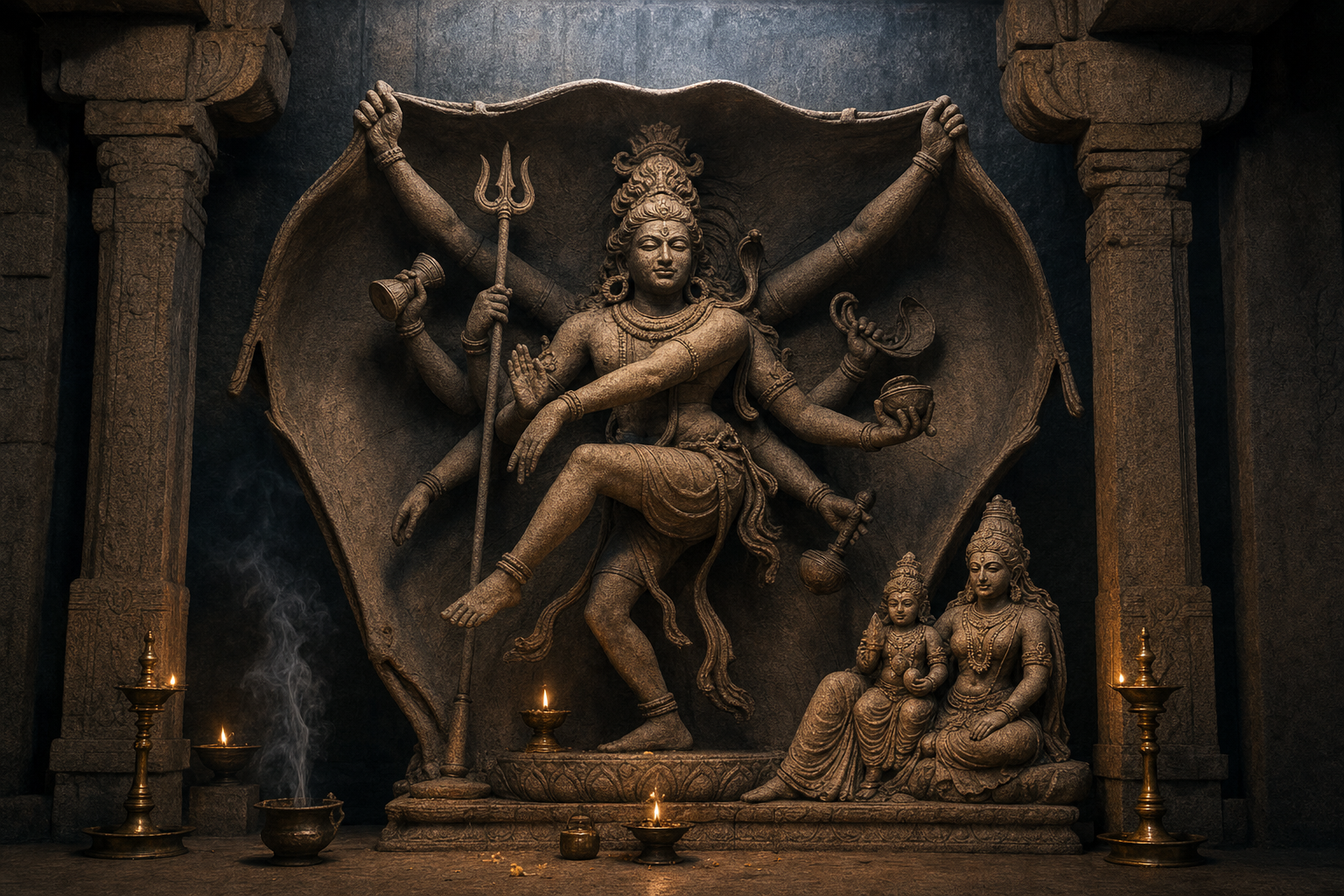
You recognize Shiva, but the image still stops you. The pose is violent, the limbs seem to fly in several directions, and an enormous elephant hide rises behind the dancing figure. Is this a victory scene, a warning about ego, or a map of liberation?
It is all three, but only if you read the parts together. Gajasurasamhara is not a collection of unrelated symbols and not a celebration of destruction for its own sake. Its visual grammar moves from hardened self-importance to exposure, from exposure to transformation, and from transformation to freedom. Once you learn that movement, even a crowded temple relief becomes legible.
Key takeaways when you stand before the murti
- Begin with the elephant hide. Shiva stretching the flayed hide around or above his dancing body is the clearest identifier of Gajasurasamhara. Weapons and attendants can vary.
- Read the elephant symbol within this episode. Gajasura represents hardened ego, ignorance, inertia, and intoxication with power. The image is not a judgement against elephants or their wider sacred associations.
- Follow the sequence, not just the killing. The obstruction is confronted, opened, and finally worn as a mantle. What bound consciousness is not merely discarded; its energy is mastered and redirected.
- Do not mistake fierceness for malice. The dominant visual mood is raudra, or the fierce rasa, but its spiritual destination is karuna and anugraha: compassion and liberating grace.
- Let the image test your conduct. The useful question is not whether other people are arrogant. Ask where your own knowledge, discipline, status, or ritual practice has become resistant to correction.
Start with the silhouette, then identify the attributes
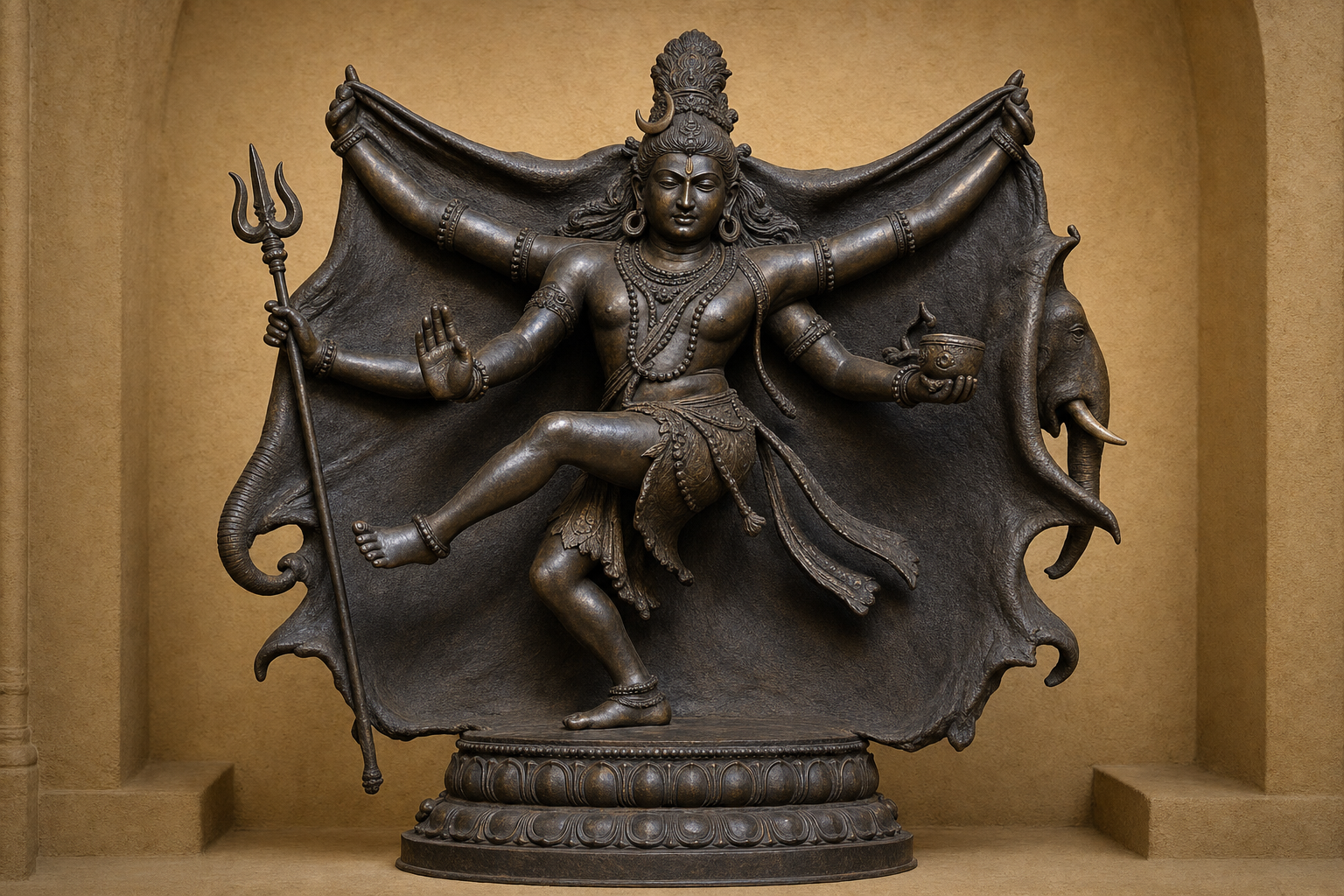
The fastest way to recognize this form is to ignore the smaller objects at first. Look for a dancing Shiva framed by an elephant hide held open in two hands. The hide may rise like a canopy, spread like a rough aureole, or create a broad arc around the body. This enclosing silhouette distinguishes the scene more reliably than any single weapon.
Next, look for movement. Shiva’s torso may twist, the legs may cross or extend forcefully, and the matted locks may flare outward. One foot can bear upon the elephant’s head or fallen body. Multiple arms enlarge the sweep of the dance, while the elephant skin makes the entire composition feel as though an obstruction has been torn open. The form is therefore often called an elephant-demon destruction dance, or Samhara Tandava.
Only after finding that main structure should you inspect the hands. Depending on the sculptural or bronze tradition, Shiva may carry the trishula, damaru, agni, parasu, or mriga. You may also see serpents, a tiger-skin garment, a radiant third eye, ganas, or Parvati. A missing implement does not by itself rule out the identification. Temple panels and Chola bronzes preserve meaningful variations while retaining the central action of the hide and dance.
| What you see | What it contributes | What to notice in yourself |
|---|---|---|
| Elephant hide stretched open | The dense covering of ignorance has been exposed and mastered | What belief or defensive habit has become too thick to question? |
| Damaru | The pulse of manifestation, sound, and renewed creation | What truthful beginning becomes possible after the obstruction falls? |
| Agni | Purification and dissolution | What must end rather than be endlessly managed? |
| Trishula | Mastery of triads such as the three gunas, the three times, and the three ordinary states of consciousness | Which passing condition are you treating as your permanent identity? |
| Mriga, or deer | The quick, unsettled mind brought under compassionate control | Where does attention leap before understanding can arise? |
| Serpents and tiger skin | Instinctive forces and vital energy brought into disciplined relationship | Are you governing your drives, suppressing them, or being governed by them? |
| Fallen elephant-demon | The loss of ego’s claim to rule consciousness | Which stubborn pattern has been allowed to make your decisions? |
This is a reading sequence, not a rigid codebook. An attribute gains meaning from its relation to the whole composition. The damaru beside agni, for example, says more than either object alone: dissolution and creation belong to one movement. The old formation is cleared so that a more lucid one can arise.
The formal complexity is intentional. Agamic and sculptural canons, including the Kamikagama, Suprabhedagama, and Shilparatna, inform the murti’s proportions, gestures, and kinetic balance. In the stone reliefs and bronze traditions of Tamil Nadu, including works associated with the Kumbakonam region and the Airavatesvara Temple at Darasuram, motion itself becomes a form of instruction. You are meant to encounter a force that cannot be reduced to a calm, static diagram.
The Darukavana story turns ritual pride inside out
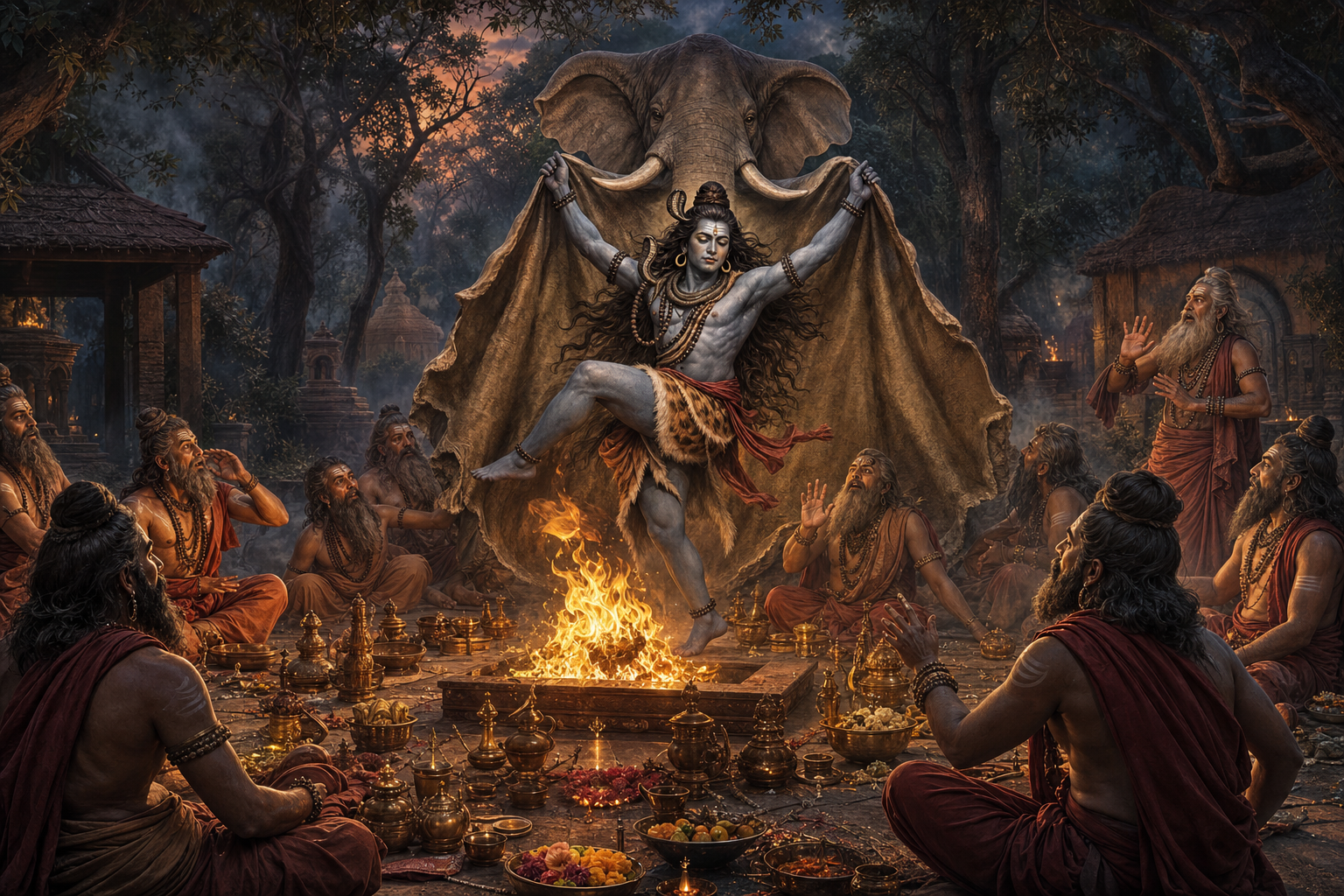
In the Darukavana narrative, ascetics had become confident that their ritual and austerity gave them mastery. Shiva appeared as a wandering presence who unsettled that confidence. The ascetics directed powers against him in the forms of a tiger, a serpent, a dwarf, and finally a ferocious elephant-demon. Shiva subdued each force, opened the elephant, and danced while holding its hide.
The story does not dismiss tapas, learning, mantra, or ritual discipline. Its target is the confusion of means with ends. A practice intended to loosen bondage can become another possession: my learning, my purity, my authority, my entitlement to prevail. Darukavana then becomes more than a physical forest. It is the bewildering interior terrain created when spiritual competence loses contact with jnana, bhakti, humility, and surrender.
Read the narrative through four movements:
- Certainty hardens. Discipline and knowledge cease to be instruments of realization and become grounds for self-importance.
- Resistance takes form. Whatever threatens that self-image is treated as an enemy. The elephant gives massive form to the resulting inertia, pride, and intoxication with power.
- The covering is opened. Shiva does not negotiate with the delusion or decorate it with spiritual language. The thick enclosure is torn apart so that it can no longer hide what lies beneath.
- The defeated force is integrated. The hide becomes Shiva’s mantle. Energy once organized around bondage is brought under awakened sovereignty.
This final movement prevents a shallow interpretation. If Shiva merely stood beside a dead adversary, the image could be reduced to conquest. Wearing the hide changes the meaning. The obstacle has been transformed into evidence of mastery and even a kind of shelter. The visual lesson is not that every difficult part of you must be hated or amputated. It is that no drive, talent, defence, or identity should be permitted to conceal truth and occupy the throne of the Self.
The elephant’s association with tamas also needs care. Tamas here means heaviness, inertia, obscuration, and resistance to illumination. It is not a claim that bodily stillness, sleep, or the animal itself is evil. The symbol becomes demonic when heaviness is joined to delusion and aggressive self-assertion. That distinction matters because otherwise contemplation turns into contempt for ordinary human limitation rather than insight into bondage.
You can use the same distinction when examining religious life. Repetition is not necessarily stagnation, authority is not necessarily arrogance, and inherited ritual is not necessarily empty. The test is practical: does the form make you more receptive to truth, more responsible in conduct, and less dependent on superiority? If correction feels like an attack on your very existence, the means may have begun to replace the end.
Why the terrible form culminates in grace
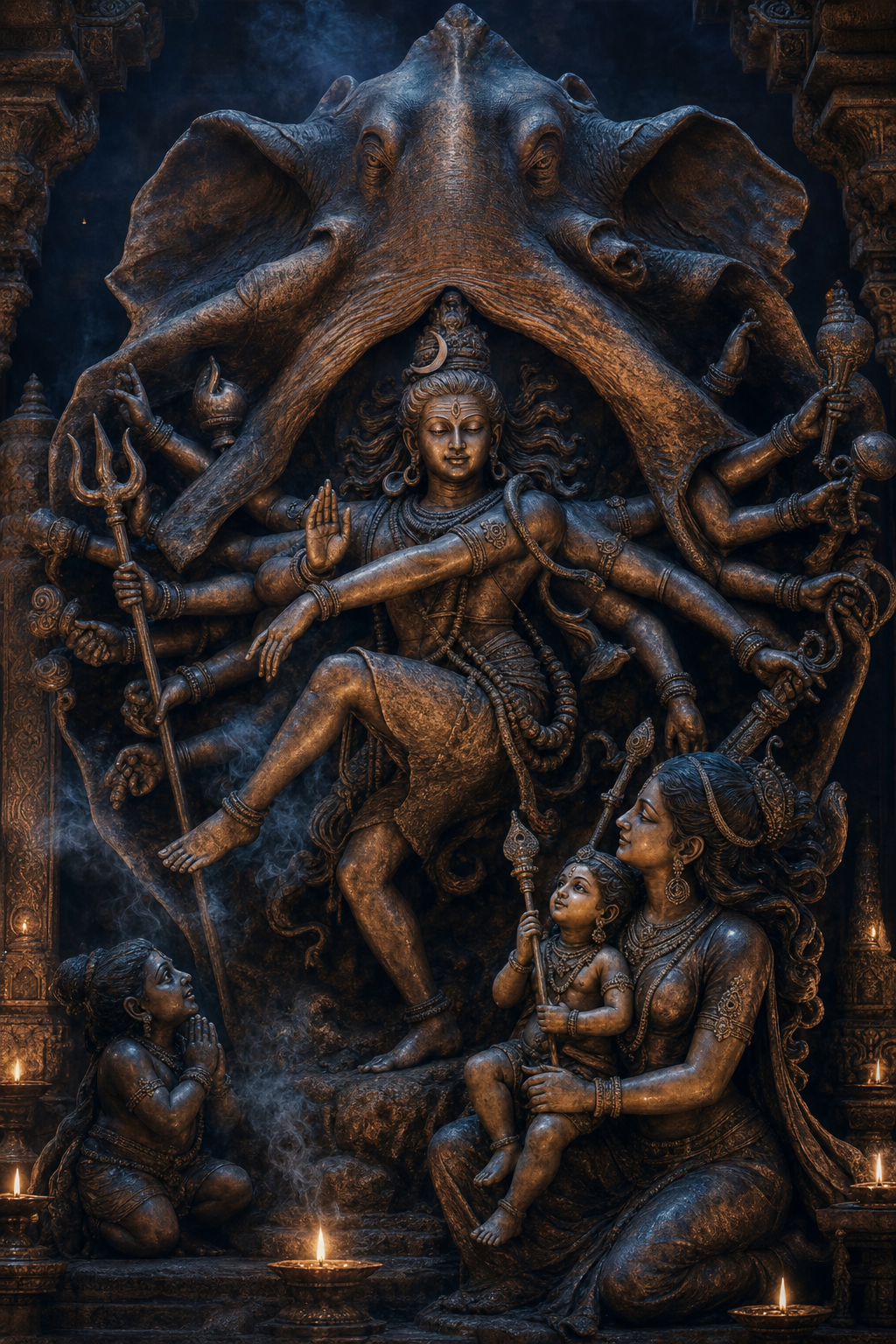
Gajasurasamhara is meant to look frightening. The flaring hair, stretched skin, forceful limbs, fire, weapons, and crushed adversary generate raudra, the fierce aesthetic mood. But stopping there misreads the direction of the dance. Shiva’s wrath is aimed at the bondage that hides freedom, not at life as such. The destruction is auspicious because the thing destroyed is an obstruction.
This is why the image can hold raudra and karuna together. Fierceness supplies the uncompromising clarity needed to break delusion. Compassion supplies the purpose. Anugraha, liberating grace, is not an unrelated reward added after the violence; it is the reason the obstruction is confronted at all. The murti asks you to distinguish anger that protects truth from anger that protects pride.
Parvati can make that distinction visible. In some compositions she appears startled yet reverent, reminding you that the terrible remains held within mangala, the auspicious. Ganas may gather around the action and enlarge its cosmic dimension. These secondary figures are not mere decoration. They help you see how different standpoints can coexist around the same event: delusion experiences terror, the devotee recognizes protection, and awakened vision perceives both dissolution and renewal.
The same logic appears in the principal attributes. The damaru signals spanda, the pulse through which sound and form arise. Agni dissolves and purifies. The trishula indicates sovereignty over the gunas, over past, present, and future, and over waking, dream, and deep sleep. The deer represents the mind’s restless movement, now held rather than allowed to bolt. Serpents and the tiger-skin garment signify mastery of vital and instinctive forces. None of these forces simply disappears. Each is placed in right relationship to consciousness.
This also clarifies the relationship between Gajasurasamhara and Nataraja. Nataraja’s Ananda Tandava foregrounds cosmic play and bliss. Gajasurasamhara foregrounds the removal of inner density. They are not rival accounts of Shiva. They show two sides of one spiritual truth: bliss is not sentimental pleasure pasted over bondage; it becomes available as the coverings of ignorance lose their hold.
A psychologically careless reading would translate the elephant into the entire personality and demand self-erasure. Shaiva symbolism is sharper than that. Ahankara is the construction that appropriates experience as mine and hardens it into self-importance. It is not healthy dignity, moral agency, or the ability to set a boundary. When you contemplate the flaying, direct its force toward false identification and obstinate pride, not toward your worth as a person.
Turn darshan into a disciplined act of self-inquiry
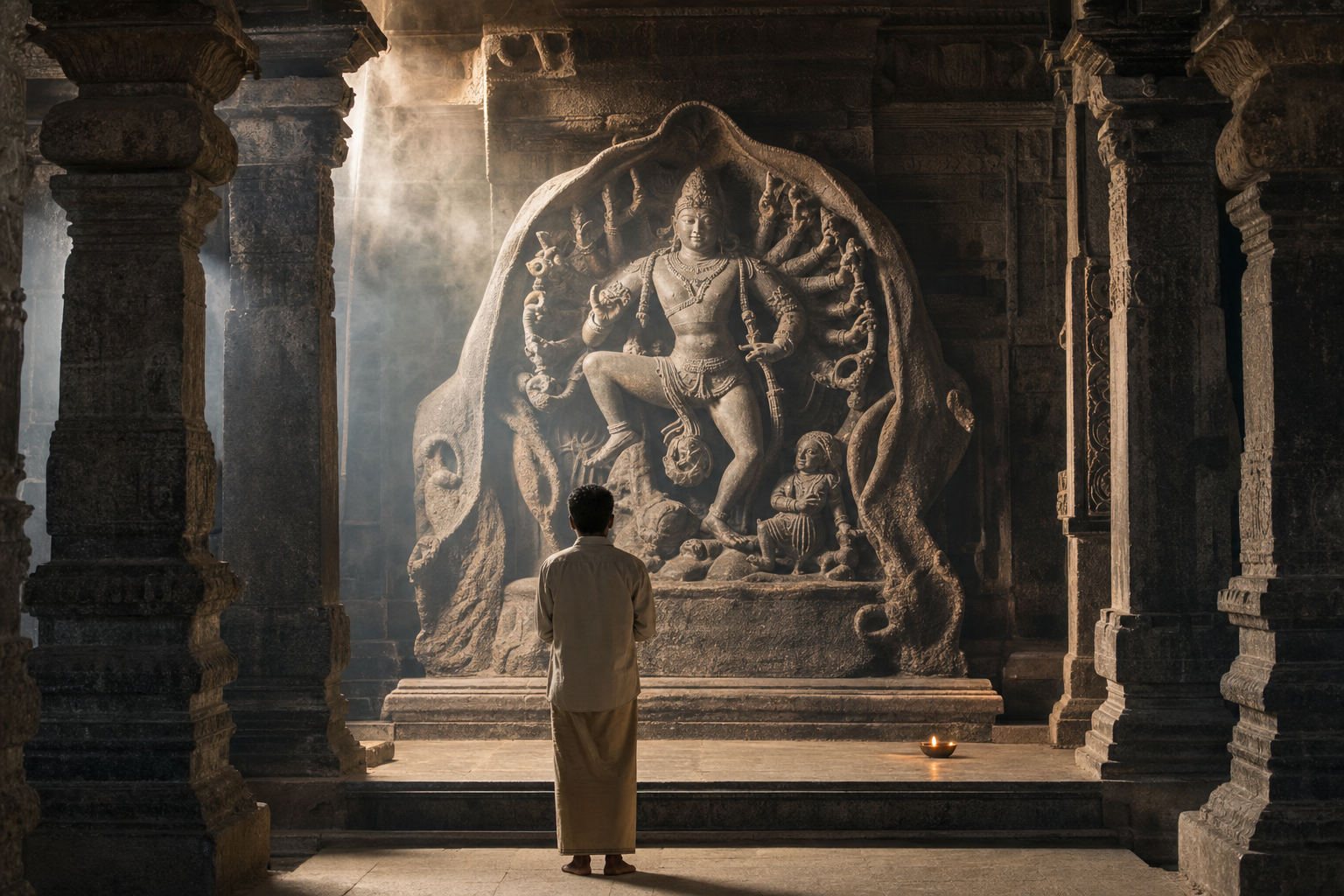
You do not need to invent an elaborate private ritual to work with this form. If you encounter it in a temple, honour the temple’s established practice and let darshan come first. If you contemplate a reproduction elsewhere, use the visual order of the murti to keep reflection concrete. The following sequence is a contemplative aid, not a replacement for lineage-specific worship.
- Look before naming. Take in the full silhouette: the body in motion, the spread hide, the relation between the lifted hands and the defeated elephant. Notice whether your first reaction is fear, fascination, resistance, or relief.
- Locate the covering. Ask what currently prevents you from seeing clearly. Name a specific pattern rather than an abstract defect: refusing advice because of who gave it, defending a decision after its failure is evident, using religious knowledge to silence a question, or postponing a duty because beginning would expose uncertainty.
- Find the force maintaining it. Is the pattern fed by tamasic inertia, rajasic agitation, fear of losing status, attachment to being right, or the mind’s deer-like movement from one justification to another? The purpose is accurate recognition, not self-accusation.
- Read dissolution beside renewal. Let agni represent what must end and the damaru represent what can begin. Pair the two in one sentence: I will stop defending this error, and I will reopen the decision; I will stop performing devotion for approval, and I will restore one sincere practice.
- Choose an embodied correction. Apologize without explaining away the harm, ask a knowledgeable person to challenge your conclusion, complete the avoided obligation, simplify an overgrown practice, or remain silent long enough to understand an opposing view. A symbol becomes sadhana when it changes conduct.
If mantra is already part of your practice, Om Namah Shivaya can accompany contemplation. You can also steady the breath while imagining the damaru’s pulse. Keep the purpose clear: not to manufacture a dramatic state, but to move from contraction and reactivity toward presence. The appropriate sign of progress is not that you feel fierce. It is that you become easier to correct and more capable of acting without the need to dominate.
Do not appoint another person as your Gajasura. The scene interiorizes the decisive struggle. It may illuminate collective pride or institutional rigidity, but its ethical force begins with the bondage you can actually examine. Fierceness directed inward at delusion should emerge outward as steadiness, humility, and protection of dignity, not as licence to humiliate an opponent.
The next time you meet this murti, begin with the hide and follow the dance toward its consequence. Then leave with one obstruction named and one corrective act chosen. That is how a formidable temple image stops being remote mythology and starts doing the work for which sacred iconography was made.
References
