
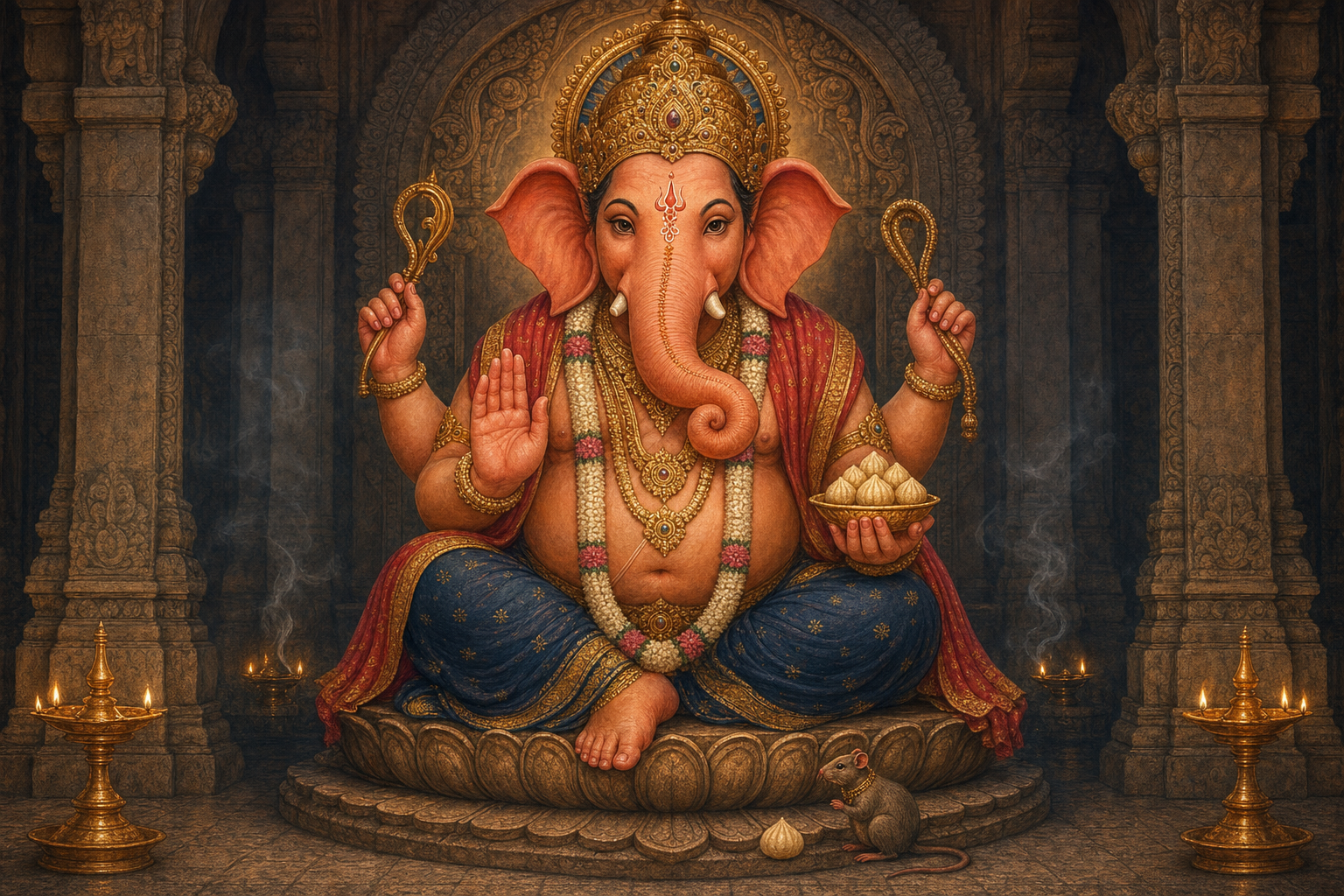
You notice the tiny mouse at Ganesha’s feet, then look again at the immense, elephant-headed deity above it. Why would the remover of obstacles choose such an improbable vehicle? The mismatch is deliberate. It tells you how to read the entire image.
Mooshika is not merely a charming companion added to Ganesha’s iconography. The mouse represents appetite, restless attention, acquisitive instinct, and capacity that has slipped free of discipline. Under Ganesha’s guidance, that same energy is restrained, redirected, and entrusted with sacred service. The point is not to destroy your difficult impulses. It is to make them carry something worthy.
The impossible vehicle is your first clue
A vahana is more than transportation. In Hindu iconography, the relationship between a deity and a vehicle can reveal which force the deity governs. The absurdity of a large Ganesha riding a small mouse therefore invites an ethical reading rather than a calculation of physical proportions.
A mouse moves through concealed spaces. It finds small openings, takes what has been stored, and keeps consuming unless something limits its reach. In the narratives surrounding Mooshika, the uncontrolled mouse damages grain, manuscripts, and implements used in sacred practice. These are not random targets. They represent sustenance, knowledge, and disciplined action: precisely the foundations that an ungoverned habit can quietly erode.
A traditional philological reading reinforces the symbolism. The Sanskrit word Mūṣika is connected with the root mūṣ, meaning to steal. Read inwardly, Mooshika resembles the part of the mind that steals attention in fragments. It takes a moment here, a resolution there, and a little integrity somewhere else. No single theft appears decisive, but the accumulated loss can redirect a life.
This gives you a sharper distinction than the familiar opposition between desire and renunciation. The question is not whether you have appetite, ambition, talent, or curiosity. The question is whether those forces receive direction from buddhi and Dharma, or whether they choose your direction for you. If Mooshika were simply evil, Ganesha would have no reason to retain him as a vahana. The continued presence of the mouse shows that instinct can be educated and power can be reassigned.
Krauncha’s fall explains why the mouse is not rejected
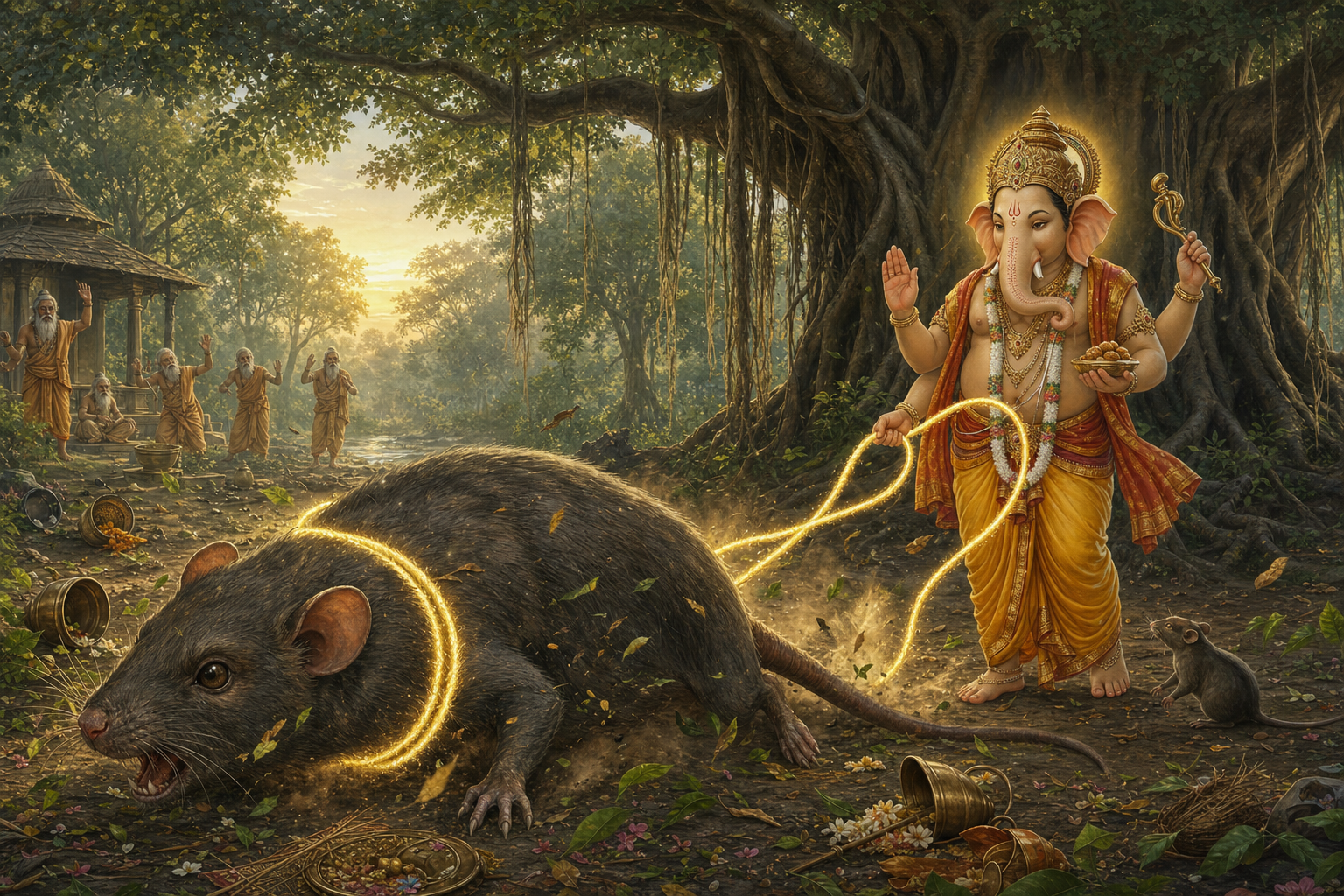
One widely told origin begins with Krauncha, a gifted gandharva. Gandharvas belong to the celestial world of music, rhythm, and refined aesthetic expression. Krauncha’s problem is therefore not a lack of ability. His ability is exceptional. The trouble begins when excellence hardens into self-importance.
Following an act of disrespect, Krauncha receives a rishi’s curse and becomes a mouse. Some versions identify the sage as Vāmadeva; details about the encounter and its location vary. As Mooshika, the former musician’s energy loses its harmonious form and becomes restless consumption. Accounts place his havoc in an āśrama or, in other tellings, in Pātāla. Ganesha finally checks him with the pasha, or noose, and the aṅkuśa, or guiding goad. Krauncha submits and enters Ganesha’s service as his vahana.
The narrative preserves an exact moral sequence: gift, pride, disorder, restraint, responsibility, and service. Ganesha does not dispose of Krauncha once the disruption ends. He gives the disruptive capacity a permanent duty. The mouse that once damaged the conditions of sacred life now carries the deity who protects right beginnings and removes obstacles.
You will also encounter versions in which the mouse begins as an asura rather than a gandharva. That difference need not be forced into a single supposedly definitive biography. Puranic and regional traditions often preserve several narrative origins for a stable sacred symbol. Here the common structure matters: a force that creates disorder meets wisdom, accepts limits, and becomes capable of seva.
This matters especially when your own difficulty grows out of a genuine strength. Intelligence can become impatience. Artistic confidence can become vanity. Efficiency can become control. Ambition can consume the relationships and duties that gave it a worthy purpose. Krauncha’s example does not ask you to pretend that the original gift was worthless. It asks you to separate capacity from entitlement and then place the capacity back in service.
How to read Mooshika in a murti or temple image
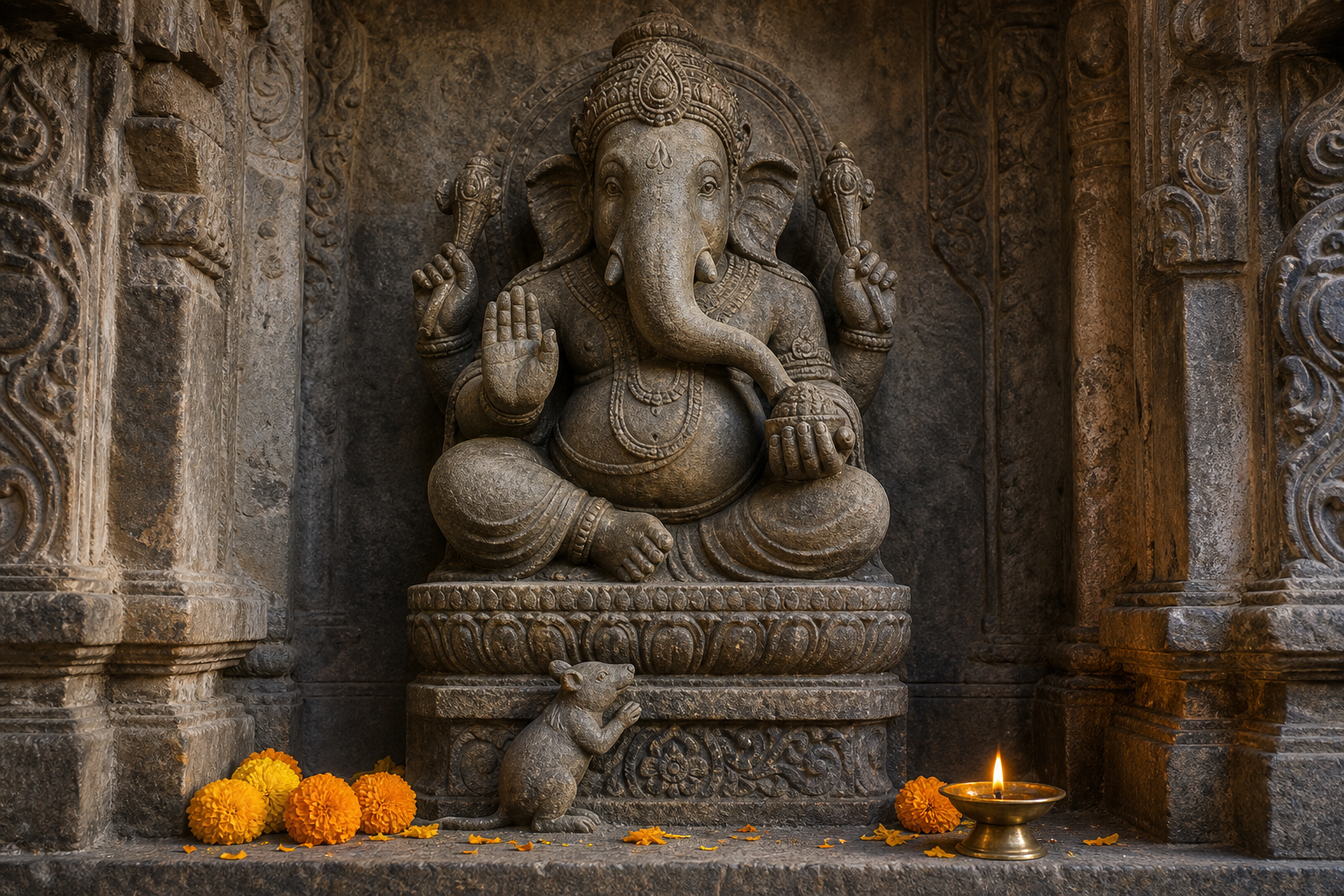
Not every representation of Ganesha includes every attribute in the same pose. When the familiar details are present, however, you can read them as a connected visual teaching rather than as unrelated decorations.
- Notice where the mouse sits. Mooshika commonly appears at Ganesha’s feet or beneath him. The placement communicates relationship: the instinct has not disappeared, but it no longer occupies the seat of authority. Ask which recurring impulse you have allowed to make decisions above its proper station.
- Follow the mouse’s gaze. Mooshika is often shown looking toward a modaka or a bowl of offerings. Desire remains visible. The image does not deny that sweetness attracts the mind; it places desire in the presence of wisdom. Ask whether you can see what you want without immediately becoming obedient to the wanting.
- Read the pasha as a boundary. A noose gathers and limits what is wandering. In personal practice, its counterpart is a clear restraint: removing access to a distraction, declining an unnecessary acquisition, or refusing the next action in a familiar cycle. A vague wish to exercise self-control is not a pasha. A boundary you can actually observe is.
- Read the aṅkuśa as direction. Restraint alone leaves energy idle. The goad supplies a course. Once you close the path of distraction, open the work, prayer, study, duty, or act of service that should receive the recovered attention. The two instruments belong together: one limits the wrong movement; the other initiates the right one.
- Take the scale seriously. The enormous difference between deity and vehicle establishes an order of importance. A passing urge may be noisy, quick, and persistent, but it need not become the largest fact in your inner world. Let the visual proportion correct the psychological proportion you have given it.
At your next darshan, choose one of these details instead of trying to decode the whole murti at once. If Mooshika faces the modaka, examine one desire. If the pasha catches your attention, identify one necessary boundary. If you notice the aṅkuśa, decide where your energy should go next. Iconography becomes spiritually useful when a visible relationship produces an honest decision.
Turn the image into a discipline you can use today
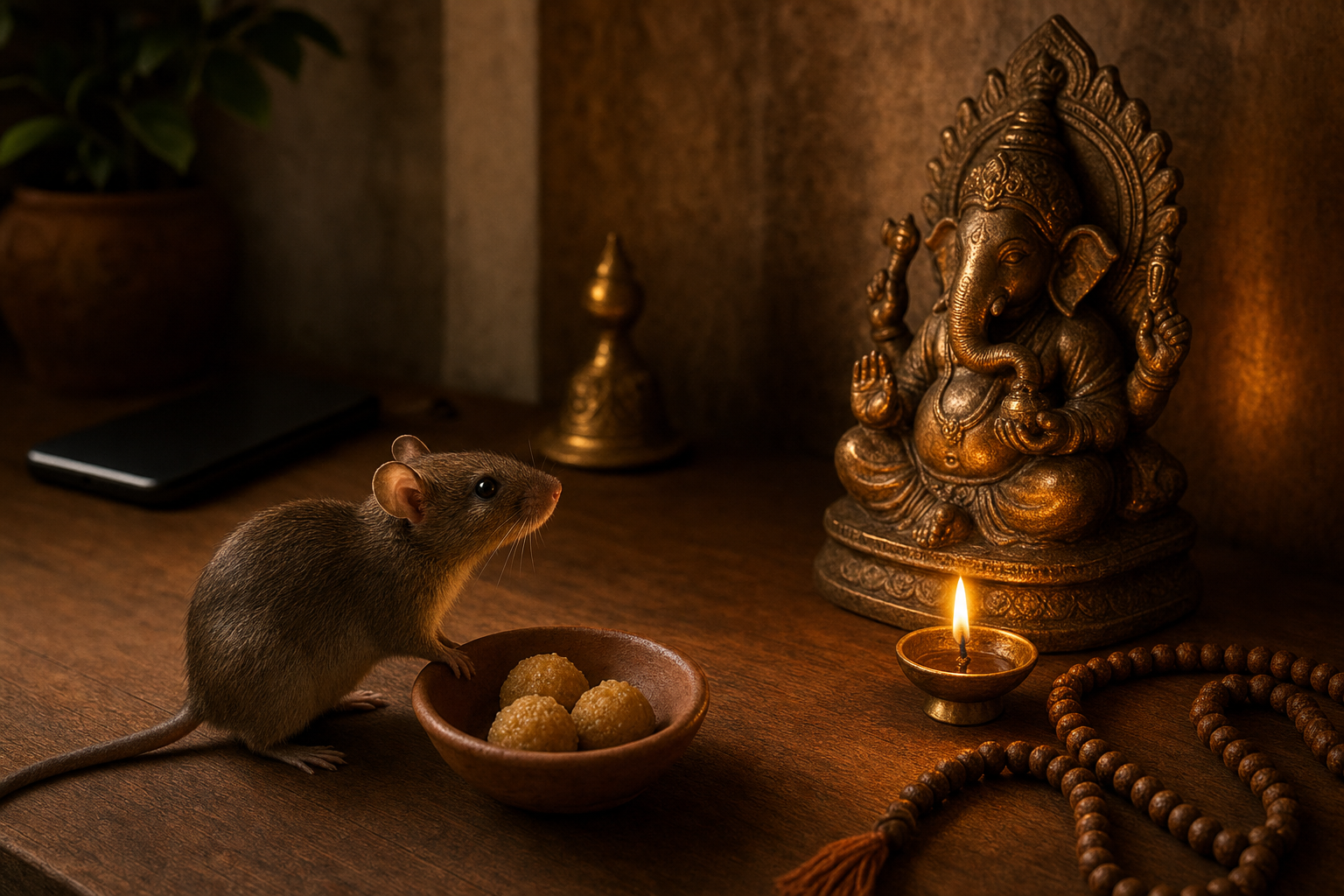
You do not need to invent an elaborate ritual around Mooshika. Use the image as a brief examination before study, work, pūjā, or seva. The following practice follows the same movement as Krauncha’s transformation.
- Name what is gnawing. Choose one specific impulse rather than condemning your whole character. It may be the urge to seek praise, check a distraction, accumulate something unnecessary, avoid a duty, or prove superiority.
- Find the strength trapped inside it. The urge for praise may contain real creative energy. Restlessness may contain curiosity. The desire to control may contain an ability to organize. Identifying the strength prevents discipline from turning into self-contempt.
- Set one pasha. Make the unsuitable route harder to enter. Put the distraction out of reach, close the unused path, defer the acquisition, or state the limit that the impulse cannot negotiate.
- Choose one aṅkuśa. Give the recovered energy an immediate destination. Begin the next visible action in your duty instead of waiting to feel completely purified or motivated.
- Complete the movement through seva. Ask who benefits when this capacity is used well. Talent becomes more stable when it answers to a purpose beyond applause, possession, or personal dominance.
If your regular worship already includes durva grass or the recitation of Vakratunda Mahākāya, let the sight of Mooshika prompt one concrete resolve. The resolve should be small enough to perform and clear enough to verify. “I will be less distracted” is too loose. “I will place this distraction outside the space before beginning my duty” gives the mouse a boundary and your attention a destination.
The same civilizational pattern has resonances across Dharmic paths without making their doctrines interchangeable. Buddhist Vinaya disciplines grasping and agitation. Jain ahiṃsā and aparigraha train conduct away from harm and possessiveness. Sikh teaching identifies haumai as a binding ego-pattern and answers it through nāam and seva. Each tradition should be approached in its own vocabulary, but all make room for a crucial possibility: human agency can be trained rather than merely indulged or crushed.
That is also why failure need not end the practice. A mouse is persistent. Your recurring habit may be persistent too. Return to the boundary and direction without turning the lapse into a new performance of ego. Ganesha’s mastery is calm and precise. The image calls for repeated governance, not theatrical self-punishment.
Key takeaways
- Mooshika represents restless appetite, appropriating impulse, and attention that can work secretly against your chosen purpose.
- Krauncha’s transformation shows how a genuine gift can become disorder when pride removes it from Dharma.
- Ganesha retains the mouse because the goal is disciplined service, not the destruction of vitality.
- The pasha supplies restraint, while the aṅkuśa supplies direction; a useful practice needs both.
- Differences among gandharva, asura, āśrama, and Pātāla versions do not erase the shared movement from disruption to seva.
- You can apply the symbol by naming one impulse, setting one observable boundary, and assigning the recovered energy to one worthy action.
At your next darshan, name the single impulse most likely to derail the duty immediately before you. Choose one boundary and one act of seva that gives the same energy a better task. Then begin. That is how Mooshika stops functioning as an inner obstacle and starts becoming a vahana.
References
