
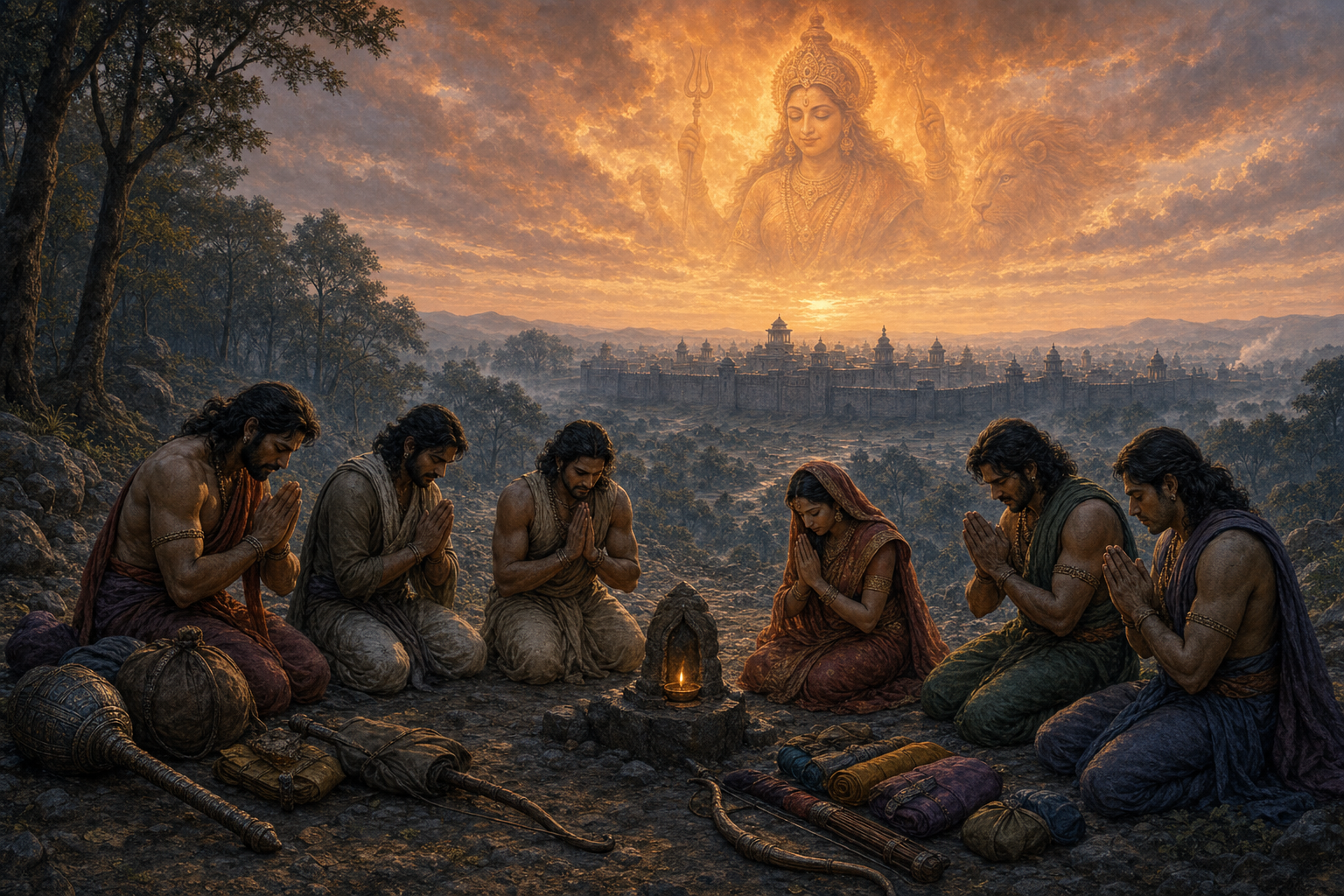
If you are trying to establish whether the Pandavas worship Durga in the Mahabharata, the careful answer is yes: several influential manuscript traditions preserve a Durga hymn as the Pandavas approach their year of concealment in King Virata’s kingdom. The necessary qualification is that the hymn’s wording, placement, and speaker are not identical across every recension.
That variation does not make the episode meaningless. It tells you how to read it responsibly. The Pandavas invoke the Goddess at the exact point where keeping their word, protecting Draupadi, hiding their identities, and eventually recovering their kingdom all depend on surviving one dangerous transition.
The worship belongs at the threshold of ajnatavasa
The dice-game settlement imposed two successive ordeals on the Pandavas: twelve years of vanavasa, or forest exile, followed by a thirteenth year of ajnatavasa, life without being recognized. Discovery during that final year would restart the penalty. Their problem was therefore more exacting than ordinary exile. They had to remain active in society while suppressing the abilities, relationships, and royal identities by which others knew them.
They chose the Matsya kingdom of King Virata because it offered political and geographical distance from the Kuru centre while keeping them within reach of developments affecting Hastinapura. Yet choosing the right kingdom solved only the first part of the problem. Each member of the group still needed a plausible identity:
- Yudhishthira entered courtly service as a counsellor and dice-player.
- Bhima worked as a cook while concealing the full extent of his strength.
- Arjuna became an instructor in music and dance.
- Nakula cared for horses.
- Sahadeva tended cattle.
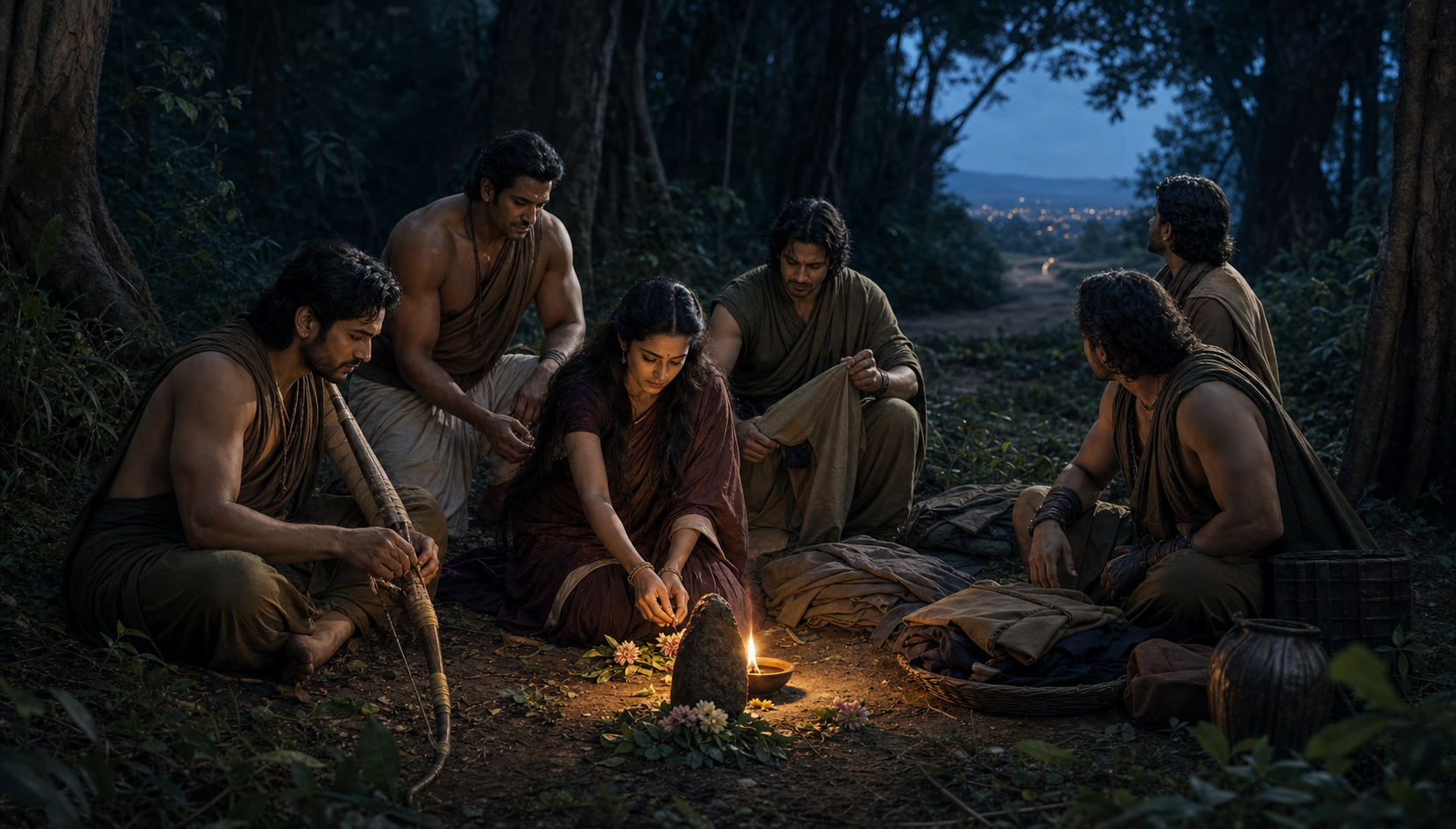
- Draupadi entered the palace as a sairandhri, a skilled female attendant.
The prayer to Durga comes at this hinge between planning and exposure. The Pandavas have completed one vow, but the most delicate part of their ordeal still lies ahead. They can control their disguises and conduct; they cannot control every suspicion, hostile encounter, or palace intrigue. The invocation acknowledges that remainder.
This timing corrects a common misreading of epic devotion. The Pandavas do not pray because they have no strategy. They pray after making a strategy and before placing themselves inside its risks. Human preparation and divine refuge operate together.
What the names of the Goddess reveal
The Goddess is praised through names including Durga, Katyayani, Bhadrakali, Chandika, and Mahishasuramardini. These are not ornamental additions to an otherwise secular plan. They identify the kind of divine power the Pandavas need: protection through danger, victory over hostile forces, and the strength to cross an ordeal without abandoning dharma.
The name Durga is especially apt. It evokes a fort, an inaccessible place, or a difficult passage. The Pandavas themselves are entering such a passage. Their kingdom lies behind them, open war lies ahead, and one narrow year separates fulfilled exile from another devastating loss. Durga is invoked not only as the power who destroys an enemy, but as the power who carries the righteous safely through constrained circumstances.
The boons associated with the invocation answer the Pandavas’ situation precisely: their concealment will succeed, sovereignty will eventually be restored, and their adversaries will be overcome. These promises form one sequence rather than three unrelated rewards. They must first survive unseen, then emerge at the proper time, and only then contend openly for rightful rule.
Key takeaways
- Setting: the invocation occurs as the Pandavas move from twelve years of forest exile into the thirteenth year of concealment.
- Immediate need: they seek protection from recognition while living under assumed identities in Virata’s kingdom.
- Longer purpose: anonymity is connected to the recovery of sovereignty and victory over forces opposing dharma.
- Theological meaning: Durga represents protective and victorious Shakti at a passage where righteous intention alone is not enough; courage, discipline, and effective action are also required.
- Textual qualification: the hymn is important in the traditions that preserve it, but its speaker and textual status vary across recensions.
How to discuss the hymn without overstating the evidence
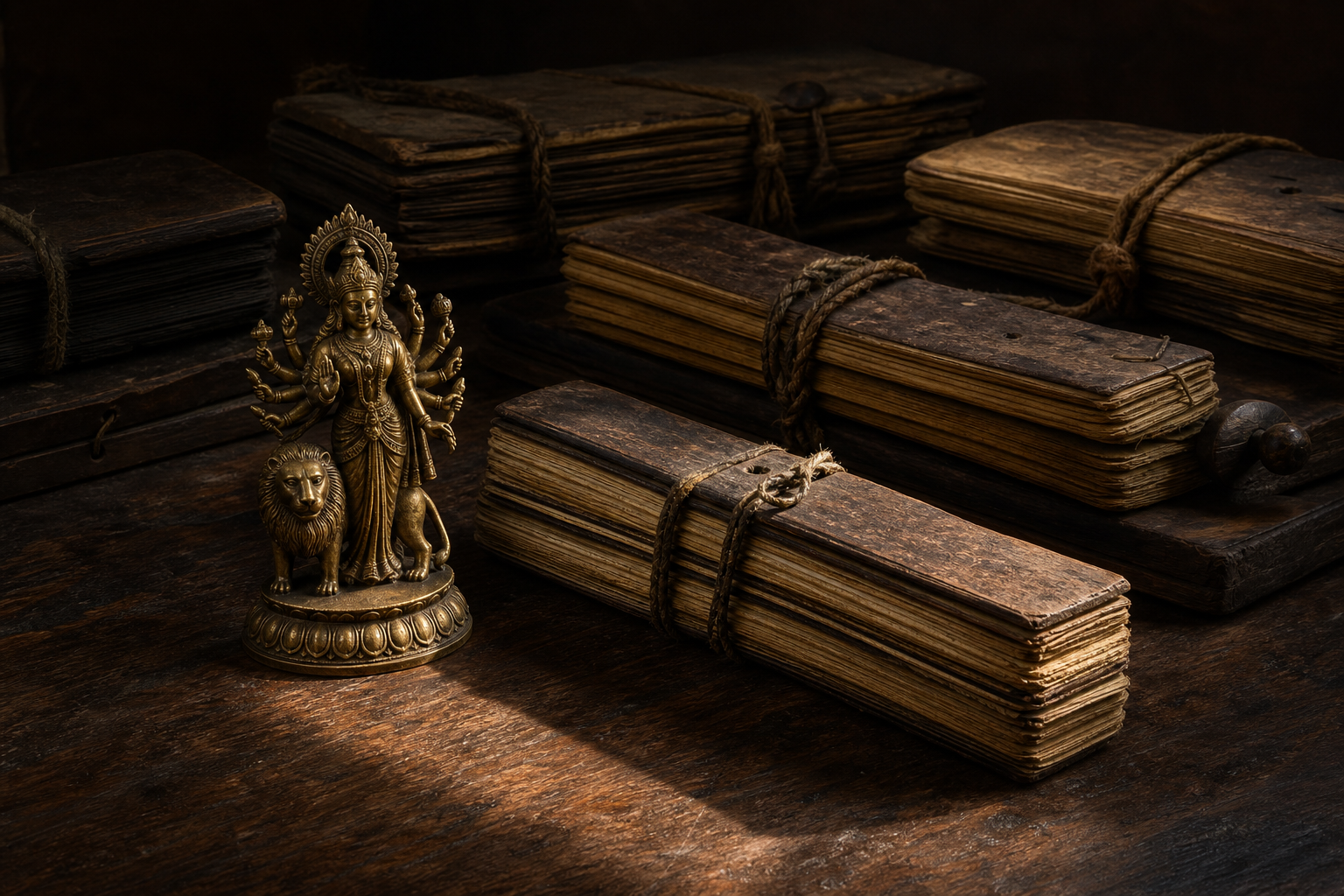
The most responsible formulation is that a Durga hymn appears in several influential Mahabharata manuscript traditions, particularly Northern and Eastern ones. Some versions associate the prayer with Yudhishthira, while others place Arjuna in the role of worshipper. Critical editions may treat relevant lines as belonging to a later redactional layer rather than to the most securely reconstructable form of the epic.
That distinction matters because two different questions are often collapsed into one. The first is historical: at what stage of the Mahabharata’s textual growth did a particular hymn enter a particular recension? The second is theological and cultural: how have communities received Durga worship as part of the epic’s sacred world? A critical judgment about textual layers addresses the first question; it does not erase the second.
You can therefore call the Virata hymn an early and influential Shakta presence in the epic tradition. You should not claim that every manuscript contains an identical hymn, that every edition assigns it to the same Pandava, or that its position in the oldest recoverable textual layer is beyond debate. Those stronger claims outrun the evidence available here.
The variation also fits the Mahabharata’s larger theological character. Vaishnava, Shaiva, and Shakta currents are not confined to sealed compartments. They meet inside the same civilizational narrative because the epic’s central concern is dharma under pressure, not the construction of mutually exclusive devotional camps. Durga’s presence beside the Pandavas need not be used against devotion to Krishna, Shiva, or any other form of the Divine.
Shakti stands beside strategy, especially for Draupadi
The disguises show intelligence, restraint, and adaptability. Yudhishthira must remain near royal power without appearing to seek it. Bhima must perform ordinary service without advertising extraordinary strength. Arjuna must inhabit a role radically different from his public identity as a warrior. Nakula and Sahadeva translate princely knowledge into unobtrusive work. Every disguise requires the Pandavas to govern their own impulses before they can hope to govern a kingdom again.
Draupadi’s position makes the appeal to protective feminine power still more immediate. She enters a palace as a dependent woman after already enduring grave humiliation, and she must navigate an environment in which rank does not guarantee safety. An interpretation focused only on the brothers’ eventual military victory misses this dimension. The sought protection must include the person whose vulnerability is greatest inside the chosen plan.
This is why the Goddess’s martial and maternal aspects belong together. Power is not celebrated merely because it can defeat. It becomes dharmic when it shelters the exposed, restrains predation, and restores a rightful order. Mahishasuramardini signifies victorious force, while the protective character of Durga prevents victory from becoming a licence for cruelty.
The same logic helps explain why protective feminine forms recur across the wider dharmic world. Buddhist traditions honour Tara and Prajnaparamita; Jain traditions include guardian figures such as Ambika and Padmavati; Sikh literature gives heroic expression to the Divine Feminine in Chandi di Var. These figures should not be flattened into interchangeable deities. Their doctrines and devotional settings remain distinct. What they share is a civilizational recognition that compassion, wisdom, protection, and courageous force need not be opposites.
Navaratri and Durga Puja later give this recognition a vast public and ritual expression, with the Devi Mahatmya supplying a central liturgical foundation. The Virata episode contributes a different but complementary image: worship offered before a year of hidden labour, when no public triumph is yet visible and discipline must carry the devotee through uncertainty.
Use the episode as a discipline for difficult transitions
You do not need to pretend that a job change, migration, period of study, or season of community service is identical to the Pandavas’ exile. The practical resemblance lies in the structure of the transition: an old identity no longer gives security, the outcome is not yet visible, and careless exposure can damage work that requires time to mature.
If you want to carry the Virata episode into such a threshold, use it as a disciplined sequence:
- Name the durga in front of you. Write down the actual difficult passage, not a vague wish to avoid problems. Is the risk exposure before you are ready, loss of income, pressure to violate a duty, danger to a dependent person, or loss of focus?
- Choose the role the passage requires. The Pandavas do not enter Virata insisting on the status they previously possessed. Decide which skills must remain visible, which claims to status can wait, and what conduct will preserve your deeper purpose.
- Build protection into the plan. Ask who carries the greatest risk if the plan fails. If one person bears the danger while everyone else receives the benefit, the plan has not yet absorbed the lesson of Draupadi’s vulnerability.
- Pray for passage, not exemption from effort. Seek clarity, restraint, protection, and a just outcome. Then perform the ordinary work that those prayers require.
- Set the condition for emerging. Concealment is not a permanent spiritual ideal. The Pandavas’ anonymity has a defined term and a dharmic objective. Know what completion, disclosure, or return to public responsibility will look like in your own undertaking.
If you wish to recite the Virata hymn itself, use a Mahabharata recension and translation accepted in your family or sampradaya, and check who the edition identifies as the speaker. The textual variation makes that small act of verification worthwhile. The episode supports a clear devotional principle, but it does not justify presenting one wording as universally fixed across all Mahabharata traditions.
Before your next difficult passage, put three things on one page: the danger you must cross, the discipline your role requires, and the person your plan must protect. Offer the work to Durga, then enter the passage with your eyes open. That union of refuge and readiness is the Pandavas’ enduring instruction.
References
