
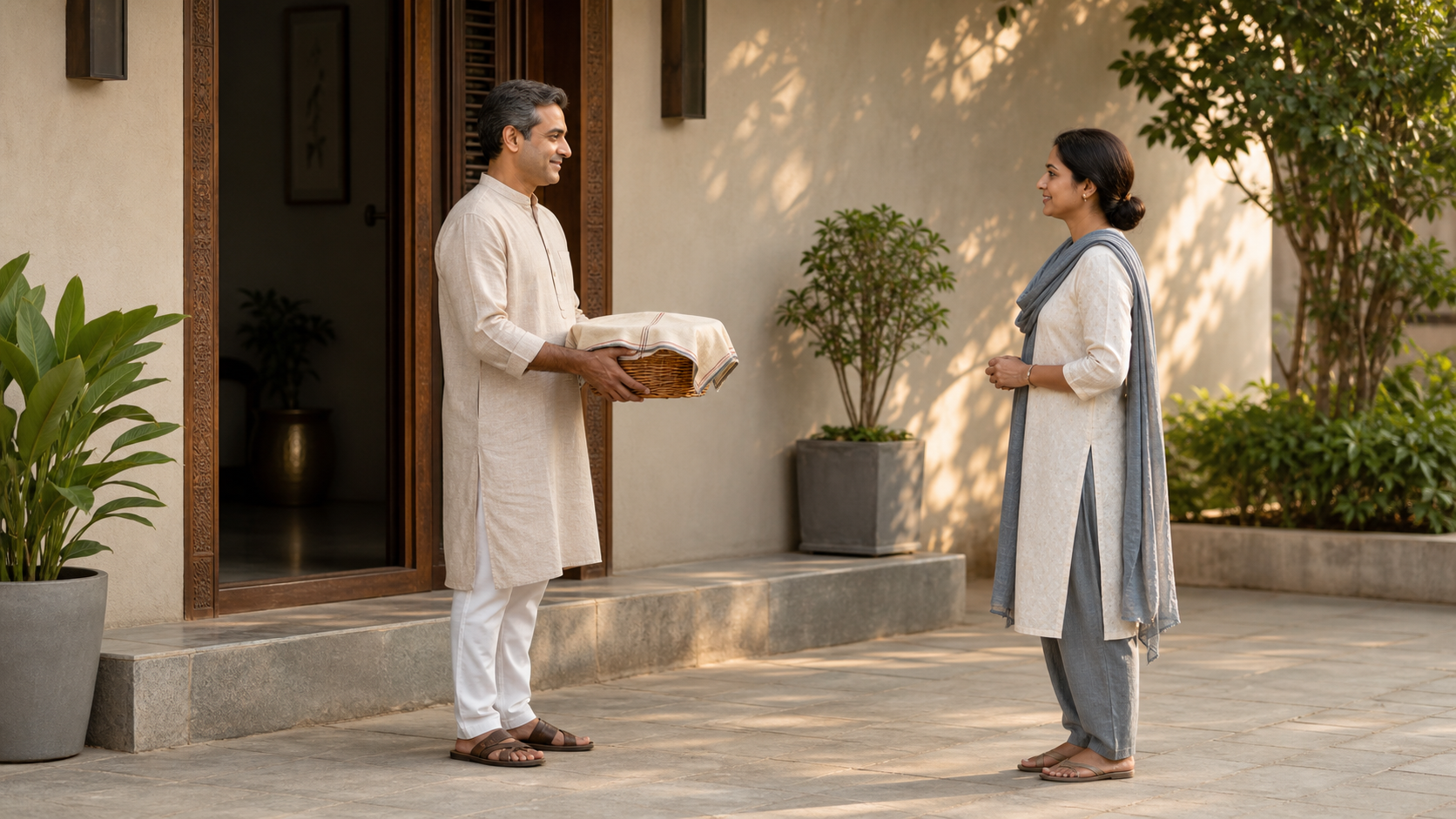
Someone asks for food or help at your door, and an elder stops you from handing it across the dehli. You don’t need to choose between respecting the custom and helping the person. Move the exchange to one side of the sill, then give with the attention that dāna deserves.
That small adjustment protects both sides of the encounter. The threshold remains a place of passage rather than transaction, while the recipient is treated as a person to be received, not an interruption to be dispatched.
The custom protects a boundary without closing the door

A threshold is neither fully inside the home nor fully outside it. It marks the point where the protected household meets the less predictable public world. Hindu domestic customs therefore give the doorway a special status: you cross it, greet people near it, decorate it and perform protective observances around it, but you avoid turning the sill itself into a counter.
In Vāstu-informed practice, the doorway may be understood as a sensitive point of the dwelling. Domestic ritual traditions also associate boundary locations with protective gestures and bali offerings. The practical custom follows that ritual logic: do not sit on, obstruct or conduct an ordinary exchange directly across the sill. Let the doorway begin the welcome, and complete the act somewhere clearly inside or clearly outside.
The familiar language of Lakshmi gives this spatial rule an emotionally intelligible form. Rangoli, kolam and representations of Lakshmi’s footprints make the entrance a route of auspicious arrival. Passing wealth or food outward across that exact line can therefore be pictured as sending prosperity away.
That image should be understood as sacred symbolism, not as a mechanical threat. Charity does not make a household poor, and a family should not refuse needed help out of fear that Lakshmi will leave. The custom regulates how you give; it does not provide a Dharmic excuse not to give. If preserving the threshold leads to humiliating or turning away a person in need, the symbol has displaced the ethical purpose it was meant to serve.
The ethical centre is the recipient’s dignity
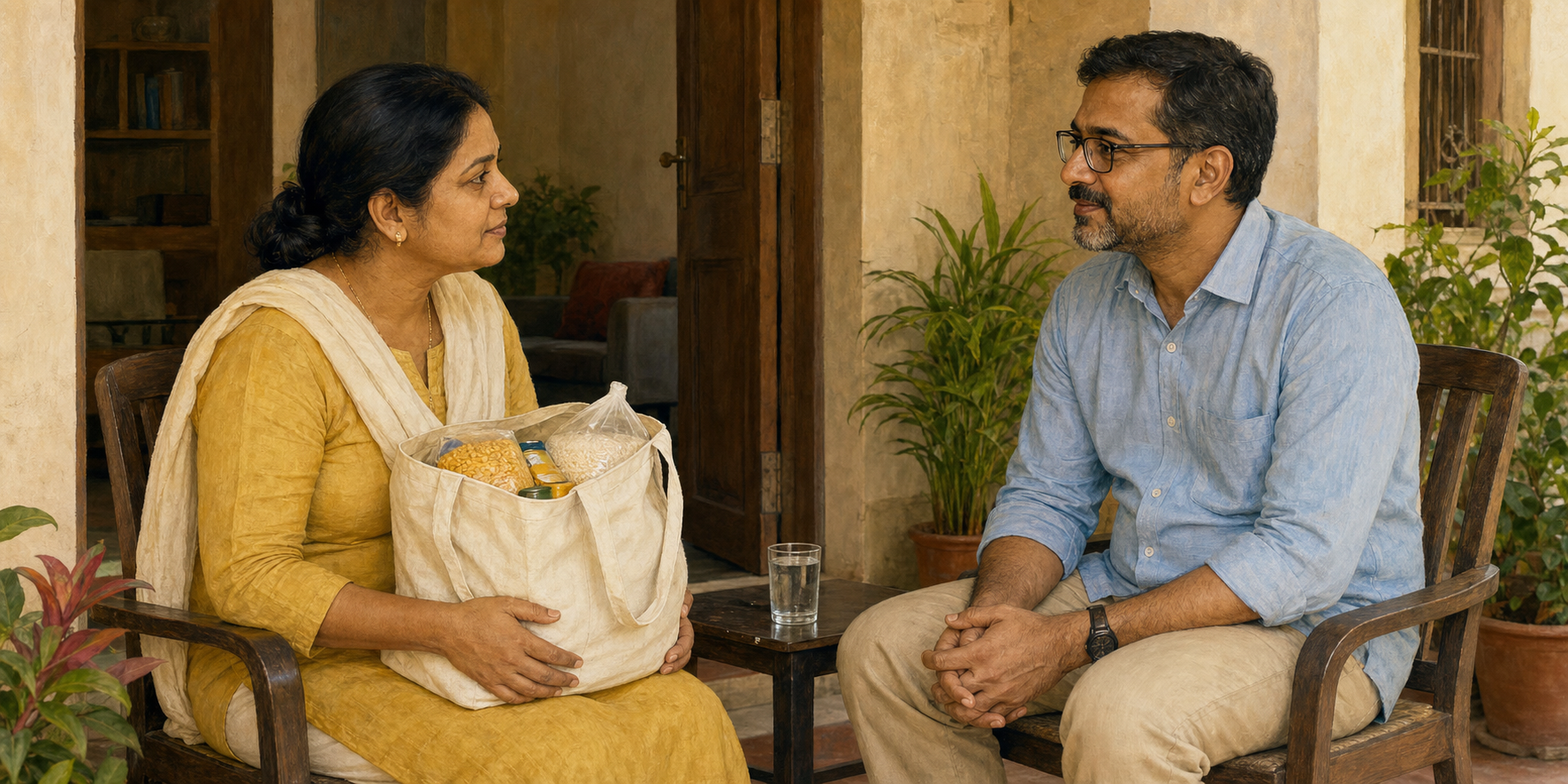
Dāna is more than transferring an unwanted object from one hand to another. A traditional ethical framework asks you to consider four connected elements: deśa, the place; kāla, the time; pātra, the appropriate recipient; and śraddhā, the sincerity and attentiveness of the giver. A large gift offered carelessly can fail this test, while a modest gift conveyed at the right moment and with genuine regard can fulfil it.
Place matters because space changes behaviour. A narrow sill is commonly exposed to footwear, dust, brooms and constant movement. It encourages a rushed handoff in which one person remains protected inside while the other waits outside. Moving the encounter to a clean, stable place creates room for eye contact, a proper greeting and careful handling of food or water. The physical correction is small, but it changes the moral posture of the act.
The Bhagavad Gītā 17.20-22 distinguishes sattvika, rājasic and tāmasic forms of giving. The distinctions turn attention away from the value of the gift alone and toward fitness of place and time, the giver’s motive, the recipient and the presence or absence of respect. In that light, avoiding a hurried doorway transaction is not anxiety about architecture. It is training in sattvika attention.
The Taittirīya Upaniṣad’s teaching, atithi devo bhava, sharpens the point. The person who comes to you should encounter hospitality rather than contempt. This does not mean that every unknown visitor must be admitted into your private rooms. It means that security and courtesy should be handled together: you may receive someone in a foyer, courtyard, veranda, apartment corridor or another suitable place without treating that person as socially untouchable.
Pātra also requires careful interpretation. Discernment about a beneficiary, organisation or intended use can be responsible, especially when substantial money is involved. It does not authorise an interrogation at the door or public judgement of someone’s poverty. You can verify before making a planned donation while still speaking respectfully to the person in front of you. Discernment evaluates the gift; it need not degrade the recipient.
A practical way to give without using the sill
You do not need an elaborate domestic ritual every time someone seeks assistance. A simple household protocol prevents awkwardness and keeps the ethical priorities in the right order.
- Acknowledge the person first. Greet them and indicate that you are going to bring the gift or consider the request. Do not leave someone waiting while you silently disappear behind a partly closed door.
- Choose one side of the threshold. Invite the person to a clean foyer, courtyard or designated spot if that is appropriate. Otherwise, step onto the veranda or corridor and conduct the exchange there. The point is to avoid passing the item while the two of you remain divided by the sill.
- Prepare the gift for clean handling. Put food in a suitable container or on a clean plate rather than placing it on the threshold. Use a clean vessel for water. Keep the gift clear of footwear and the strip of floor constantly crossed by feet.
- Offer rather than discard. Hand over the gift with both hands where practical and culturally natural. Do not toss money, slide food across the floor or make the recipient pick something up from among shoes.
- Keep the moment free of display. A photograph, announcement or self-congratulatory speech can turn the recipient into material for the giver’s reputation. Let the person’s need, not your public image, determine the form of the encounter.
Food, cash and digital assistance require different care
Anna-dāna places the strongest practical demands on the location. Food and water need clean vessels, stable handling and protection from the dust and foot traffic concentrated at an entrance. If there is room, a seat and a place to eat are more dignified than a package pressed into someone’s hand. If there is no room, a clean, well-packed offering made outside the doorway still respects the principle.
Cash does not carry the same hygiene concern, but it can still be given badly. Move away from the sill, hand it over discreetly and do not force the recipient to display what was received. For a planned donation, verify the recipient and intended purpose before the encounter rather than staging an investigation during it.
A digital transfer removes the literal threshold but not the ethics of dāna. Deśa becomes the suitability of the setting in which you make the decision; kāla asks whether the assistance reaches the person when it is useful; pātra calls for proportionate verification; and śraddhā asks whether the gift is motivated by care rather than pressure, vanity or the expectation of a return. Technology changes the handoff, not the responsibility.
Adapt the custom to the home you actually have

The relevant distinction is not between a traditional house and a modern apartment. It is between an ambiguous exchange across the boundary and a clear, respectful exchange on one side of it. You can preserve that distinction in a large courtyard, a narrow foyer or a shared corridor.
- In an apartment: use the corridor as the outside location, or invite the recipient wholly into the foyer when it is appropriate and safe. Avoid standing on opposite sides of the open door and reaching across the sill.
- When you do not admit unknown visitors: keep the door secure while you assess the situation. If you decide to give, arrange a clean handoff outside the doorway without compromising personal safety. Hospitality does not require abandoning prudent boundaries.
- When illness or vulnerability makes entry unsuitable: use a clean tray, container or designated surface beyond the sill. Explain the arrangement courteously instead of making the recipient feel personally rejected.
- When space is extremely limited: keep a small clean mat, tray or chowki near the entrance as a dāna-sthala. Place it entirely on one side of the threshold so that the household does not have to improvise during every request.
- When the need is urgent: do not let ritual perfection delay practical help. Move the exchange to the nearest safe, clean side of the boundary and give. Dharma is not served by making a vulnerable person wait while you search for an ideal arrangement.
A household can decide its procedure before the next knock. Agree on the appropriate giving place, keep a clean container or tray available, and make sure children understand both parts of the rule: nothing is passed across the sill, and no person seeking help is mocked, shouted at or treated as a bearer of misfortune.
A family resemblance across Dharmic traditions
The precise household custom should not be projected unchanged onto every Dharmic path. The shared moral pattern is more important than claiming an identical rule. Buddhist dāna cultivates mindful generosity and composed offering. Jain atithi-samvibhāga joins hospitality to rigorous attention to cleanliness and ahiṁsā. Sikh langar gives the principle an unmistakably communal form: people sit in pangat and are served in a shared space of dignity and equality rather than being kept as supplicants at a door.
These practices differ in theology, discipline and setting, but they help you notice the same ethical test: does the arrangement make the recipient fully present within the act of giving, or does it keep that person at an embarrassing distance? Place, posture and intention converge when generosity is done well.
Key takeaways
- The custom concerns the literal exchange across the sill; it is not a prohibition on helping someone who comes to the door.
- Conduct the handoff wholly inside or wholly outside, using a clean and stable place.
- Lakshmi symbolism protects the auspicious character of the entrance; it should never be used to frighten a family out of charity.
- Deśa, kāla, pātra and śraddhā ask you to judge the place, moment, recipient and intention together.
- Clean handling matters especially for food and water, while discretion and proportionate verification matter for money.
- Hospitality does not require admitting an unknown person into private space, but safety does not cancel courtesy.
Before the next request reaches your door, choose your household’s dāna place and keep a clean tray or container there. Then the threshold custom becomes what it should be: not a reason to hesitate, but a discipline that helps you give promptly, cleanly and without diminishing the person who receives.
References
