
If you need an auspicious time on 23 February 2026, a generic all-India clock time is not enough. The useful answer begins with your city, the task you intend to start, and the exact moment at which that start becomes effective.
The date falls on a Monday in Indian Standard Time. That fixes the weekday framework, including Monday’s Rahu Kalam pattern, but sunrise, sunset, lunar transitions, Choghadiya, and Lagna timings remain location-sensitive. Here is how to turn those moving parts into a defensible muhurta instead of choosing a convenient-looking time from an undated chart.
Start with the city, not the national clock
IST is a common baseline, not a substitute for local astronomy. Sunrise in one Indian city can differ from sunrise in another by tens of minutes. Because Rahu Kalam, Yamaganda, Gulikai, Abhijit Muhurta, Durmuhurtham, and Choghadiya are derived from the local daylight span, that difference moves every calculated interval.
Before selecting a time, collect four pieces of information:
- The exact city: Use the place where the action will occur, not the family hometown or the office’s registered address.
- The nature of the action: Daily puja, beginning a journey, signing an agreement, entering a home, and conducting a samskara do not require the same degree of refinement.
- The effective start: Decide whether the relevant moment is the first prayer, departure from home, first signature, opening of a door, transfer of funds, or another clearly defined act.
- Birth information, if personalization matters: Janma Nakshatra and Janma Rashi are needed for Tarabalam and Chandrabalam. An exact birth chart is needed for a carefully selected Lagna.
Most Panchang conventions treat local sunrise as the beginning of the calendrical day. The Tithi present at sunrise ordinarily governs the civil observance, but a Tithi or Nakshatra transition later in the day can still change the suitability of a particular action. This is why a date label alone cannot settle a muhurta.
You may also see the lunar month described as Magha in one calendar and Phalguna in another. That does not automatically make either calendar wrong. Amanta and purnimanta month reckoning, local parampara, and the underlying siddhanta can produce different month labels while communities continue to observe the same lunar sky through their inherited conventions. Follow the system used by your family, temple, or sampradaya rather than combining whichever labels seem most favorable.
Build the Monday timing map in the right order

Begin with the local sunrise and sunset for 23 February 2026. Let sunrise be S and sunset be T. The daylight length is T minus S, and one-eighth of that interval is E.
On Monday, Rahu Kalam occupies the second of the eight daylight segments. Its local boundaries are therefore:
- Rahu Kalam begins: S + E
- Rahu Kalam ends: S + 2E
This formula is more reliable than copying the familiar fixed-hour version based on an assumed 6 a.m. sunrise and 6 p.m. sunset. Seasonal daylight rarely fits that assumption exactly. Use the Monday entries in the same city-specific Panchang for Yamaganda and Gulikai, because their boundaries must be scaled from that identical local daylight interval.
Then apply the timing filters in this order:
- Exclude Rahu Kalam, Yamaganda, and Gulikai for a new beginning. These periods do not require you to abandon ordinary duties already underway. The distinction is between initiating an important act and continuing necessary work.
- Exclude Durmuhurtham. Monday carries brief weekday-dependent intervals whose exact clock placement changes with the length of the day. Check them separately; they are not automatically captured by a Choghadiya label.
- Identify favorable Choghadiya. Prefer Amrit, Shubh, or Labh for an auspicious beginning. Chal is generally treated as neutral or movable. Udveg, Kaal, and Rog are normally set aside when you have a reasonable alternative.
- Consider Abhijit Muhurta. It is a narrow period centered on local solar noon and can be useful when a bespoke muhurta is unavailable. Its precise width can vary by regional method, so use the interval printed for the target city.
- Check for overlaps. A favorable Choghadiya is not an unconditional pass. If it overlaps a prohibited interval or an unsuitable lunar factor, choose the cleaner alternative rather than relying on the most favorable label alone.
For an evening action, do not extend the last daytime Choghadiya beyond sunset. Day and night are each divided into eight separate segments, and the nighttime sequence resets according to its own weekday pattern. Calculate the night from local sunset to the following sunrise or consult a table that explicitly supplies nighttime Choghadiya.
Abhijit Muhurta also needs context. It can strengthen a workable period, but it does not erase every conflict in Tithi, Nakshatra, Karana, or task-specific rules. Treat it as a strong general option, not as permission to ignore the rest of the Panchang.
Read the lunar factors at the moment you act
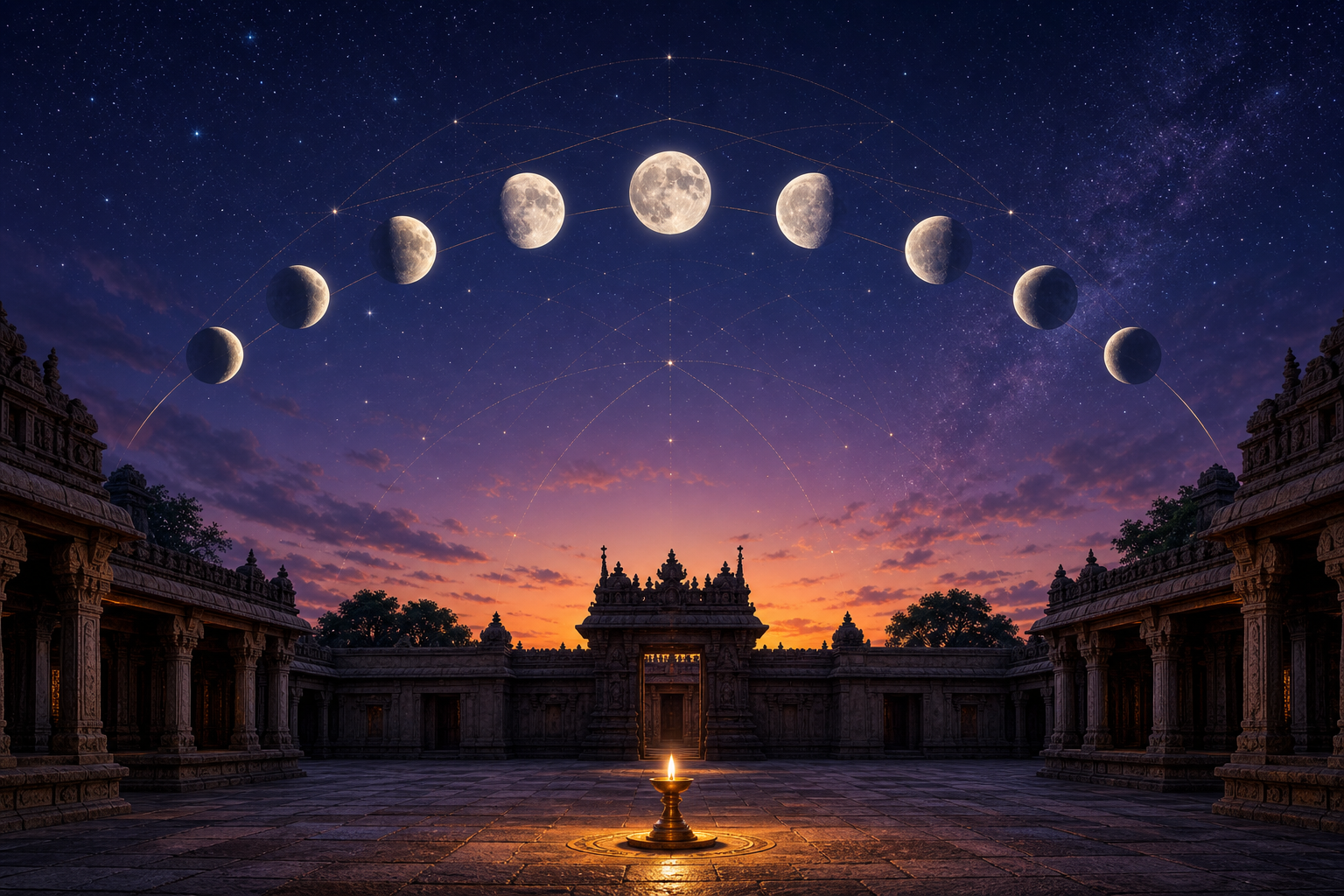
Once the clock-based exclusions leave you with one or more candidate windows, examine the Panchang factors operating inside those windows. Their transition times matter more than the value shown in a date header.
- Tithi: A Tithi represents each 12-degree step in the angular separation between the Moon and Sun. There are 30 in a lunar month, divided between the waxing Shukla Paksha and waning Krishna Paksha. Use the sunrise Tithi for the day’s observance, but use the Tithi present at the actual start when assessing a time-sensitive undertaking.
- Nakshatra: The Moon’s path is divided into 27 lunar mansions of 13 degrees and 20 minutes each. Nakshatra is especially important for samskaras, naming, mantra anushthana, Tarabalam, and other practices in which lunar quality or personal resonance matters. If the Nakshatra changes inside your proposed interval, determine which side of the transition contains the effective start.
- Yoga: Yoga is calculated from the combined sidereal longitudes of the Sun and Moon and divided into 27 parts. It refines the qualitative character of a candidate time. It should be read alongside Tithi and Nakshatra rather than used as a solitary verdict.
- Karana: A Karana spans half a Tithi, or 6 degrees of Sun-Moon separation. Because it changes more frequently than Tithi, it can distinguish two otherwise similar windows on the same day. Gentle or cooperative Karanas are commonly preferred for constructive undertakings, while Vishti, also called Bhadra, is traditionally avoided for auspicious beginnings.
The practical rule is simple: record the transition time for each factor and place it on the same timeline as your Choghadiya and exclusion periods. A broad favorable interval may contain a much narrower usable window once a Tithi, Nakshatra, or Karana boundary is added.
When two almanacs disagree, first compare their city, sunrise convention, ayanamsa, and calendar system. Panchang calculations commonly use the sidereal zodiac, often with Lahiri ayanamsa, but interpretive and regional conventions can differ. Mixing transition times from one almanac with Choghadiya from another can create an apparent window that neither system actually recognizes.
Match the precision of the muhurta to the decision
Not every act needs an elaborate electional chart. Use enough precision for the consequence and ritual weight of the decision.
- Daily puja, japa, reflection, or seva: Begin with the relevant Tithi, local sunrise or Sandhya period, and the discipline of the observance. Do not postpone sincere worship merely because an ordinary avoidance period is in progress.
- A journey, application, interview, first signature, or new project: Remove Rahu Kalam, Yamaganda, Gulikai, and Durmuhurtham; then prefer an Amrit, Shubh, or Labh Choghadiya. Confirm that the Tithi, Nakshatra, Yoga, and Karana remain acceptable at the moment of initiation.
- A vrata tied to lunar sighting: Use local moonrise or moonset and the observance rules of your parampara. A moonrise time copied from a distant city can defeat the purpose of a sighting-dependent vow.
- Vivaha, griha-pravesha, a major samskara, or the formal beginning of an enterprise: Use a city-specific calculation and a competent traditional adviser. After finding a broadly favorable period, refine it through Lagna and the relevant ritual rules. Lagna changes roughly every two hours, and smaller shifts can change the structure of the elected chart.
- An urgent health or safety decision: Act without delay and follow qualified professional guidance. Panchang selection must never postpone emergency care or another necessary protective action. If an elective matter offers genuine scheduling flexibility, consider timing only after the responsible professional requirements have been satisfied.
For decisions that affect you personally, add Tarabalam and Chandrabalam as personal filters. Tarabalam counts from your Janma Nakshatra to the day’s Nakshatra through a ninefold cycle. Chandrabalam assesses the day’s Moon in relation to your Janma Rashi. These checks can help distinguish between two generally acceptable windows, particularly for travel, examinations, interviews, reconciliation, or cooperative work. Without reliable birth information, do not pretend that a generic table is personalized.
The same lunar markers can support different forms of discipline across Dharmic communities: Hindu vrata and samskara, Buddhist Uposatha reflection, Jain Poshadha vows, and household observances among some Sikh families. Shared astronomical markers do not erase differences in theology or practice. Use the calendar in the way your living tradition teaches, with dharma, self-restraint, compassion, and service as the purpose of the timing.
Key takeaways for 23 February 2026
- 23 February 2026 is a Monday in IST, but there is no single exact muhurta that applies unchanged to every Indian city.
- Calculate Monday’s Rahu Kalam from the second eighth of local daylight; do not rely on fixed-hour charts unless their sunrise and sunset match your city.
- Remove Rahu Kalam, Yamaganda, Gulikai, and Durmuhurtham before choosing among favorable Choghadiya periods.
- Prefer Amrit, Shubh, or Labh for a new beginning; use Chal cautiously as a neutral option, and avoid Udveg, Kaal, and Rog when flexibility exists.
- Use Abhijit Muhurta as a strong general window around local solar noon, but still check Tithi, Nakshatra, Yoga, Karana, and any overlapping avoidance period.
- For a major samskara or irreversible commitment, add a city-specific Lagna and the rules of your parampara. For a personal decision, add Tarabalam and Chandrabalam.
Open the local Panchang for the city where the action will occur and write every candidate interval on one timeline. Cross out the prohibited periods, mark the lunar transitions, and choose the cleanest remaining window that fits the task. If the decision carries substantial ritual or personal consequence, take that short list to a trusted practitioner who works within your parampara; a precise question and a defined start moment will produce a far more useful answer than asking whether the entire date is good.
References
