
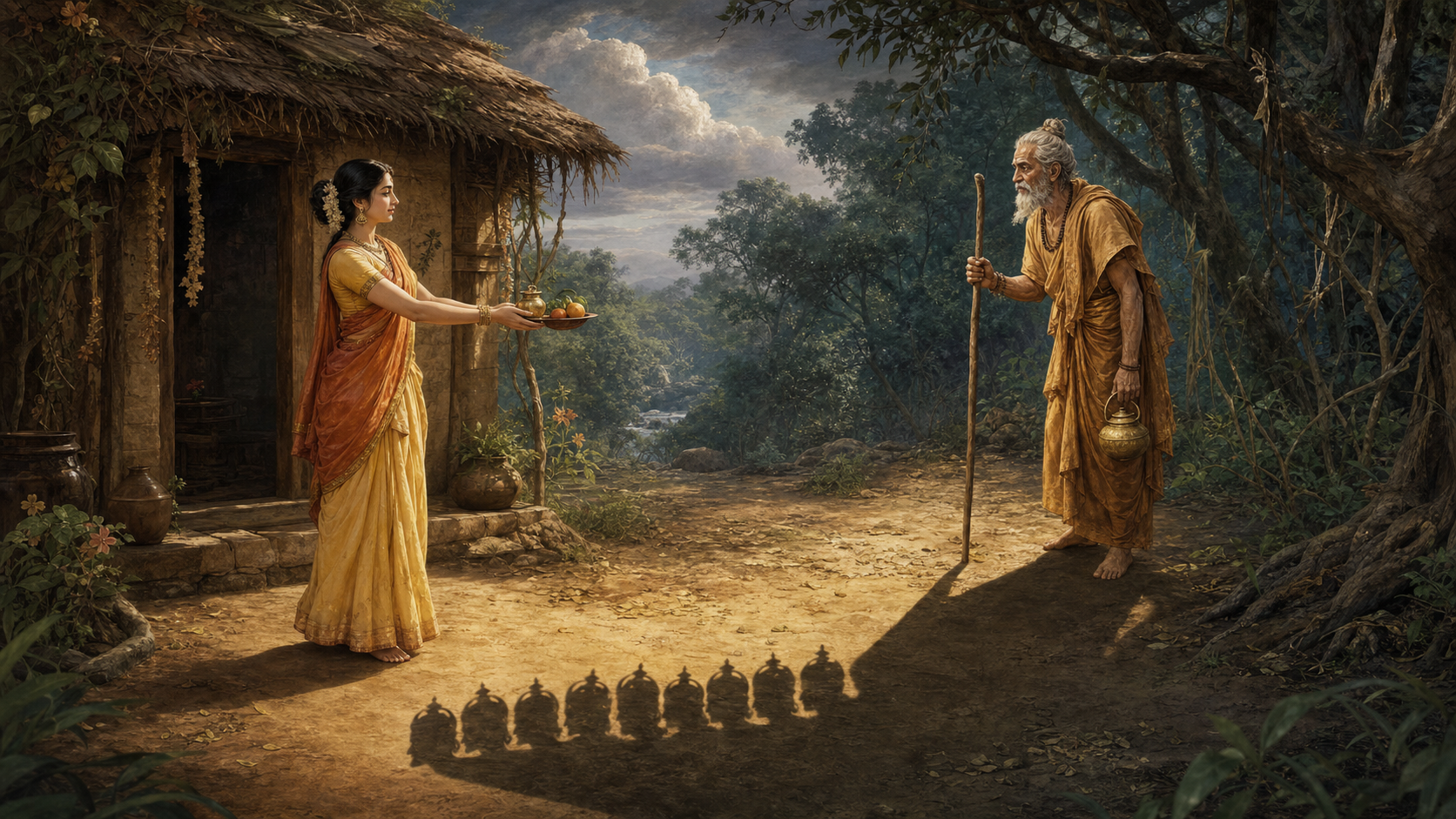
If you are trying to decide whether Sita’s abduction is a warning against hospitality, begin with the detail that makes the episode morally decisive: Ravana does not approach her honestly. He borrows the appearance of renunciation because that appearance promises harmlessness. Her virtue is the opening he chooses to exploit.
That distinction changes how you read the entire encounter. It prevents a later boundary motif from becoming an accusation against Sita, explains why the disguise is more than a clever tactic, and shows why Ravana’s devotion to Shiva could never turn adharma into an act protected by divine grace.
Start with the textual distinction most retellings blur

In the Aranyakanda of the Valmiki Ramayana, Ravana first creates an opening through Maricha’s golden-deer deception. He then approaches Sita in the guise of a brahmana mendicant. The familiar expression “Sanyasi disguise” captures the ethical character of the deception, but “brahmana mendicant” is the more precise description for this telling.
The Lakshmana Rekha is not part of Valmiki’s narration. It emerges in later traditions and becomes one of the best-known images in popular memory. This does not make the Rekha meaningless. It means you should not insert it into an earlier account and then use it as evidence that Sita violated an explicit command found there.
The distinction matters because the two elements do different work. The mendicant disguise identifies Ravana’s method: he counterfeits holiness to obtain trust and proximity. The later line motif dramatizes a problem communities continued to think about: how can a household preserve atithi-dharma while also maintaining a prudent boundary?
Across Sanskrit and vernacular traditions, words such as yati, bhikshu and vipra-vesa vary with language and theological setting. The stable moral core is not the exact label attached to the costume. It is the deliberate use of a sacred identity to conceal predatory intent.
When you encounter different versions of the episode, use three questions instead of forcing every detail into one composite scene:
- Which narrative layer am I hearing? Distinguish Valmiki’s account from details developed in later devotional and regional memory.
- What remains stable across the tellings? Ravana uses the moral authority of a mendicant’s appearance to overcome Sita’s natural caution.
- What problem does a later motif help its community express? The Lakshmana Rekha gives visible form to the tension between hospitality and protective limits; it does not rewrite responsibility for the abduction.
This reading method lets you respect a living tradition without treating every remembered detail as if it occupied the same place in every text. It also keeps the ethical centre where the narrative places it: on the person who designs and executes the deception.
Why the Sanyasi disguise is an attack on dharma

A mendicant’s robe is not merely clothing. Within the Dharmic imagination, it signifies renunciation, truthfulness, restraint, non-possession and harmlessness. A householder who offers food, water or respectful attention to such a visitor is responding to those represented vows. Ravana understands that response and turns it into a weapon.
His offence therefore extends beyond lying about his name. He falsifies an entire moral relationship. The guest who should enter without threatening the household becomes the source of danger. The figure associated with abhaya, the assurance of fearlessness, becomes the cause of fear. The sign of freedom from appetite conceals an appetite for possession and domination.
The inversion can be seen precisely:
- Satya is inverted: an appearance that should communicate integrity is used to sustain a false identity.
- Ahimsa is inverted: the social sign of harmlessness conceals a plan that ends in violence and captivity.
- Aparigraha is inverted: the garb of non-possession serves an attempt to seize and control another person.
- Atithi-dharma is inverted: the respect owed to a guest is manipulated against the person extending it.
- Abhaya is inverted: a presence that should reduce fear is used to disable the ordinary defences created by caution.
This is why describing the disguise as mere strategic cunning is inadequate. Traditions of statecraft may debate when deception is permissible in conflict, but Ravana does not simply misdirect an opposing army. He makes sacred trust itself part of the machinery of abduction. The robe is conscripted into an act that contradicts every virtue it signifies.
The damage also reaches beyond the immediate victim. Hospitality survives only when people can ordinarily trust signs of peaceful intent. Impersonating a renunciant corrodes that shared confidence. If sacred identities repeatedly became instruments of coercion, householders would have to treat genuine seekers as possible threats. One person’s deception would impose suspicion on an entire religious relationship.
This concern is recognisable across Dharmic paths, even though their disciplines and institutions are not identical. Buddhist monastic rules protect the credibility on which alms-based life depends and condemn false religious claims. Jain ethics make satya and asteya incompatible with obtaining advantage through sacred deception. Sikh teaching repeatedly rejects the idea that an outward marker can compensate for inner falsehood. The comparison should remain narrow but firm: sacred appearance acquires authority only through truthful conduct.
That principle gives you a practical way to honour spiritual symbols without becoming captive to them. Ask whether conduct agrees with the meaning of the sign. Truth, restraint and non-coercion confirm religious credibility; demands for unquestioning access, secrecy or obedience contradict it. Verification is not an insult to genuine holiness. Treating appearance as an exemption from moral scrutiny is what empties the appearance of meaning.
Read Sita’s hospitality without transferring Ravana’s guilt

Sita stands at an unusually difficult threshold. Atithi-dharma calls for respect toward a mendicant visitor, while the circumstances of the forest demand caution. Ravana succeeds because he arranges those duties against each other. He expects a virtuous person to hesitate before refusing someone who appears to have renounced worldly power.
That is not evidence that hospitality was Sita’s moral failure. It is evidence that Ravana selected his disguise with a precise understanding of her dharmic disposition. The sharper her commitment to receiving a seemingly harmless guest with dignity, the more useful the counterfeit identity becomes to him.
Two judgments can coexist without contradiction. Hospitality is a virtue, and protective boundaries are prudent. The second judgment does not make a victim responsible when a deceiver deliberately defeats the conditions under which the first virtue normally operates. A lock may be wise, but the absence of a lock does not transfer authorship of a theft from the thief to the householder.
This is where careless use of the Lakshmana Rekha causes harm. The motif can teach that duty need not require the abandonment of every boundary. It cannot honestly be used to claim that Valmiki supplied Sita with a visible line, that she knowingly violated it in that telling, and that the abduction therefore followed as the deserved result of her disobedience. The line belongs to later narrative development; Ravana’s mendicant deception belongs to the textual baseline.
If you are explaining this episode to children, students or a discussion group, avoid the compressed moral, “Sita crossed the line and was abducted.” It teaches the wrong causal lesson and blurs the textual history. A more accurate explanation has three parts:
- Ravana first creates separation and then conceals his identity behind a religious form associated with safety.
- Sita responds to someone she has been deliberately led to perceive as a mendicant guest.
- Later traditions use the boundary image to explore prudence, but responsibility remains with the person who counterfeits holiness and commits the abduction.
The distinction is useful beyond this one episode. Whenever trust is exploited, ask first who engineered the false conditions. A virtue does not become a vice merely because an offender anticipated it. The ethical task is to protect the virtue with discernment, not to shame the person whose good faith was targeted.
Shiva’s silence is a moral reading, not a sectarian rivalry
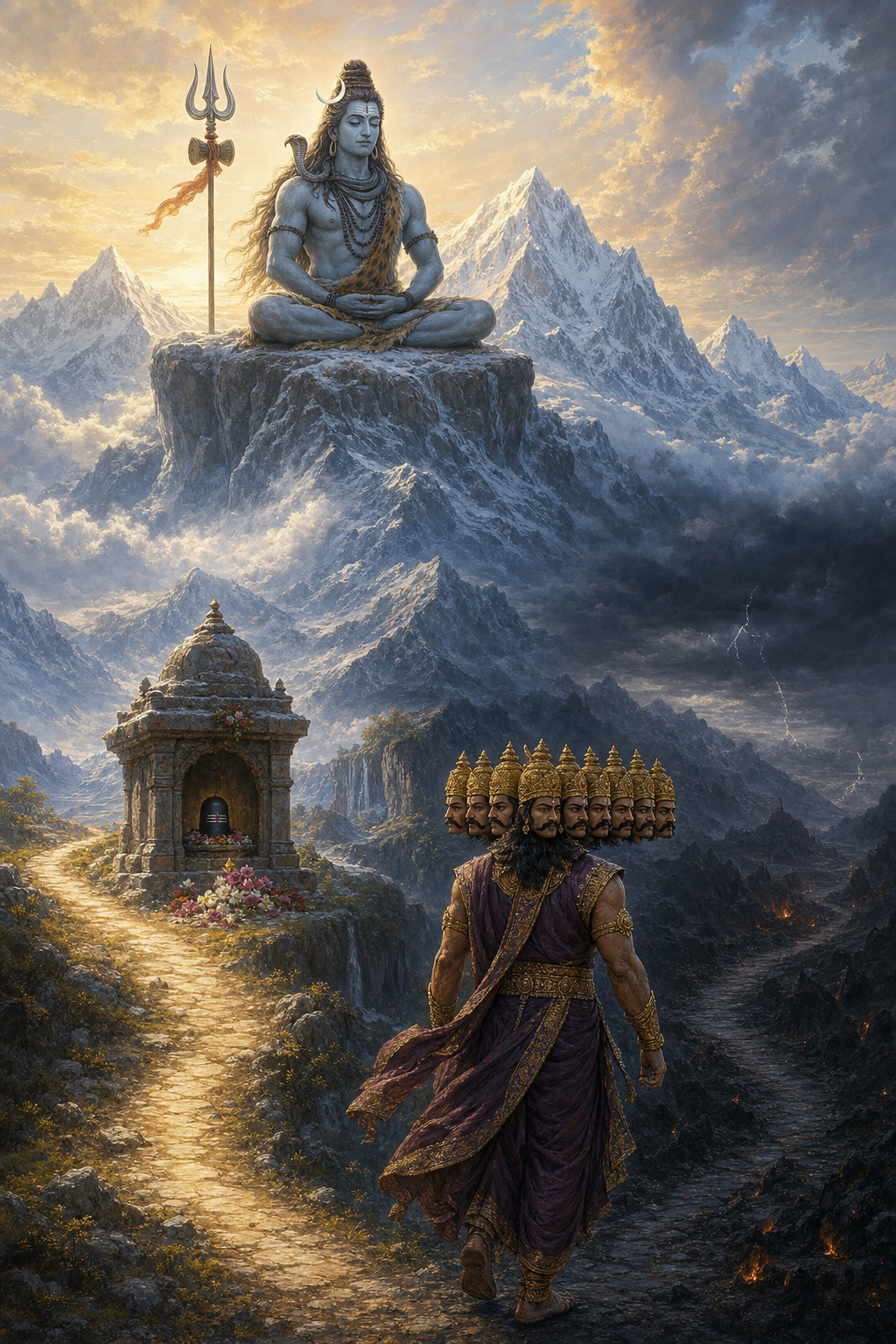
Ravana’s reputation as a formidable devotee of Shiva makes the episode theologically uncomfortable only if devotion is treated as immunity. Shaiva narrative memory associates him with severe tapas, extraordinary boons and, in some tellings, the celestial sword Chandrahasa. None of these makes Shiva the guarantor of every later choice Ravana makes.
The language of Shiva withdrawing protection or responding with “silent wrath” is best understood as an interpretive motif. It is not a claim that every recension records a single moment at which Shiva formally cancels a boon. It condenses a larger Dharmic principle: grace cannot be turned into a licence for adharma, and spiritual power cannot make the profanation of sacred trust righteous.
Tapas can display discipline and generate formidable capacity, but capacity and moral authority are different things. Ravana’s failure is not that his austerity was too weak. It is that accumulated power becomes governed by appetite. When he wears the form of renunciation in order to possess another person, the contradiction is complete: tapas has been subordinated to the very grasping that renunciation is meant to overcome.
This also explains why the episode should not be turned into a contest between Shiva and Vishnu. The tradition of Rama worshipping Shiva at Rameshwaram before the crossing to Lanka points in the opposite direction. Hari-Hara abheda places Shiva and Vishnu within a shared guardianship of dharma. Ravana’s fall does not require Shiva to oppose Vishnu or Vishnu to humiliate a Shaiva devotee. It requires the divine not to become partisan to abduction merely because the offender once performed great austerities.
You can test a theological interpretation with three questions:
- Does it turn a boon into a blank cheque? If divine favour is said to protect knowingly unrighteous conduct, devotion has been detached from dharma.
- Does it make sectarian allegiance more important than conduct? Ravana’s Shaiva identity cannot outweigh his deliberate violation of a woman and a sacred form.
- Does it portray Rama and Shiva as competing patrons? That framing misses the Hari-Hara unity expressed by the restoration of moral order and the Rameshwaram tradition.
“Silent wrath,” then, need not mean anger in an ordinary human sense. It names the refusal of grace to endorse what grace itself cannot sanctify. Ravana may possess learning, rank, strength and the fruits of tapas, yet none of them can convert adharma into dharma. His grandeur makes the lesson more exacting, not less: spiritual achievement increases responsibility; it does not suspend it.
Key takeaways for reading and teaching the episode
- Keep the textual layers clear. Valmiki’s Aranyakanda includes Ravana’s brahmana-mendicant disguise; the Lakshmana Rekha belongs to later tradition.
- Place responsibility on the deceiver. Sita’s hospitality is the virtue Ravana exploits, not the cause that absolves him.
- Notice why the costume matters. Ravana counterfeits satya, ahimsa, aparigraha, abhaya and atithi-dharma at once.
- Pair reverence with discernment. Sacred clothing deserves respect, but conduct must remain consistent with the vows that clothing represents.
- Read Shiva’s withdrawal of protection as a theological interpretation. It expresses the inability of boons or past tapas to authorise present adharma.
- Reject the Shiva-versus-Vishnu frame. Hari-Hara unity makes Ravana’s downfall a restoration of dharma, not a sectarian victory.
The next time someone reduces Sita’s abduction to a crossed line, ask which telling is being discussed and who manufactured the deception. That one correction preserves both textual honesty and the episode’s demanding moral insight: protect hospitality with discernment, but never make betrayed trust the victim’s offence.
References
