
When someone calls a ruler, party, or state “Dharmic,” you need more than a religious symbol or a promise to defend tradition. You need a way to judge whether power is actually serving dharma or merely borrowing its prestige.
King Vena gives you that test. His story does not make sacred kingship absolute. It makes authority conditional, public speech morally consequential, correction accountable, and succession part of justice. Read carefully, it also closes the door on a dangerous conclusion: that religious conviction gives private actors permission to punish rulers by force.
Vena’s offence was a claim to own the sacred
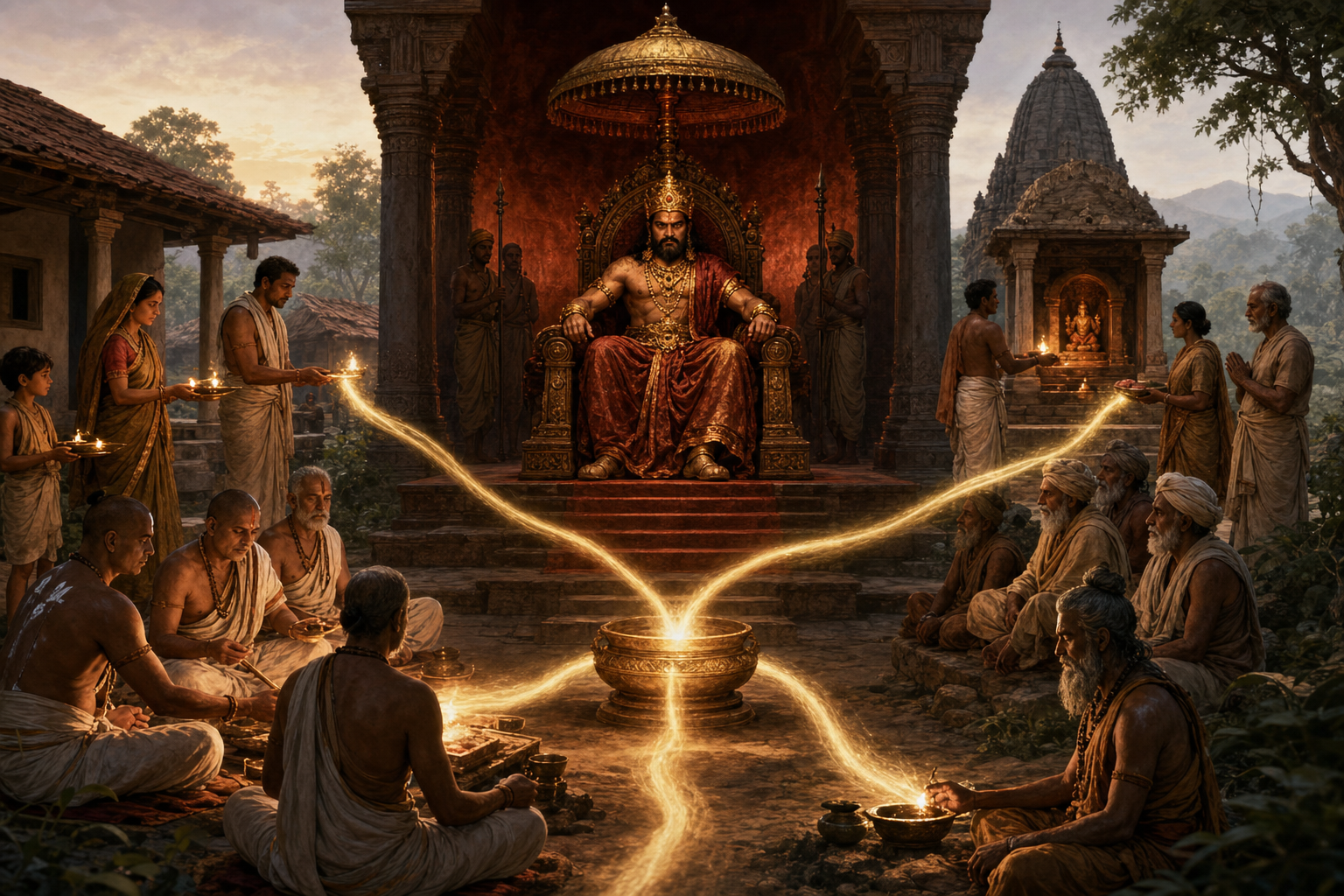
After the virtuous King Anga withdrew from rule, the realm installed his son Vena in the hope of immediate stability. The choice addressed an urgent political problem: a kingdom cannot simply leave the protective office vacant and expect social order to maintain itself.
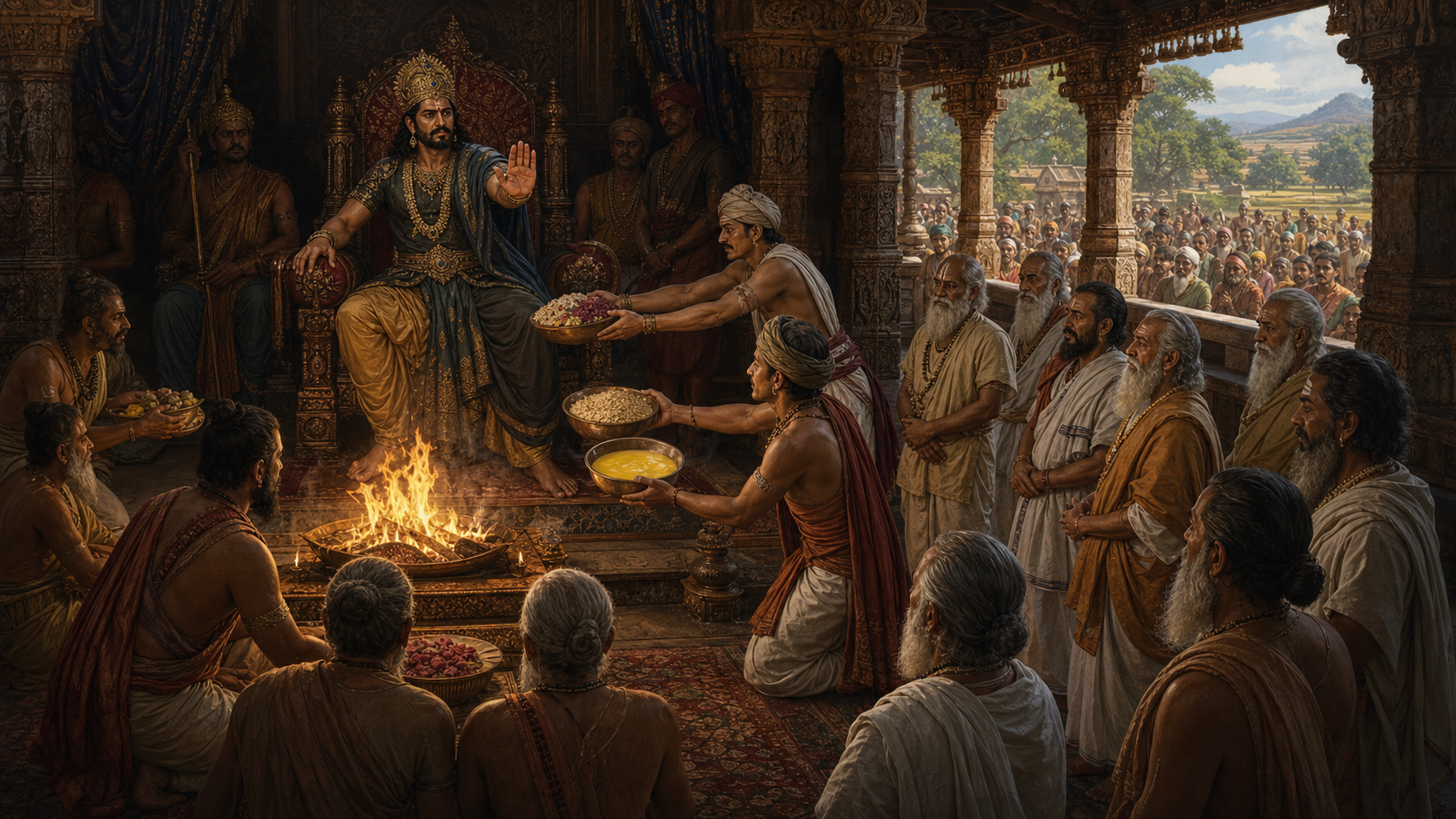
Yet the attempt to secure order produced a more serious disorder. Vena interfered with the sacrificial and devotional life of the realm, denied the transcendent source that gave kingship its meaning, and claimed that offerings owed to the divine should be directed to the sovereign. He did not merely govern religious institutions badly. He tried to occupy their sacred centre.
That distinction matters. A shallow reading turns the episode into a story about an impious man receiving supernatural punishment. The deeper political offence is usurpation. Vena treats the king not as the protector of a moral order but as its author, beneficiary, and final object of loyalty. Once the person of the ruler becomes indistinguishable from the office, criticism looks like betrayal, worship becomes political tribute, and obedience displaces conscience.
Rajadharma reverses that arrangement. The ruler receives a protective responsibility; he does not acquire ownership of dharma. Sacredness therefore places more limits on office, not fewer. A king who invokes the divine while refusing restraint is not displaying stronger sacred authority. He is hollowing it out.
You can apply this principle without pretending that an ancient monarchy and a modern republic are identical. Ask whether a leader acknowledges any law, duty, truth, or institution above personal will. Watch whether public resources and ceremonies honour a civilizational inheritance or are redirected toward a personality cult. Notice whether communities may pursue worship, charity, learning, ethical livelihood, and their legitimate forms of svadharma without being made dependent on personal favour.
A modern officeholder need not settle every metaphysical question to pass this test. The essential requirement is restraint: the state must not present itself, its leader, or its ideology as the highest object of human loyalty. Dharmic government can protect spiritual life without commandeering it. Indeed, its willingness to protect genuine plurality is evidence that it understands the sacred as something the state serves rather than owns.
The sages withdraw legitimacy only after counsel fails
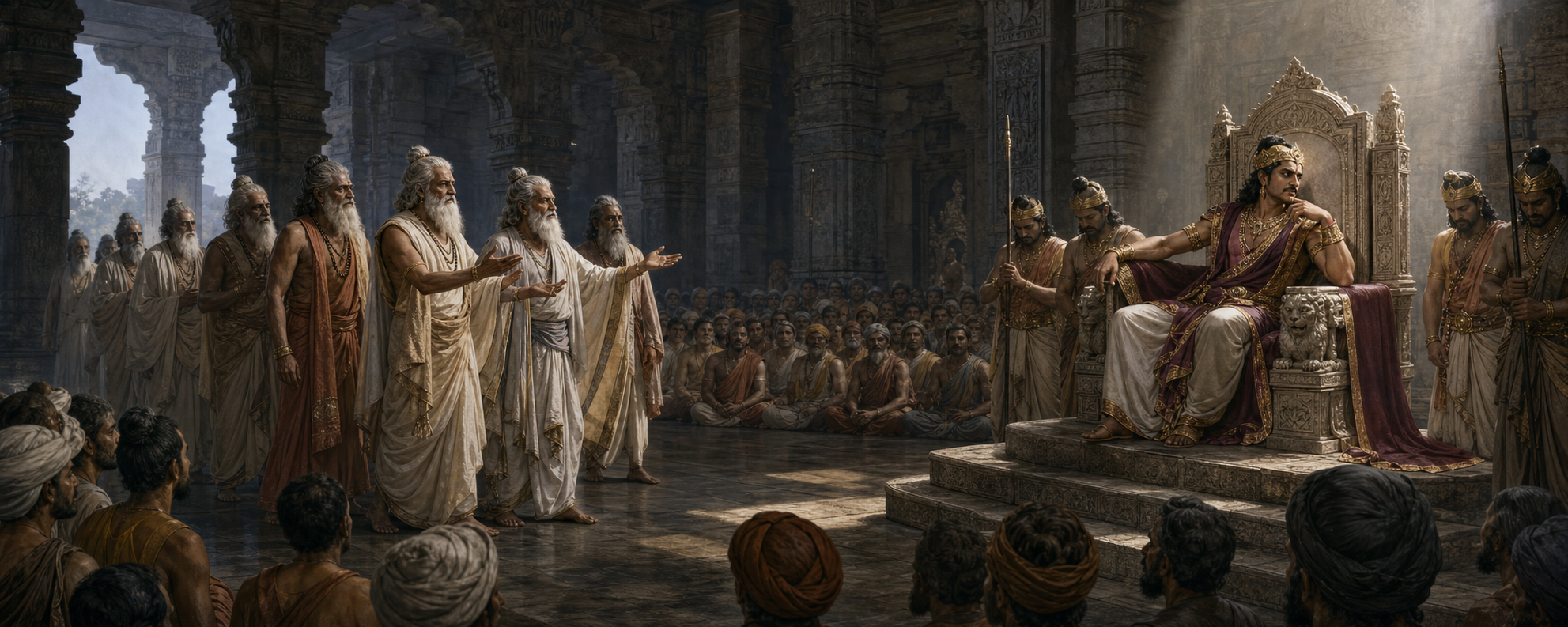
Śrīmad Bhāgavatam 4.14.34-37 brings the conflict to its severe conclusion. The sages admonish Vena and identify the inversion at the heart of his rule. He rejects their counsel. They then end his misrule through sanctified speech rather than conventional weapons.
This sequence is morally important. The sages are not offended spectators who act on a burst of rage. They first speak as custodians of an order older than the throne. Their indignation is disciplined by tapas, ethical restraint, truth, and responsibility for the whole realm. Vāk-śakti, the power of speech in this account, cannot be separated from the character and obligations of those who employ it.
The episode therefore supplies no warrant for vigilantism. A private person cannot imitate the sages merely by claiming purity, reciting a mantra, or declaring an opponent adharmic. Such an imitation discards every limiting feature of the narrative: recognised responsibility, prior counsel, disciplined intention, concern for public order, and acceptance of the duty to rebuild what follows.
Three levels of meaning can be held together without forcing one to cancel the others:
- Metaphysical: mantra is treated as efficacious sacred sound when uttered by persons formed through truth and austerity. Its potency is never reduced to a verbal technique available independently of character.
- Juridical: the sages’ pronouncement recognises that Vena has destroyed the moral warrant of his own rule. Their speech makes public a vacancy his conduct has already created.
- Inner and ethical: adharma is self-cancelling. When authority severs itself from truth, duty, and service, it may preserve the appearance of power while losing the trust that makes rule legitimate.
The juridical level offers the clearest contemporary lesson. Ethical institutions do not manufacture a leader’s wrongdoing by naming it. They establish facts, apply standards, and recognise the consequences. Courts, councils, scholars, spiritual teachers, journalists, and citizens serve governance when they can tell power a truth it would prefer not to hear. Their correction must still use legitimate, proportionate means. Moral certainty by itself does not authorise violence.
When you hear Vena’s fate invoked in present politics, ask four questions before accepting the analogy: Was counsel attempted? Who has the recognised duty to judge? What procedure limits personal vengeance? Who will protect the public during the transition? If those questions have no answer, the invocation is probably using scripture to sanctify anger rather than discipline it.
Removing misrule is only half of civilizational repair

Vena’s removal does not end the political problem. The sages must prevent anarchy and restore legitimate kingship. The account first externalises the accumulated vice associated with Vena’s rule and then brings forth King Prithu through a sanctified rite. Prithu becomes the positive answer to Vena: a ruler who restores prosperity, renews sacrificial and ethical life, and reconciles the earth with those responsible for her care.
The extraction of vice is best handled with interpretive care. Its usable political meaning is not that wrongdoing belongs inherently to a social group. It dramatizes the need to identify, contain, and separate destructive habits from the institutions being renewed. If corruption, flattery, coercive habits, and falsehood survive the departure of one ruler, changing the person at the top will not change the regime beneath him.
The transition from Vena to Prithu gives you a practical order for reform:
- Name the inversion precisely. Do not settle for “bad leadership.” Identify what the office has been made to serve: personal glorification, suppression of conscience, extraction without stewardship, or immunity from counsel.
- Preserve the legitimate function. Vena’s misconduct discredits his rule, not the need for protection and order. Reform must distinguish a necessary institution from the person who has corrupted it.
- Remove the embedded vice. Examine appointments, incentives, public rituals, language, and habits that taught people to reward obedience over truth. Otherwise the same pattern will recruit a new face.
- Prepare succession before celebrating removal. Decide who maintains essential duties, which restraints follow the successor, and how public confidence will be restored. A vacant throne can expose the vulnerable as surely as a corrupt one.
- Judge renewal by service. Prithu’s legitimacy appears in restored nourishment, prosperity, sacred life, and reciprocity with the earth. A replacement who offers only a new personality cult has not completed the transition.
This is where many moral critiques become politically thin. They know what must stop but cannot say what must continue on the next morning. The Vena-Prithu sequence refuses that incompleteness. Anyone demanding the withdrawal of authority also assumes a duty to think about continuity, competence, restraint, and the common good.
Public speech is already an act of governance
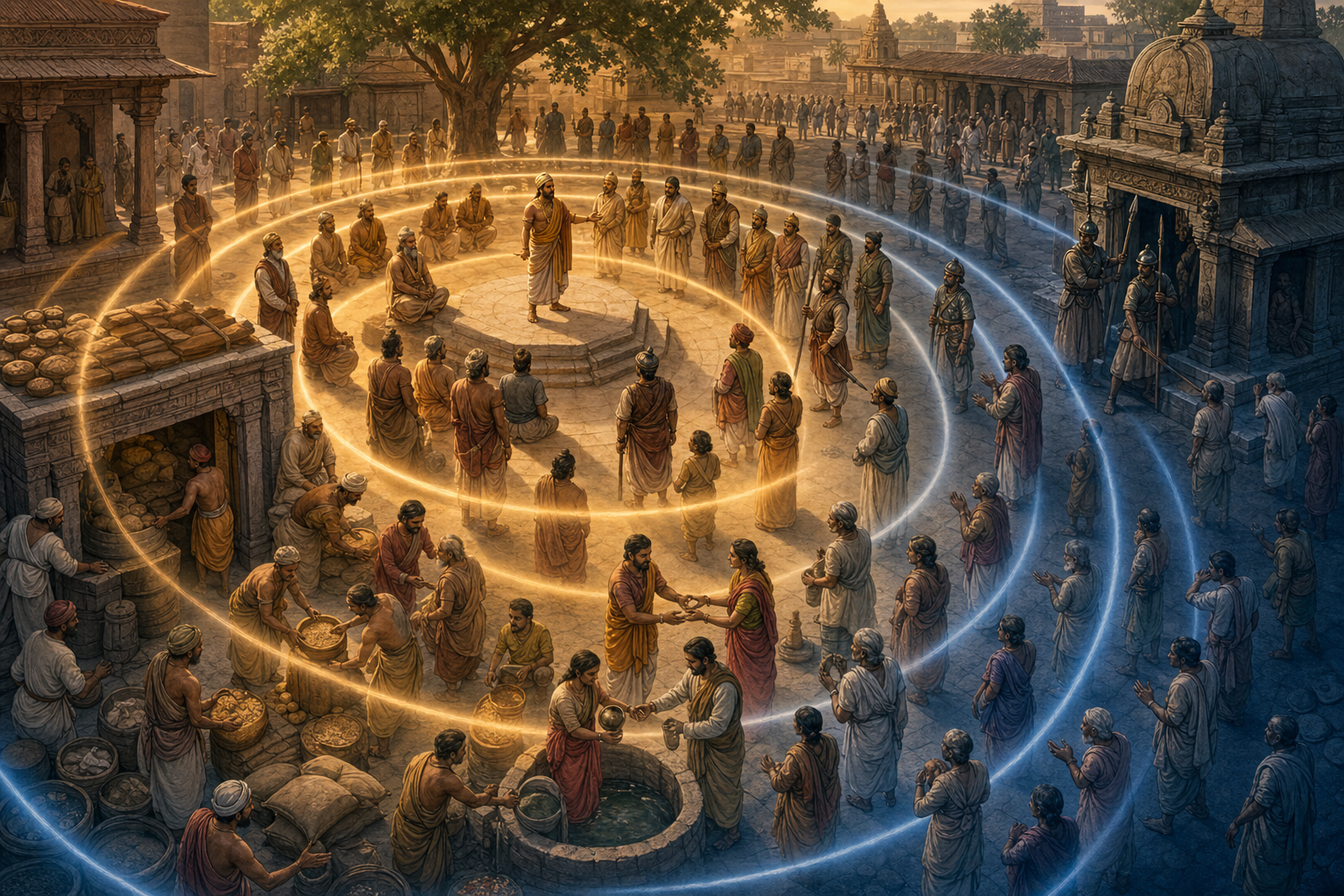
Vena governs through proclamations before the sages answer through mantra. Both sides use words, but their speech moves in opposite directions. Vena’s commands concentrate sacred honour in himself and disrupt the realm’s spiritual ecology. The sages’ words expose that false claim and restore a distinction between the office, the officeholder, and the higher order both are meant to serve.
This is why public language cannot be treated as decoration around policy. An edict, speech, slogan, judicial finding, or ritual formula tells people what may be honoured, questioned, offered, or refused. Repeated language also trains institutional reflexes. If every success is credited to one leader and every criticism is described as hostility to the realm, the vocabulary of stewardship has already been replaced by the vocabulary of possession.
The wider Dharmic family supplies complementary disciplines. Buddhist right speech directs words toward truth and compassion. Jain commitments to satya and ahiṃsā bind truthfulness to non-harm, while the Namokar Mantra directs reverence away from personal ego and toward spiritual qualities. Sikh devotion centres the Shabad and remembrance of the Divine Name. Hindu traditions place mantra within discipline, austerity, devotion, and truthful conduct. The shared point is not that every tradition holds an identical theory of sound. It is that spiritually consequential speech requires formation of the speaker.
Before you use religious language in leadership, activism, teaching, or family conflict, apply five checks:
- Is the claim true enough to survive scrutiny by someone outside your faction?
- Does the language correct an action, or does it strip a person or community of dignity?
- Are you speaking within a real duty and mandate, or using sacred vocabulary to enlarge your authority?
- Have proportionate counsel and correction been attempted before condemnation?
- Will you accept responsibility for the practical consequences of what your words set in motion?
Mantra practice can help steady intention before difficult speech, but it is not a magical substitute for evidence, lawful procedure, competent administration, or patient persuasion. In the Vena episode, spiritual power is credible because it is inseparable from disciplined responsibility. Technique without character reproduces Vena’s error in another form: it tries to possess sacred power rather than serve through it.
Key takeaways: five tests for Dharmic authority
- The higher-order test: Does the ruler accept moral and institutional limits above personal preference?
- The stewardship test: Are worship, conscience, charity, learning, livelihood, and the earth protected as trusts rather than treated as instruments of political loyalty?
- The counsel test: Can qualified people contradict the leader without being cast as enemies of the realm?
- The correction test: Are wrongdoing and loss of legitimacy addressed through recognised, proportionate procedures rather than private vengeance?
- The succession test: Does reform preserve essential duties, remove corrupt habits, restrain the successor, and produce visible service to the public?
Use these questions the next time sacred language enters a political claim. Do not ask only whether a leader honours Dharma in public. Ask what that reverence makes the leader willing to limit, protect, hear, and repair. That is where sacred authority becomes ethical governance rather than ornament.
References
