
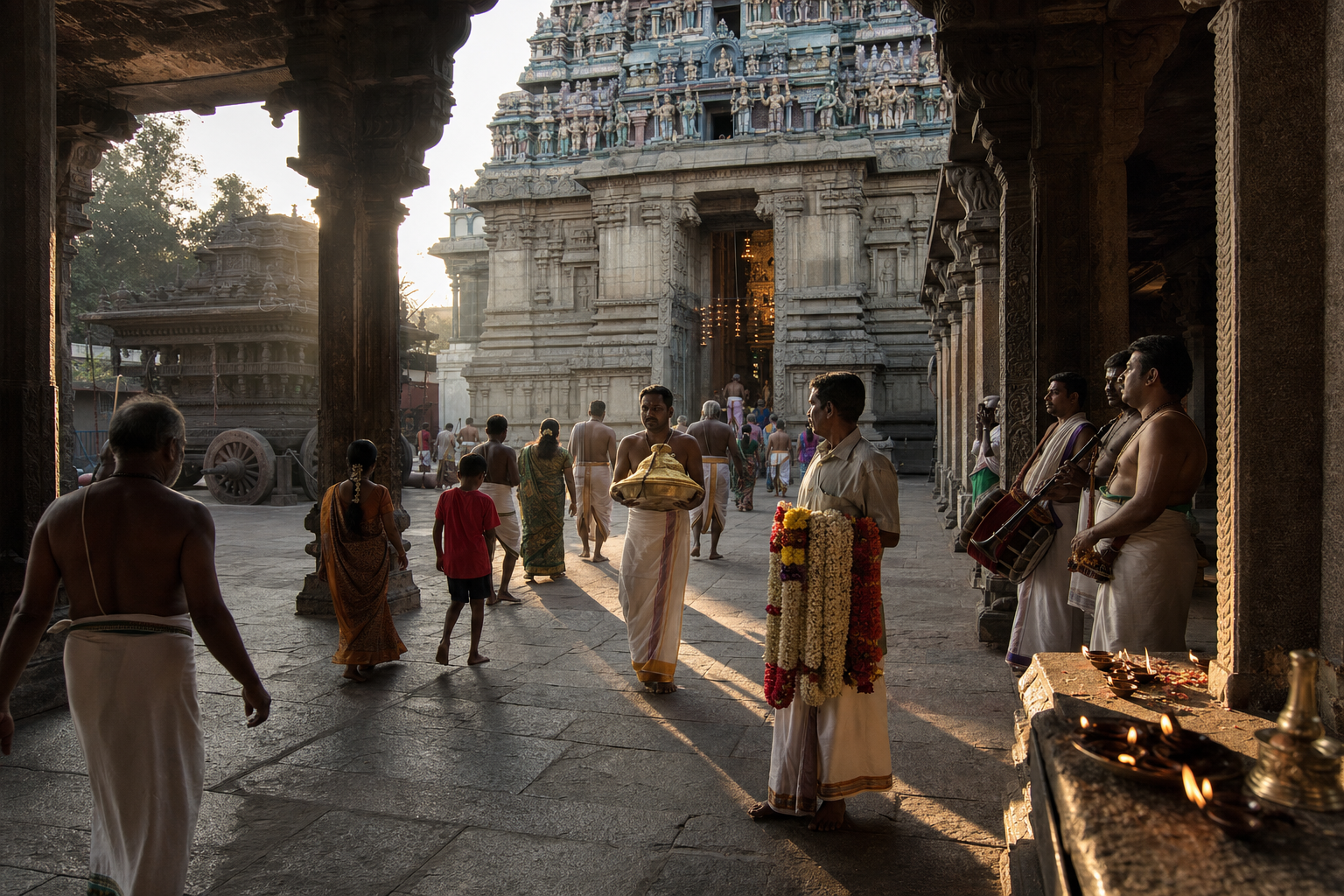
You can walk through a South Indian temple, photograph the gopura, receive darshan and still miss much of what the place is preserving. The archive is not confined to inscriptions or old stone. It is moving around you in the route to the sanctum, the order of offerings, the sound of a composition, the festival vehicle waiting in a mandapa and the people responsible for repeating an inherited duty.
A more rewarding visit begins with a practical question: what kind of memory is being carried here, and how is it kept alive? Once you learn to separate sacred tradition, historical documentation and present observation, the temple becomes legible without being reduced either to a museum or to an architectural checklist.
A living archive preserves obligations, not only objects
A conventional archive protects records after events have occurred. A living temple does something more demanding. It preserves knowledge by renewing it. A lamp must be lit again. A murti must be adorned again. A mantra must be recited in its proper setting. A festival route must be walked again. A composition must be taught to another voice.
This repetition explains why age alone is a poor measure of continuity. A building can survive after its ritual ecology has disappeared. Conversely, a structure may be repaired or expanded while worship, hereditary knowledge and festival memory continue. South Indian temples commonly contain material from different periods, so an old-looking pillar, a later gopura and a current ritual need not belong to the same historical moment.
Tirumala makes the distinction especially clear. Its sacred memory places Sri Venkateswara at the dawn of Kali Yuga, while inscriptions and copper-plate records trace patronage, endowments and structural development across more than a millennium. These are not interchangeable claims. Sacred memory explains why the kshetra matters within devotional life. Epigraphy identifies how particular people and institutions supported it at identifiable moments. Present observation shows what is being done now.
Keep those three registers separate in your notes:
- Observed: what you can see or hear during the visit, such as a procession, recitation, threshold or offering.
- Documented: what an inscription, charter, notation or administrative record establishes.
- Received: what the temple’s sthala-purana, oral memory or devotional lineage teaches about the deity and place.
The registers can illuminate one another, but they answer different questions. Confusion begins when a devotional account is forced to behave like an administrative ledger, or when an inscription is expected to exhaust the spiritual meaning of a kshetra. A responsible reading preserves the character of each.
Read the temple through five connected layers
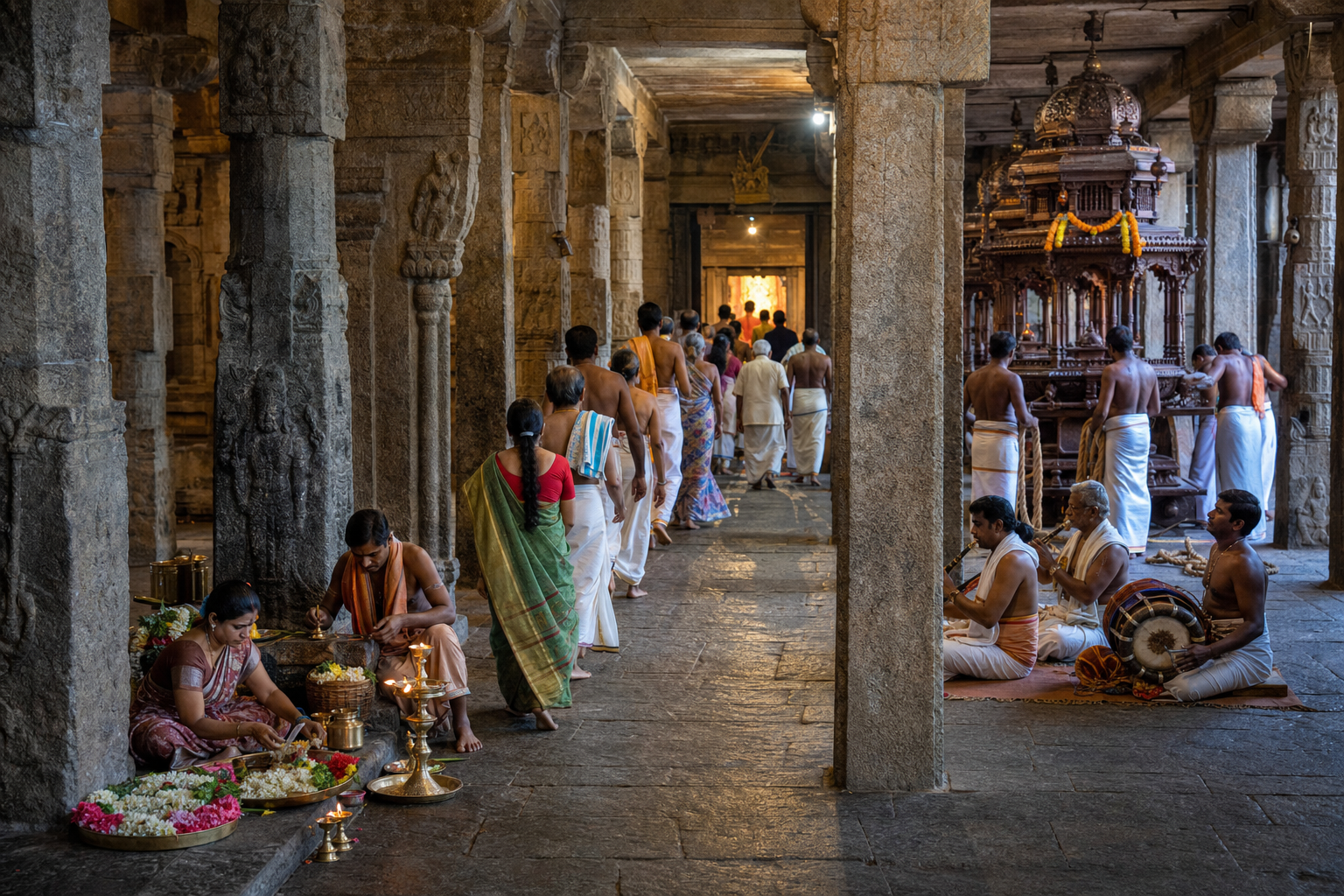
You do not need specialist training to begin. Move through five layers and keep asking how each one supports the others.
- Space: Notice how the gopura, prakara, mandapa, sanctum and vimana organize movement. Do not treat them as isolated architectural terms. Ask where you slow down, turn, wait, circumambulate or lose sight of the outside world. At Tirumala, concentric prakaras lead toward the garbhagriha beneath the Ananda Nilaya Vimana. The spatial sequence teaches through the body: public movement narrows toward concentrated presence.
- Ritual: Watch for order rather than spectacle. Which action awakens the deity, which adorns, which offers food and which closes the ritual day? Tirumala’s Vaikhanasa practice moves through Suprabhata, Thomala, Archana, Naivedya and Ekanta seva. That sequence is theology performed in time. It should not be assumed to describe every South Indian temple, because ritual traditions and local protocols differ.
- Institution: Look beyond the donor’s name to the duty a donation sustained. South Indian temple records preserve gifts of land, villages, gold, grain and lamps for worship, recitation, festivals and temple personnel. Pallava, Chola, Pandya and Vijayanagara patronage at Tirumala appears in this language of continuing obligation, and royal women are prominent among its benefactors. The useful question is not merely who gave, but what had to keep happening after the donor was gone.
- Festival and public space: A temple is larger than its walls. During Tirumala’s traditionally nine-day Salakatla Brahmotsavam, the Lord travels through the mada streets on different vahanas, with Garuda Seva as the climactic observance and Chakrasnanam closing the cycle. Procession turns streets, water, vehicles, music and collective memory into parts of the archive. If you visit only on an ordinary day, ask what the stationary vahanas and processional routes become during utsava.
- Sound and performance: Listen for names, places and attributes that architecture alone cannot explain. Temple-centered compositions can preserve tirthas, iconographic features, ritual associations, sacred stories and theological relationships. Muthuswami Dikshitar’s kritis unite such details with raga, tala and Sanskrit poetics, allowing temple memory to travel into homes, classrooms and concert halls.
These layers are most revealing at their points of contact. A mandapa may house a festival vehicle. An endowment may finance the offering performed there. A composition may name the deity as seen during that festival. The same tradition is being stored materially, administratively, ritually and musically.
Follow one recurring act from sanctum to society
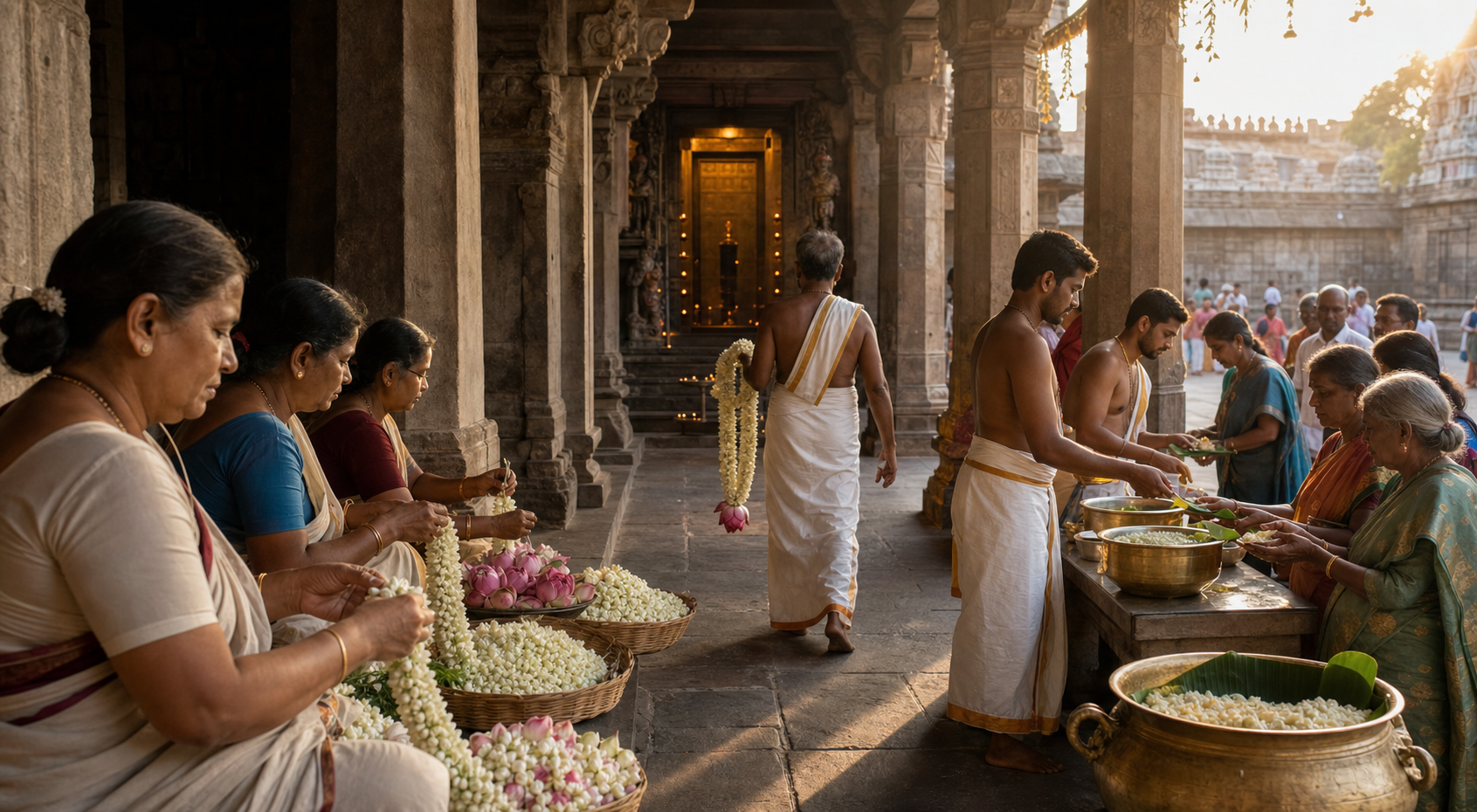
Trying to understand an entire temple in one visit usually produces a collection of disconnected facts. A better method is to choose one recurring act and follow its maintenance chain.
Consider a perpetual lamp. The visible flame is only the final moment. Behind it may stand an endowment, the management of resources, the provision of materials, an assigned ritual duty and a rule about when the lamp is to burn. The important inference is that perpetual did not mean an indestructible physical object. It meant an obligation designed to outlast its donor. When temple inscriptions mention lamps, ask what institutional arrangement converted a past gift into repeated worship.
Food reveals an even wider chain. Naivedya belongs to the ritual relationship with the deity; prasada carries grace outward to devotees; organized feeding turns hospitality and dana into public service. At Tirumala, the Srivari laddu, sanctified kitchens and annaprasadam programs show how theology, quality control, administration and care can converge around food. Reducing the kitchen to logistics misses its sacred purpose. Treating prasada as merely a souvenir misses its social and devotional movement.
A garland offers another path. Thomala seva is not simply decoration. It belongs to a timed act of honoring the deity. The flowers, the person who prepares them, the iconographic form of the alankara and the devotees who see it all participate in the event. Even when you cannot enter the sanctum or observe the full rite, you can ask how the offering fits into the day’s sequence.
Use the same questions for a lamp, flower, recitation, musical performance, festival vehicle or food offering:
- What exactly is repeated: an action, a text, a route, an offering or a form of adornment?
- When does it occur: daily, on a particular observance or during an annual festival?
- Which space and objects does it require?
- What endowment, office, lineage or community responsibility has supported it?
- Which part is visible to a visitor, and which part survives through explanation, memory or documentation?
- Has the practice continued unchanged, or has its method adapted while its purpose endured?
This last question matters. Continuity is not the absence of change. Repairs, new administrative arrangements, altered performance settings and technological systems can all enter temple life. The serious task is to identify what changed, what remained obligatory and who had the authority to carry the practice forward.
Listen to compositions as sacred maps, not background music
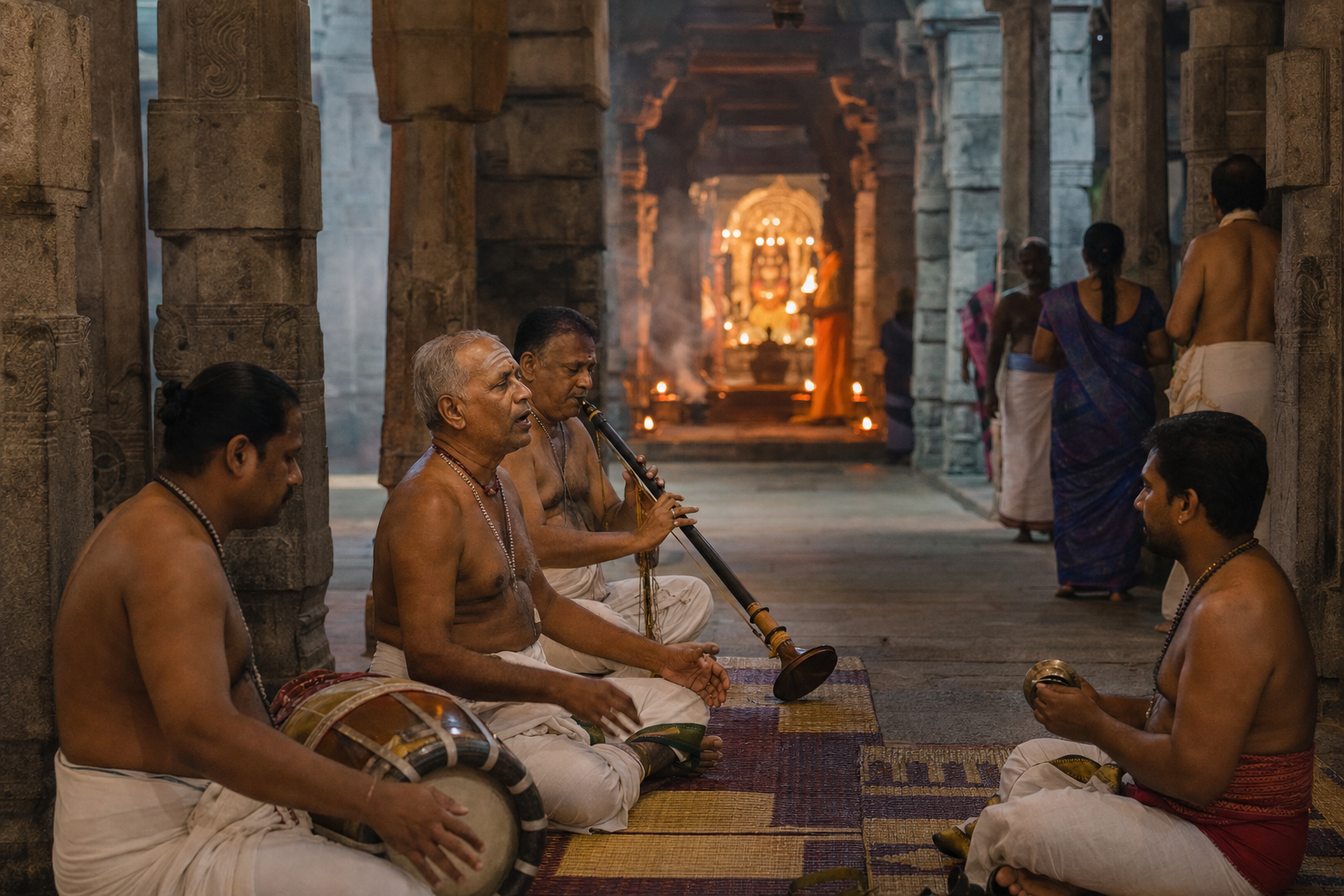
Stone is not the only durable medium. A composition retained in a teaching lineage can carry a temple’s name, deity, sacred geography and doctrinal associations far beyond the site. This is especially clear in the work of Muthuswami Dikshitar (1775-1835), whose kritis bring devotion, scholarship and musical architecture into the same form.
Dikshitar’s Sanskrit compounds and faster madhyamakala passages are not ornamental padding. They can condense sthala-purana, iconography, sacred geography, Agamic and Tantric ideas, and even the identity of a raga. His Guruguha signature connects authorship with devotion to Subrahmanya, while the musical setting gives the words a disciplined structure of raga and tala.
Several composition cycles show how much can be preserved in sound. The Panchabhuta Linga kritis connect Shiva’s five elemental abodes with place, ritual and theology. The Kamalamba Navavarna cycle gives musical form to layered Sri Vidya worship. The Navagraha kritis join devotional attributes with jyotisha, while the Abhayamba and Tyagaraja vibhakti compositions turn Sanskrit grammar into a method of praise. These are prayers first, but their devotional purpose does not prevent them from carrying precise cultural knowledge.
That distinction should shape how you use a kriti during a temple visit. Do not treat its lyrics as if they were a neutral inventory. Instead:
- Choose a composition connected with the temple, deity or sacred geography you plan to encounter.
- Read a reliable text and translation before listening. Mark names of the deity, place, tirtha, iconographic attributes and ritual acts.
- Separate place-specific description from theology, poetic praise and musical information such as a raga mudra.
- Listen for how the slower lines and madhyamakala passages distribute attention. The musical form affects which details remain memorable.
- Return to the composition after the visit. Note which words now correspond to something you observed and which still require explanation from the tradition.
Transmission deserves the same attention as composition. Subbarama Dikshitar’s Sangita Sampradaya Pradarshini, published in 1904, preserved notation, raga-lakshana and interpretive guidance associated with the Dikshitar lineage. The Tanjore Quartet, among Dikshitar’s disciples, carried aspects of this musical and rhythmic world into dance and helped shape the Bharatanatyam margam. Temple knowledge therefore continued through notation, pedagogy, voice, veena and embodied movement, not through a single medium.
The same musical world also demonstrates that fidelity need not mean immobility. Dikshitar could work within older Carnatic raga grammar while engaging selected Hindustani ragas and European band melodies in his nottusvara-sahityas. Sanskrit devotional identity remained central even as the acoustic vocabulary widened. When you encounter adaptation in temple culture, ask whether it displaced the sacred purpose or became a new vehicle for carrying it.
Use a field method that respects worship and evidence
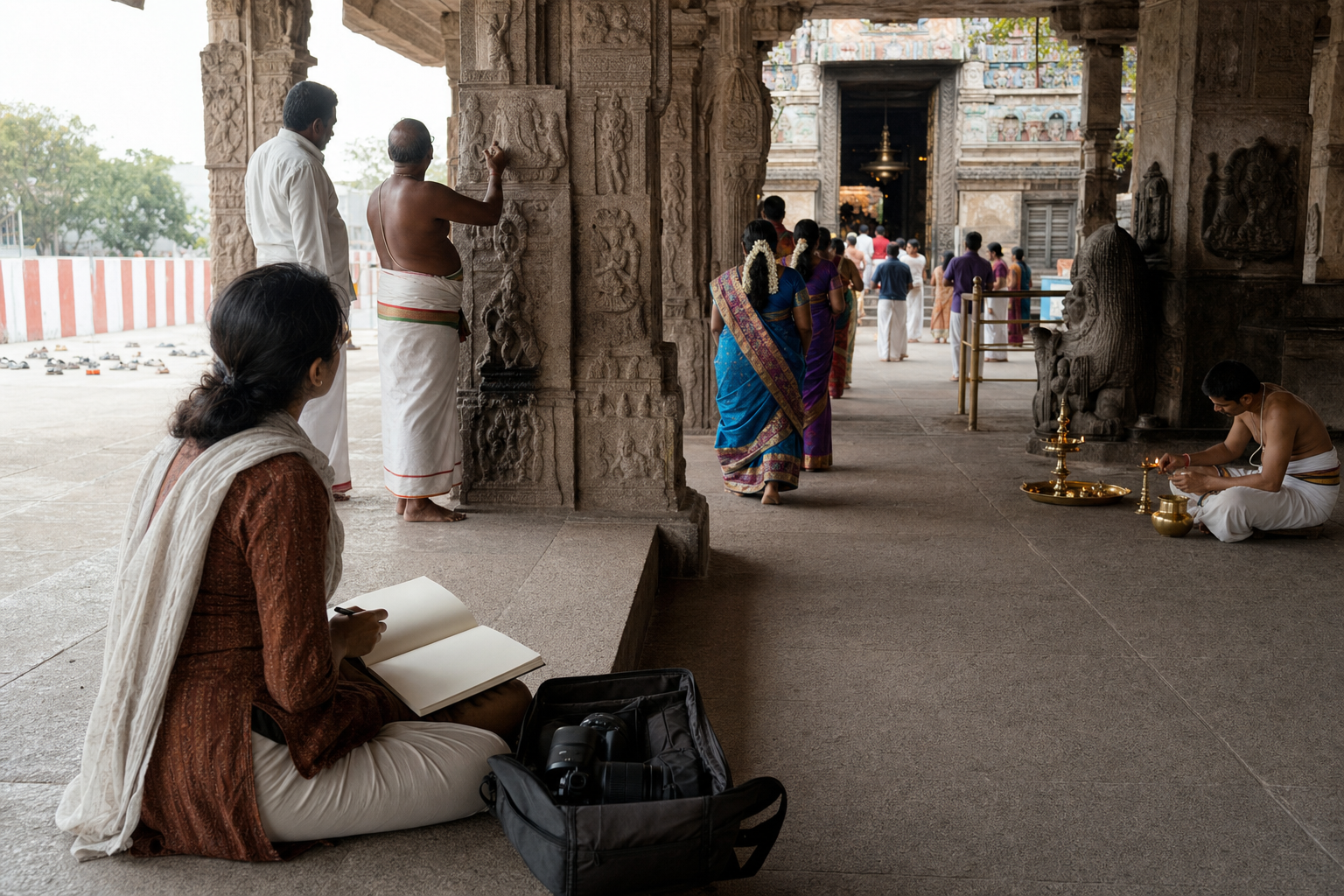
A temple is not a ruin arranged for unrestricted inspection. It is a place of worship with rules, restricted spaces and people performing responsibilities. Your method should improve attention without obstructing seva or turning devotees into exhibits.
- Begin with a narrow question. Ask how one festival uses the streets, how one offering is sustained or how one composition describes the presiding deity. A focused question will reveal more than an attempt to catalogue everything.
- Check current local practice. Confirm timings, access rules, photography restrictions and festival arrangements through the temple’s authorized channels. Do not project Tirumala’s Vaikhanasa sequence onto another temple or assume that every shrine within one complex follows an identical schedule.
- Map movement before details. Walk only through permitted areas and note the progression from outer threshold toward the sanctum. Mark where processions turn, where devotees circumambulate, where musicians may perform and where festival objects rest.
- Record the evidence register. Label each note as observed, documented or received. If a priest, hereditary custodian or informed devotee explains a tradition, preserve it as attributed oral knowledge rather than silently converting it into a dated historical claim.
- Trace a maintenance chain. For one repeated act, identify its space, objects, timing, personnel and institutional support. If one link is unknown, leave it unknown and frame a better question for later.
- Pair sight with sound. Listen to a relevant kriti or recitation with its words in front of you. Look for details that architecture made visible and for meanings that the physical visit could not supply.
- Write down uncertainty. A repaired structure may preserve an older plan; a current festival may contain elements from several periods; an oral tradition may convey sacred meaning without supplying a datable chronology. Responsible interpretation does not require false certainty.
Key takeaways
- A South Indian temple is a living archive when inherited duties continue through worship, teaching, patronage and community participation.
- Architecture tells you how sacred movement is organized, but ritual tells you what the spaces are for.
- Inscriptions become more useful when you ask which recurring obligation a gift or endowment sustained.
- Festivals extend the archive into streets, water, music, vehicles and collective memory.
- Temple compositions preserve knowledge through devotion; read them as prayers with historical and cultural detail, not as neutral catalogues.
- Keep observation, documentary evidence and received sacred tradition distinct before relating them.
On your next visit, resist the urge to collect disconnected sights. Choose one threshold, one recurring offering or one temple-centered song, and ask how it is kept alive. That question will take you beyond architectural admiration and into responsible participation in Bharat’s continuing civilizational memory.
References
- DharmaRenaissance Blog — Muthuswami Dikshitar: Timeless Master of Carnatic Music’s Sacred, Scholarly Soundscape
- DharmaRenaissance Blog — Timeless Tirumala Tirupati: History, Architecture, Ritual Science, and Venkateswara’s Grace
