
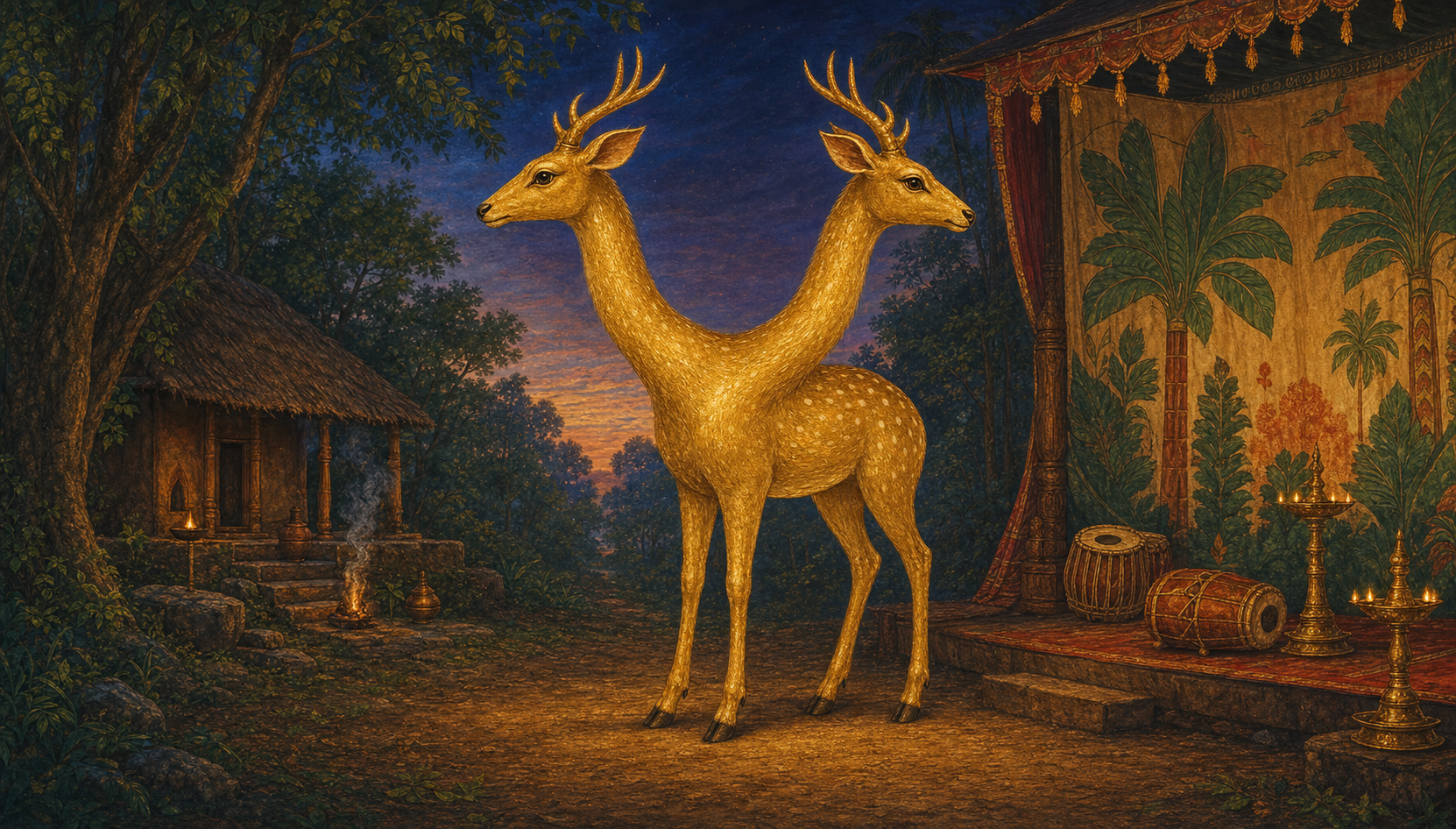
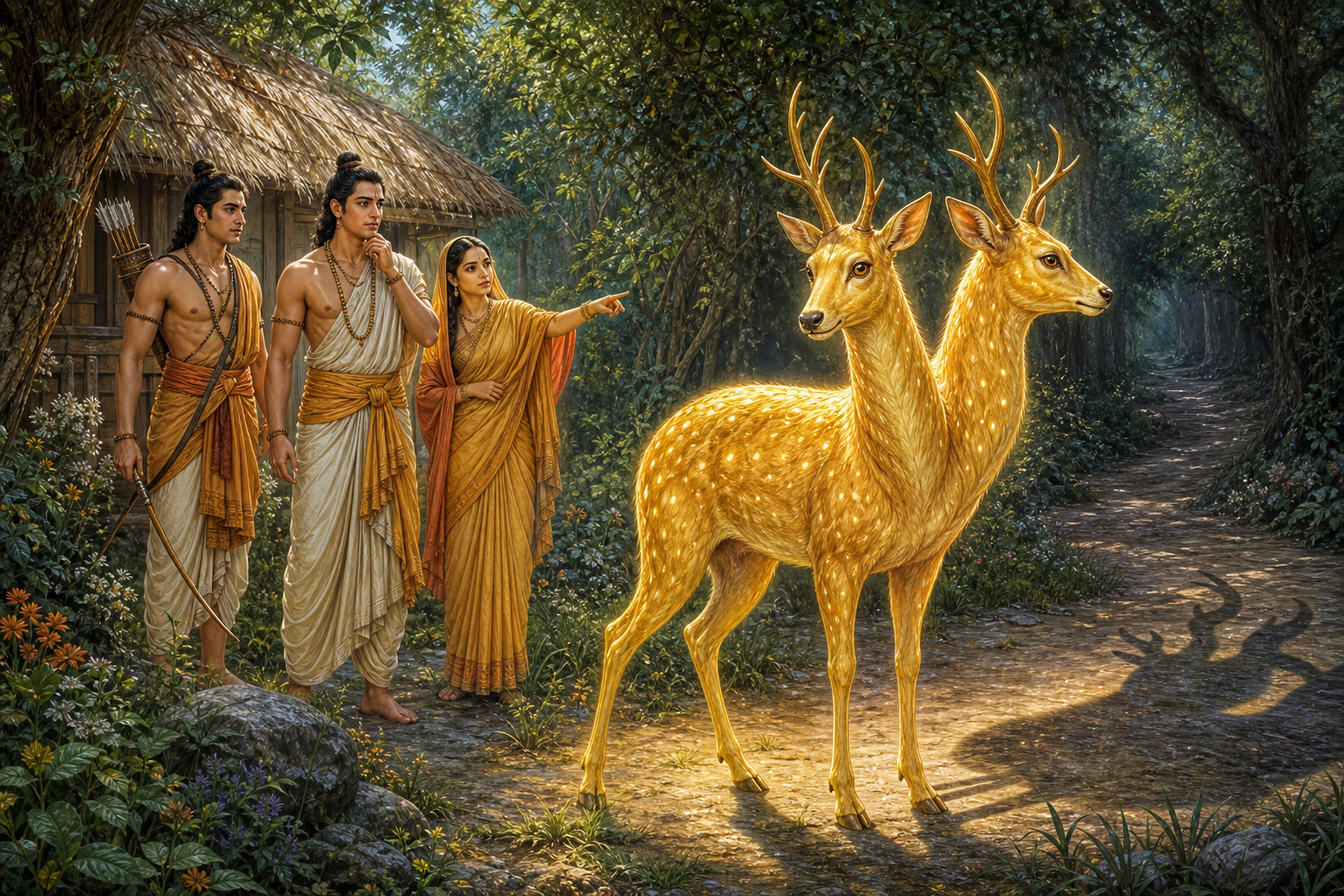
You have seen a painting, stage image, or online claim showing Marica as a golden deer with two heads, and you want a clean answer: is that form actually in the Ramayana? It is a genuine motif in select Tamil and Kerala folk and performance traditions, but it is not a feature stated in Valmiki’s description of the deer.
That distinction does not make the regional image false or disposable. It tells you how to read it. The familiar golden deer belongs to the narrative foundation; the second head is a performative interpretation that makes deception visible before the consequences unfold.
Start with the deer Valmiki actually describes
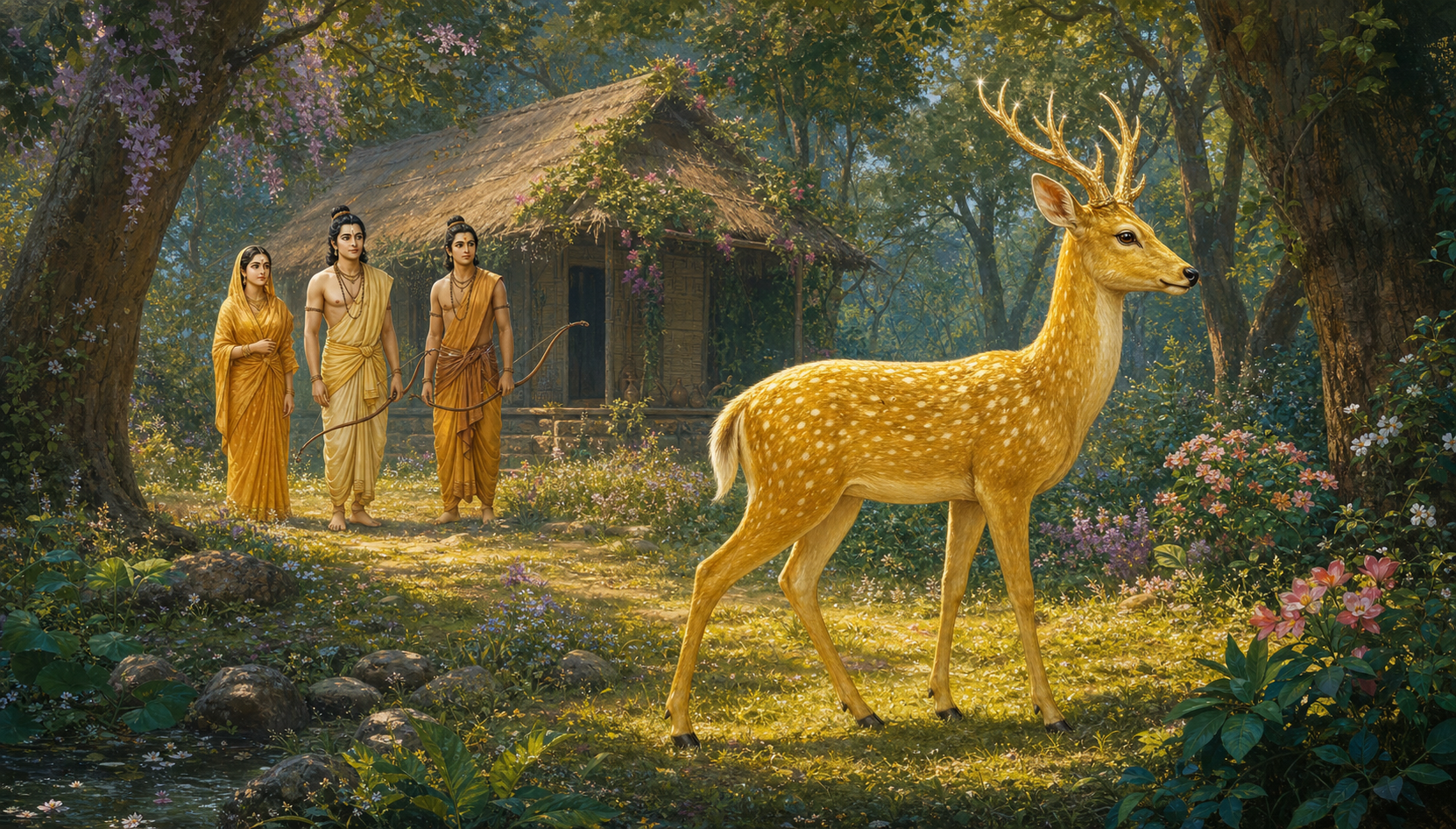
In the Aranya Kanda, around sargas 41-44, Ravana pressures Marica to help separate Rama from Sita. Marica assumes the form of a preternaturally beautiful golden deer. Sita is captivated by an animal that exceeds anything ordinary nature could produce, and Rama goes after it while Lakshmana remains responsible for her safety. The resulting separation creates the opening Ravana needs for the abduction.
The disguise is already impossible and deceptive. Valmiki does not need a second head to establish that point, and the text does not state that the animal has one. If someone attributes a two-headed deer directly to Valmiki, ask for the kanda, sarga, verse, and edition. A reference only to the golden-deer episode does not prove the extra head.
This is the first distinction to keep clear: a feature can belong to the Ramayana tradition without appearing in every Ramayana text. The epic has moved through Sanskrit composition, regional literary works, oral memory, temple narration, song, dance, and theatre. Those forms preserve a shared narrative while placing different interpretive accents on it.
Place the second head in the correct narrative layer
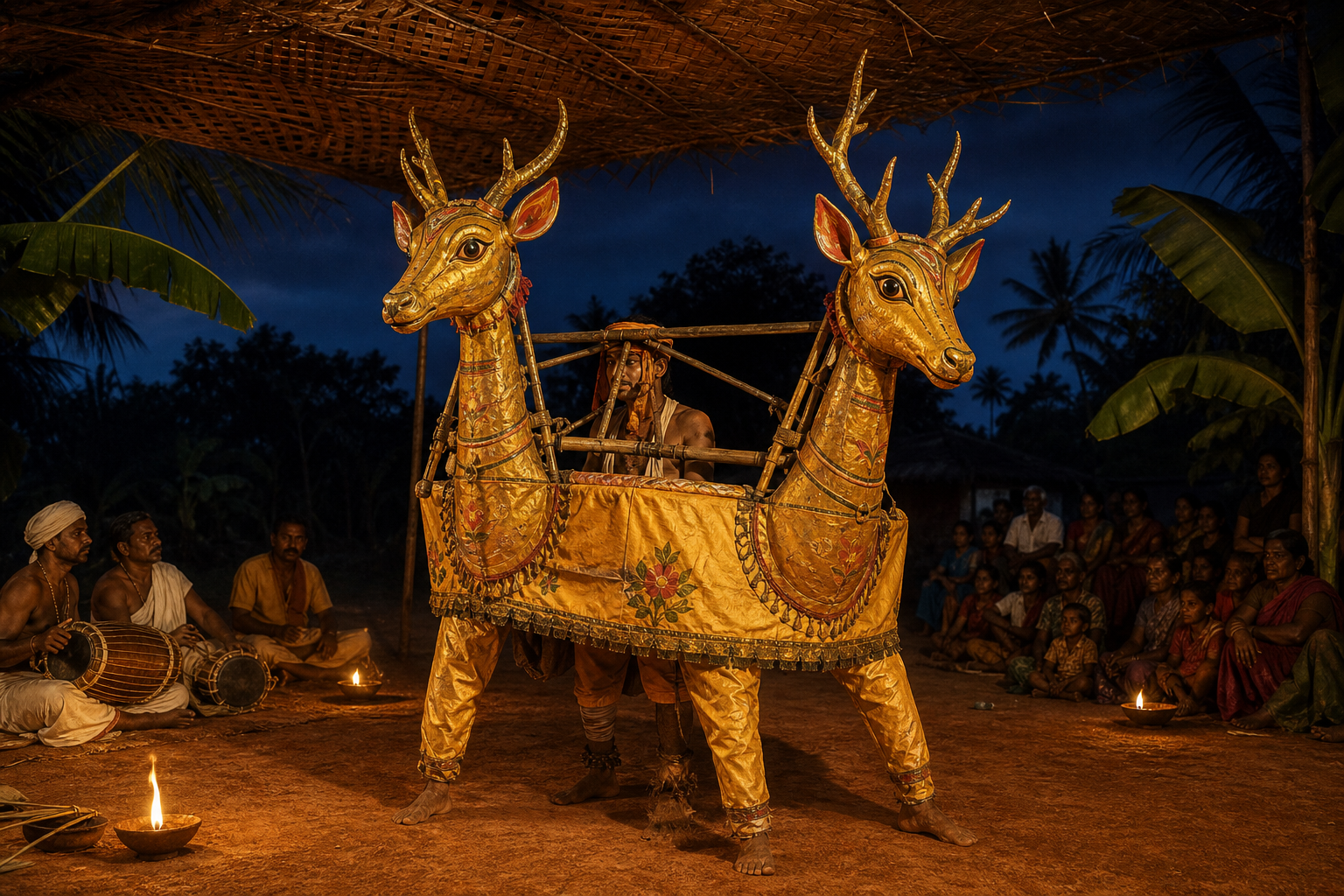
The phrase sometimes associated with the Tamil motif is iru-thalai maan, meaning a two-headed deer. Its safest attribution is not to Tamil tradition as a whole, but to select oral and performance idioms. Some Kerala storytelling environments also give the deer an intensified, unnatural form that can include or resemble this doubling.
| Ramayana layer | What you can responsibly say | What you should not assume |
|---|---|---|
| Valmiki Ramayana | Marica becomes a wondrous golden deer in the Aranya Kanda; no two-headed feature is stated. | That Valmiki describes a two-headed deer. |
| Kamba Ramayanam | Kamban heightens the disguise’s extraordinary beauty and dramatic unreality. Later commentary and performance can push that hyper-reality toward imagery such as doubling. | That Kamban explicitly gives the deer two heads without a cited passage establishing it. |
| Malayalam devotional and performance settings | Story worlds shaped by the Adhyatma Ramayanam Kilippattu, kathakali, and allied arts can magnify the deer’s unnatural wonder. | That every Malayalam telling uses the two-headed form, or that the Adhyatma Ramayanam itself necessarily states it. |
| Tamil oral and stage traditions | The two-headed deer can function as a memorable theatrical device in select repertoires associated with therukoothu, kattaikkuttu, and villupattu. | That there is one uniform Tamil version of the episode. |
This layered view prevents two opposite errors. One error back-projects a regional stage image into Valmiki. The other dismisses anything absent from Valmiki as a corruption. Neither approach understands how a living sacred narrative operates across text and performance.
Kamban is especially important to handle with care. His poetry intensifies Marica’s disguise, but the connection between that poetic hyper-reality and the doubled animal belongs particularly to subsequent interpretive and performance lineages. Similar care is needed in Kerala: heightened wonder within a storytelling ecology is not the same thing as a verbatim statement in every text associated with that ecology.
The second head turns maya into something you can see
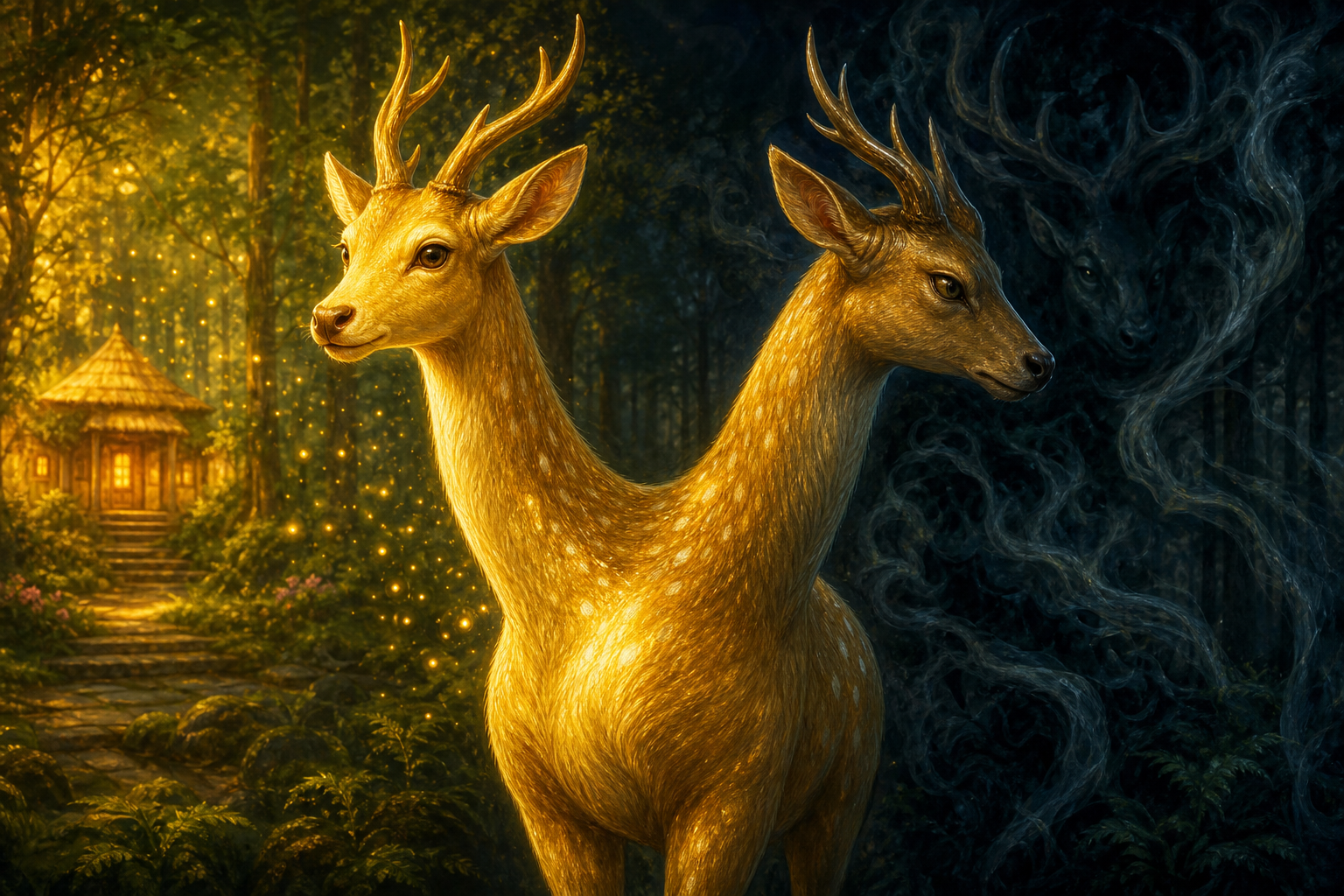
A two-headed deer works on stage because the audience recognizes the deception before the characters fully respond to it. The body itself announces that natural order has been bent. What looks precious is also structurally wrong.
The first symbolic force is duplicity. Two heads imply divided presentation: more than one face, direction, or promise, with no stable truth behind the display. The animal therefore embodies the method of the plot. Ravana cannot reach his goal through a righteous encounter, so he engineers an appearance that conceals intention.
The second force is distraction. A doubled spectacle gives the eye more to follow and the mind more to explain. That external multiplication mirrors what desire can do internally. Attention divides, ordinary tests are suspended, and the urgent appearance displaces the duty immediately at hand. The practical warning is not that beauty must be distrusted. It is that fascination should not be allowed to disable discernment.
The third force is the inversion of nature. A golden animal is already beyond ordinary experience; a second head pushes the disguise even farther from the natural world. Yet the very impossibility that should provoke caution can increase fascination. This is how the motif sharpens the episode’s account of maya: an illusion need not be plausible when it is precisely tailored to desire.
The Sanskrit expression mriga-trishna, literally the deer’s thirst, refers to a mirage. It evokes an animal pursuing water that appears to be present but is not. Marica’s disguise stages the same cognitive movement. The senses register radiance, the mind assigns value to it, and action follows before appearance and reality have been separated. The second head dramatizes that error by multiplying the apparent promise without adding any truth.
You can also place this lesson beside other Dharmic accounts of misperception without pretending that their doctrines are interchangeable. Hindu thought speaks of kama entangled with maya; Buddhist teaching examines craving and ignorance; Jain teaching warns that attachment and delusion bind the self; Sikh wisdom identifies haumai and the deceptive glamour of worldly display. The shared practical point is disciplined attention: do not surrender ethical judgment merely because an appearance has been designed to command it.
Do not turn the episode into blame directed at Sita
The symbolism becomes distorted when the entire abduction is reduced to Sita wanting a beautiful deer. Ravana plans the violation. Marica knowingly creates the deceptive conditions. Ravana then exploits a separation produced through guile. Wonder, misjudgment, manipulation, and deliberate adharma are not morally equivalent acts.
This matters whenever you teach the scene to children, discuss it in a study group, or caption an image. The useful question is how a predatory scheme captures attention and disrupts protective relationships. The unhelpful question is how to make the person targeted by that scheme carry the offender’s responsibility.
The two-headed form can actually improve the ethical reading. Because the audience can see that the lure has been artificially constructed, attention returns to the intelligence behind the deception. The deer’s beauty is not an accidental temptation. It is a weapon chosen because it can make an impossible object feel urgently desirable.
At the same time, the episode does ask every listener to examine discernment. Desire narrows the field of attention; fear and urgency can narrow it further. A dharmic response therefore requires both personal self-command and trustworthy relationships whose warnings are not casually discarded. That lesson applies to everyone in the scene without erasing the difference between vulnerability and culpability.
How to assess a two-headed-deer claim or depiction
If you are evaluating a painting, performance, book, video, or social-media claim, use the following sequence. It will let you respect regional creativity without making an unsupported textual attribution.
- Identify the claimed carrier. Ask whether the two heads are being attributed to a Sanskrit verse, a regional literary Ramayana, an oral account, a stage convention, or a modern visual interpretation. The word Ramayana by itself is too broad to settle that question.
- Request a locator appropriate to the claim. A textual claim needs a named work and passage. A performance claim needs a genre, locality, troupe, repertoire, or documented staging. Do not accept a reference to the Aranya Kanda alone as evidence for the second head.
- Keep absence and inauthenticity separate. The feature’s absence from Valmiki means it should not be attributed to Valmiki. It does not mean a community’s inherited performance symbol is meaningless or fraudulent.
- Avoid turning affinity into proof. Kamban’s heightened description can help explain why later performers intensified the animal, but thematic continuity does not by itself establish that a particular line of Kamban names two heads.
- Use precise language when labeling the image. A careful caption would read: Marica as a two-headed golden deer, a motif found in select Tamil and Kerala folk or performance traditions. Avoid calling it the original Ramayana’s two-headed deer.
- Interpret only after locating. Once you know that the second head is a regional amplification, you can discuss its work as a sign of duplicity, distracted attention, maya, and the unnatural machinery of adharma.
Precision is especially important because memorable visual forms travel faster than their explanations. A stage prop can become an illustration, the illustration can acquire a confident caption, and the caption can soon be mistaken for a verse. Recording the narrative layer at the point of sharing prevents that drift.
Key takeaways
- Valmiki’s Aranya Kanda describes Marica as an extraordinary golden deer, not explicitly as a two-headed one.
- The doubled form belongs to select Tamil and Kerala folk, oral, and performance settings; it should not be generalized to every regional Ramayana.
- Kamba Ramayanam and Malayalam devotional-performance environments intensify the deer’s unreality, but heightened description is not automatic proof of an explicit two-headed passage.
- The second head makes three ideas visible: duplicity, divided attention, and the distortion of natural order by adharma.
- A responsible caption names both the character and the narrative layer instead of presenting a performance symbol as a universal scriptural detail.
The next time this image appears, ask which layer of the tradition you are seeing before asking whether it is true or false. Then carry its lesson forward: where Marica scatters attention through spectacle, Hanuman later demonstrates the opposite discipline – clarity fixed on a dharmic purpose. When an appearance demands immediate pursuit, pause long enough to identify what duty, relationship, or boundary the pursuit would make you leave behind.
References
