
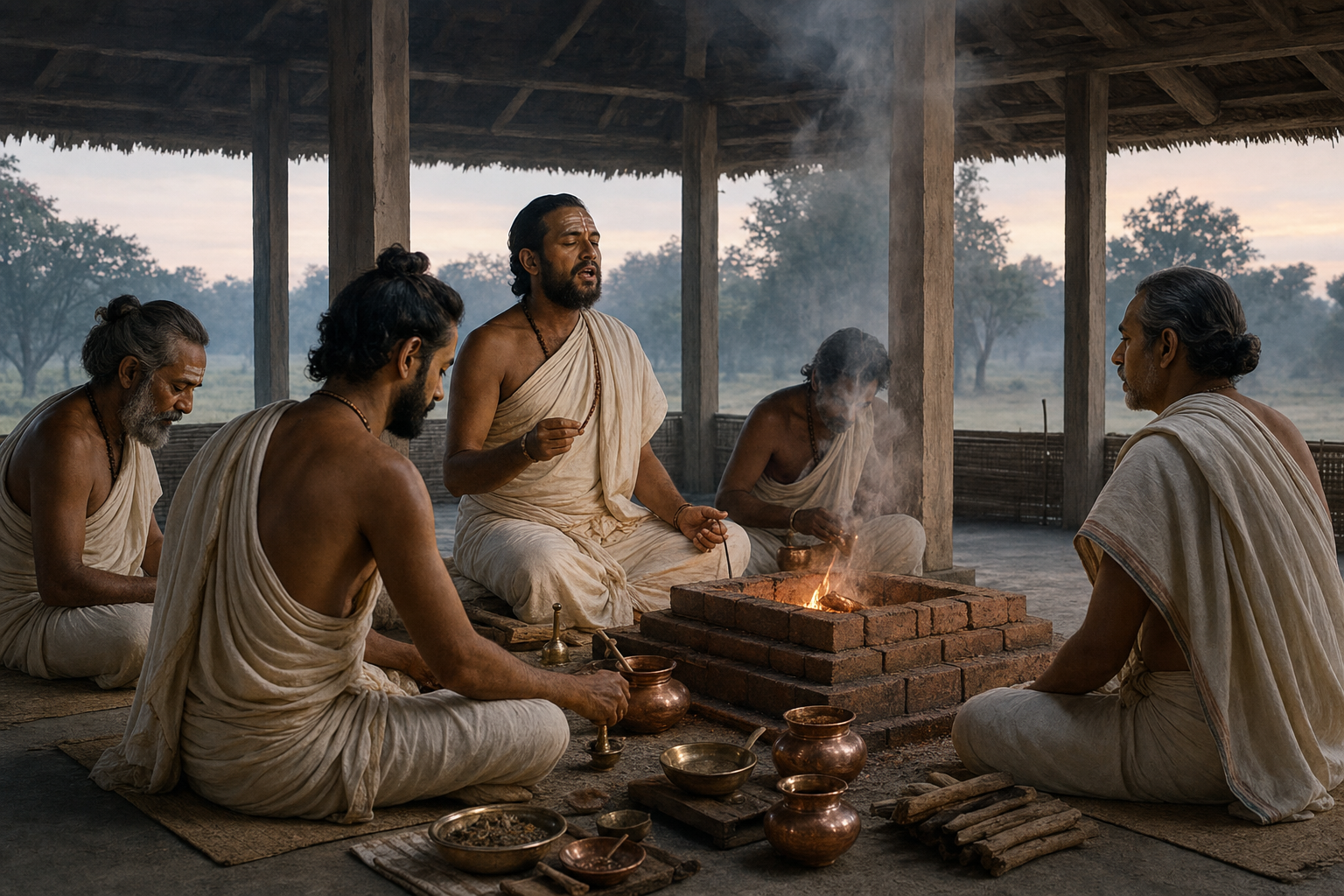
You are watching a yajña. Several priests speak around the fire, their voices overlap with ritual actions, and someone identifies one of them as the Hotṛ. How can you tell what he is actually doing? Listen for measured Rigvedic speech: not the melodic praise of the Sāma Veda and not the formulas accompanying the handling of offerings, but the articulate invocation that gives the rite its Rigvedic voice.
Once you can separate these functions, a complex yajña becomes easier to follow. You can recognize the Hotṛ without treating every reciter as interchangeable, understand why pronunciation carries such weight, and ask an officiating lineage informed questions without reducing Vedic practice to generic chanting.
Identify the Hotṛ by function, not by position near the fire
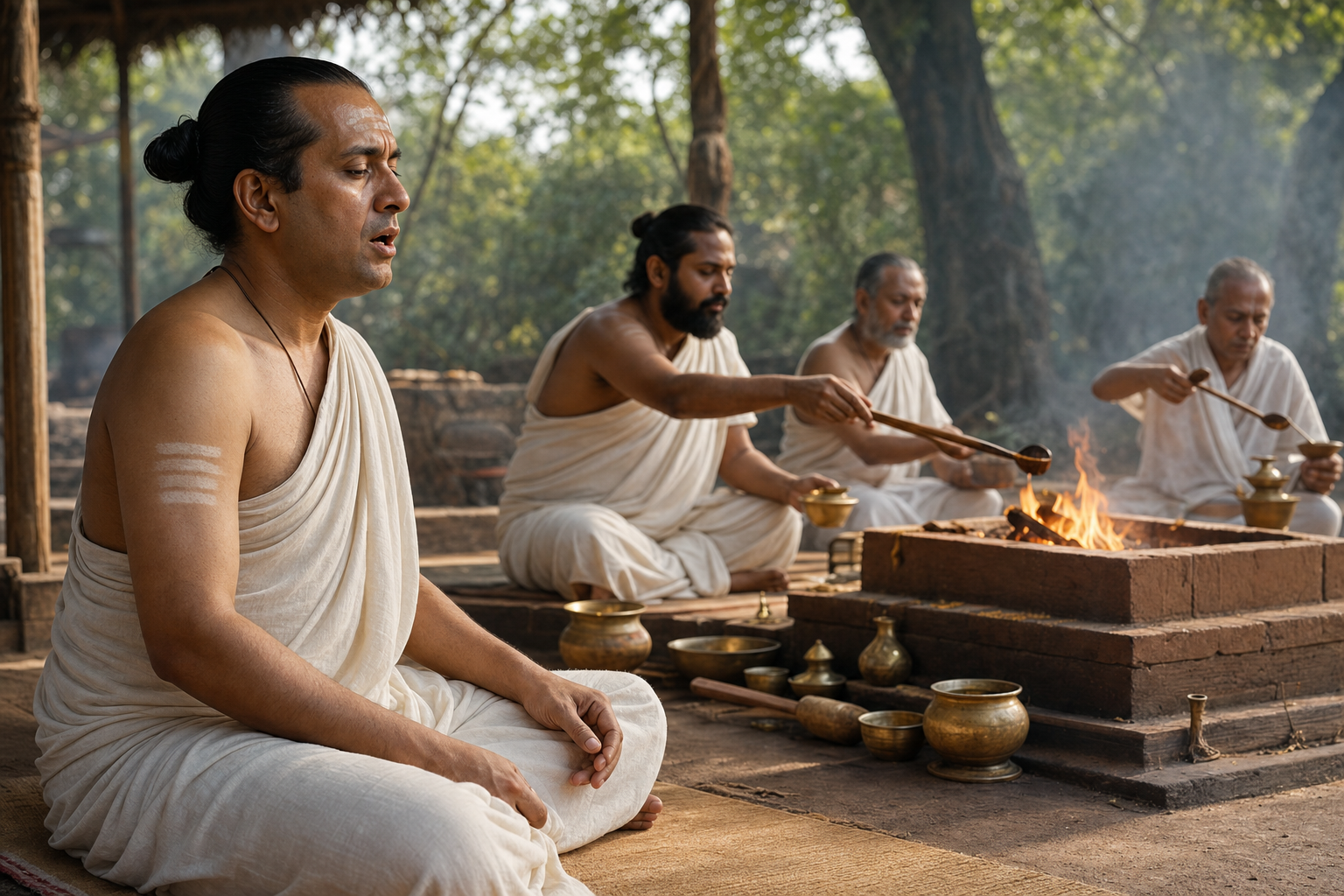
The Hotṛ, pronounced roughly Ho-tri, is the Rigvedic invoker in a solemn Vedic sacrifice. The name comes from the Sanskrit root hu, to invoke or call, joined to the agent-forming suffix -tṛ. Its literal sense points directly to the office: the Hotṛ calls through ṛcas, the metrical verses of the Ṛg Veda.
That definition becomes useful only when you place the Hotṛ beside the other principal ṛtvij offices. A classical fourfold division of ritual responsibility distinguishes the following streams:
| Priestly office | Vedic association | Work to listen or look for |
|---|---|---|
| Hotṛ | Ṛg Veda | Recites spoken śāstras of praise and invocation |
| Adhvaryu | Yajur Veda | Directs physical and procedural action while using operative yajus formulas |
| Udgātṛ | Sāma Veda | Sings melodic stotras |
| Brahman | Atharva Veda | Supervises the whole performance, detects faults, and directs remedies |
This is coordinated specialization, not a contest for the title of main priest. The Adhvaryu’s action, the Udgātṛ’s melody, the Hotṛ’s recitation, and the Brahman’s oversight must remain connected. Action without correctly formed speech is incomplete within this ritual grammar; speech detached from the prescribed action is equally incomplete.
Three common identifications therefore fail. The Hotṛ is not a loose name for anyone who says a mantra. He is not the singer merely because a modern listener calls all sacred vocalization chanting. Nor is Hotṛ simply another word for purohita, the household or court chaplain who may advise on many rites. One person could historically fill both roles, but the offices remain distinct: Hotṛ names a Rigvedic liturgical specialization.
Key takeaways
- The Hotṛ is the designated Rigvedic invoker in solemn Vedic yajña, not a generic ritual speaker.
- His characteristic contribution is śāstra: extended, spoken Rigvedic praise at prescribed moments.
- Śāstra differs from the Udgātṛ’s sung stotra and the Adhvaryu’s action-linked yajus.
- Correct deity, verse, metre, sequence, accent, and timing all belong to the performance.
- The Hotṛ works with three assistants and remains subject to the Brahman priest’s oversight.
Śāstra turns Rigvedic praise into timed ritual speech
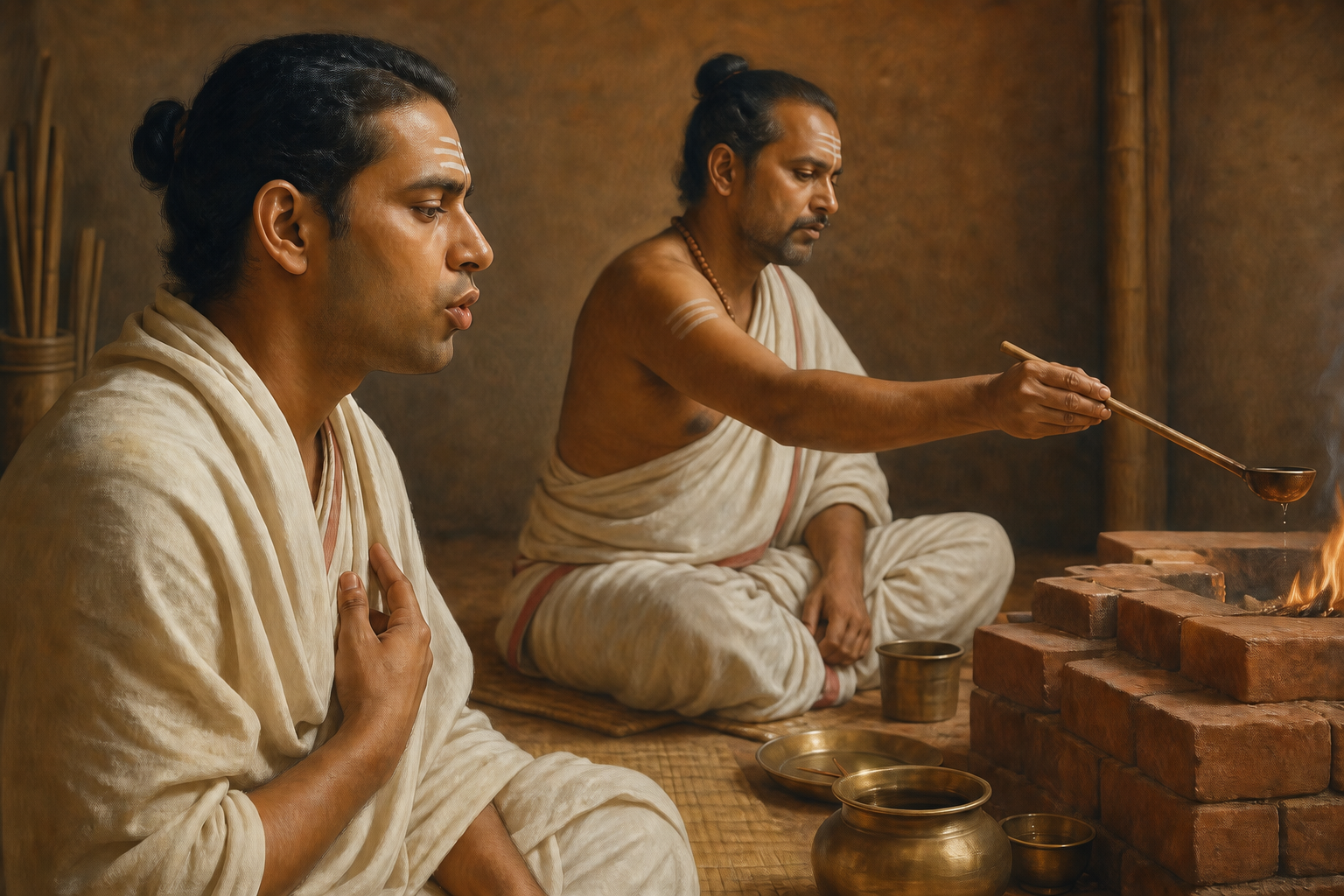
In this context, śāstra does not mean a treatise sitting on a shelf. It means an extended Rigvedic recitation delivered at a defined point in the rite. The Hotṛ is responsible not merely for remembering verses but for deploying the appropriate recitation when the ritual sequence calls for it.
A śāstra is governed by several linked decisions:
- Devatā: whom the recitation addresses. Invocation must fit the deity of that ritual moment.
- Ṛṣi and textual identity: which received hymn or verses belong in the sequence. A familiar verse cannot simply replace the prescribed one because its theme sounds suitable.
- Chandas: which Vedic metre shapes the utterance. The metre is part of the verse’s ritual form, not a decorative rhythm added by the performer.
- Placement: where the recitation belongs in relation to the actions, offerings, sung stotras, and other formulas around it.
- Delivery: how accent, pace, articulation, vowel length, and breath preserve the received sound.
The practical point is easy to miss: a mantra relevant to Agni is not automatically the correct recitation at every moment involving fire. Relevance is only one condition. The selected material must also have the required textual identity, metrical form, sequence, and ritual location.
This tightly ordered work becomes especially visible in soma sacrifices. The Hotṛ’s śāstras form part of the elaborate vocal architecture of rites such as Agniṣṭoma, Ukthya, Atirātra, Vājapeya, and Aśvamedha. You do not need to memorize each sequence to hear the underlying distinction. Attend to three modes: Rigvedic praise is spoken, Sāmavedic praise is sung, and Yajurvedic formulas accompany operations. Their interlocking, rather than any one voice in isolation, produces the ritual soundscape.
If you are observing a yajña, resist judging a recitation as though it were a standalone performance. Notice what happens immediately before and after it. A pause, response, procedural movement, or transition to song may reveal the śāstra’s place in the larger sequence. Timing tells you almost as much as vocal quality.
Accent and metre are safeguards, not ornament
A printed translation can tell you what a verse means in another language. It cannot show you the whole responsibility of the Hotṛ. Vedic recitation preserves a sounded text whose metre, accent, phonetic joins, and vowel lengths carry received form. A transliterated line without those features is useful for reading, but it is not a complete performance score.
The Hotṛ may work with verses in Gāyatrī, Anuṣṭubh, Triṣṭubh, or Jagatī metre. Each establishes a recognizable rhythmic organization. Gāyatrī has a compact symmetry; Triṣṭubh has a broader cadence often experienced as expansive. These descriptions can help you listen, but do not turn them into fixed mood labels. Their first importance in yajña is exact fit: the prescribed metre belongs with a particular text and ritual use.
The accent system that a trained Hotṛ must preserve includes:
- Udātta: the raised accent.
- Anudātta: the unraised accent.
- Svarita: the circumflex or combined tonal movement.
- Pluta: a lengthened vowel where the recitation requires it.
These are not optional expressive choices comparable to a singer changing a melody. They determine how the inherited syllables are voiced. Within the tradition, a misplaced accent can count as a ritual doṣa rather than a harmless stylistic variation. That is why confidence, volume, or emotional intensity cannot substitute for trained accuracy.
The oral disciplines behind this accuracy form a system of built-in checking. In saṃhitā-pāṭha, the text is learned in continuous form, including its phonetic combinations. Pada-pāṭha separates it word by word. Krama, jaṭā, and ghana patterns recombine words in increasingly elaborate sequences, creating redundancy that helps expose loss, substitution, or displacement. Śikṣā supplies the foundational science of sound, while the Ṛgveda Prātiśākhya sets out recension-specific rules for articulation, sandhi, and accent.
If your aim is serious understanding rather than ritual performance, use a layered study path:
- Begin with the difference between saṃhitā and pada recitation so you can see why a word may sound different inside continuous speech.
- Study basic śikṣā terminology and the Ṛgveda Prātiśākhya before drawing conclusions from Roman transliteration.
- Use the Aitareya Brāhmaṇa and Kauṣītaki, or Śāṅkhāyana, Brāhmaṇa to understand why particular Rigvedic material enters particular ritual settings.
- Consult the Āśvalāyana and Śāṅkhāyana Śrauta Sūtras for procedural placement and coordination.
- Seek a qualified oral lineage if you intend to recite. Books and recordings can support learning, but they cannot hear and correct your own accent in real time.
This order prevents a common error: treating comprehension of a translation as competence to perform the liturgy. Meaning matters, but the Hotṛ’s office also demands embodied command of breath, articulation, memory, metre, and sequence.
The Hotṛ’s quartet makes precision collaborative
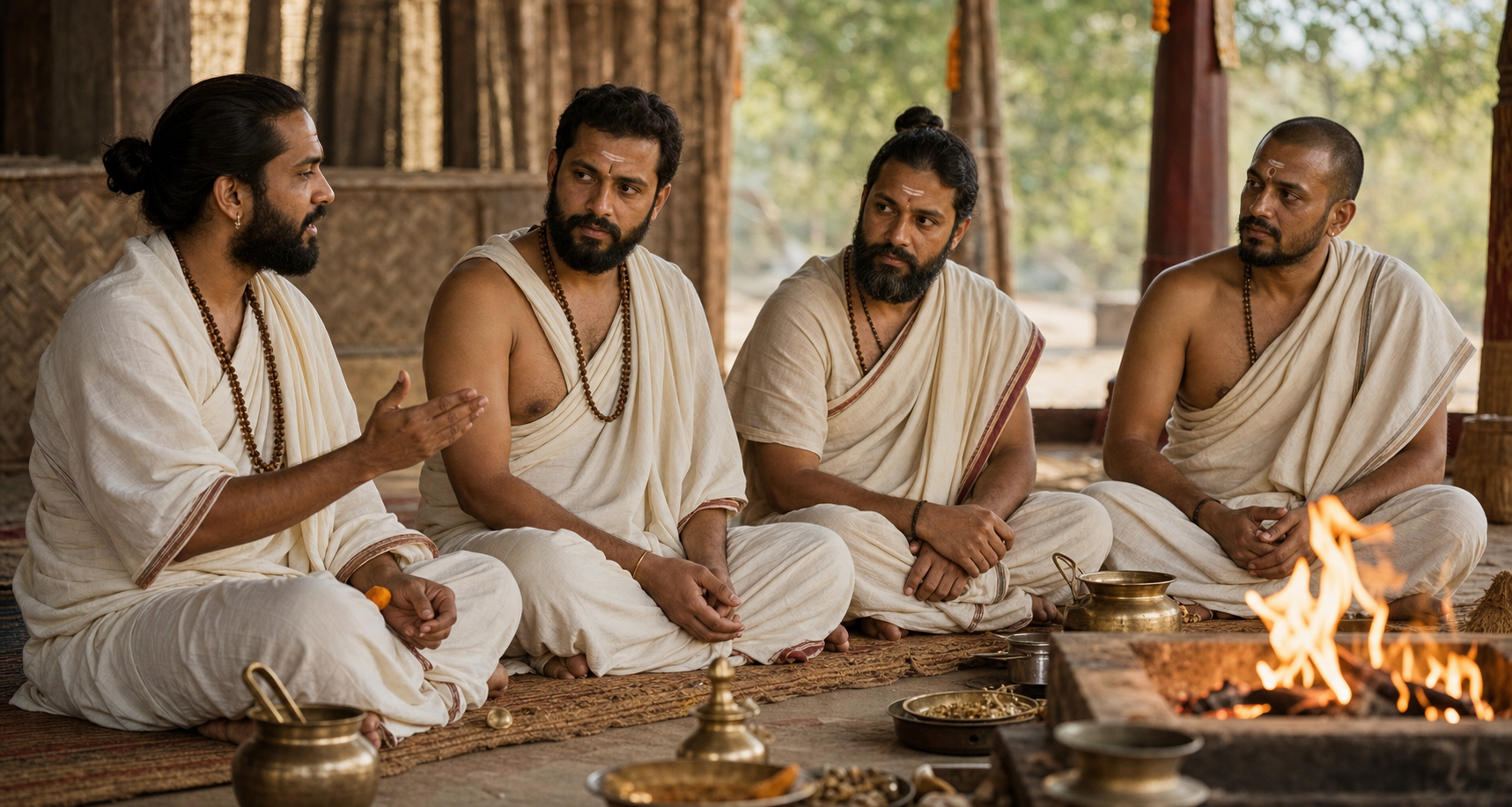
The Hotṛ is not a solitary voice operating independently. He leads a specialized group with three assistants whose responses and interventions protect the structure of the recitation:
- Maitrāvaruṇa: supports coordination, timing, and the integrity of the recitational sequence.
- Acchāvāka: provides responsive repetitions and confirmations, sustaining the dialogic movement of the rite.
- Grāvastut: praises the soma-pressing stones, or grāvan, bringing even a ritual implement into the field of addressed sacred speech.
Knowing these roles changes what you notice. A responsive voice is not necessarily interrupting or duplicating the Hotṛ. Praise directed toward pressing stones is not a digression from the sacrifice. Both belong to a liturgy in which people, words, materials, and actions are related through prescribed address.
Beyond this quartet stands the Brahman priest’s wider supervision. If a syllable, accent, textual choice, or sequence departs from the required form, the Brahman may identify the fault and direct an Atharvavedic śānti or prāyaścitta remedy. Correction is therefore part of the ritual institution itself. Precision does not mean pretending that trained people never err; it means preserving a recognized way to detect and address error.
That arrangement also carries an ethical lesson. The most visible reciter remains accountable to another specialist, while assistants perform tasks that cannot be collapsed into the lead office. Mastery and correction coexist. For a community organizing or documenting a yajña, respecting that structure means naming actual responsibilities instead of captioning everyone as a priest chanting mantras.
If you know the assignments, use exact descriptions: the Hotṛ recites a Rigvedic śāstra; the Udgātṛ sings a Sāmavedic stotra; the Adhvaryu conducts a ritual operation with a yajus formula; the Brahman supervises. If you do not know, ask the organizers after the rite rather than assigning a role from clothing, seating, or vocal prominence.
What to notice at a yajña, and what not to assume
You can attend with informed attention even if you have not studied Vedic recitation. The goal is not to audit specialists from the audience. It is to recognize the kind of discipline you are witnessing and avoid conclusions that the ritual form does not support.
- Establish the ritual context. Ask whether this is a śrauta yajña with a formally designated Hotṛ. Not every ceremony involving a fire displays the full division of offices used in solemn Vedic sacrifice.
- Ask for the priestly assignments. A program or a brief explanation from the organizers can tell you which person serves as Hotṛ, Udgātṛ, Adhvaryu, and Brahman.
- Listen for modes rather than volume. Separate spoken Rigvedic praise, melodic Sāmavedic song, and formulas tied to physical action. The most dramatic voice is not necessarily the Hotṛ.
- Watch the coordination. Responsive recitations, pauses, changes of speaker, and praise directed toward an implement may be deliberate parts of the sequence rather than improvisations.
- Ask which recension is being maintained. Contemporary lineages may identify, for example, the Śākala recension of the Ṛg Veda. That answer is more informative than a broad claim that the recitation is simply ancient or authentic.
- Do not imitate from a fragment. If a verse moves you, record its identity and seek the complete accented form from a qualified lineage. Repeating a Romanized approximation does not reproduce the Hotṛ’s discipline.
The emphasis on exact, intentional sound also gives you a careful way to notice kinship across Dharmic traditions. Buddhist paritta and sutta recitation can gather attention around refuge, protection, and compassion. Jain sūtra recitation within sāmayika supports steadiness and nonviolence. Sikh kīrtan and sustained recitation of the Guru Granth Sāhib unite sound, devotion, and ethical orientation.
The comparison should stop where the differences begin. These practices do not share one priestly office, one theology, or one ritual mechanism. Their useful point of contact is a civilizational refusal to treat sacred utterance as disposable content. Textual fidelity, trained attention, and the ethical formation of the speaker or congregation matter in distinct ways within each tradition.
At your next yajña, begin with one concrete task: map the voices. Notice which one recites, which one sings, which one accompanies action, and which office watches the whole. Then ask about the lineage and recension after the sequence is complete. You will leave with something better than a vague impression of chanting: an understanding of how disciplined speech helps make yajña an ordered act.
References
