
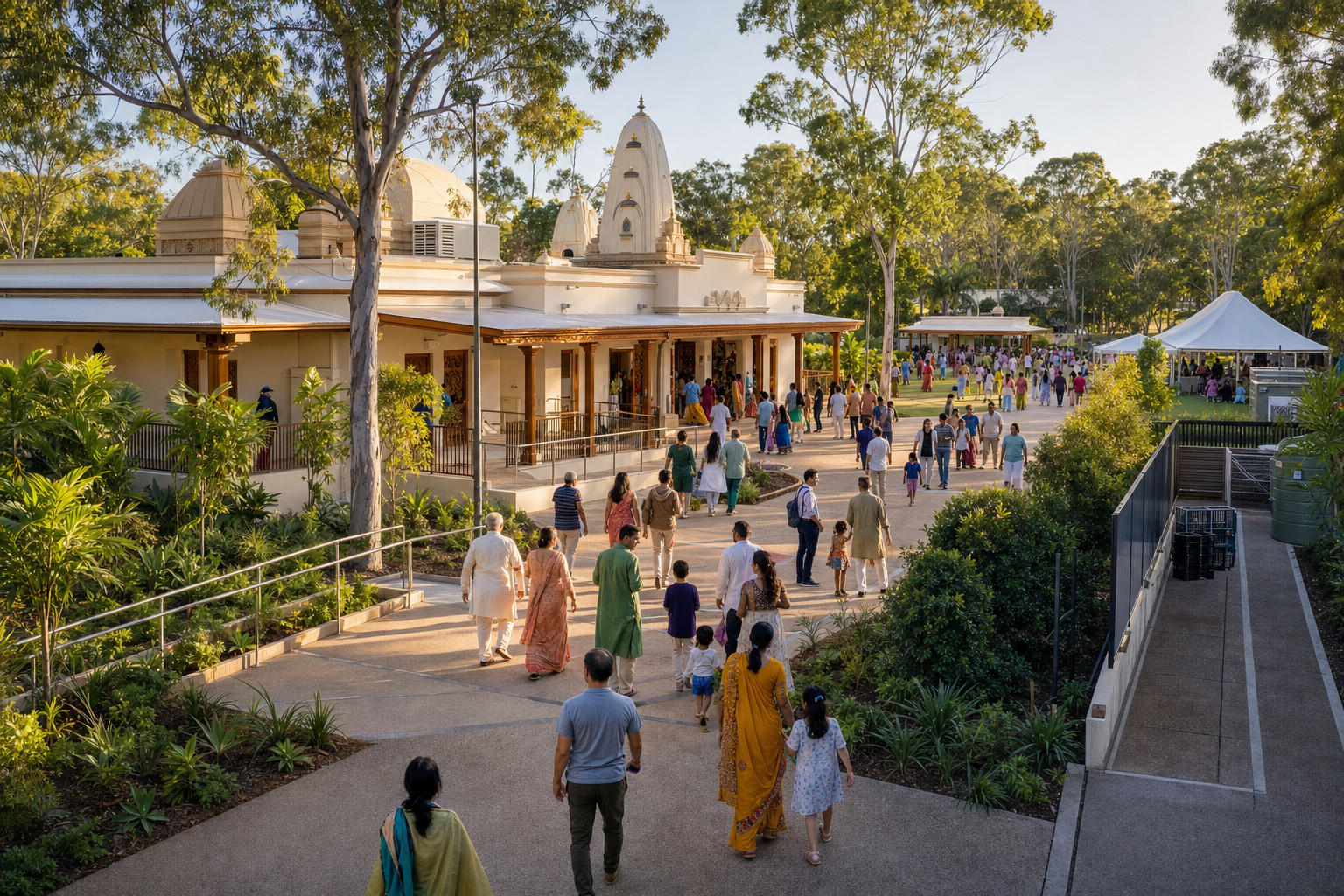
If you are planning to visit ISKCON Brisbane with children, elders, or a festival group, the important question is not whether the temple looks renewed. It is whether the whole campus can carry a crowded day without turning darshan, prasadam, or seva into an avoidable struggle.
The renovation addresses that question as a connected facilities project. Ground stabilisation, access routes, utilities, cooling, commercial food facilities, fire measures, security, and outdoor event infrastructure have all been upgraded. Here is what those changes mean for you, and what they do not remove from your own preparation.
Key takeaways
- The most consequential work is largely invisible: stabilised ground, stronger utility systems, drainage, plumbing, and electrical distribution support everything visitors see.
- New stairs, landings, and access routes should make movement more orderly, but visitors still need to keep thresholds and evacuation paths clear.
- Air conditioning improves indoor comfort in Queensland’s subtropical conditions; outdoor festival areas still require event-specific weather preparation.
- Commercial kitchens, rangehoods, gas servicing, storage, and cold rooms improve the temple’s ability to prepare prasadam at scale, but they also make disciplined access and food-safety procedures more important.
- Upgraded facilities reduce operational risk. They do not establish unlimited attendance, guarantee that every route is step-free, or replace the need to confirm arrangements for a particular event.
The hidden infrastructure is the foundation of festival readiness
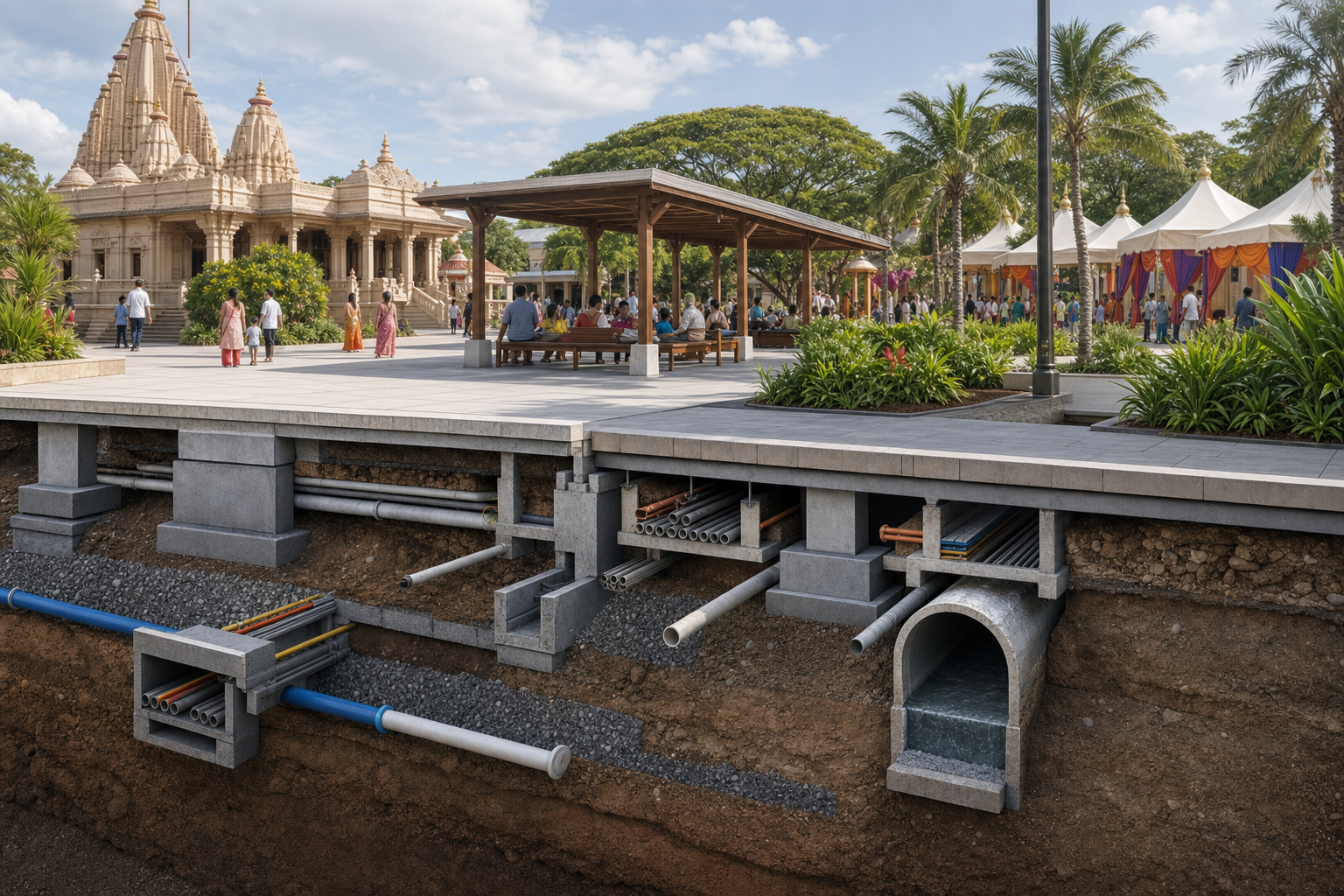
A temple can have a beautiful altar and still struggle as a festival venue if the site beneath it, or the services behind its walls, cannot handle sustained use. ISKCON Brisbane’s civil works included earthworks, excavation, retaining walls, and concrete stabilisation. These measures address ground conditions and long-term structural performance rather than merely changing the appearance of the campus.
That matters when large numbers of people repeatedly cross the same approaches, wait in the same gathering areas, and place concentrated demand on buildings and external surfaces. Stabilisation is not something you will notice during arati. You notice its absence when surfaces settle, drainage fails, or heavily used areas become difficult to maintain.
The same principle applies to water, drainage, plumbing, electricity, and power distribution. A festival simultaneously places demands on lighting, sound systems, refrigeration, cooking equipment, cleaning, and ordinary visitor services. The upgraded systems were planned around contemporary standards and peak festival use, reducing the chance that one overloaded service disrupts several parts of the program.
If you are helping organise a program, do not translate “upgraded” into “unlimited.” Confirm the approved capacity of the spaces you will use, the electrical connections available to your team, kitchen permissions, and the wet-weather arrangement before publishing your plans. Additional appliances, temporary wiring, or gas equipment should never be improvised by visiting volunteers. Route those requests through the temple’s authorised facilities team because a resilient system can still be made unsafe by an unplanned connection.
A calmer visit begins with circulation and climate
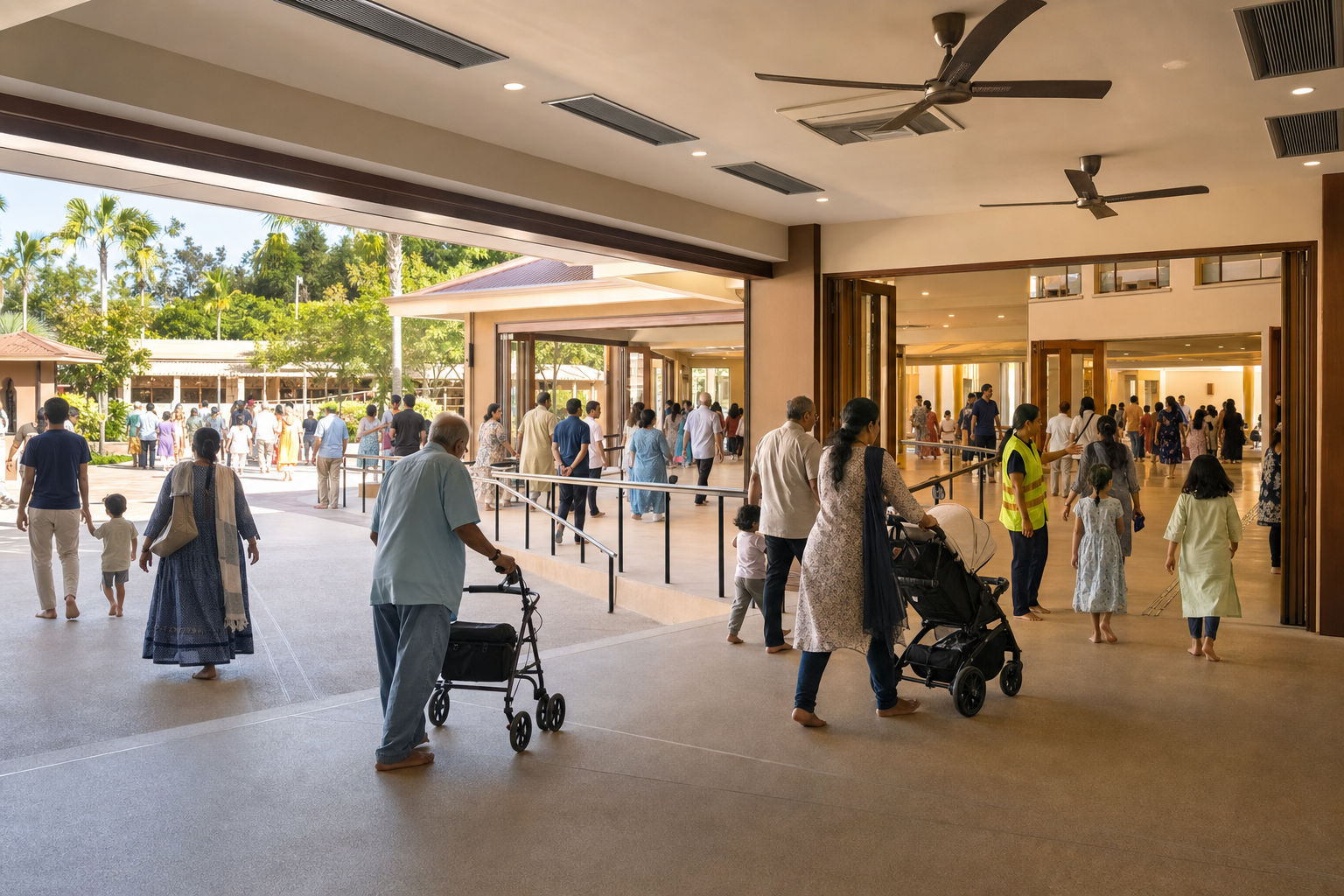
New stairs, landings, and improved access routes change more than the walk from the gate to the temple room. They distribute people across the campus, reduce pressure at narrow thresholds, and shorten the distance people may need to travel to an exit. During a busy program, that can mean less stop-start movement and less fatigue for families, elders, and volunteers.
The benefit depends partly on how the congregation uses the space. A landing is circulation and safety space, not a convenient place for a long conversation. Doorways are poor meeting points. If your group becomes separated, move to an open gathering area instead of waiting at the entrance to the temple room. Keep bags, prams, footwear, serving equipment, and musical cases out of marked routes even when the obstruction seems temporary.
If someone in your group has limited mobility, ask about the appropriate entrance and route before travelling. “Improved access” should not be read as a guarantee that every destination can be reached without steps or that the same route will remain available under every festival configuration. Giving the organisers the person’s actual requirement is more useful than asking only whether the site is accessible.
Air conditioning adds another practical layer of comfort. In Queensland’s subtropical climate, a cooler temple room can reduce heat strain during a long, crowded schedule and make it easier to remain attentive during kirtan, classes, and darshan. It also creates a temperature difference between indoor rooms and outdoor marquees. Dress in layers, especially if you expect to move repeatedly between the two, and avoid holding conditioned-space doors open while waiting for someone.
Prasadam at scale depends on disciplined back-of-house service
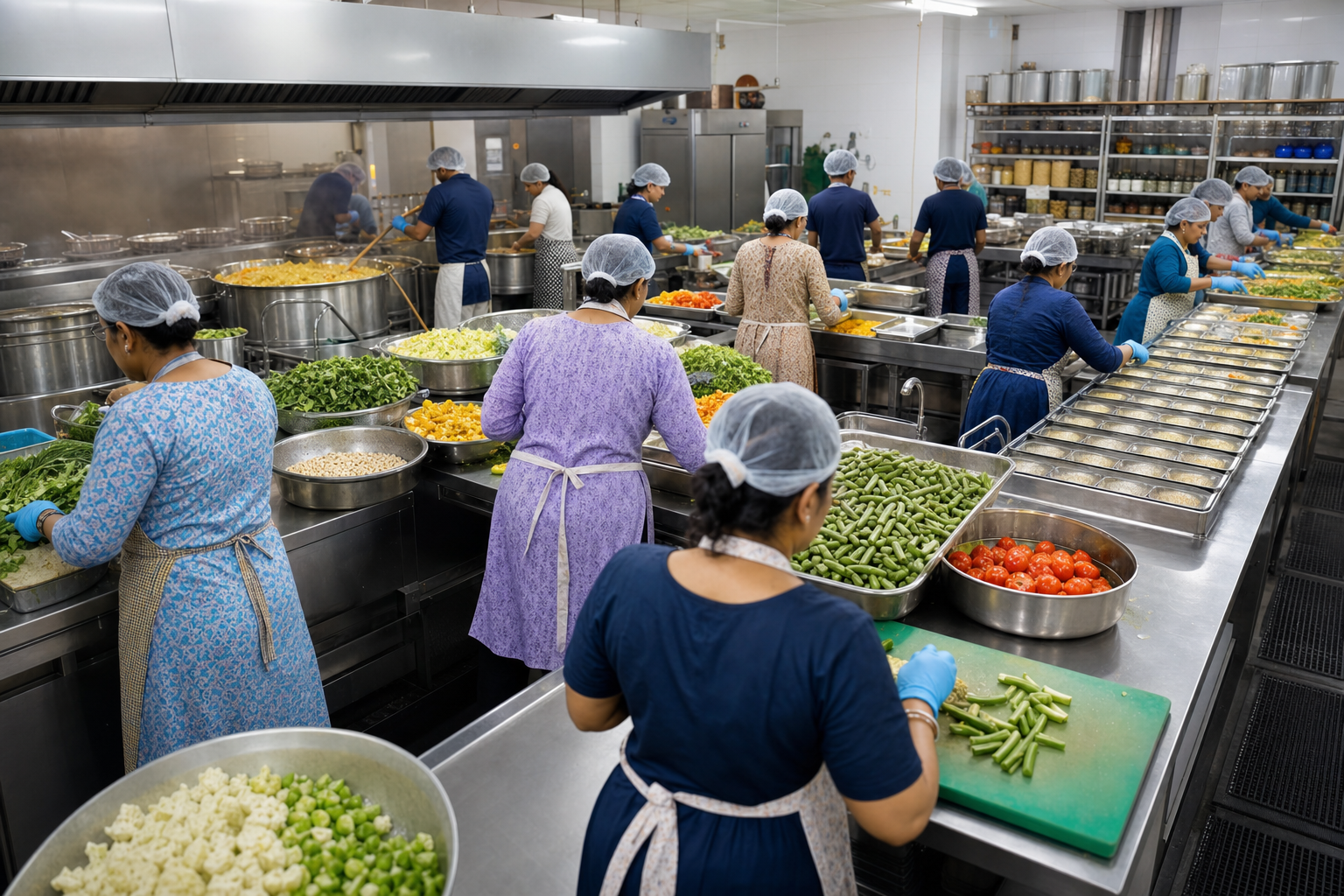
The kitchen renovation is one of the clearest signs that the campus is being prepared for more than ordinary daily use. Commercial appliances, rangehoods, gas servicing, cold rooms, storage, and refitted service areas support larger preparation cycles, ventilation, refrigeration, cleaning, and orderly distribution.
For a visitor, the visible result should be a more reliable prasadam service. For a volunteer, the important change is that the kitchen must be treated as a controlled working area. Commercial equipment and cold storage are effective only when people follow the assigned workflow. Enter through the designated route, use only equipment you have been authorised to use, return stored items to their assigned place, and report a spill or a cold-room door left open rather than assuming somebody else has seen it.
Do not use the kitchen as a shortcut between public areas. Unplanned foot traffic interferes with carrying, cleaning, ventilation, and food handling at precisely the time the team is under the most pressure. Parents should also keep children out of preparation and storage zones, even if family members are serving inside.
If you have a food allergy, intolerance, or another ingredient restriction, ask the event team what can be confirmed for that particular service. The sacred status of prasadam tells you how the food has been offered; it does not by itself tell you every ingredient used or whether cross-contact is possible in a busy kitchen. Where the consequence of a mistake could be serious, bring the necessary medication and make your decision from specific information rather than assumption.
Safety, security, and festival grounds work as one system
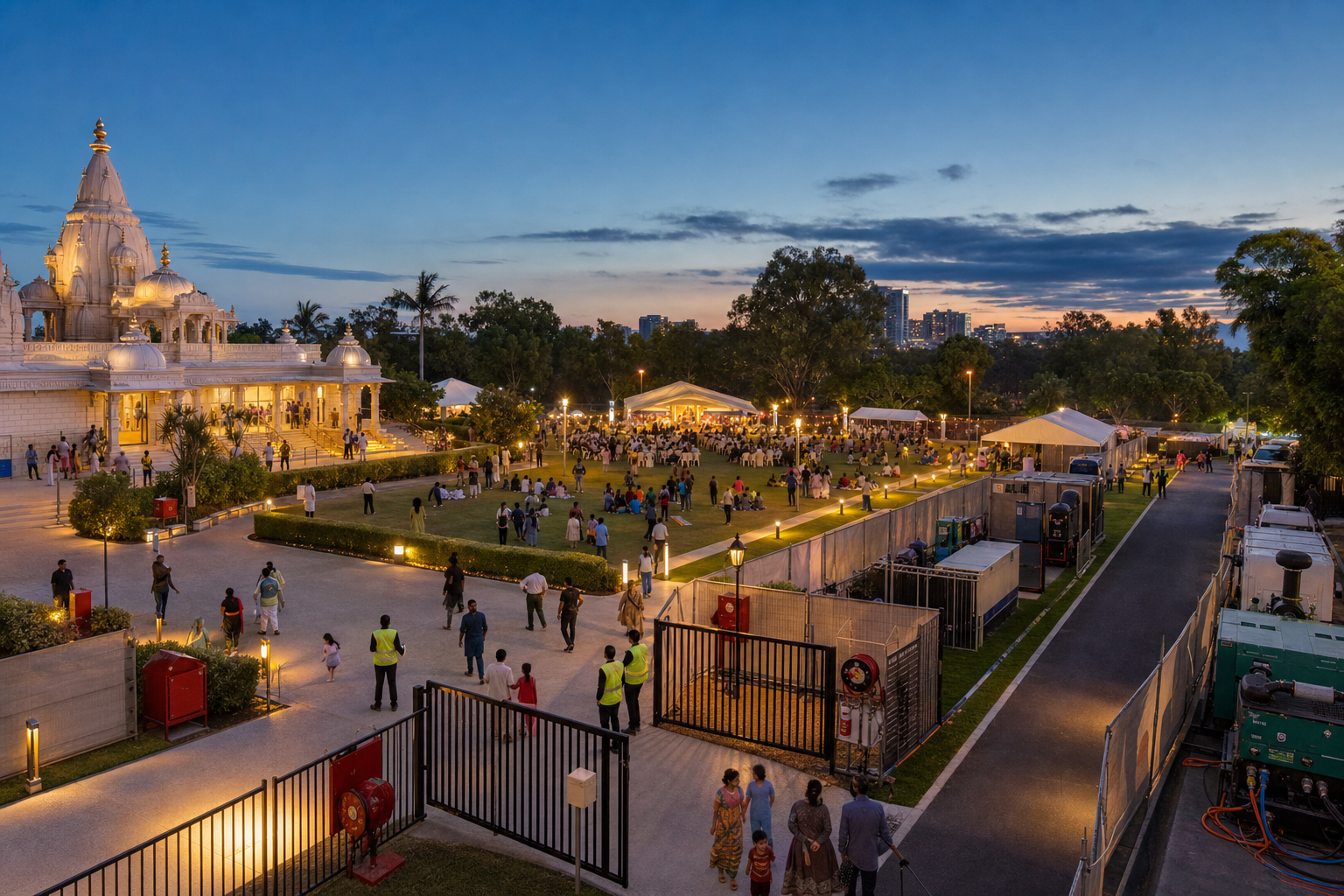
Fire-compliance work, clearer movement routes, surveillance cameras, upgraded doors and locks, perimeter fencing, and gates serve different purposes, but they function together. Fire measures protect high-occupancy gatherings; controlled doors and gates separate public, sacred, and operational areas; cameras assist monitoring. None is a substitute for clear behaviour by the people using the campus.
Do not prop open a controlled door, block a gate with event supplies, or place seating in an egress path because the program has become crowded. If a volunteer redirects you, follow the direction first and discuss the inconvenience after you are clear of the route. Security controls can feel unnecessary during a welcoming community gathering, but their purpose is to preserve that welcome without leaving people, Deities, equipment, or service areas unprotected.
Cameras also do not replace supervision. Agree on a meeting point with older children, keep younger children with a responsible adult, and tell a designated volunteer promptly if someone is missing. If you notice an unattended object, damaged lock, blocked exit, water leak, or suspicious conduct, report it rather than confronting another visitor or attempting a repair.
Outside, new turf and concrete slabs provide more durable surfaces for movement, queues, and temporary event use. Marquees add sheltered zones for seva, cultural programs, and gathering. These elements allow the grounds to be configured for different occasions, but a marquee is not a guarantee against every weather condition. Check whether your program is indoors or outdoors, wear suitable footwear for moving between surfaces, and follow event staff if weather changes the site plan.
How to prepare for your next visit or seva shift
Before leaving home, confirm the event time, the entrance being used, parking or drop-off instructions, and whether the program moves between indoor and outdoor spaces. If you are bringing an elder or someone with limited mobility, give the organiser enough detail to identify a suitable route: steps, walking distance, standing time, and proximity to seating may matter in different ways.
For a seva shift, confirm your reporting time, supervisor, work zone, and whether you need any orientation before handling equipment. Arriving early is useful only when you know where to report. Otherwise, an extra person in a kitchen doorway, loading area, or controlled corridor can add congestion rather than capacity.
If you are leading a family or community group, share the meeting point and basic conduct expectations before arrival. Keep one person responsible for the headcount, tell the organisers about mobility or dietary needs in advance, and avoid promising your group a particular route, seating arrangement, or menu until it has been confirmed for that event.
The broader promise of the campus is not only operational. It is intended as a dharmic commons rooted in the Gaudiya Vaishnava tradition, with space for Hindu, Buddhist, Jain, and Sikh neighbours to meet through seva, learning, music, and dialogue. That welcome does not require every tradition to become interchangeable. It asks visitors to enter respectfully, learn the customs of the sacred space, and contribute without obstructing the disciplines that sustain it.
Use the upgraded temple with the same care that went into building it. Confirm the details that matter to your group, arrive knowing your route or role, keep circulation clear, and let the new systems do their quiet work. More of the day can then remain where it belongs: with darshan, kirtan, prasadam, and seva.
References
