
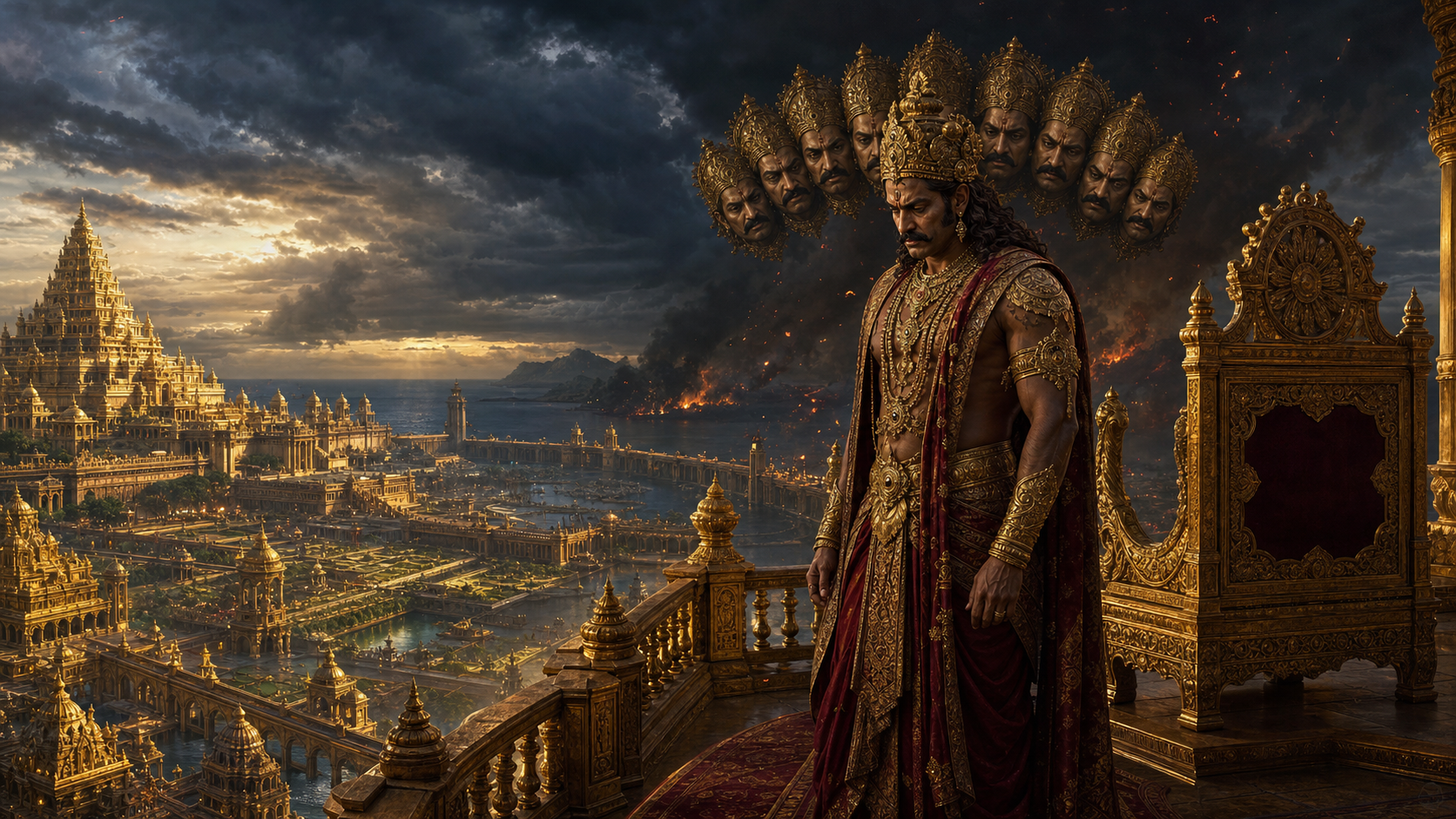
If Ravana was learned, devout, powerful, and the ruler of a prosperous kingdom, why does his reign end as one of the clearest warnings in Dharmic political thought? Because rajadharma does not judge a sovereign by talent alone. It asks what the ruler does when knowledge, appetite, pride, and public duty pull in different directions.
If you want to understand Ravana’s failure, do not begin with the battlefield. Begin with the moment he made Lanka responsible for satisfying his private desire. Everything that followed – rejected counsel, strategic blindness, the departure of Vibhishana, and the destruction of Lanka’s defenders – grew from that choice.
Ravana’s achievements make his failure more serious
Reducing Ravana to an ignorant brute makes the lesson too easy. He was learned, formidable, devoted to Shiva, and sovereign of a magnificent Lanka. His failure cannot be blamed on an absence of education, strength, wealth, or religious accomplishment.
That is precisely the point. Knowledge is not self-mastery. Bhakti does not grant political immunity. Military success does not convert a ruler’s desire into justice. A person can possess extraordinary gifts while allowing kama, personal craving, and ahankara, the ego that refuses correction, to govern a decisive act.
Rajadharma places a stricter burden on the king because his errors do not remain private. A private person may damage a household through uncontrolled desire. A sovereign can place ministers, soldiers, families, institutions, and an entire realm in danger. The scale of authority enlarges the scale of moral responsibility.
The classical duties of rulership therefore include more than courage and conquest. The ruler must protect praja, uphold justice through lawful danda, seek competent counsel, preserve order, and practise indriya-nigraha, or control of the senses. The Arthasastra expresses the governing principle plainly: the king’s welfare is bound to the welfare of his subjects. Authority is held for them; it is not personal property.
This gives you the first test of rajadharma: when the ruler’s preference conflicts with the security and justice of the realm, which one yields? Ravana made the realm yield. His brilliance could not compensate for that reversal of purpose.
One private desire became a public catastrophe

The abduction of Sita was not merely one immoral act followed by an unrelated war. It was the act through which Ravana converted a personal appetite into state policy. That distinction matters. Once Lanka’s power was committed to preserving the consequences of the abduction, every official and warrior was pulled into the ruler’s private transgression.
Surpanakha’s humiliation supplied grievance, but grievance did not remove Ravana’s agency. He still had opportunities to examine the facts, measure the danger, and refuse a course that violated dharma. Maricha warned him before the abduction. Ravana chose deception despite that warning.
The method deepened the violation. Ravana did not issue an open kshatriya challenge. He exploited disguise and the expectations of hospitality to approach Sita. The ruler who should have defended social boundaries instead misused them. The taking of another man’s wife, the violation of a woman’s autonomy, the abuse of a sacred guest-host convention, and the use of deception were not separate technicalities. Together they showed that Ravana would bend the norms sustaining social trust when those norms obstructed his desire.
You can trace the political failure through a clear sequence:
- A personal grievance and desire distort the ruler’s judgment.
- Deception is used to cross a boundary that an open and lawful course would not permit.
- The kingdom’s authority is committed to defending the resulting wrong.
- A simple remedy – returning Sita – becomes politically difficult because the ruler treats correction as humiliation.
- Ministers and relatives are pressured to defend the ruler’s prestige rather than protect the realm.
- Soldiers and subjects inherit the danger created by a decision they did not need.
The crucial turn occurs at the fourth step. A ruler can make a serious mistake and still recover by acknowledging it, restoring what was taken, and accepting the loss of face. Ravana repeatedly refused that exit. Ahankara transformed a reversible wrong into an existential conflict.
This is why rajadharma cannot be reduced to whether a kingdom looks prosperous. Golden palaces, military capacity, and accumulated victories are lagging indicators. They may remain visible after the ruler’s decision-making has begun to decay. When you assess a state, look beyond its display of strength. Ask whether its strength still serves public order or has become an instrument for protecting one person’s appetite and reputation.
Lanka began to fall when truthful counsel became punishable
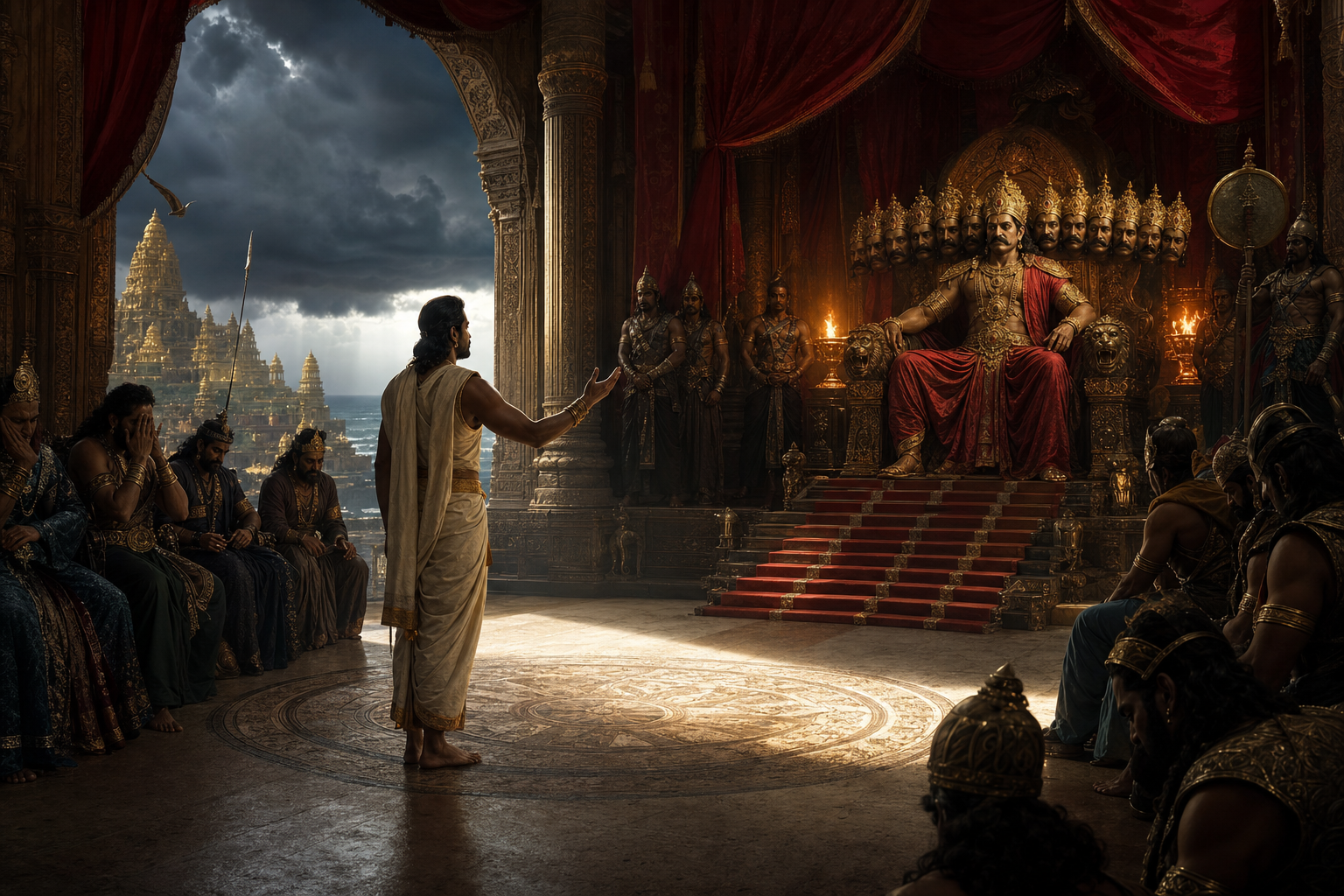
Ravana’s original transgression did not make destruction inevitable. His treatment of counsel made recovery progressively less likely. Maricha warned him before the deed. Mandodari urged restraint. Malyavan gave sober political advice. Vibhishana repeatedly pressed for the return of Sita and the restoration of dharma. Ravana did not defeat their arguments; he rejected the restraint those arguments required.
The banishment of Vibhishana was therefore much more than a family quarrel. It announced that continued access to the ruler depended on reinforcing his chosen course. Once an adviser can be punished for describing an avoidable danger, every remaining adviser learns the same lesson: report what protects your position, not what protects the kingdom.
Classical statecraft calls the power of sound deliberation mantra-shakti. It is not ornamental wisdom added after the real work of government. It is one of the mechanisms by which a ruler detects error before error consumes military strength, diplomatic influence, and legitimacy. Ravana’s court still possessed weapons and accomplished warriors, but its corrective mechanism was failing.
This gives you several early warning signs to notice in any institution:
- Disagreement is recast as disloyalty instead of being answered on its merits.
- The leader’s prestige becomes more important than the institution’s stated duty.
- Past success is used to dismiss a new and materially different threat.
- Advisers learn to flatter, remain silent, or leave.
- A correctable decision is defended because reversal would expose the leader’s original error.
- Coercion is mistaken for commitment, and the absence of open dissent is mistaken for genuine agreement.
These signs matter before visible collapse. By the time every minister publicly agrees, the institution may already be receiving less truthful information than its opponents.
Hanuman’s arrival makes that hidden weakness visible. His reconnaissance and the burning of parts of Lanka demonstrate that the kingdom’s glittering defenses are penetrable. Material brilliance had not produced strategic resilience. Lanka faced an adversary with a clear objective, committed allies, and a cause capable of sustaining action.
This need not be read as the simplistic claim that the side invoking dharma will automatically win every conflict. The sharper political lesson is that adharma creates operational weaknesses. It corrupts threat assessment, drives away honest counsel, narrows diplomatic options, and forces capable people to spend themselves defending an unnecessary wrong. Kumbhakarna’s valor and Indrajit’s prowess could win battles, but valor at the execution stage could not repair corruption at the decision stage.
Rama’s restraint shows what legitimate force requires

The contrast between Rama and Ravana is not merely a contest between a stronger hero and a weaker villain. It is a contrast between two ways of using power. Ravana uses the resources of sovereignty to preserve a private wrong. Rama keeps the public remedy visible: Sita must be returned, and war can be avoided through restitution.
Dharmic statecraft places danda, coercive force, after attempts at peaceful resolution. The familiar sequence is sama, conciliation; dana, accommodation or concession; bheda, strategic division; and finally danda. It is not a license to manipulate mechanically. Its governing insight is that force carries grave public costs and must not become the ruler’s first response to injured pride.
In Lanka’s case, Hanuman and later Angada carry opportunities for restitution before the final war. The demand is intelligible, limited, and connected to the original wrong. Ravana can still return Sita. Peace does not require Lanka’s population to pay for his decision; it requires Ravana to relinquish what he had no right to take.
That distinction helps you evaluate claims of dharma-yuddha. Calling one’s own side righteous is not enough. Before force can plausibly be described as dharmic, ask four concrete questions:
- Is there a specific wrong to be corrected, rather than a vague appeal to glory, revenge, or wounded prestige?
- Has the other party been offered a clear and proportionate way to end the conflict?
- Were deliberation and nonviolent remedies genuinely attempted, or merely staged after the decision for war had already been made?
- Will force restore a defensible order, or simply satisfy the anger and ambition of those commanding it?
Ravana fails this test at its beginning. He creates the wrong, refuses the proportionate remedy, and makes other people fight so that he will not have to admit fault. Rama’s sequencing matters because it shows that restraint is not weakness. Restraint is what distinguishes disciplined kshatra, power yoked to dharma, from violence used as an extension of ego.
How to apply the rajadharma test without misusing the epic
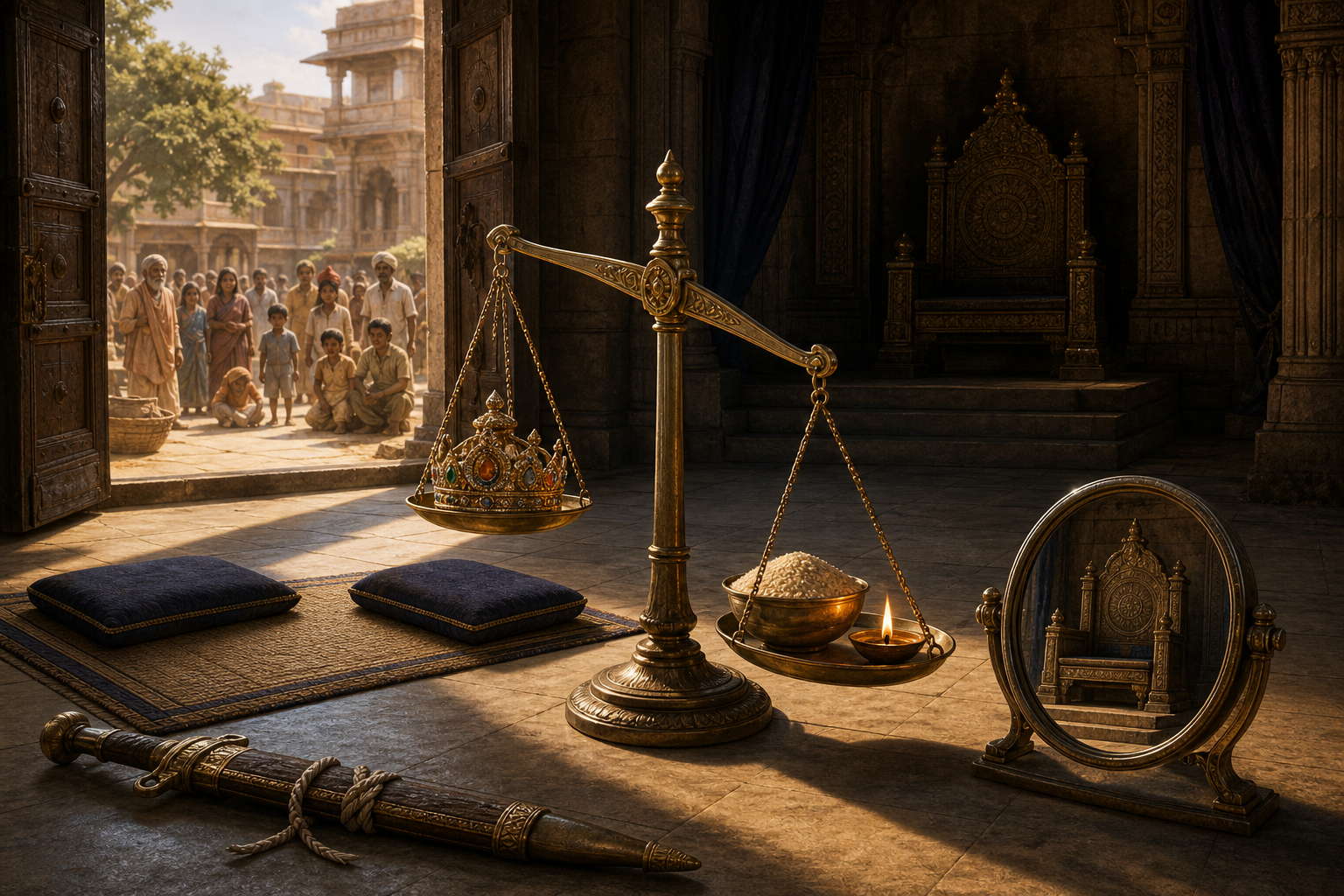
Ravana should not become a label for every leader you dislike. That use of the epic produces heat, not judgment. Rajadharma is more demanding because it asks you to examine decisions, incentives, procedures, and consequences – including when the ruler belongs to your own political, religious, or cultural camp.
When assessing a government, community institution, religious body, or any office that holds power in trust, work through this audit:
- Whose problem is the decision solving? Separate a real public need from the leader’s anger, desire, family interest, or fear of embarrassment.
- Which boundary must be crossed to carry it out? Deception, selective enforcement, abuse of hospitality, and the suspension of ordinary protections are signs that the desired end cannot survive lawful scrutiny.
- Can counsel change the outcome? A council is not functioning if members may speak but the leader has made reversal personally impossible.
- What is the clean off-ramp? Identify the concrete act that would correct the wrong. If it is repeatedly refused only because it would look like retreat, prestige has displaced duty.
- Who bears the downside? A rajadharmic ruler does not transfer the cost of private gratification to subjects, soldiers, employees, devotees, or families.
- Was coercion kept last? Look for actual attempts at conciliation and a remedy proportionate to the original wrong.
- What happens to the person who tells an unpleasant truth? The fate of that person often reveals more about an institution than its official declarations do.
This audit also prevents a common mistake: treating prosperity as moral acquittal. Ravana’s Lanka could be wealthy while its ruler violated the purpose of rule. Administrative competence and ethical legitimacy are connected, but they are not identical. A capable ruler can still direct capable institutions toward an adharmic end.
Distinct Dharmic traditions converge on a limit to power
The traditions of Bharat do not use one interchangeable political vocabulary, yet they converge on a crucial restraint. Hindu rajadharma binds kshatra to duty, justice, counsel, and the welfare of praja. The Buddhist Dasa Raja-dhamma includes generosity, self-restraint, non-anger, and nonviolence among the duties of a ruler. Jain commitments to ahimsa and aparigraha resist the pursuit of possession at the expense of other beings. Sikh thought joins raj dharam to sarbat da bhala, the welfare of all, while miri, temporal authority, remains answerable to piri, spiritual and ethical purpose.
The shared limit is more important than superficial sameness: authority is fiduciary. It is entrusted for a purpose beyond the office-holder’s gratification. The throne is not absolved by magnificence, piety, lineage, or military success when it abandons that purpose.
Key takeaways
- Ravana’s learning, bhakti, wealth, and strength make his lack of self-restraint more instructive, not less culpable.
- His defining political failure was making Lanka defend a private act of desire.
- Returning Sita offered a practical path away from war, but ahankara made correction feel worse to him than public destruction.
- Silencing Vibhishana and dismissing other warnings broke the feedback system a ruler needs for sound judgment.
- Legitimate force requires a just objective, a proportionate remedy, genuine attempts at peace, and freedom from private vengeance.
- The safest way to use the epic politically is to audit conduct and institutions, not attach mythic labels to opponents.
The next time a leader is defended as brilliant, devout, prosperous, or invincible, do not stop at the achievement. Ask what happens when that leader is contradicted, whether a private desire has become a public burden, and who will pay if pride prevents correction. That is where rajadharma becomes visible – before the golden city begins to burn.
References
